
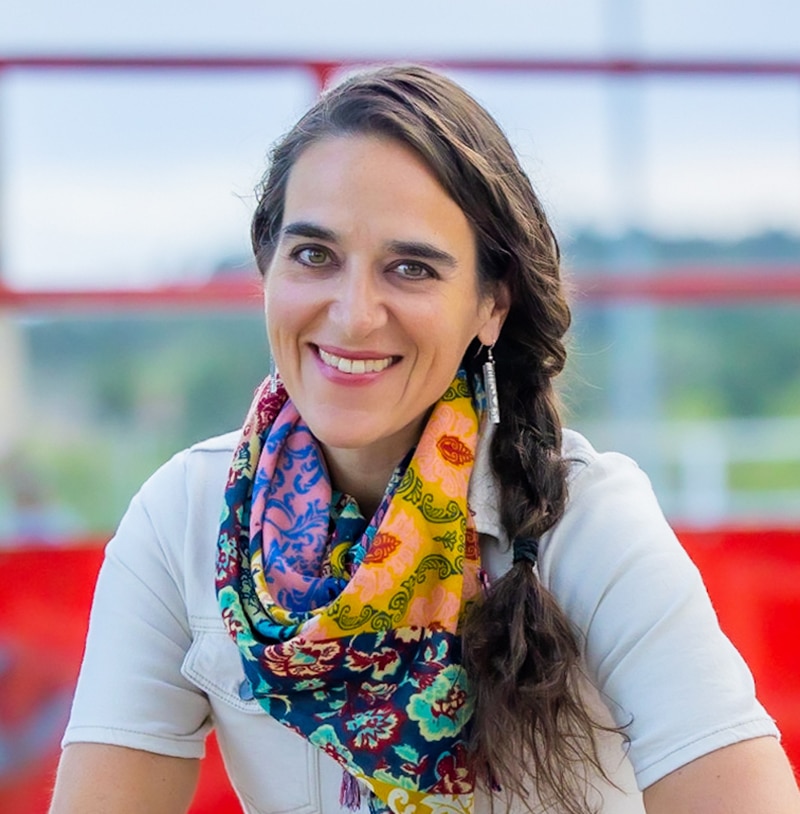
“I’m not gonna write this entire book or I can’t do it all right now. And I had to start taking, small steps and asking myself again, going back to that simple word can and like, okay, well what can I do? It’s just simplifying it, like those small wins and like step by step and then eventually reaching that bigger thing. And so that would be, that would be my advice. Ask yourself, like, what can I do?”
~Risa August
The award-winning author, TEDx speaker, screenwriter, Gestalt practitioner, and patient advocate, Risa August, has been living with a pituitary tumor and the rare disease acromegaly for over a decade. From being a girl with sparkles in her hair to an Ironman athlete, Risa still has a passion for her bike and barbells. With genuine curiosity and a love for trying new (and old) things, you may find Risa taking Bollywood or Hip-Hop dance lessons, trying out aerial silks, a boxing class, going indoor skydiving, or guiding inspirational workshops in creativity.
Through her personal transformation, Risa has learned and practiced removing limiting beliefs, shifting her perspective, and embracing an expansive life unleashed. Risa shares her insights and perspectives on stage, offering words of inspiration to audiences. Additionally, Risa works one-on-one with clients, guiding them through the many roadblocks of life and toward living in a more fully inspired way.
Recently, Risa published her book, The Road Unpaved: Border to Border with a Brain Tumor and a Bike. I’ve read The Road Unpaved and can tell you I was deeply moved and awestruck by Risa’s struggles to overcome the strains of a grueling 1000+ mile bike ride along the U.S. Pacific Coast while contending with her tumor and acromegaly. If you’re interested in stories about people engaging in their deepest will power to triumph over extreme challenges, then I highly urge you to check out The Road Unpaved.
WEBSITES:
The Road Unpaved: Border to Border with a Brain Tumor and a Bike
Instagram: @RisaUnleashed
Risa’s Coaching Page: Feathers and Sage Coaching
IF YOU LIKE THIS EPISODE, YOU MAY ALSO ENJOY:
- Anthony Swofford, Writer-Memoirist-Professor – Episode #371
- Janet Skeslien Charles, Bestselling-Author – Episode #368
- Kit Karson, Novelist – Episode #366
- Alexandra Hainsworth, Pop Artist-Novelist-Advocate – Episode #365
- Teddie Dahlin, Author-Publisher – Episode #361
- Qin Sun Stubis, Columnist and Author – Episode #359
- Samuel A. Simon, Playwright-Actor-Advocate – Episode #353
- Maria Baltazzi, TV Producer-Teacher-Author – Episode #297
Steve Cuden: On today's Story Beat.
Risa August: Not gonna write this entire book or I can't do it all right now. And I had to start taking, small steps and asking myself again, going back to that simple word can and like, okay, well what can I do? It's just simplifying it, like those small wins and like step by step and then eventually reaching that bigger thing. And so that would be, that would be my advice. Ask yourself, like, what can I do?
Announcer: This is Story Beat with Steve Cuden. A podcast for the creative mind. Storybeat explores how masters of creativity develop and produce brilliant works that people everywhere love and admire. So join us as we discover how talented creators find success in the worlds of imagination and entertainment. Here now is your host, Steve Cuden
Steve Cuden: Thanks for joining us on Story Beat. We're coming to you from the steel City, Pittsburgh, Pennsylvania. Well, my guest today, the award winning author, TedX speaker, screenwriter, Gestalt practitioner and patient advocate, Risa August has been living with a pituitary tumor and the rare disease acromegaly for over a decade. From being a girl with sparkles in her hair to an ironman athlete, Risa still has a passion for her bike and barbells. With genuine curiosity and a love for trying new and old things, you may find Risa taking Bollywood or hip hop dance lessons, trying out aerial silks, a, boxing class, going indoor skydiving, or guiding inspirational workshops and creativity. Through her personal transformation, Risa has learned and practiced removing limiting beliefs, she shifting her perspective and embracing an expansive life. Unleashed, Risa shares her insights and perspectives on stage, offering words of inspiration to audiences. Additionally, Risa works one on one with clients, guiding them through the many roadblocks of life and toward living in a more fully inspired way. Recently, Risa published her book the Road Border to Border. With a Brain Tumor and a Bike, I've read the Road Unpaved and can tell you I was deeply moved and awestruck by Rissa's struggles to overcome strains of a grueling 1000 plus mile bike ride along the US Pacific coast while contending with her tumor and acromegaly. If you're interested in stories about people engaging in their deepest willpower to triumph over extreme challenges, then I highly urge you to check out the Road Unpaved. So for all those reasons and many more, it's a tremendous honor for me to welcome the outstanding author and speaker, the inspiring Risa August, to Story Beat today. Risa thanks so much for joining me.
Risa August: Oh my gosh, Steve. Well, first of all, you make me sound Amazing.
Steve Cuden: Well, you are amazing.
Risa August: Second of all, I am so honored to be here. And as I was telling you earlier, you have such incredible people on your show, and I am just so grateful that I get to join, you this time.
Steve Cuden: Well, it's a great privilege to have you on the show, and I'm delighted that you're now part of the gang. so let's go back in time just a little bit. How old were you when you first started thinking about athletics, being someone who is very physical in life?
Risa August: Oh, gosh, yes. well, I was kind of a tomboy growing up, and so I had an older brother, and if I want to hang with him, you know, that meant, you know, getting out there and, you know, playing football or baseball, or things like that. So I was kind of athletic growing.
Steve Cuden: Up in the rough and tumble. You were a rough and tumble kid?
Risa August: Yeah, I'd say so, for sure. But then, you know, when I went off to, you know, I played sports in school and. But when I went off to college, that kind of changed, and I got more into, you know, it was going to classes and working and, maybe partying a little bit and less about athletics.
Steve Cuden: Well, school is. I think school should be about 50% partying and 50% studying. That's just the way I look at school. When did you start riding a bike?
Risa August: I mean, I learned to ride a bike as a child, but I actually didn't really get into cycling until, oh, gosh, my late, 20s. and someone actually was training for a triathlon, and I asked them what they were doing, and they were like, oh, I'm doing a triathlon. You should try one. So I remember borrowing an oversized mountain bike and doing my first sprint triathlon shortly after that. And that's kind of where that journey began.
Steve Cuden: So, that's what I'm curious about. Where did the inspiration for being a bicyclist start? It didn't start till you were in your late 20s.
Risa August: Well, yeah, and I actually still didn't even like biking. Like, I liked the running portion, and I was getting better at the swimming portion of these triathlons, but my least favorite was the bike. And, it wasn't until fast forward, 15 years later, when I was diagnosed with a brain tumor and this very destructive disease called acromegaly, as you mentioned. And I was never going to run again. And, I physically didn't have, the ability, to do that. And so I was like, well, okay, bike. It's me and you. If I want to stay active. I got to find something that I can still physically do.
Steve Cuden: And we're going to dig in deeper on the bike, the ride, the book and all that shortly. I just want to cover some early things as background for you, which I think is important for the listeners to understand. when you were in school, did you learn how to be a decent or a good or a wonderful writer? Then when did you start to write?
Risa August: Well, this is an interesting story too. I started journaling probably when I was 20. Around 20. I didn't really enjoy writing at all. English was my least favorite class class. And I didn't like writing reports or anything. I was a journaler and I have stacks and stacks of journals. Again, Fast forward maybe 15, 20 years later, I started looking back at some of those journals and I'm like, wow, I can't believe I was this profound. I wasn't half bad, let's put it that way. And I had some interesting things to say.
Steve Cuden: well, the book is so well written. That's why I ask where this began, because that's part of creativity, is being able to translate what your thoughts are into the written word so that others can read it and understand it. That's no mean feat. That's something that's really challenging to do. Well, almost anybody can write something, but to write it so that it's. That has tone and style and voice and all that, that's hard to do. And, and you're very good at it. So that's why I wondered how long you'd been at it. Were you always a reader?
Risa August: That came later in life as well. and, especially my appreciation for that. And as I start. When I started learning about myself as a person and as a human and who am I on this planet and what am I doing with my life and all those questions that come as you age. And I started exploring those things and how I see the world and what's important to me and what do I value. And that evolved as a write, as a writer too. And you were saying, like I write, like I talk, like I write how I exist in the world. internally I'm a. And maybe externally I'm a very colorful person. And I, and I see people and my characters that way. Like, like I see who they are and how. How do I translate that to paper? So, yeah, that started unfolding over time. like I really write how I view the world and how, how I am as a person in this world.
Steve Cuden: Well, your and powerful and you draw Very interesting, compelling characters. Just what you were saying. And the people that were on the ride. We'll talk about the book. now, I guess, the folks that you draw in the book are all quite interesting. There's no, dead wood in the book. They're all very compelling characters. Was that just lucky or did you somehow, build them up?
Risa August: I feel that every human on this planet has a story. I find that in people. I find their story, I find their interesting parts. I find their quirks. Like I see them, I, I see people beneath the surface of, of maybe who, who, who they are, presenting as. And I'm a detail person. I notice all the details and oftentimes I notice details that maybe other people wouldn't.
Steve Cuden: Well, we know that you were a party planner, so you must be a detail oriented person.
Risa August: Yes. And so, so I feel like I don't, when it comes to creating, even representing these people who became my characters in my book, I didn't have to embellish or make anything up. like that's really kind of what I drew from, from each person and that's how I experienced them.
Steve Cuden: So you see people for who they are and what's going on beneath the surface, don't you?
Risa August: I feel, I do. And I feel like I maybe see people at a depth that could even potentially scare them.
Steve Cuden: Well, I think it probably would scare a lot of people. And in fact, I think, at least in my experience, most people don't see beneath the surface of others very well. And so if you do, yeah, you could scare the heck out of somebody, no doubt. Do you think of yourself as an empath?
Risa August: Yeah, I would say, yeah, for sure. You know, there's a lot, to be said about what is, is not said and as well as mannerisms, and body language and all of it. So, you know, I feel like, I'm really good at reading and feeling energy. I don't talk about that too much, you know, because it might sound weird to people, but I really do feel.
Steve Cuden: Like, well, like all things that are metaphysical. It feels weird to some people, no doubt. you clearly have an amazing story to tell and it's tremendous that you survived to tell your tale. You've had a rough ride along the way in more ways than one. so tell the listeners a bit about the road unpaved. More than what I've already said. What's it all about?
Risa August: It started off as a bucket list item, actually. it started as, a conscious decision to start living my life full on, 100% not. And, instead of talking about all the things I wanted to do someday, just start living them. So I remember sitting on my living room sofa and having this moment. Okay, my life is no longer going to be that. So what can it be? What do I want it to be? It went from, being this very rigid, organized, detailed person, like a planner. I lived my life like I was an Ironman athlete.
Steve Cuden: And heavy discipline.
Risa August: Yeah, very disciplined. Thank you, that's a great word. And very focused and, but very like, maybe even narrow minded. I didn't understand why everyone in the world didn't operate the way I did. and then suddenly, you know, I'm hit with this brain tumor diagnosis and this disease that was, is destroying my body over time. And I'm like, oh my God, like, I'll never be the same. Life will never be the same. So what do I want it to be? And I didn't think I had a choice. And then one day I'm like, wait a minute, I have a choice. Like, I get to choose what my life looks like moving forward. It doesn't have to be what it was. And so when I started embracing that, that's when I really started living. so that same day I signed up for a 1800 mile bicycle journey from Canada to Mexico.
Steve Cuden: Which, as you say, was on your bucket list of things to do.
Risa August: On my bucket list of things to do. And from that, another bucket list item was my. That bike ride became my book and my story. and it was less about, you know, cycling and more about, the, the road unpaved is more about like how the road, an unpaved road is like a metaphor for life, or a road is a metaphor for life. Not always smooth and easy, it's not always straight and narrow. It's you know, or expansive. you know, there's detours and turns and obstacles and pop holes and all of that. And, and sometimes it's not even paved and it's pretty rugged.
Steve Cuden: And so there's no doubt life is. What is the cliche? Life is a journey and hopefully you never actually arrive.
Risa August: Yes, yes.
Steve Cuden: So then you decided at some point to combine these two bucket list items. Writing a book and the bike ride. Which came first, the bike ride or the book?
Risa August: I started writing the book on the bike ride, so. But I knew I was going to be writing a book. You know, I just didn't know where or how it was going to start or form or unfold. But I knew this bike ride was going to be a part of the story. And so I was doing a lot of writing and recording on that journey. And again, I'm a details person. I take in so much details with my eyes. And so that journey, that bike journey, was just overflowing with details and experiences. But I went in, thinking this was going to be my, my journey and the solo journey. I'm going to do it my way, on my terms. But I had. There was a lot of people in that journey that became a very important part of the journey and me learning more about myself and, you know, this life I was stepping into.
Steve Cuden: Well, the, the ride. It's clear in the book that the ride, revealed to you and unveiled to you many things about yourself that had not really occurred to you before. And so was there an epiphany at some point during the ride where you went, you know what? I really have to get this out and into the world and so that others benefit from what I'm experiencing.
Risa August: I knew I wanted that. Like, I knew I wanted that so badly. But there's still that, part of that doubt, you know, that kind of seeps in where you're like, but is it really gonna happen? Like, I really want this to happen, but is. Is it really. Am I really gonna make this a book? Like, is it gonna really be a story? And so it wasn't until about maybe five months after the ride where I was like, this is happening. and I hired, a coach, like, for accountability, if nothing else, to keep me going.
Steve Cuden: you're talking about as a, as a writer.
Risa August: As a writer, yeah. Because, you know, I, I was having a love hate relationship with my story, and one day it's the best thing ever, and I'm, you know, and I'm doing this, and then the next day I'm like, this sucks. Who's. Who's gonna want to read this and who cares?
Steve Cuden: Like, do you know, do you know what that's called?
Risa August: Imposter syndrome?
Steve Cuden: No, it's called being a writer. That's what all writers go through, unless they're just super into it. You know, most writers suffer that experience all the time. I think at this, this book is no good. The script is no good. Whatever it is they're writing, I'm going to put it away. I'm going to come back to it later. It is imposter syndrome. There's no doubt about it. Why, at the moment that you decided to write the book, why did you decide this is the right time to talk in such Detail and depth about what is clearly a really perf. Personal set of issues.
Risa August: I don't know. I think that's like a layered. There's, a layered answer to that. So there was the one. One aspect of it, about my diagnosis. Had I been diagnosed earlier when like, you know, took seven years for me to get diagnosed and had my doctors listened to me seven years ago, like, I might have had a very different trajectory. And so I was like, okay, if I can get this out there, maybe I can save lives. Like, maybe I can save other people from my same prognosis.
Steve Cuden: So you had an altruistic reason on top of going through the experience yourself, you had an altruistic reason, which was to, help others with your story.
Risa August: Yeah, that was a big part of it. the other part of it was, you know, it felt important to me to follow through with that commitment I made to myself about living on that day on the couch. I chose to live and I chose to, you know, I was going to start doing those things on my bucket list, not just talking about them, going to start doing that.
Steve Cuden: So once you got the diagnosis, you sort of collapsed into yourself a little bit, didn't you?
Risa August: I did. I became very, yeah. Self reflective and. Absolutely.
Steve Cuden: And you didn't leave the house very much. And, it was internal. It became a very internal thing. And you made a decision at some point to get out of the house and be external, which is what the book is all about, basically. Why did it take seven years for the diagnosis to happen? What was that about?
Risa August: It's difficult to diagnose these types of tumors and the diseases they couldn't cause because the symptoms are kind. That can be assigned to almost anything interesting. You know, fatigue, headache, joint pain. And there's always this easy explanation for it. Well, I'm aging or I'm. You know, my doctor told me once, like, well, I think you're over training. You drink more water. So. And I had significant weight gain, even though I was a very rigid athlete and healthy, very rigid in my diet. And my doctor was like, well, no, I'm not worried. You're an athlete. And I'm like, but this doesn't make sense. So. So it's. It was just kind of. I really think people started, thinking maybe I was lying about what I was eating and that I wasn't taking care of myself. And. And, And so I, I don't. I actually signed up for Overeaters Anonymous because I thought, okay, maybe. Maybe I'm in denial. Maybe I'M maybe I'm lying to myself about how much food I'm eating.
Steve Cuden: Did some of the doctors think it was psychological?
Risa August: No one said that, but I had a feeling.
Steve Cuden: Cause they couldn't figure it out. So they have to hunt, for things that it might be. And that's an easy way out for them. Obviously. once you did get the diagnosis, what did you do to gain knowledge and insight into it so that you could then attack the issue itself?
Risa August: Oh, gosh. well, at first I fired my doctor and I, found a new doctor. And, and I, I'm a researcher. And again, back to the. I love the details. So I got online, found whatever I could about the disease. I started looking for specialists and people who are really knowledgeable about the endocrine system and, these types of tumors and diseases. And I got really involved, I got really involved in this type of awareness because they, they're calling me like a disease, like acromegaly rare. But it's believed that these tumors and diseases aren't so rare and again, difficult to diagnose. So I was, I just had, I was like, I need to change this.
Steve Cuden: They're not so rare, they're just hard to diagnose.
Risa August: Yeah. And again, if the doctor maybe listened to me and did a little further research, a little, maybe a few more blood tests, I might have had a much earlier diagnosis and thus a different prognosis. And so, yeah, so that led to my advocacy work and support.
Steve Cuden: Understood. And so once you got this, decision making in your blood, not literally in your blood, but once you started to make these decisions about moving forward with what you were doing, then you were able to take action. And prior to that you were kind of stuck. You couldn't really move forward because you didn't know what to do.
Risa August: Yeah, yeah. I mean, I used it as rocket fuel.
Steve Cuden: So tell the listeners who Bubba is. Yes, I found Bubba fascinating.
Risa August: Oh my gosh, he is fabulous. so Bubba is my tumor, my brain tumor, and, my mentor at the time. I was going through a gestalt, certification program.
Steve Cuden: Well, let's stop right there. What is gestalt?
Risa August: Gestalt is a very non traditional approach, to like, mental health, therapy or coaching. And so it's very experiential, you know, like going back to treating the whole person. like there's many layers to us, not just what you see on the surface.
Steve Cuden: And you got trained in gestalt. You're a gestalt practitioner. And so how did Bubba fit into this.
Risa August: Yeah. So my mentor, she said, you know, Risa you know, maybe instead of, like, cursing your body and being mad at it for betraying you, what if you named your tumor and gently, helped him along to kind of move on out and be moving along. And I was like, you're crazy. I don't. This is ridiculous. And I'm not doing. And then one day in my car, I'm like, huh? Well, what would I name you? Like, you know, And I'm, like, trying all this stuff on, but that. But Bubba kept sticking, like. Because I just kept thinking of this, like, oafish, goofy type of being, like, kind of sitting in my head, like, because I saw this image of my brain with the tumor, and it was just kind of this blobby, gray thing, and it had this little arm m. That's, like, wrapped around my carotid artery. But it looks like a selfie. Like, it looks like this tumor was taking a selfie with my carotid artery. And I'm just thinking of this goofy thing, and Baba is what stuck? and so he's hilarious.
Steve Cuden: Is he still around?
Risa August: He's still around. Yep. Yep. So, they couldn't get, the entire tumor out, and so Bubba is still with me, and we have less dialogue than we used to, but whenever I need a kick in the pants, he's there.
Steve Cuden: So how important is this personification of the tumor? How much. How important has that been to your mental condition and how you've survived and all the rest of it? How vital is that?
Risa August: We're in it together. Like, I had to stop fighting against him. Bubba. Bubba, My tumor. And start living with him. Like, what is. What does life look like living with Bubba? And. And so. So I really had to shift my perspective on that. Like, okay, we're in this. We're in this together.
Steve Cuden: So I'm wondering, you. In the book, you talk about feeding your soul. Is Bubba part of that?
Risa August: Yeah. Well, without giving too much away, you know, going into the story, I was out to prove him wrong. Like, I was out to. I was out to do this journey in spite of him. Like, you know, you're not gonna bring me down kind of thing. Like, I'm gonna. I'm gonna do. I'm gonna show you and everyone else that this. This isn't taking me down. Like, I'm gonna still. Still do life on my terms. And, yeah, I still had that going into it. I saw that very rigid, like, disciplined attitude that I had pre diagnosis. But along the way, that changed.
Steve Cuden: Well, you. You talk about also in the book about, you're a perfectionist, that you call yourself a perfectionist. And I understand that I have a bit of perfectionism in me, too, so I. I empathize with that and understand it. How difficult has it been for you to learn to flex and be less of a perfectionist and still live what I guess you could call a perfect life?
Risa August: Ooh. It still comes and goes. Like, I'm. I work hard at not perfecting things.
Steve Cuden: Do you just love stuff go. Is that how it works?
Risa August: The tumor and the radi and the brain surgery and the radiation treatment has also changed. my cognitive abilities, my memory, even. I mean, I can honestly say I used to rarely ever make mistakes. And now. And now I make them left and right all the time. And I'm forgetful, and I forget things. And those are the people I used to be annoyed with. And now I'm that person. And so I've learned to accept that it's not always easy. But there's also times where in my personal life, like, I'll purposely leave things. And I take inspiration from. I think it's the Navajo that used to purposely leave imperfections in their art, especially their blankets, their woven blankets. And, Because nothing could be perfect, more perfect than God in their. In their eyes. I don't consider myself a religious person. maybe a little bit spiritual, but, But I. I was like, who am I trying to be so darn perfect for?
Steve Cuden: I think the imperfections make us human. Yes, it is difficult if you all have a perfectionist, attitude toward things, to overcome that and say, okay, it's good enough. I had a friend of mine who was a very, successful inventor, and he used to say, there comes a time in the course of every product development when you must be willing to kill the engineer, because the engineer will keep futzing around, futzing around forever until, you know, ad infinitum. So you have to stop at some point and say it's good enough. That's what you're talking about, right?
Risa August: Yes. And my editor finally was like, Risa you're done. You keep rewriting the same stuff over and over. You're just saying you're saying the same thing, just in a different way.
Steve Cuden: Well, how many times did you rewrite the book before he stopped you?
Risa August: I mean, it got down to the point I probably had three or four drafts of the entire book. But, like. But I would rewrite, Rewrite, like, chapters or Sections of it, like, over and over and over again. And, that just got to, like I said, to the point where my editor is like, okay, I need to. Now I need to stop you. Like, I was supporting you in it, and now I need to stop you.
Steve Cuden: It becomes too much for other people. So you have to take them into consideration. How does the gestalt practice fit into that?
Risa August: I've really done a lot of personal healing through, gestalt work and through. Through coaching other people and, you know, seeing some of my, like, a little bit of myself maybe in each person. And, and recognizing that, staying humble in that of like, okay, I may have been a perfectionist, but I was never perfect.
Steve Cuden: Never perfect, whatever that is. So. So then the question is and always will be, what is perfection? What's perfect? Right? And I think that things are perfect. It's hard to say it, but things are perfect the way they are, but they can always be improved in some way. But that doesn't necessarily make them more perfect. that's just how I look at it. M. But I've come at it also from an arts perspective, and the arts are a perfect, very personal thing. People see the arts, writing, painting, etcetera, in their own way, and everybody sees it a little bit differently. So whatever that, whatever that thing is, that's perfect. What did your background and your discipline in Ironman competitions, how did that help you to get through the challenges of the disease before you got to the bike ride?
Risa August: It's that mindset that, like, the grit and, and the drive and the will and the determination that I always had to always going to finish a race. Like, I. Like I was. It was. There was never a question that I wouldn't finish. And. And so I actually remember talk. I was in the office with my neurosurgeon and I was like, look, doc, I have a 250 mile bike ride, six weeks post surgery. So, like, I just need to know, like, you know, what. What is my recovery like, you know, estimated recovery time. And. And he stood there, like, I think he thought I. He was being punk. He stood there like, like, just like, is she joking? Like, I'm not sure. Is she serious? And so he stood there for a minute, and then when he realized I was dead serious, he's like, rissi, you're not even allowed to drive for a couple months post surgery. There's no way you're getting on a bike.
Steve Cuden: Like, and what did that do to you? How did you think about that?
Risa August: Well, the rebellious side of me said, we'll see about that. but I did quickly learn that I was not going to get on a bike ride and I was not going to be able to do that 250 mile bike ride.
Steve Cuden: But that's the Ironman brain feeling. The thought, the emotional reaction as an Ironman athlete is I'm going to overcome that, right?
Risa August: Yeah. And then you throw in other people telling you what you can't do. And I was like, oh, wait a minute, you know, challenge accepted. So yeah, so it's this mindset and a little bit of rebellion.
Steve Cuden: So, you also talk in the book about alone time, aiding and healing. How important is alone time?
Risa August: Yeah, it depends how you use that time. You could spiral, you know, into a dark place, which isn't necessarily a bad thing if you have the tools to get yourself out of it. And then there's also,
Steve Cuden: Because you can spend too much time alone. Is that what you're saying?
Risa August: Yeah. Like what? Like being alone. I lean more towards introvert and I love my alone time and that's where I kind of refuel. And But you could like, I go, I can go to dark places in that alone time too. And so, but those are the times where that Ironman mindset is like, okay, Marissa, time to get up. Time to get back out there. Because you're going to a place that isn't going to serve you, it's just not going to serve you well.
Steve Cuden: But you also then say that connection is one of your top values.
Risa August: Definitely.
Steve Cuden: So that sort of counteracts the alone time, doesn't it? The connection part of
Risa August: Depends what type of connection. I could sit on this call with you for hours and we could talk about deep things and I will feel so energized after that. But if someone wants to, I don't know, talk about the weather or I don't want to sound rude here but like just more trivial things, Mundane, mundane things. Then, I can spend my time doing other things.
Steve Cuden: So the connection is not just the idea of two people in a room together or on zoom together or whatever. It's the idea of the depth of that connection.
Risa August: Absolutely.
Steve Cuden: I see. And so do you seek that out or do you wait for it to come to you?
Risa August: I'd say I definitely seek it out. I'm not a sit around and wait kind of person. I'm not the type of person of, oh, it'll come to me. I'm a doer. I don't know. And again, it's Also because I want to live, I really want to experience life in all capacity and not just like the wonderful happy things that happen. I, I recently rode across northern Spain and it was the most challenging, worst trip of my life and I loved it.
Steve Cuden: The most challenging, worst trip of your life?
Risa August: Worst trip of my life and I would never trade it for anything. So I, like, that's what I mean by living all like living full on all of it. Like I want to experience all of it and not just the happy rainbows and unicorns.
Steve Cuden: So you also talk, I think wonderfully about small wins and that leads you to a kind of victory. Talk about that. What do you mean by small wins can lead you to a victory?
Risa August: Oh, I feel emotional. A, ah, little emotional about this question. There were days and there still are days where I don't know how I'm going to get out of bed. my energy is lack. Like I struggle with immense fatigue, symptoms and side effects, a lot of pain. you know, I had to, I had to get to a point of like, okay, what am I capable of? Like what am I capable of and able to do right now in this moment? It's, it really became a profound question for me. Okay. Like I know what I'm capable of. What's okay, what's realistic right now? What can, what am I able to do in this moment and, and focusing on the right now? Not, not what I like. Okay, what all the things that have to get done today. No, like bringing it to the now. And sometimes my days are step by step. Okay, I can get up and I can sit on the side of my bed for a few moments. Okay. I can get to the bathroom and brush my teeth. That's the next thing. All right, am I going to get out of these sweatpants today? I don't know. Maybe I will, maybe I won't. What's the next thing that needs to happen? And it's step by step. And that's where I started with this journey. And that's what I meant. I started with getting out of bed and brushing my teeth and I ended up 1800 miles later at the Mexican and US border. So. But again, I had to start with small wins. you know, getting back on the bike. Someone who used to ride 65 miles a day for fun was like, am I going to be able to even ride one mile? And my first bike ride out on the open road again post brain surgery was eight miles. I'm going to start crying again. And, but I did it it's interesting.
Steve Cuden: How parallel that is to life itself and not just in your specific case, which is amazing. I mean, you're. It's miraculous that you have taken this one step at a time and gone as far as you've gone. I mean, not everyone would. But there's a parallel to the arts as well in what you're talking about, that you don't have to create an entire book in a day. You don't have to create an entire movie in a day. It can be little simple steps at a time to get to your ultimate victory. In your case, it's really big because it's life itself. And so, I think that that's a very powerful message. That little, little steps can take you to a much bigger conclusion.
Risa August: Absolutely. And even when I decided I was going to do this big bike ride, I actually, I didn't get out of my bike for months. I actually started painting. Painting. That was a step in the process of kind of healing and getting on my bike. I had to start somewhere.
Steve Cuden: And so how does painting relate to the bike?
Risa August: I knew in that moment, when I talk about being on that couch and making that conscious decision to live, that was the same day I signed up for a bicycle journey. That bicycle journey. But I, was in no physical condition to even get back on a bike. And I was like, I have to do something. And again, I was like, what can I do? And I remember I was like, I have to get off this couch. And then I started painting. I knew I, like, I had to again, it was the mindset. And so I started painting, gifts for my fellow practitioners, the certification program I was going through. The painting became an outlet and a step toward, you know, I think after that I started walking to my mailbox. So it was a step in the process of healing. so no, it didn't have anything to do with the bike ride itself, but it was, had everything to do with my process toward that.
Steve Cuden: And you had to bring yourself to it. Or as Auntie Mame once famously said, most people, can't bring themselves to bring themselves to them.
Risa August: They can only see it one way. Like, well, if you're gonna go do this bike ride, you better get on your bike. And I'm, I, couldn't get on my bike. Like, I had to get off that couch first. So I really, yeah, I really had to simplify. And, and again, that's my message. You know, it's not gonna be a bike ride for Everybody, like an 1800 mile bike ride. It's gonna be very different things and there's going to be different ways to get there. But, I had to start stop seeing obstacles as obstacles and just see them as like, okay, it's just a detour, it's just a pivot.
Steve Cuden: How long did it take you to finally get to the point where you thought, okay, I can get on the bike and I can do this trip? Even though you weren't 100% sure. But how long did it take to get to the point where you thought, okay, I can get out of the house, I'm off the couch and actually take a long bike ride?
Risa August: I had 14 months to get to the Canadian and US border and I'd say it was at about 10 months when I started believing it, like, believing that I can do it.
Steve Cuden: That's amazing. Did you know at that time that you would be able to use the ride as a means of advocacy?
Risa August: I didn't. because again, I was going in like, I'm doing this ride for me. And someone said, I think someone said that to me, like, oh, are you, are you doing this for your disease? And I was like, oh, why would I do that? and so then I said, well, maybe I can wear a jersey or something. But it just caught wind and it actually gained a lot of attention and momentum. And I remember being mad about it that, you know, that people were more excited about the bike ride as opposed to like the disease or the story behind it. But then I, then I started realizing, oh, well, the bike's just, it's just the platform for it. It's just, it's just the platform for all the other amazing things.
Steve Cuden: Well, you eventually had Risa unleashed buttons.
Risa August: Yes, I had buttons and you know, constant check ins and interviews along the way. And, and I had a love hate relationship with that. And,
Steve Cuden: Why did you love and hate that? What was it about that?
Risa August: It was that fight of, old Risa versus New Risa I'm here to do this ride for me and. But yet I wanted to save lives and save people from this, you know, fate that I was facing. And, and it was kind of this push and pull of like, oh, I want to help people and, but wait a minute. I want it to be my ride and I want to heal. And again, just, ah, an unfolding and a learning opportunity and, you know, finding out who I really was.
Steve Cuden: Now, you were also putting out videos of your trip, right? And so you started to spark hope in certain people as they were following you along.
Risa August: I Didn't see myself that way. I just was like, no, I would be out here doing this anyways. It was hard to see myself as an inspiration to other people.
Steve Cuden: All right. But at some point, you had to know you were inspiring other people. It had to have been somewhat obvious to you.
Risa August: that's what people were saying.
Steve Cuden: So you don't know whether that's sparking hope in others, actually sparked hope in you, or did it?
Risa August: Well, I remember the first time someone told me I inspired them. Again, I feel emotional around it. And so then I think that was a time I was like, okay, maybe what I'm doing does really matter.
Steve Cuden: Well, clearly it does, because lots of people followed you. And I'm certain that there are many people that are now reading your book and being inspired by it.
Risa August: I actually just got a text today, someone saying, oh, my God. I felt like I was reading my story. so it's really beautiful.
Steve Cuden: Well, do you think of yourself as a teacher?
Risa August: Maybe on some level, yeah. Now, I am.
Steve Cuden: well, let me tell you, after teaching for 10 years at the college level, there's nothing less humble than teaching. You have to be willing to give out of yourself in front of a group of people and hope that what you're saying has some value to them and that they're walking away with something. So being humble about it is very challenging because you have to sort of be out there and. And once you went on this trip and you were videoing it and submitting the videos to the Internet, people were then tracking you and taking some kind of inspiration from it. You. You write, and I'm going to quote, you write in the book, quote, what was important was what my soul was going to do on this ride, what my soul would carry, and the layers I hoped it would shed along the way. Close quote. Can you expand on that? What does that mean? And how does that relate to what we're just talking about?
Risa August: It was the first time in my life I was asking, myself, like, what does Risa want? Like, what do I want this life to look like? I had to shed a lot of ego. I had to shed a lot of worrying about what the world and what everyone in my life would think about this new Risa and, who I wanted to be and how I wanted to be in the world. And I was so used to living life kind of according to the role everyone else put me in. And so, yeah, there was a lot of. I had to let go of in old ways of thinking and being and stepping out into this new life with confidence and trust and all of it.
Steve Cuden: So as an Ironman, you clearly had to have had courage and been tough on yourself and disciplined. We've talked about that a bit. And you had to be able to persevere. But once you came to the disease and it changed who you were and how you looked at life in your world, I assume that there was some of that courage was taken away from you, but then you needed to persevere on this trip. So did you have to summon that courage back up again?
Risa August: Yeah, there was that defiant, rebellious part of me that I don't know if I was trying to prove it to everyone else or myself, but there were.
Steve Cuden: Times when you wanted to give up. You write about wanting to give up in the book, but you didn't. You kept going. And I think that that's a metaphor for life too. So I think that's what's great about it, is that you can see your story plays out in many different aspects of life.
Risa August: Yes, absolutely. And I feel that, like, I knew what it would get me, if that makes sense. Like, for example, like, I didn't train for an Ironman because I loved training for an Ironman, and I, and I didn't love racing in an Ironman. Like, I didn't train to race in an iron. Like, I didn't love any part of it. Know what? I loved crossing that finish line.
Steve Cuden: So, so that's interesting. I'm going to give you a parallel to what, my little tiny world of writing is, says about that. I'm. There are two kinds of writers, I think, two basic kinds of writers. Those who love to write and those who love to have written. I, think that that's out there. I'm one of those that likes to have written. I find the writing process very painful and very challenging. And it's, you know, I don't, I want to give up half the time, but I, I frequently find myself pushing through and then I get to the point where I have written. And so what you're talking about is you don't like the writing of it. You like having ridden.
Risa August: Yes. And because I know what it gets me, I, I, I, I don't know how else to say it, but there's crossing. For example, crossing the finish line of the Iron man is so euphoric. It's the most incredible feeling. Accomplishing anything I set out to do is, whether it's this gratifying feeling or, I don't know, I don't know what it is.
Steve Cuden: But, it's the notion of completion and then you want to do something to go do something else that becomes complete.
Risa August: Yeah, that's a great way to put it. I love it. Absolutely. And that's how it was with my book. Painful to write, but, man, I love my story now. I love it. It's so.
Steve Cuden: Because you can look back on it with pride.
Risa August: But.
Steve Cuden: But while you're doing it, it's like, what am I doing here? I understand that totally. You write that the ride was an opportunity to break free from limiting beliefs. We talked about in your bio about limiting beliefs. Explain. I think it's kind of obvious, but explain what limiting beliefs are and how a person can go forward and overcome limiting beliefs.
Risa August: I was in ICU for 10 days post brain surgery. And, and I remember, the physical therapist came in and said to me, I think I was about five days in, five or six days into my ICU stay and my, physical therapist comes in. She's like, Risa what do you say we get up and go for a walk? And I was, I had every kind of wire and tube attached to me, coming out of every orifice, everywhere. Like, I, I mean, you name it, I, I was. And I was looking at myself. I'm like, I don't think so. Like, like, I mean, I had compression boots on, an oxygen mask and, and I had wires coming out of my chest and, and tubes out of my arms and a catheter. And I, I thought she was crazy. She was like, Risa we can unhook the wires and we can gather the tubes and we can take your boots off. And I remember and I'm, and I, I got up and I, and I remember walking around, I made it around the whole ICU floor that day with my walker. And again, this is an emotional moment, but I was like, I had it in my mind that I was confined to that bed. Like, I had all these constraints. And again, a metaphor. Like we have these self imposed constraints we put on ourselves. But all I had to do was unhook a few, ask for some help and lean on people and a walker and, you know, and, and people on the floor were cheering for me and all the nurses and doctors and, and so like, and that's what we do in life. We find all these reasons why it's not possible, why it can't happen, why we can't do it. but most of the time those are our own personal beliefs, our own thoughts, but they're, not necessarily true.
Steve Cuden: So sometimes you just need to be able to unhook what's holding you back and then get the kinetics going to push the ball down the hill a little bit.
Risa August: And if you can't figure out how, ask for help, get some support.
Steve Cuden: Well, I'm here in Pittsburgh, And Fred Rogers, Mr. Rogers, famously said, always, under times of stress, always look for the helpers.
Risa August: Absolutely. Which is something old Risa would have never done, because she would have done it all herself.
Steve Cuden: Because you would have taken the sense of pride of your own self, perfection of your own completion. But sometimes it does take others to help you. I've been in a business my whole life in show business, where you can't really do most anything by yourself, except maybe. Right. I've been having really intense, emotional, wonderful conversation for an hour now with Risa August. And we're going to wind the show down just a little bit. We could have talked for much longer. Maybe someday we'll do a second session. We could talk about how you put together a TEDx talk and how you wrote your book in specific. But this was. I thought this was a really great way to, go through your story, which is to talk about how it actually unfolded. But I'm wondering, in your experiences, are you able to share, with us beyond the stories You've already told us. A story that's either weird, quirky, offbeat, strange, or just plain funny.
Risa August: I'll just tell a funny story from my bike ride. I was riding with two other people. This dog comes bolting out of the yard running after us. And it was really one of those, like, in my mind, I created this dramatic moment, like a spirit scene you would see in the movie. And I'm like, pedal for your life, you know, because I've been chased on my bike by many a dog. And I'm, just like, pedal, pedal. And two of us made it, and we got away from the dog. We look back and our other friend is. Has his bike between the dog and him. And I was just laughing. You know those hard belly laughs where you can't catch your breath? And I remember being, like, in slow motion, like, no, you know, like, we lost our friend to the dog. but we ended up all having just a very good laugh about it. and it was a fun time, and our friend made it unscathed.
Steve Cuden: Does it ever happen that the dogs chase you, but they just want some affection? Or are they always mad at you?
Risa August: I'm not really sure what it is. I've been knocked off my bike by dogs. Like, I'm really not sure what it is, if it's confusion or they're, you know, protective mode. I've never been like, bitten or attacked, but I've never stuck around to find out, of course.
Steve Cuden: Well, that's probably a wise decision. I think most dogs that are going to chase you or a car or whatever they're going to chase, they've got an agenda that's not just pet me. So, last question for you today, Risa you've shared quite a few interesting bits of advice along the way here today, but I'm wondering, do you have a single solid piece of advice that you like to give to those who are maybe starting off on a journey of recovery or they're starting out to write a book or whatever it might be, or they're maybe a little ways up, but they are trying to get beyond one.
Risa August: I wanted to, reference Tim Quinn, who was, one of your guests in episode 362. And he talks about believing in yourself and not just saying, oh, I like, I believe this will happen. Or. Or, I, like not just saying it, but like, I forget how he describes it, but like, really believing it in your core. And, And so I remember reframing my language around, like, you know, when people would ask me about my book and I'd be like, well, you know, I think it's a good story. I started reframing my language and being like, it's a good story and really believing in that and embodying it. And so I just love. Tim framed it much, better than I have. So go back to that episode 362 and, and just. And believe in yourself. And the other thing is, is, when I find myself feeling stuck or like, in the place of like, I'm ready to level up. I just had this thing. I actually wrote the screenplay for my book and. Which is a whole different animal. And I'm not sure I'll ever do it again. But. But, And. And I, and I went on to do the TEDx talk, which you mentioned. But. But I remember again, I had to stop, like, overwhelming myself with the big, like, I'm not going to write this entire book or screenplay or do this TEDx. Like, it's just, I can't do it all right now. And I had to start taking, small steps and asking myself again, going back to that simple word can. And like, okay, well, what can I do? Like, what can I do right now to take a step toward that? And so it's just simplifying it, like, those small wins and, like, step by step, and then eventually reaching that bigger thing. And so that would be my advice. Ask yourself, like, what can I do?
Steve Cuden: I think that that's very valuable advice because as we already mentioned in the show, you can't. The old adage is, how do you eat an elephant? Well, where do you start? And so you start wherever you need to start, and it's one bite at a time. And that's what you're talking about. And it is the way to overcome, the long odds of creating something big. and so you have to take it in bits and pieces, not as one thing. And I think that that's extremely valuable. Risa August, this has been an absolutely terrific hour on Story Beat, and I can't thank you enough for your time, your energy, and for this great wisdom. And I wish you much good health going forward.
Risa August: Oh, my gosh, Steve, thank you so much. It was. It was just such a pleasure to be here. Thank you.
Steve Cuden: And so we've come to the end of today's Story Beat. If you like this episode, won't you please take a moment to give us a comment, rating, or review on whatever app or platform you're listening to. Your support helps us bring more great Story Beat episodes to you. Story Beat is available on all major podcast apps and platforms, including Apple Podcasts, YouTube, Spotify, iHeartRadio, TuneIn, and many others. Until next time, I'm Steve Cuden and may all your stories be unforgettable.











0 Comments