
“When you’re trying to come up with a character, I look at it a little more technically. What’s the age? So she’s maybe a teenager. Okay, where’s she from? Okay, just to make it easy, put her in the south, maybe she’s a little bit snarky. So then we have a teenager in the south and she’s snarky. Well, maybe she has braces. Okay, so now we have this teenage snarky thing and she’s got braces on. so you layer the different things that are in your wheelhouse that you can do to come up with different characters.”
~ Debi Derryberry
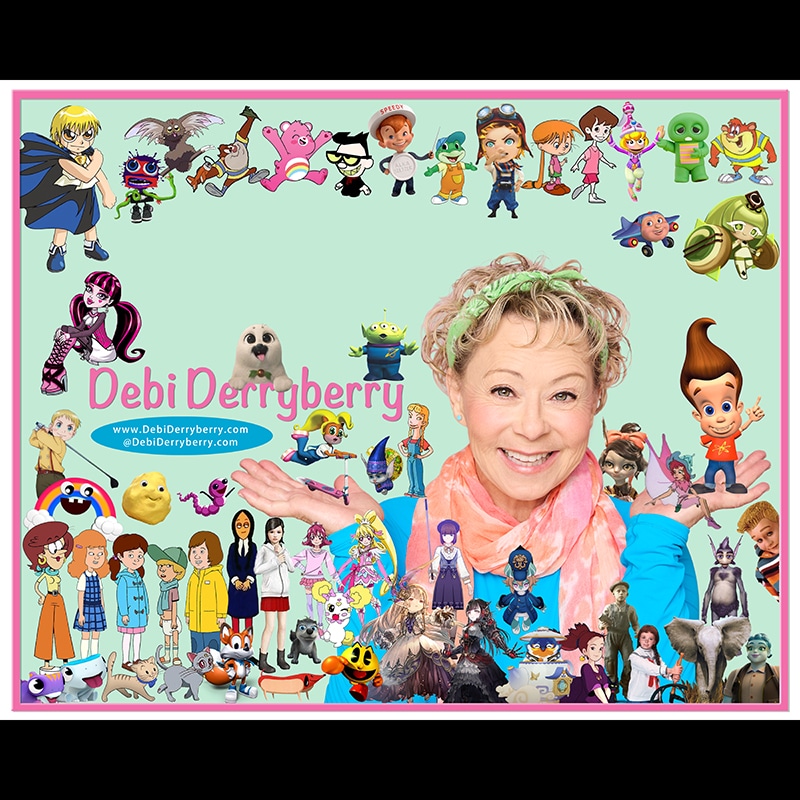
Debi Derryberry is one of the most in-demand voiceover actresses in Hollywood. She’s perhaps best known for voicing Jimmy Neutron in both the Academy Award-nominated film Jimmy Neutron: Boy Genius and in the TV series The Adventures of Jimmy Neutron, Boy Genius. Debi’s also played dozens of memorable characters in features like the original Toy Story in which she’s one of the aliens, The Boy and the Heron, Despicable Me 2, Kiki’s Delivery Service, The Christmas Chronicles and many more. She’s also appeared in well more than 100 TV series, including Monster High, Sharkdog, Bugs Bunny Builders, Pokemon Horizons, and The Loud House.
Debi’s video game work includes Cookie Run Kingdom, Crash Bandicoots, Final Fantasy, Guild Wars 2, Genshin Impact, and World of Warcraft.
For Anime, you can hear Debi in Netflix’s Rising Impact, Zatch Bell, Sailor Moon and Glitter Force.
Debi’s also written and recorded 5 award-winning children’s music albums. Her 2 most recent are: Go to Sleep-Lullaby Album and Gotta Go Green. Debi’s song Baby Banana hit #1 on Sirius/XM Kids. Her music can readily be found on all digital streaming platforms. Look for her new kids single, Compost Bin, with Grammy Award winner Lisa Loeb.
You can also find Debi at debiderryberry.com and on her YouTube channel, Debi Derryberry KIDS! which has animated videos to accompany her children’s music. Her TikTok page has over 1.3 million followers and over 28 million likes!
WEBSITES:
Debi Derryberry Kids YouTube Channel
IF YOU LIKE THIS EPISODE, YOU MIGHT ALSO ENJOY:
-
Scott Christian Sava, Artist-Animator-Illustrator—Episode #372
-
Michael Mason, Jazz and World Flutist (Session 2)—Episode #276
Steve Cuden: On today’s Story Beat,
Debi Derryberry: When you’re trying to come up with a character, I look at it a little more technically. What’s the age? So she’s maybe a teenager. Okay, where’s she from? Okay, just to make it easy, put her in the south, maybe she’s a little bit snarky. So then we have a teenager in the south and she’s snarky. Well, maybe she has braces. Okay, so now we have this teenage snarky thing and she’s got braces on. so you layer the different things that are in your wheelhouse that you can do to come up with different characters.
Announcer: This is Story Beat with Steve Cuden. A podcast for the creative mind. Story Beat explores how masters of creativity develop and produce brilliant works that people everywhere love and admire. So join us as we discover how talented creators find success in the worlds of imagination and entertainment. Here now is your host, Steve Cuden
Steve Cuden: Thanks for joining us on Story Beat. We’re coming to you from the Steel City, Pittsburgh, Pennsylvania. My guest today, Debi Derryberry, is one of the most in demand voiceover actresses in Hollywood. She’s perhaps best known for voicing Jimmy Neutron in both the Academy Award nominated film Jimmy Boy Genius and the TV series the Adventures of Jimmy Boy Genius. Debi’s also played dozens of memorable characters in features like the original Toy Story in which she’s one of the aliens, the Boy and The Heron, Despicable Me 2, Kiki’s Delivery Service, the Christmas Chronicles, and many more. Her voice can also be heard in well more than 100 TV series including Monster High, Shark Dog, Bugs Bunny Builders, Pokemon Horizons and the Loud House. Debbie’s video game work includes Cookie Run, Kingdom, Crash, Bandicoots, Final Fantasy, Guild Wars 2, Genshin Impact and World of Warcraft. For anime, you can hear Debi in Netflix’s Rising Impact, Zatch Bell, Sailor Moon and Glitter Force. Debi also written and recorded five award winning children’s music albums. Her two most recent are Go to Sleep Lullaby album and Gotta Go Green. Debi song Baby banana hit number one on SiriusXM Kids. Her music can be readily found on all digital streaming platforms. Look for her new kids single Compost Bin with Grammy Award winner Lisa Loeb. You can also find Debi at debiderryberry.com and on her YouTube channel, Debi Derryberry Kids, which has animated videos to accompany her children’s music. Her TikTok page has over 1.3 million followers and over 28 million likes. So for all those reasons and many more, it’s my tremendous Honor and truly great pleasure to be joined today on Story Beat by the extraordinarily multi talented Debi Derryberry. Debi welcome to the show.
Debi Derryberry: Wow. Thanks, Steve. That was quite the intro. Thank you very, very much. It’s so nice to be here and.
Steve Cuden: Well deserved, well deserved. So let’s go back in time just a little bit and into your history. When did acting and singing first pass bite you? How old were you?
Debi Derryberry: Golly, I would say. Well, my, My mom had a guitar. We always did little songs from camp. When we drove places, we’d do, songs together. And I just got the harmony bug and loved to do harmonies. It just makes me tick inside, makes me go all happy. And so I got my guitar when I was nine and I, you know, back then we had a newspaper and they put the, the top 40 song they printed in the newspaper with the chords and you could cut it out and play the song and learn how to play it. I had a singing partner, I think I was maybe 8 or 9 when I was just, overcome with. I must sing all the time. Our family was in a. We grew up in the desert near Palm Springs. We were members of the Valley Valley Players Guild. So we were in, ah, community theater. And I did a number of community theaters in the desert as well as high school theater. And I went to UCLA to be a doctor. To be a pre med and I took drama there. Obviously I did not go to med school much to my dad’s dismay, but I continued studying acting and doing stage shows and then segued into some on camera. So it sort of always been part of my life. my favorite part is when people clap for me. I like being clapped for.
Steve Cuden: But. But in a studio setting, you don’t get clapped at very often, do you?
Debi Derryberry: No, not at all. But then there’s conventions where people give you your accolades at your table. When they, when you sign their items.
Steve Cuden: Are they amazed that you are who. Who you are? Because they m. Many times won’t even know what you look like.
Debi Derryberry: That’s right. I have, you know, we have our banners there at our tables and usually, people will walk up to the table and they’ll look at. I have these pictures that have all the characters that I’ve done well, some of them around me. And they’ll look at the characters and they’ll do like a double take. Wait, you were Jimmy Neutron. Wait, wait, you were Zatch Bell. Wait, you were. And I’ll reply yes, in the character’s voice. And sometimes, you know, Steve it can be very emotional for the listener because this was what they grew up with. And just like, you know, when you smell something that reminds you of, like, grandma’s house, that fried chicken smell, or that plant at that place, when you hear that sound, I would say two or three times at each convention, people break down in tears. You know, they apologize. I’m like, don’t apologize. It happens. You know, you have memories. There are things that spark genuine, primal emotions. And I guess sound voice is one of them.
Steve Cuden: Absolutely. Especially when it’s, a, sound from your childhood and it’s something that had meaning to you in resonance. It comes all the way back up. By the way, that’s the first time in nine years of doing this show that anyone has used the word verklempt. So I’m thrilled.
Debi Derryberry: Well, I don’t know how to spell it. I didn’t know there was an R in it. Verklempt. Verklempt. Well, there you go.
Steve Cuden: At what point in your career, as you were starting out, did you think to yourself, I not only love doing this, but I’m actually good at it? When did you figure out that you were good at this?
Debi Derryberry: I don’t know if I figured that out yet. I don’t ever think that that thought came into my head. I love to work really hard, and I love to do what I love to do. I’ve had these opportunities come my way, and I just kind of run through the door and I say, yes, I want to try that. You know, if one thing isn’t working and another door opens, then I run through that door. And a few of these doors have led me to projects that have been really successful. Not by my doing, maybe a little bit. But, you know, there’s so much more involved in a show than the voice. There’s the creators and the writers, the directors and the producers and the advertisements, the networks, that there’s so much more. And I’m just lucky to be doing the voice. And that seems to be what people notice.
Steve Cuden: Well, I’m here to tell you that you’re actually very good at what you do.
Debi Derryberry: Thank you.
Steve Cuden: And not only that, but, the truth is that as a writer, we’re going to talk about this a little more, but as you know, I’ve written lot of animation scripts.
Debi Derryberry: Yes.
Steve Cuden: And I never wrote a single animation script in all of my whole career that wasn’t made much better by the actors.
Debi Derryberry: Is that right?
Steve Cuden: Whatever’s in your head as a writer, it’s not what winds up being done by the actors, and it’s almost always much better.
Debi Derryberry: I do a lot of coaching, a, lot of voiceover teaching, and I tell my students, you know, the writer puts their on the page, who. What his idea is, but we get to play with that, we get to interpret that, but we also need to give the animator something to do. The words are a suggestion and you need to stick to them fairly close, but you can play with them. And that’s where the acting part comes in. You have to be able to get them off the page.
Steve Cuden: I think the great voiceover actors that I have watched and seen work in LA are also great improvisers. They can riff on things and make things much, much better than what’s on the page.
Debi Derryberry: Before COVID when we would be in the booth together, it was so much more fun to riff and to be able to have that camaraderie and bouncing off each other. And now that we record alone, we don’t get that as much. And I think product suffers, quite honestly.
Steve Cuden: Do you. It’s a different energy, isn’t it? You don’t get the energy off of the other people.
Debi Derryberry: That’s exactly it. You don’t get to bounce off them. And you remember back in the days when all the actors have their headphones on and, you know, the engineer would just let it run and it was just crazy what would come out.
Steve Cuden: Absolutely. Well, so many of them came from, either the world of acting prior to. Or they were comedians or whatever. But almost all of the successful voiceover actors that I’m aware of are funny people. They’re not, dull, uninteresting folks. And when they’re in this, in a, a booth together as a group, it just gets completely crazy.
Debi Derryberry: It does get completely crazy. With Jimmy Neutron, I was basically Steve. I was the straight man. I was in that studio with the funniest people I’ve ever been around. Mark DeCarlo, Megan Kavanaugh, Rob Paulson, Jeff Garcia. Just hilarious people who could riff and had so many stories. And I think to make something work, you need both the straight man and the riffer.
Steve Cuden: So do you feel like the work that’s being done today is really, less amusing or less entertaining or less full of energy than it was. Is that what you’re saying? That that’s the big difference as an actor?
Debi Derryberry: Yeah, because it’s, you know, I’m. I’m, I’m pointing. I know you can’t see because we’re audio only, but I’m pointing at my Booth, which is a little room here in my office. And that’s where I go to work. And it’s not like we’d get in the studio and go to Nickelodeon. I could. I mean, sometimes we go into the studio still, but it’s never a group. I do miss it. And it was a special time. When you’re in something like that, you don’t realize until you’re out of it. Wow, that was the golden time. That was amazing. Because now it’s gone.
Steve Cuden: That was. That was a very special period. Well, especially when I was doing most of my work was the 1990s into the 2000s, and it was the business. The animation business was rocking and rolling. They were doing, throwing off time. Tons of episodes of. Tons of shows, mostly for syndication. All right, so let’s talk for a moment about the business of being a voiceover actor, actress. There must be at least a thousand people in your head. Where do all the characters come from? Is it just from the written page, or are you out there in the world and characters are coming to you before you even know you’re going to do them?
Debi Derryberry: I think it’s a combination of that. I do have, what I call the, your legacy characters that live in your head. You know, you have your standard characters, but then when you’re trying to come up with a character, I look at it a little more technically, a little more scientific. You know where I’ll have. I’ll say, okay, what’s the age? Well, so she’s maybe a teenager. Okay, where’s she from? Oh, okay. Just to make it easy, put her in the South. Okay, we have a teenager in the south and make her. Maybe she’s a little bit snarky. So then we have a teenager in the south, and she’s snarky. Well, maybe she has braces. Okay, so now we have this teenage snarky thing, and she’s got braces on. and so you layer the different things that are in your wheelhouse that you can do to come up with different characters. So for me, there’s, you know, the skills that I have that I can put together. There’s my wheelhouse characters. There’s my, copycat characters. In Jimmy Neutron, Rob Paulson does this character named Carl. And everybody wants to imitate Carl. Well, I kind of stole him for a show I did with Bill Burr called F is for Family. And there was a little character named Philip. Yeah. So I did my version of Carl as Philip, but he had some braces, too. And so you can steal, impersonate. There’s so many different ways of bringing characters into crazy brain.
Steve Cuden: Do you work with your voice every single day?
Debi Derryberry: Yes. whether I’m using, know, just picking up my guitar and writing a song, or this morning I was at, my producer’s house singing. I had two auditions yesterday. One of the auditions took a while because they wanted me to sing this particular song, so I had to learn it, download the karaoke track. Now we have to be our own engineers too. So I have to learn how to use software where I can download music and sing with it and edit it together and do that.
Steve Cuden: You produce your own work. That way you actually do the physical work as well, not just the singing.
Debi Derryberry: For auditions, we have to record ourselves and edit it. If there’s a song that they want us to sing, we have to record that together too.
Steve Cuden: And so you’re still. You just said auditioning. You’re still auditioning. People don’t just call you and say.
Debi Derryberry: I get asked so often, Steve. We still have to audition once in a while. They’ll throw me a bone. You know, back in the day of Jenny McSwain and Sue Blue, they would say, get Debi over to Nickelodeon or get Debi over to Salome Studios or just, just go. But it’s different now. You have to audition for every single thing. So I do. And there’s so many different things to audition for, Steve. Every, there’s video games, and every video game has, you know, over 300 characters. It’s a constant audition process for video games, for the, all the dubbing, for the anime shows. It’s never ending.
Steve Cuden: So what, as you’re working with your voice during the day, what do you have a typical set of exercises that you do, or is it different every day?
Debi Derryberry: I don’t. I mean, sometimes if it’s a rough. If it’s going to be a challenging singing session, I will do my standard singing exercises, usually in the car on the way over to the studio. But I think just in general, I, I work on my breathing. I swim every morning, and I hold my breath a lot to try and really get my lung capacity up. And, you know, I do all the things you’re supposed to do and not do, like no smoking and no coffee. And, I’m drinking. You can’t see it, but I have my hot, my hot beverage and I don’t really drink sodas. So we just standard makes sense, take care of your voice kind of things.
Steve Cuden: Is there anything that you learned about your voice early on that you’re still doing and working on. Or, have you passed all that into some other phase?
Debi Derryberry: I used to do things that would hurt my voice, and I think, oh, I’ll just have to do it for a second. But, you know, I’ve learned if you can’t sustain it for two to four hours, that’s not a voice you should be doing.
Steve Cuden: What do you mean by sustain it?
Debi Derryberry: If, where you place that voice, if you can make it sound like that and keep that voice print for the length of the session and, and guide that voice print through all the emotions that go with that character in that episode. Maybe there’s some laughing, maybe there’s some crying, maybe they’re screaming. Maybe there’s some, something very dramatic. And maybe there’s cursing, maybe there’s laughing. Maybe there’s no talking at all and it’s just all laughing. Can you stay in that character for all those requirements? And it can be hard. I had one show called Tasmania, and I played Jim Cummings was Taz, and I played his little brother Jake. And the voice that I got cast with was a voice I could not sustain. And I ended up with almost a vocal, vocal node. So I know never, never to audition that voice again because every time I went into session, I always ended up blowing it out.
Steve Cuden: Did you know when you first started doing it that you were in trouble?
Debi Derryberry: I, knew that it would be challenging and I better be, you know, healthy and up to the task. But I didn’t think it would be a problem doing that voice. Usually as a professional athlete, they will say no pain, no gain. But with voiceover, it’s not that way. If there’s pain, don’t do that voice.
Steve Cuden: Well, some voices, some voice actors, they do stuff. I don’t know how they do it.
Debi Derryberry: Yeah, I mean, in. Everybody’s vocal cords are different. Some smokers have that signature smoking sound, and some people sound smoky without even smoking.
Steve Cuden: Like Julie Kavner.
Debi Derryberry: Yeah, she has that. You know, I can do that, that ancient rasp now without it hurting me. I call it sort of my. My granny spot. It doesn’t hurt me to talk like this, but I just lower it and there’s some texture there. And hold. Oh, Bob’s your uncle.
Steve Cuden: That’s. That’s Warner Brothers classic granny.
Debi Derryberry: Yes, but it doesn’t hurt. And there are so many screaming scenes and death scenes in video games. And the directors are always very, thoughtful and let you scream at the end of the session. And sometimes they’re very young directors and they don’t know how a voice works. And us voice actors who do know, we will say, listen, there’s these few lines that are really pushing a lot of emotion. Let’s save it to the end. I’ve been really fortunate that my voice has remained strong and I’ve been able to, do all these different characters.
Steve Cuden: Well, for sure, because you can hurt yourself if you’re not careful. And, that’s why I was curious. If there is a preparation that you go through every day and you’re saying, not really. It’s a day by day thing, Are there certain preparations that you go through with your voice when you’re getting ready to record, a show that’s going to take you several hours?
Debi Derryberry: Yeah, I will, make sure that I eat the right things beforehand or not eat the wrong things. No, you know, no bubbles, no tuna fish, no garlic, no soda, no coffee. Comforting kind of easy foods that don’t give you a lot of phlegm, you know, no milk, cottage cheese, ice cream. Things to me that are just second nature. Just that you’re not going to do before a session.
Steve Cuden: Did you know that when you first started out, or did you have to learn it the hard way?
Debi Derryberry: I think I had to learn it the hard way. But of course, 30 years ago, you know, when you’re 20 or 38, you’re so resilient and you’ll never die. There’s never anything that’s going to hurt you. You just keep at it. But now you just have to take care of your body and your voice. It is really the key. and the, the eyes, that’s another thing, because now we don’t get paper scripts anymore. Steve. Everything’s on a digital monitor. When I coach people, when I train people, I still have them use a paper script because I want them to get used to being able to take that adjustment, whatever the director is asking them to do and not forget it. But these days you don’t have a paper script, so you usually have a little pad of paper. These monitors on which the scripts are placed are at different distances. I have a distance for my booth, so I have booth glasses. I have computer glasses so I can look down and up for a bicycle. Look, I have distance glasses for when. Because I’ve always needed glasses. When I’m in a video game studio, Sometimes they put that monitor on the far wall. So. So, you have to be prepared with your eyes. And also another thing is the headphone situation. Because I have glasses, the headphones can smash against the temples and give you headaches. So, for recording, I have these custom ultimate ear buds that are custom made to my ear, and I’ll take that into the studio with me, and that’ll plug into the interface because the headphones smash against them. I’m really short. I’m 4 foot 10. So sometimes I travel to a studio with a. You know what a yoga block is? It’s like a little square that’s, not. It’s made out of foam, really, but it’s like my foot stool, because if my feet don’t touch the ground and I’m sitting in a chair for four hours, that can be hard on somebody’s back or if you’re standing for a long time. So it’s, there’s a lot of physicality you have to think about.
Steve Cuden: And do you exercise every day to work with your body so that you.
Debi Derryberry: Can do that every single day? I’m on my exercise cycle in the sunroom at 6:00am I do 20 minutes of high cardio. And then, we’ll do 20 minutes Pilates on our YouTube. Pilates. And then in the swimming pool for the lung and the, stretching, and then, we’ll do the dog walk. So every day is a combination of those.
Steve Cuden: So I think the listeners need to pay close attention to this. If you have any thought in your head about becoming a voice actor or even just not, a voice actor, an actor in general, you have got to take care of what they call your temple, which is your body. And if you don’t, then you run the risk of having. You’re burning yourself out or not being able to do it. And so it’s a very important aspect of doing what Debi does. So, when you receive a script, I assume you receive most scripts ahead of time. You’re not seeing them for the first time in the studio. or do you.
Debi Derryberry: Video games. You never receive a script. You receive your few lines. You sign an NDA. You don’t get to know the story. You have to be a really good cold reader because you just go in and here’s your script, here’s your lines. Go for cartoons. Sometimes they send you the script, or sometimes they’ll send you a scene and a digital one. Never on paper. You know, as an actor, you want to read through the scene and know what’s going on. You have to look at the stage direction. You have to see what the person said just before you spoke. you have to know why you’re saying it. You have to know where you are, how far away is that person from you? it is the video games director’s job to know what’s going on in each scene. And. And a very important part of a video game session is the beginning, where I always have a paper and pencil, and they say, this is what’s going on. The Tridacodon is coming back through the Palauthics period. And you know that all the dragons wore, laftas, so the loftas were going over the Phanamenoas. And it makes no sense. But you have to make sense of it and they have to explain it to you.
Steve Cuden: I think that’s phenomenal that anything comes out that sounds like it belongs together because you’re doing sometimes, as you say, in an individual booth by yourself. And they have to piece all that together. And it should sound like it’s people talking to each other, but frequently you’re not together at all. So that’s the trick, isn’t it?
Debi Derryberry: Yeah. I mean, good luck to the engineers. They’re the ones. They’re the ones that have to make it sound like they’re talking to each other. But if you listen to, say, a Bobby’s World or a Tasmania, where we all recorded together, or Jimmy Neutron, if you listen to those finished products, as opposed to, say, a Paw Patrol or, you know, something that’s current now that’s not recorded together, there’s a big difference in the way it sounds.
Steve Cuden: Yeah. I’m guessing that the producers don’t worry about it too much because they probably think to themselves, the audience at that age is not terribly discriminating, and so they’re not worried about the audience reaction being to the negative. But I think that it does make a difference.
Debi Derryberry: I think the audience is very discerning. Especially children. Especially. I mean, I do music for kids and I don’t perform live anymore. I have an animated character that I use called Little Debi And when I was performing live, if those kids were not engaged, they will get up and walk away. I mean, an adult will sit there and be polite. Kids are not so, you know, they’re not so trained in good manners because they want to be entertained.
Steve Cuden: Yeah. And if you don’t keep them engaged, they will absolutely disengage quite quickly.
Debi Derryberry: That’s exactly right. I have this whole YouTube Kids channel. It’s not YouTube Kids yet, it’s Debi Derryberry Kids. And I’m hoping one day to make it down that lucky funnel that puts you into YouTube kids, which is a Whole other thing. But currently it’s Debi Derryberry kids. And my demographic is like 2 to 6 year olds. And I’m having so much fun with all my kids music. I, having them animated. the songs are animated now and I put them up on my YouTube channel. And you can look at the analytics and see how long somebody watches your video before they piece out.
Steve Cuden: I know that you do multiple characters within a single show. What’s the most characters you’ve ever done in one episode of a show?
Debi Derryberry: I think it was F is for Family. I had seven shows, seven characters. I had Bill Barber’s daughter named Maureen. That was his little princess. That’s like my standard clear voiced little girl. And then there was Philip, the fella down the street who has braces and he was a little nervous. And then there was the kid down the street named Kitty. He, he wore a diaper and his mama was in the people jail. and he watched the squirrels in the TV set. And then I did the nurse from kind of Midwestern. She was in the hospital all the time. What kid did you almost kill this time? And then I did Bridget, Bridget with a friend down the street. And she was very foul mouthed and she would say, say terrible sailor mouth things. And then there was Gert. Gert was Suzanne’s friend from college. And she had those cat eye glasses. And then I had Scott. Scott was a little computer nerd. So that was, I don’t know if that was seven or more, but there were a lot.
Steve Cuden: Did you ever have to do characters talking to themselves back and forth?
Debi Derryberry: Oh yeah. But what I prefer to do in that instance is just record one and then record the other and let the animator, you know, go to town.
Steve Cuden: So I had the great privilege to sit in the booth and watch. Not in the booth, but you know, outside the booth. Watch. Jim Cummings doing two characters back and forth. Was in the show Bonkers when he was doing Lucky Paquelle and Bonkers. And it was, I mean they were two completely utterly distinct sounding characters. They didn’t sound anything alike. Their rhythms were different. Everything was different about them. And he did it back and forth to himself and it was like, how is he doing that?
Debi Derryberry: I know, it’s mind boggling, isn’t it?
Steve Cuden: It’s completely mind boggling. The great ones like you are very smooth at doing it in a way that you go, I don’t know how they’re doing it. It’s, it’s like a magic trick. It really is.
Debi Derryberry: Oh, that’s very kind of you to say. You know, it’s been so long that I’ve been doing it.
Steve Cuden: Well, yeah, I mean you’ve got it down to a thing where you know how you’re doing it. Do you use your body in your acting? Do you, even though it’s voice acting, do you need to use body movement and expression in your face to get a character to work?
Debi Derryberry: Absolutely. there was this one show I did with Tim Curry called Peter Pan and the Pirates and Jason Marsden played Peter Pan and I played Tinkerbell. And Tinkerbell was a little petulant, kind of, I want to use the B word. She was a petulant in love with Peter and she didn’t like Captain Hook and I was like her first voice, normally she was just a tinkle. When I recorded her, I would look at the mic and I do this and when I looked at the drawn animation, she did this and she sometimes went cross eyed. I’m like, why is she doing that? It’s because that’s what I did when I recorded her. And sometimes they film you when you’re doing the voice because they want to know how does she get that voice out?
Steve Cuden: They do that more often than people know is that they will record the actors and use the actors expressions in the actual animation as they do.
Debi Derryberry: Yeah, they have to let you know if it’s a Screen Actors Guild union job, they have to tell you ahead of time they’ll be filming, for the animators, which is fine, I mean, whatever they have to do. But yes, there is a physicality that goes with each character.
Steve Cuden: I think one of the most fascinating things that you do and you have a specific voice for it is you do both young boys and girls. Is there a, is there a distinction in your head how you get from a boy to a girl? Does it, Is it, how do you do that? Is it just the modulation of the voice?
Debi Derryberry: In real life, little boys and little girls sound the same. But in cartoons they expect the boys to have some gravel and the girls to be a little more clear voiced. If you’re talking like a, I don’t know, like a six year old, they’re not going to have the same smooth cadence that maybe a teenager does because they stop and think. And that would be a little girl maybe. But then if it’s a little boy, then you come out at. I kind of come out the side of my mouth and he has a little bit more gravel and they a little Tougher, you know? yeah. So for me the difference is clear versus side of the mouth and gravel.
Steve Cuden: So I’m just curious, is there anything you wish animation writers would do more of to make your job easier?
Debi Derryberry: I like it when they give pictures. They give images of what the character looks like and that gives me an idea of, what voice I might want to come up with. If it’s a really very large character, kind of lumbering, then I have a couple choices. I might go lumbering or I might do it a little high pitched, which would be really funny next to the visual of a very large character. So having the, pictures is often helpful. I’m trying to think if there’s something else in the scripts. sometimes if it just doesn’t ring true to the character that I’ve given it, I’ll switch it up a little bit. You know, depending on the regionalisms, maybe the character is upset or, excited and they’re from, you know, if they are from the south, you might add something to it. You know what, I will tell you what, that might not be in the script, but you can add it or say they’re from Wisconsin. It would be, oh, for accordance sakes. Do you know, I, I’m taking a tuna casserole and all those little woo hoo, those little expressions, the regionalisms, they bring it to life. and sometimes I’ll add that.
Steve Cuden: Do you do stuff like that in the booth? And they go, no, that’s not what we want at all. Do something totally different. Does that happen?
Debi Derryberry: Oh yeah, Sometimes I’ll audition that way and they’ll be, happy about the audition and they’ll book me and they’ll say, but we want to pull back on that accent. Pull back on that character a bit. Just give it to us straight. And so I tell my students when I’m coaching, you know, if you have two really separate characters, give them both because they might really love them. But once you get into the booth, they’re going to pull it back anyway. They’re going to do it the way, I don’t know, the way that they want. Who knows, maybe there’s another character that they want to be the funny right then.
Steve Cuden: You alluded to it a little bit a moment ago. But I love it when the voice with whatever the character drawing is is counterintuitive to what you think the voice should be.
Debi Derryberry: Yeah, I think that’s super fun. And I guess that’s the freedom we get as a voice actor is to try those sorts of things. And sometimes when you’re in a show as a utility player, the writers will have, you know, some one off character and they’ll say, just take that character, this show, Debi and you’ll get to come up with something, you know, just on the spot. And you better be able to just reach into your bag of tricks and put something together right quick.
Steve Cuden: And no doubt you do. what kind of direction do you get that you think is very helpful? What would you like to have more direction of?
Debi Derryberry: Oh, more Jeannie McSwain. More Debi chew up the scenery on this one. Come on, make me cry, Debi She was the best director ever. I like direction that is, being. Being from a science, scientific, pragmatic background. You know, I like the easy ones. Faster or slower. Something that’s, that’s very easy to do, that’s very tangible. I really admire directors who have such a great, retrieval skills with their words, and they can just reach down deep and find the exact thing they need to say. And of course, I don’t have that, so I’m not able to communicate that to you right now. But a good director is, is rare and hard to find. And I’ve worked with just some of the best. And I’m always amazed at their word retrieval skills.
Steve Cuden: You’re talking about, you’re talking about that they have good verbs to use that help you to figure out where you’re going with the, with the line, how to say the line, and so on.
Debi Derryberry: Not just necessarily grabbing the verb, but coming up with. With the sentence that communicates to you rather than just, he’s madder than that. You know, just instead of telling me more mad, they would say something that would just really resonate with me. Like, you know, he just sliced off your, your dog’s foot and it was your favorite dog. I know, look at me going really dark. But sometimes they’ll just say the right thing and it’ll get you right where you need to be. I wish I could think of a great example for you, but that’s why I’m on this end of it, doing the voices and marveling at the great directors.
Steve Cuden: Does anybody ever give you line readings?
Debi Derryberry: Oh, yes. Sometimes I think it’s wrong when an actor objects to it because sometimes the director does not have good retrieval word retrieval skills and does not have good communication skills. And all they can do is say, I want it like this. And I will tell them because they’re struggling not to line read you. And I will say, just tell me the way you hear it in your head, it’s okay. If it’s a line read, that’s okay with me. And I let him off the hook. And then they’ll tell me and, you know, it might be something that the emphasis was wrong or that they were hearing something completely different than how I was reading the line. If you haven’t got it in the first three takes, give me a line read.
Steve Cuden: Of course, there are two extremely famous examples of famous actors who notoriously railed, against directors who were trying to give them line readings or something like that one being William Shatner, who I’ve had the great fortune to interview. And also, Orson Welles, both of whom are in Maurice Lamarche’s, wheelhouse. Right. and so the notorious thing is, don’t give me a line reading. Don’t tell an, actor how to read a line.
Debi Derryberry: You prefer it in the interest of time? Yeah, it’s just a line. And if I’m not getting it in a few takes, give it to me. So I just think it’s a little. I think it’s a little snooty of an actor. Not that. Anything against orson Welles or Mr. Shatner. They have a. Studios are expensive, studio time is expensive, directors are expensive. Let’s just get her done.
Steve Cuden: Absolutely. Let’s, switch gears a little bit and talk about your songwriting, which you’ve already chatted about a moment ago or a little while ago. do you think of yourself primarily as an actress or a songwriter or both?
Debi Derryberry: Oh, both.
Steve Cuden: How long have you been writing songs? Since you were nine and you got the guitar. Were you writing songs back then?
Debi Derryberry: Yes, I wrote. My first song was called My Dog’s My Buddy, and that’s actually on my first album, what a Way to Play. And I have an animated. Not an animated video. Yeah, I have both, actually animated and live action. They both bring me great joy. But writing, music songs, whether it’s kids songs or adult songs. I also have a country band called Honey Pig. It’s a six person band, three female harmonies. I love them both so much. I don’t think of myself as anything, you know, if you’d say, I’m a really good dog walker and I’m a good songwriter, I’m a good singer, I’m a good actress. I work really hard at everything I do because I love working and I want to be good at everything.
Steve Cuden: Why did you decide to focus on writing songs for kids?
Debi Derryberry: Easy for me to sing in a voice that kids love. There’s something about my singing Voice that kids just like to listen to. And I think it’s important as a steward of the grown upness is to be able to, have messages for kids that are on point, that are educational but not educational, that are fun but nurturing.
Steve Cuden: Are you, do you write your songs on guitar? Is that what you write on? Or do you also write on any.
Debi Derryberry: Other instruments, just on guitar? I’ll generally because I’m a competent guitar player, but, you know, I don’t love E flat at all. And I play your basic chords. So my songs are fairly basic. you know, they’re generally your 14 fives or your 164 5s.
Steve Cuden: Well, you have, you put into your songs rather repetitive, simple, interesting, fun melodies. That’s what I’ve noticed in looking at your work. It’s not like you’re doing complex orchestral stuff. It’s purposely done for kids and it has a repetition to it. And that’s the way that most kids songs play. And that’s right.
Debi Derryberry: And most country songs as well. some of my adult songs are a little more complicated.
Steve Cuden: Do you have a preference?
Debi Derryberry: No, I like it all. And sometimes I’ll wake up and I’ll have a kid song in my head that I’ll have to write down. Or sometimes I’ll wake up and I’ll have a country song in my head that I have to write down. Or I’ll have to turn on my voice memo on the phone and sing it to my phone in the middle of the night. And then I’ll wake up in the morning and go, what were you thinking, Debbie? Or I’ll be like, that’s a really good song. So, they come to me in different ways.
Steve Cuden: So where did Baby Banana come from?
Debi Derryberry: My, kids. My, my second husband, came up with this character, a baby banana. He said his dad was a gorilla and his mom was a duck. And I heard him telling this story to, my son and I thought, well, that’s an interesting diverse family. And so I, I wrote that song Baby Banana and the Licorice Tree. And it was on my very first album. And I didn’t know it was going to do so well. so I wrote a book called Baby Banana and the Licorice Tree. And then I did a whole separate album called Baby Banana with all kinds of, you know, tropical fruit songs and Baby Banana type things flying. So that’s how that song came up. And I did give him credit in the, in the book inspired by.
Steve Cuden: It’s a very catchy song.
Debi Derryberry: Thank you. Yeah, kids like it and it has little hand motions to it. And I have a couple of different, videos for it on my, wwberry Kids animated channel. One of them is just coming out soon, and it’s 3D, and the other one is 2D. So much fun doing these animated videos.
Steve Cuden: So one of your more recent songs is the Compost Bin. How in the world did you get Lisa Loeb to sing it with you?
Debi Derryberry: well, she lives down the street. We have the same voice agent. So I called her and I said. And I coached her actually a couple times for voiceover. And I said, I want to do a song more green based, so let’s do a compost song. So I went over to her house and we wrote it. She really liked my music producer, Steve Brickman, and we recorded it over at his studio.
Steve Cuden: So where do you. When you get a song idea, where do you begin? Do you just. It’s a. Is it usually a melody or is it a hook or a lyric? What usually comes to you first? Or is it all the above?
Debi Derryberry: All of the above. Sometimes it’s a hook. It’s never usually the melody. And sometimes it’s an actual word. Hook. sometimes I work on it so hard and nothing ever comes of it. And sometimes it just comes out like vomit, like, boom.
Steve Cuden: And, So when you typically write a song, are you a pretty fast writer, or does it take you a long time? Do you dwell on it for a long time?
Debi Derryberry: I’m not a dweller, Steve. I like to get things done. so it might take. Some songs might take longer than others. I look for the finish line. My dad used to say to me, Debi if you can’t decide, it doesn’t matter.
Steve Cuden: So if you can’t decide, it doesn’t.
Debi Derryberry: It comes down to a couple things.
Steve Cuden: You also from your career, you’ve had to go in and do it. It’s not like you go into a studio and spend days trying to figure out a line.
Debi Derryberry: You just go in and do it sometimes. M. I mean, I don’t want to say that I don’t get stuck. Stuck. I do get stuck. I. I have a few songs that have just sat there forever because they just haven’t risen to the. You know, with the cream to the top.
Steve Cuden: Is there a typical number of drafts that you go through, or is it usually one, two drafts and you’re done?
Debi Derryberry: Sometimes I think it’s done, and then I’ll sit on it and I’ll record it and I’ll Be like. And then it’ll come to me that there needs to be a change and I’ll go back in and have to re record and make a change.
Steve Cuden: If you’re the creator of, a work of art, you’re entitled to keep working it. I always think, I know for a fact, certain, that your first drafts are usually not very good of anything. And then it takes a little while to refine, to revise, to make it better. And then sometimes it takes a while longer than that to get it where you really want it. I mean, a lot of painters take a year or longer to paint a painting, so they just keep coming back at it. I’m just gonna, tell you that I think that it’s such a joy to listen to you speak, to listen to all the characters, and it’s just fantastic. But we’re gonna wind the show down just a little bit. And I’m wondering, in all of your experiences, you’ve told us all these great stories already, but I’m wondering, can you share with us a story that’s either weird, quirky, offbeat, strange, or just plain funny?
Debi Derryberry: I’ve been a scuba diver since 1983, so I’ve been diving a long time time. A friend of mine said, Debi they’re looking for a scuba diver to be the body stunt double for a little boy in this movie they’re doing at Warner Brothers called Free Willy. And so I went over to Warner Brothers and I’m, it’s still at my age, I’m still the size of a 12 year old boy. I’ve done a lot of jobs as a 12 year old boy in costume or whatever. And I met with them and the next day I was flying down to Mexico City to be the body stunt double to ride the whale for Free Willy. So in that movie, in Free Willy, when the little boy is, running around the tank and he slips and hits his head and he falls in the tank and the whale rescues him, it’s all me. I’m the one that rode that whale really. And I want to say that I do not believe in males, in mammals, in captivity. And I would never do the job again. Back then I didn’t have the deep knowledge that I do now on how cruel it is. So I don’t want people to think that. I think it was a great thing to do to have a whale in captivity, but it was a very cruel job and it was very fun to be in that whale tank with that whale for seven weeks.
Steve Cuden: You were actually in with the live Whale.
Debi Derryberry: And I know that your audience can’t see this, but I’m just going to show up this picture of me on the whale.
Steve Cuden: Debi is showing us this beautiful framed portrait of her sitting on a real whale in Free Willy. That’s crazy.
Debi Derryberry: So that’s my story.
Steve Cuden: I’m glad you survived that.
Debi Derryberry: My mom and dad wanted me to get life insurance, and I called Lloyd’s of London and they said, no go. You don’t get any insurance for that. But, you know, we were young, indestructible, Nothing ever hurts us.
Steve Cuden: And nothing did. And that’s a good thing.
Debi Derryberry: Nothing did. Nope. And that was before I had eye Lasix. I was, legally blind without my glasses, and I couldn’t wear glasses in the whale tank.
Steve Cuden: So how did you see what you were doing?
Debi Derryberry: It was very fuzzy, but I, you know, could basic see basic shapes. And I was basically the rat toy, you know, that the trainer told the whale what to do and I was like the tennis ball you throw for your dog.
Steve Cuden: Oh, my goodness. Was that whale tossing you up in the air and all that stuff?
Debi Derryberry: No, people tossing. he did, there were a lot of nose pushes. There was a back, back rides. I was 18ft under in the dark when the whale came at me with his big snout. And I couldn’t see it, but I could feel the water moving. And my job was to let go of the grate on the bottom of this 18 foot pool and let the whale stick his, head under my body and bring me to the surface and rescue me.
Steve Cuden: I had no idea. That is really. That would be intense. No question about it. Well, thank you for sharing. Thank you for sharing that story. so. All right, last question for you today, Debi you’ve given us a tremendous amount of advice throughout this whole show, but I’m wondering if you have a single solid piece of advice that you like to give to those who come up to you and say, I’m starting out. I’d like to be a voiceover person or whatever they say to you, or a songwriter. What kind of advice do you give to those people?
Debi Derryberry: I would say if you’re sure there’s nothing else that you could possibly do, if there’s nothing else you want to do that you could possibly do besides voice acting, then you have to be a voice actor or a singer. But it is super hard and it’s such a long shot and it’s. I’ve been so fortunate, you know, that it’s just such a hard way to make a living that I really try to discourage people unless they really want it. Because when you’re passionate about something, then it’s fun and you must do it. So if, if you must do it, then do it.
Steve Cuden: That is so, excellent to hear coming from someone who’s had such great success. Because I’ve told people forever the business of show, is not for the faint of heart or weak of stomach. And it really is extremely hard. And if you don’t have the fire in your belly for it, it’s not a good idea to go too far down the road because your heart’s going to get broken. There are too many people that do have the fire in the belly, and that’s the problem you’re up against.
Debi Derryberry: That’s exactly right, Steve.
Steve Cuden: It’s a tough road to hoe. And when you do have success like you’ve had, sometimes there are ups and downs and you have to deal with those too. It doesn’t all necessarily come as one smooth ride.
Debi Derryberry: Oh, yeah, it’s an up and down business for sure. I want to make sure I take a minute to tell people about my, kids YouTube channel. I know I spoke about it briefly.
Steve Cuden: Sure.
Debi Derryberry: it’s, called Debi Derryberry Kids. And Debi is spelled D, E, B I with four letters. Derryberry is D E, R, R Y B E, R, R Y Kids. And I would love everybody to subscribe to it and, show all the animated videos to your kids. Or maybe you’re just a big kid and you can watch them as well. But it’s my new pride and joy and I’m having so much fun doing it.
Steve Cuden: And your work is widely available on all, almost all the major podcasts, or, not podcasts, but the major apps and platforms.
Debi Derryberry: Oh, yeah, it’s on all the streaming platforms. It’s on every single streaming platform out there in every country.
Steve Cuden: And tons of videos that are out there with Debi in them. All kinds of wonderful stuff and songs that you can find. yeah, I highly encourage you, especially if you’re a parent with little kids, that you’re trying to keep entertained. I would suggest that you go find Debi Derryberry Kids.
Debi Derryberry: Oh, and, my latest compilation song list is called dad Needs a Break. And it’s over an hour of videos.
Steve Cuden: Wow. Dad needs a Break. What about Mom? Doesn’t she get a break?
Debi Derryberry: That’s the next playlist, Steve. It’s going to be Mom Needs Break.
Steve Cuden: The next compilation, Debi Derryberry. This has been absolutely a fantastic hour on Story Beat, and I can’t thank you enough for your time, your incredible energy, and all this wisdom that you’ve shared. I thank you kindly for all of it.
Debi Derryberry: Thank you for having me, Steve. Always a pleasure.
Steve Cuden: And so we’ve come to the end of today’s Story Beat. If you like this episode, won’t you please take a moment to give us a comment, rating, or review on whatever app or platform you’re listening to? Your support helps us bring more great Story Beat episodes to you. Story Story Beat is available on all major podcast apps and platforms, including Apple Podcasts, YouTube, Spotify, iHeartRadio, TuneIn, and many others. Until next time, I’m Steve Cuden, and may all your stories be unforgettable.











0 Comments