
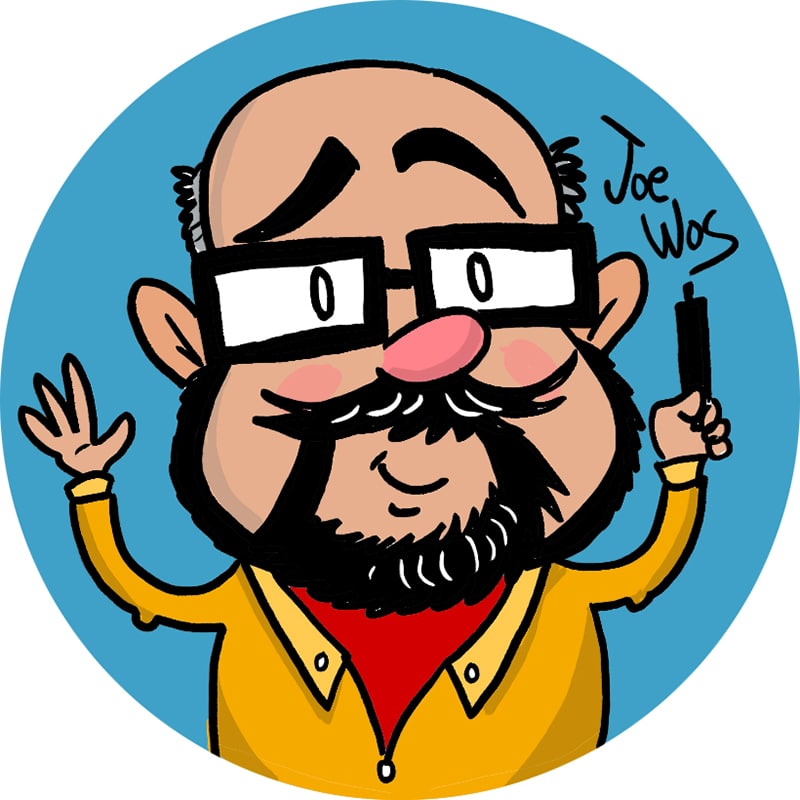
“And Fred Rogers took one look at me, knew nothing about me, and said, you’re an artist, aren’t you? And I said, yes, I’m a cartoonist. He said, well, please keep drawing. I think it’s wonderful that you’re an artist. Fifteen years later, Fred came down to watch my show, so I brought him back. And Fred came to me and said, you know, I loved your work. Your storytelling was very beautiful and the way you interact with the children is so nice. And I said, you know, this isn’t the first time we met. And I met you and you looked at me and said, you. You’re an artist, aren’t you? And Fred Rogers looked at me and said, well, I was right, wasn’t I?”
~ Joe Wos
Joe Wos is the 6-time Emmy Award-winning creator and host of “Cartoon Academy” as seen on PBS affiliates nationwide.
Joe’s been a professional cartoonist since the age of 14. Over the past 35 years, as he’s sought new and innovative ways to pursue his passion for the cartoon arts, his career path has taken as many twists and turns as one of his wonderful mazes. For example, he spent 30 years touring the U.S. as a performer, illustrating stories live as he told them. He founded and ran a cartoon art museum here in Pittsburgh called the Toonseum. He illustrated symphony performances live with the Pittsburgh Symphony Orchestra. And he’s exhibited his art in museums worldwide. Beyond all that, Joe’s been the visiting resident cartoonist of the Charles M. Schulz Museum for over 23 years.
With MazeToons — his unique hybrid illustration that is part cartoon and part puzzle — Joe has fulfilled a lifelong dream to appear in the funny pages.
He’s the author and illustrator of a dozen books, including “A-Maze-Ing Peanuts”, “Mega Maze Challenge,” “Our A-Maze-Ing National Parks,” “A-Maze-Ing America,” “A-Maze-Ing Animals,” “The Exploding Kittens Activity Book,” and many more. Joe’s also the Brand Character Integrity Consultant and artist for Charlie the Tuna of StarKist fame.
Joe won the 2020 Divisional Reuben Award for the Variety Category as presented by the National Cartoonists Society.
For the record, Joe and I have known one another for more than a decade, from his days running the Toonseum here in Pittsburgh.
WEBSITES:
Emmy Award Winning Host of Cartoon Academy on WQED/PBS
Reuben Award-Winning Cartoonist/Author/Master Maze Maker
Creator of MazeToons, Available from King Features Syndicate
JOE’S LATEST BOOKS:
IF YOU LIKE THIS EPISODE, YOU MAY ALSO ENJOY:
- Scott Christian Sava, Artist-Animator-Illustrator – Episode #372
- Tom Ruegger, Animator-Producer-Writer – Episode #369
- Bill Kroyer, Animation Director – Episode #358
- Mark Arnold, Comic Book and Pop Culture Historian – Episode #327
- John Cerney, Muralist – Episode #318
- Tim Quinn, Writer-Editor-Artist-Manager – Episode #231
- Candi Milo, Voiceover Actress-Author – Episode #219
- Mark Simon, The Godfather of Storyboarding – Episode #175
- Jeff Keane, The Family Circus Cartoonist – Episode #161
- Wendy Pini, Creator-Writer-Artist of Elfquest – Episode #1
Steve Cuden: On today’s Story Beat.
Joe Wos: And Fred Rogers took one look at me, knew nothing about me, and said, you’re an artist, aren’t you? And I said, yes, I’m a cartoonist. He said, well, please keep drawing. I think it’s wonderful that you’re an artist. Fifteen years later, Fred came down to watch my show, so I brought him back. And Fred came to me and said, you know, I loved your work. Your storytelling was very beautiful and the way you interact with the children is so nice. And I said, you know, this isn’t the first time we met. And I met you and you looked at me and said, you. You’re an artist, aren’t you? And Fred Rogers looked at me and said, well, I was right, wasn’t I?
Announcer: This is Story Beat with Steve Kewton, a podcast for the creative mind. Story Beat explores how masters of creativity. Develop and produce brilliant works that people everywhere love and admire. So join us as we discover how talented creators find success in the in. The worlds of imagination and entertainment. Here now is your host, Steve Cuden.
Steve Cuden: Thanks for joining us on Story Beat. We’re coming to you from the Steel City, Pittsburgh, Pennsylvania. My guest today, Joe Wos is the six time Emmy award winning creator and host of Cartoon Academy as seen on PBS affiliates nationwide. Joe’s been a professional cartoonist since the age of 14. Over the past 35 years, as he’s sought new and innovative ways to pursue his passion for the cartoon arts, his career path has taken as many twists and turns as one of his wonderful mazes. For example, he spent 30 years touring the US as a performer, illustrating stories live as he told them. He founded and ran a, cartoon art museum here in Pittsburgh called the Toonseum He illustrated symphony performances live with the Pittsburgh Symphony Orchestra, and he’s exhibited his art in museums worldwide. Beyond all that, Joe’s been the visiting resident cartoonist of the Charles M. Schultz museum for over 23 years. With Mazetoons his unique hybrid illustration that is part cartoon and part puzzle, Joe has fulfilled a lifelong dream to appear in the funny pages. He’s the author and illustrator of a dozen books, including Amazing Peanuts Mega Maze Challenge, Our Amazing National Parks, Amazing America, Amazing Animals, the Exploding Kittens Activity Book, and many more. Joe’s also the brand, character, integrity, consultant and artist for Charlie the Tuna of Starkist fame. Joe won the 2020 Divisional Rubin Award for the variety category as presented by the National Cartoonist Society. For the record, Joe and I have known one another for more than a decade. From his days running the Toonceum here in Pittsburgh. So for all those reasons and many more, I’m truly delighted to have the prolific cartoonist Joe Wos join me on Story Beat today. Joe, welcome to the show.
Joe Wos: Thanks so much for having me. What a delight to be here.
Steve Cuden: Well, it’s a great pleasure and privilege to have you here. So let’s go back in time a little bit. How old were you when you first noticed drawings and cartoons?
Joe Wos: I was four years old. my parents got me drawing on the walls with a crayon. And, they didn’t yell, they didn’t scream, they taped paper up on the walls and said, go ahead. And I have been drawing ever since.
Steve Cuden: Wow. So they gave you the means to do it and they let you go.
Joe Wos: Yeah. And it’s an important thing because I say there’s only a couple things you need to be a really successful cartoonist, when you’re starting out young. the first is something to draw on. It can be paper, cardboard, a computer, whatever, something to draw with, again, markers, crayons, a stylus, an imagination that inspires you to create. But one of the most important things is encouragement. Friends, fans, parents, teachers, someone who says, hey, you’re pretty good at this. Keep it up. I think that’s so important and it’s probably one of the most overlooked, things that we need.
Steve Cuden: I certainly think that’s important for all artists of all kinds that, that they have some encouragement. And I think it’s very damaging sometimes when they receive little or none as a young person, they have to be very self disciplined to get to that next step.
Joe Wos: Yeah. Although, I will say that sometimes I’ve noticed that I’ve succeeded not in spite of people, but to spite people. all those teachers who said, you know, what are you thinking? I do make a living drawing your little doodles, stuff like that. So there is something to be said for, a little bit of pushback now and then to really just light that fire.
Steve Cuden: Well, of interest, I mean, you probably remember that I have written 90 cartoons for, you know, animation. But it’s your art, your form of art. Cartooning and what I wrote. Many people think it’s silly or not adult or why are you bothering with that? Why aren’t you doing something serious? But it is, isn’t it?
Joe Wos: It is a silly business that we’re in. But at the same time, you know, cartoons, almost across the board were created for an adult audience.
Steve Cuden: Yes, that’s true.
Joe Wos: The comic strips were created so that, people would read the back pages where the advertisements were Exactly. Kids reading those were the grown ups animation. You look at the early Betty Boop cartoons and Popeye cartoons, it is clear they were made for adults. The only reason they became for kids is because, you know, in the 1950s, all those cartoons were just sitting in a warehouse somewhere. Saturday mornings were just a dead zone. There was nothing on television. And they realized they could buy up these cartoons real cheap, hire a literal clown to come out and say, hey, hey, kids, here’s another Popeye cartoon. And Saturday mornings were born. And that’s where you get that even stronger association with kids.
Steve Cuden: Walt definitely made cartoons for kids. Animation for kids.
Joe Wos: He did, but he didn’t consider that. He viewed it as he was making cartoons for everybody.
Steve Cuden: An art form. It was his art form.
Joe Wos: Yeah, he was making an art form that was for adults and kids and it was just for everybody. So a lot of times they don’t go into it saying, okay, I’m creating something for kids. They say, I’m going to create something for everybody. And when you do that, it gets that dreaded letter G in the rating, which is so strongly associated with children that we forget that that G means general. It’s for everybody.
Steve Cuden: Exactly. And it is. It becomes associated one way or another psychologically for an audience to overcome whether they want to go see something or not. Most adults think to themselves, I don’t want to see something that’s a cartoon. I want to see something that’s live action and full of violence. Which, by the way, can very much be part of cartooning.
Joe Wos: Absolutely. Cartoons have a rich tradition of violence.
Steve Cuden: Indeed they do. So who were your influences way back when? Who did you, as a kid, as you were drawing and drawing, who did you look at and think to yourself, wow, that’s really great. I want to be like them?
Joe Wos: It was Charles M. Schultz. Charles M. Schultz, creator of Peanuts. Snoopy. That was my hero. Probably among the very first things I ever drew were Snoopy and the Gang. that was number one. he was first and foremost in my heart, in my mind and in my work, my biggest influence. But then as I got a little older, I discovered Sergio Aragones from MAD magazine, another big influence. Goodness. Just so many. Chuck Jones. Ah, working Looney Tunes. And then as I got even older, I was still learning and discovered, Walt Kelly, and Pogo and Crockett, Johnson and Barnaby. And, you know what happens with style is you end up with so many different influences that at some point you reach a point where all those little pieces become you and become your style. And you could look at my work, and you stare at it, and stare at. You go, I don’t see anything that looks remotely like any of the people he’s mentioned. Like, that’s what happens. Your style evolves because you’re taking a piece here, piece there, and it becomes something new.
Steve Cuden: Well, and you come through. Your voice, your arm, your brain, you’re creating something, and suddenly it’s yours, not someone else’s. How long do you think it took in your life before you had that style that was uniquely you?
Joe Wos: You know, I probably, by the time I was about 11, I had a style that was developing that was uniquely me. Now it changes. I have a style that’s evolved over the past couple years that is a direct result of when I taught my kids to draw. And I was very hands off because I wanted them to have their own style. I didn’t want them to be under Dad’s shadow. But what I would do is I would try and learn to draw in their style. So that if they said to me, you know, hey, dad, how do I draw, hippopotamus? I would draw it in their style, not my own. That influenced me. And now I have a style that I’ll use that is, strongly influenced by my, daughter Lyda’s work. You never stop developing and growing and changing. But you can look at my stuff and you’ll know that’s Joe Woes.
Steve Cuden: You’re absolutely right. I know when I see something and I know it’s yours, it’s not someone else’s, it’s yours. you can tell it has a very distinct look to it. Plus, you’re a very colorful cartoonist. It has a certain brand of color to it.
Joe Wos: Yes, I definitely am sort of that vibrant school that I. That I like.
Steve Cuden: No question.
Joe Wos: I like bold colors. I like, I like the light of cartooning. Nothing wrong with the stuff that’s darker. You know, the Batmans and, you know, some of the darker comic book stuff that’s out there. I enjoy that stuff. But, you know, I want to put something out in the world that makes people smile. They look at the drawing, it makes them feel like, oh, that’s cute. I like that.
Steve Cuden: There’s no question your work is not pastels. It’s not cleverly shaded. It’s bright, bold, very cartoony. But it’s very much you, for sure. So why. Obviously, as a kid, it was something that brought you to it. But why cartooning? Why didn’t you eventually turn into a fine artist or A sculptor or something else like that. Why cartoons?
Joe Wos: I easily could have. I mean, I did, you know, do a lot of sketching and stuff, and it bored me out of my mind. I find, you know, love the work that people produce in fine art. for me to look at a tree, draw the tree, exactly what I see, capture on paper is beautiful to look at. To me, the process of that is just boring. for me, again, I want to be very clear. This is just my opinion. Cartooning, does two very contrary things. It simplifies and it exaggerates. So it simplifies all that line and shadow and texture into just very simple line work and shapes. And yet it exaggerates the features and the concepts and the personalities and makes it much bigger. So the very opposite things, very polar opposites. but cartooning, to me, the appeal was that ability to create again. I can look at a tree, I can see a tree. I draw the tree. Great. Done. cartooning, I’m creating something that doesn’t exist. I’m bringing something into this world, and I think I got a real thrill out of that.
Steve Cuden: And I’ll take it a step further for you. It’s fun.
Joe Wos: It is. It is just fun to see lines fall a certain way. And you go, ah. Ah. There. That. I captured it. It’s right. I’ll give you an example. I’m doing these very simple, drawings that are. You know, the term would be caricature, but in. Honestly, my style is more cartoony than caricature style.
Steve Cuden: Sure. Absolutely.
Joe Wos: So they’re cartoon. My style. And I did this one of Larry David, curb your enthusiasm and is simple lines. So simple. And it’s one, eyebrow raised, the other one just cocked slightly, and then the turn of the mouth downward. It is a simple line. And I probably did it four or five times before I went. That’s the expression. That’s the perfect expression. That line, the way it fell just right. Sometimes it’s an accident. But that’s what I love about cartooning. When you look at something go, ah. yes. That line right there is the finishing touch. That completes the character. That’s what was missing. That is what brings it to life.
Steve Cuden: What do you think? Is it in your mind, in your brain, that enables you to look at a person or a landscape or whatever and see it in simple lines? What do you think that translation is?
Joe Wos: You know, I actually think, for me, you know, I grew up, dyslexic. The concept of, like, the letters on a page backwards you know, they’d flip around. And the breakthrough was a teacher who said, hey, you love to draw. Draw your words. So if I learned a word like cat, I would take those letters and turn them into a drawing.
Steve Cuden: So you could see the shape of the letters in what you were looking at?
Joe Wos: Yes. So I see. So I stopped seeing letters as letters and started seeing them as shapes and images.
Steve Cuden: Interesting.
Joe Wos: And it was sort of this breakthrough for me of like, oh, just forget that it’s a shape. It’s just a line. And drawing is a lot like writing. Okay. You have a line, and then you put this next line, and then the next line, and then you put it all together. You get a word. Okay, so cat is a word. Well, for me, it’s for drawing a cat. It’s a letter A. It’s, an O for the I’s another O. An upside down letter T for the mouth. And you put that all together and there’s a draw.
Steve Cuden: That’s great.
Joe Wos: So my teaching method, when I teach you to draw, is always to learn how that learning how to draw isn’t actually learning how to draw. It’s learning how to see. It’s learning how to see the world around you by seeing the shapes, by converting the shadows into line. So I think that’s one of the big things for me is that. That I see those shapes everywhere. And then sometimes, you know, a lot of times, too, it’s also trying. It’s being able to interpret your own imagination of saying, okay, what shape would work for this and work for that and then, just building it. But it’s all very automatic.
Steve Cuden: But you’ve explained for me why, when I’ve watched a few of your Cartoon Academy shows, your episodes that you explain in the drawing of things. This is like A. You say, this is like a B. This is like a C. This is like an A. You actually say it that way. And I thought. I thought that was something that you created just for the show. But in fact, it’s what you’ve done your whole life.
Joe Wos: It’s. It’s. It’s my internal process. And I realize it. It works so well because it makes drawing less intimidating. You know, there are lots of terms and drawings for all these specific shapes. Everything else, it’s like, that looks like a letter C. well, let’s just call it that. You know, that looks like that’s a circle. That’s easy. But rather than, say, an oval, it’s a letter O shape. And what it does is it really, you know, Kids and adults, because I get a lot of adult audience too. They, generally speaking, can learn or have already learned to read and write and have forgotten how difficult it was then. Now it’s as easy as abc. And so you can tap into that idea of as easy as ABC and say, okay, it’s the same concept. We’re just going to position these letters a little bit differently. We’re going to stretch them and flatten them and twist them and turn them until we get the shape we’re looking for. It’s much more accessible when you break it down that way.
Steve Cuden: Well, yeah, obviously it’s really accessible when you break it down that way. Because the other part of that, that’s comparable to writing in a sense. When you think of I want to write an entire book or a feature length screenplay, if you think you’ve got to write the whole thing as one, it’s daunting. But if you can think about breaking it up into little scenes or little bits, then it’s a lot easier to conceive. What you’re talking about is instead of looking at an image and thinking, I have to draw that whole thing. No, you’ve broken it into little component parts that are very easy to understand.
Joe Wos: Yeah, I mean, every drawing tells a story. There’s a beginning, a middle and an end. And it’s at the end, where the full character is revealed in all its emotion, its personality, its characteristics and as well as its physical appearance. But there’s a process to it, step by step.
Steve Cuden: Do you think of yourself as a storyteller?
Joe Wos: Oh, yes, I actually, you know, I probably first and foremost a storyteller. I’m a visual storyteller. All cartoonists are. But I’m also a literal storyteller. I do on stage draw stories as I tell them. and I do write stories as well. But, but yeah, I think cartooning is in fact visual storytelling.
Steve Cuden: How do you bring emotion into a cartoon drawing? How does that work?
Joe Wos: I’ve really simplified it. It’s this wonderful secret power that everybody has, but the cartoonists are really adept at tapping into it is called empathy. and empathy is really the ability to read someone else’s emotions. And our empathy often relies on visual, cues, primarily in the face, the eyebrows, the eyes and the mouth. Now, there are other things that can be involved in emotions. You know, your nostrils can flare, but if you think about it, those eyebrows, when they pull in tightly and close, you know, you get an anger, but you can change that up. It’s really, you know, if you have the eyebrows raised, that appears. Surprise. But the mouth has to be open, too. Okay? So each of them, they work together to convey a certain emotion, convey how a person feels. The eyes, eyebrows, and mouth are the main ways, but it’s also, you know, physical mannerisms. The way a character is standing, the way their hands. It’s just like how we observe people. but we’re doing it through, you know, the line work on the page.
Steve Cuden: But you’ve got to, as you say, you’ve got to have some empathy. I think not everyone that I’ve met in my life I would call an empathetic person. and there are people that don’t have that empathy. And I think that they would probably have a hard time doing what you’re talking about.
Joe Wos: They would have a hard time doing it. but they actually don’t have as hard a time reading it as one might think. Because I’m simplifying it. There’s no. There’s not a lot of nuance. you know, the expressions are bold. But sometimes, you know, I mentioned that drawing of Larry David, you know, that is a bit nuanced, but it relies on the viewer knowing who this character is and picking up on a very specific attitude or emotion. And when they see that eyebrow raised and the corner of the mouth curled, they go, oh. Oh. That’s a very distinct. Eh. That’s the. That if there was a sound that went with it, the sound would be, eh.
Steve Cuden: You’re able to imitate Larry David on top of drawing him.
Joe Wos: You know, it’s funny. I think a lot of cartoonists also do impressions as well.
Steve Cuden: Probably. right.
Joe Wos: We’re trying to convey so much, in these drawings, and so we come up with ways to do it just, you know, through those.
Steve Cuden: Do you find yourself physically doing things so that you can get a feeling of what it should look like on the page?
Joe Wos: I don’t as much. I used to use a lot of reference material. I would look up a photo of someone playing tennis, and I still have to sometimes do that kind of stuff. What I do find myself doing a lot, though, my emotion will take on whatever emotion I’m drawing. So, my kids would come in the room and go, what are you mad about? I’m like, what? I’m not mad. And then I’d look at the character like, oh, okay, I’m drawing a dragon. So the dragon’s mad, but I’m not. But, you take on the emotion of your characters and your characters take on Your personal emotion as well.
Steve Cuden: So you’re feeling what you’re drawing and drawing what you’re feeling.
Joe Wos: Yes, yeah, yeah, you definitely are. And it’s wonderfully beneficial. You know, I will tell people, you know, if you’re feeling sad, there are two things you can do. One, you can draw that out so that you can sort of, why am I feeling sad? And you draw it out and you sort of think about that. You begin to think about the emotion a bit more. But you can also go, I’m feeling sad. I’m going to draw a character who’s happy. And you cannot help but smile. If you draw a smile, it’ll lift your mood. and if you look at a drawing of a smile, it’ll lift your mood. And it’s really simple because, you know, that magical sort of Morris code is the same thing, only it’s a drawing. If you do two dots, dot, dot, and underneath it a dash, and then above those dots, two dashes separated, that’s a face. And however you manipulate those lines and dots, you change the emotion drastically. But it’s really that simple. Dots and dashes is all it is. And, and you can still read that emotion.
Steve Cuden: That’s quite brilliant that you’ve, brought it all the way down to the essence of what it is.
Joe Wos: Yeah, it’s, you know, that’s what cartoons, you know, we’re distilling things down and down and down. And it can get, you know, there’s a broad. Cartoonist styles are just so broad. Of course, you know, you have someone like Frank Frazetta who did beautiful, you know, renderings that are just so detailed, or Thomas Nast with all the cross hatching. But then you have Charles Schulz on the other side. Very, very simplistic line art. But the emotion he can convey with just a couple dots and lines. It’s unbelievable.
Steve Cuden: It is unbelievable. And you’re correct. I mean, the variation on the abilities of various cartoons and cartoonists is as infinite as there are stars in the heaven. and yet every one of them is able, if they’re any good, to convey something to us.
Joe Wos: Yeah, it’s something within us all that we want to see faces everywhere. When we look at an electrical outlet, we see the two eyes and the nose. When they designed the car, they gave it two headlights and a bumper for a reason so it could smile at you. New technology. We try and think, well, how can we give it a face? How can we humanize it? It’s a very comforting experience for us. It tells us you know, even when we are alone in this world, we’re really not alone. There’s someone behind all these creations. And in each creation, each thing, there’s an element of humanity. You know, even, you know, you look at a tree, you’ll still try and look for. Are those arms? Are those, you know, where are the eyes? Is that. Are the leaves? It’s hair. We want to humanize everything, and I think that’s a very comforting thing for us.
Steve Cuden: Well, if you look at most, if not all, animation that’s been successful in some way, way, no matter what’s in that animation, everything has been anthropomorphized in some way to make it human. Like.
Joe Wos: Yes. Yeah. I mean, that’s. That’s one of the big keys in cartooning is that we do anthropomorphized things. That’s. That’s, you know, our role is to bring things to life.
Steve Cuden: So I think the hardest form of storytelling of all is the short story. And the shorter, the harder. And what you’re doing with a single panel or a single drawing or a single maze, and we’re going to talk about mazes here in a moment. just one single panel, I think that’s the most difficult to master. Why is that? What is so hard about that? Why is it difficult to do?
Joe Wos: Well, one of the reasons it’s difficult to do well is you’re drawing, you know, this single panel, and you have to at least be thinking of your audience that is going to read this six months from now or whatever, or if it’s a book, a year, two years from now. And how are you leading their eye to tell the narrative? Because you only have one panel to do it.
Steve Cuden: Right?
Joe Wos: So the, example, I give of I do a drawing where I draw a porcupine and then I have a cactus. That’s it. Okay. But that tells an entire story because the porcupine, we know he has quills, so we know he doesn’t have a lot of friends, so we know he’s a lonely porcupine. Okay, we know this. All right. All right. He’s standing on what looks like sand. So he’s left his home in the woods and he’s went wandering out somewhere. Where has he wandered? Well, there’s a prop. There’s a cactus there. So we know he’s wandered out into the desert. Well, when does this take place? Well, the sun is in the sky, so we know it’s daytime, so we know when it is, we know where it is. But what’s he looking for? Well, he’s looking for a friend, obviously. How are we going to give him a friend? Do we add another character? No, all we need to add is a symbol. If I had a heart between the cactus and the porcupine, then the porcupine and the cactus have found a common bond. They’re both prickly, they fall in love and they live happily ever after in a cartoon. That’s one drawing. Now, I told all that and it took a little bit of time for me to tell it all and lay out each of the things. But in the second that someone views that drawing, they look at the porcupine drawn on the left hand side, especially Western, art. So drawn to that left hand side, then they see the heart, then they see the cactus and all those connections. That entire story, they came up with it. Now, I led them a little bit, but it’s really a shared experience. They relate to the idea of, oh, a lonely character, another lonely character. They find love. It’s something we all can identify with, understand? And I use symbolism and I use these visual cues to inform the audience and then let them. Really, they’re the ones telling the story, not me.
Steve Cuden: Me being the cynical, writer that I am, I would see that drawing and my brain would then go to, oh, that poor porcupine who’s fallen in love with a pineapple in the middle of some desert. That love’s not going to last very long.
Joe Wos: Yes, well, that’s the thing is, when you think about comic strips, in particular, you have four panels. That is not a lot of room to tell a story. The real story takes place in the white space in between. It’s called the gutter. That’s where the story pauses and the audience’s imagination fills in everything else. So when I’m performing on stage, at a school, if you ask the kids afterwards, you know, a single story might be seven minutes, it might only be six drawings. Okay, maybe, maybe, maybe a little more, maybe a little less. But if you ask the kids, how many drawings did he draw in that story? You have kids, say, 25, 30. Because their brains are filling in all the, all those other drawings and the action that’s happening, how interesting.
Steve Cuden: They’re filling it all in.
Joe Wos: You have to trust your audience. You know, the toughest decision an artist makes is not what to draw. That’s easy. I can, you know, if I want to draw a scene, I can draw the whole thing. I could draw the cactus and the porcupine falling in love and what happens Afterwards. And that all that I could draw that. But the real magic to it, the real power to it is deciding what not to draw. What do you leave for the audience to imagine? And that’s the toughest decision an artist makes, because every artist has had the point where they’ve gone. That is one line too many.
Steve Cuden: Charles Schulz was really good at the four panel cartoon, obviously.
Joe Wos: Yes.
Steve Cuden: But he also did single panel cartoons sometimes.
Joe Wos: Yeah, he could do single panel and he could do the Sundays, which could be, you know, 12 panels. Yeah, he was just, he was a masterful storyteller.
Steve Cuden: So I’ve also had on this podcast, Jeff Keane, who’s Bill Keene signed Jeff has taken over the Family Circus. And that’s all. That’s years and years and years of single panels. And so that’s got to be something difficult to master. That single panel. Constant, constant, constant churn.
Joe Wos: So when I first decided that I was going to really pursue syndication, to appear in the funny pages, I thought about, okay, a comic strip, a single panel, and I want to do something different. I thought, boy, you know what? I don’t know if I can handle that pressure of having to be funny every day for the rest of my life. I don’t know if I can handle the rejection. I don’t know that I can handle the pressure. It seemed so daunting. So I decided I would do cartoon illustrated mazes because it was unique, it was something I was good at and that no one else did. But I don’t have a cast of characters I can fall back on.
Steve Cuden: No, no, that’s right. Correct.
Joe Wos: Every day something different, and it’s over 10 years now. So that’s 3,650 different mazes.
Steve Cuden: Okay, so let’s talk about mazes then, which it’s fascinating to me for the three people on the earth that don’t know what a maze is, tell us what a maze is.
Joe Wos: So, a maze. A maze is a puzzle which has a start and a finish and then multiple paths leading as the solution. And there are twists and turns and dead ends and, sometimes optical illusions and just convolutions, I call them things that just make it convoluted and misdirect you to try and make it more challenging. Mine have illustrations that you actually go through. And what makes them so difficult is the human eye, especially for adults. If I draw a circle, but there’s a tiny gap in that circle, you’ll still say it’s a circle. You won’t say it’s A circle with a gap.
Steve Cuden: But a kid. A kid will see the gap.
Joe Wos: A kid will see the gap. As we get older, we have this habit of wanting to see things as completed. So a lot of times people are going through and there’ll be a very obvious gap in a, a squirrel’s tail that you have to go through. And they’ll sit there and they’ll pass it. Like, how do you go through this? How do you go through this? Especially if it’s in color? Because we’ll see color. Adjacent colors we’ll see as a line. So even if it’s not a black line, if we see a yellow right up against a light blue, we’ll perceive that as a line.
Steve Cuden: Hm.
Joe Wos: And so it makes it even more challenging to go, oh, no, wait a minute, I can go right through that. So. So you have to be able to see in a certain way.
Steve Cuden: All right, so what are the major principles that you’ve Learned toward creating 3,000 plus mazes? How do you begin and how do you proceed?
Joe Wos: It sounds so obvious. You start at the start and you finish at the end. That’s too easy. I do not have any plotted path. I do not do a rough sketch. I just sit down and I draw it.
Steve Cuden: But you don’t know where you’re going to start?
Joe Wos: I don’t. I mean, I will put on the page like a little circle with a letter S in it. And that’s going to be. My sort is. But I might decide, you know, no way I want it over here. I don’t know what decides that. I, Usually I think one of the factors is I’m very careful not to repeat myself, because once you get locked into patterns and the mazes become very easy. So I try and make sure I mix things up, or where I’m placing the start, the finish, and so forth. But I start drawing the start, and then I’ll start with a little bit of the path, usually breaking that off into another path. And then what I have is called my. My true path, which is the path that I keep breaking off more paths as I’m going, right? And then those paths split off and, you know, it’s this constant tree branching out. But then I have an illustration integrated, and, you know, you might be going through. I’ll use the squirrel again through its tail and then up through its arm and then out. But then you’re going through more path. Then you come back and you go through its ear and then out the other ear and working your way to the Finish. But that’s really it. It is. It’s. It’s start to finish. And as I’m thinking, I’m like, okay, how difficult do I want this maze to be? You know, how complicated? What do I want the line patterns to look like? What do I want the line texture to look like? So there’s a lot of just automatic thought process that is happening, internally, but I really just sit down and start drawing.
Steve Cuden: So how much of it is actual architecture and how much of it is pure whimsy?
Joe Wos: There have been. I’ve had people who are mathematicians and scientists and so forth have said, oh, my God, you must have such a mathematical mind. And I go, no, absolutely not. I am the exact opposite. I have no aptitude for math or engineering or anything else. It just happens. It’s the, You know, there’s a reason they call them magic markers, because there’s just a magic in them. I mean, there. And I. And I try not to overanalyze it too m much. I just let that process happen.
Steve Cuden: Do you feel like the ideas then? I’m going to be careful how I say this come through you. You’re not actually creating them. It’s being fed through you from somewhere else.
Joe Wos: You know, I’ve struggled with that question. It then brings an even bigger question, which you allude to, in a sense, I think that if it’s coming from somewhere, where’s it coming from?
Steve Cuden: Well, I’ve spoken to hundreds of creative people on this show, and I’ve also done a lot of studying of creativity and the creative process. And I’m also a creative person myself. And a huge number of very famous, successful creative people will not take credit for what they’re doing. They will say, no, I’m just a conduit. It’s coming through me.
Joe Wos: I absolutely take credit for every last bit of it.
Steve Cuden: Good for you.
Joe Wos: 50 years of doing this. I’m taking credit now. And that’s important to me, though, because I actually, when you watch the show, I end every drawing by saying the same thing. Sign your name. Take pride in your work. I get so frustrated by teachers who make kids sign the back of their drawing so that it’s hidden, you know, when it goes up on a wall or refrigerator. That’s ridiculous. This kid poured a lot of effort into this. They should be proud of this. Sign your name. So I’m not inclined to say that I’m a conduit necessary. I will say that I am trying to tap into a sort of universal consciousness that we all have the shared experiences. because the fact of a cartoon is a cartoon cat does not look like a real cat. And yet it universally is recognizable as a cat. Snoopy is probably one of the most recognized works of art in the world. It’s more recognized in more parts of the world than the Mona Lisa and is universally recognized as a dog. Snoopy is not a dog. He is a cartoon of a dog. Bugs Bunny looks nothing, like a rat. Mickey Mouse looks very little like a mouse, but is universally a mouse because there are certain aspects of the idea, mouse, or the idea rabbit or the idea cat, this philosophical idea of what is the embodiment of the idea version of that entity, that a rabbit has long ears. Are there short eared rabbits? Of course there are. Sure there are. But a rabbit has long ears, a rabbit has whiskers, a rabbit has buck teeth. Now what happens if I draw a, a, rabbit with short ears and whiskers? Well, it’s not a rabbit, it’s a cat. It’s the same base, it’s the same head shape, it’s the same eyes or so forth. But by, you know, stretching out the ears, it then becomes a rabbit. You know, if I round off the ears and change the body and bring those buck teeth bath, that, that cat now becomes, you know, a squirrel or a chipmunk.
Steve Cuden: And your squirrel that has a bushy tail is really a rodent of some kind with a bushy tail.
Joe Wos: Yeah. But what you’re trying to do is tap into that. What are the universal things we accept as the perfect embodiment of that being or object? You know, what makes a teapot a teapot? It is not simply a receptacle that holds tea, because, then a jar would be a teapot. no, there are elements to a teapot that make it a teapot. There’s the handle, there’s the spout, there’s the lid. All those things I need for it to look like and be accepted as a teapot. So there’s a visual shorthand we use as cartoonists. We use a lot of symbolism and stuff, but I have to make sure it’s universally accepted. And what’s interesting about that to me is cartoons have kept alive ideas that have long since passed. If you watch a cartoon doctor, one of the symbols we’ll use to show it’s a doctor is a little silver plate on top of their head. Now, if you ask somebody under the age of probably 40, why do they wear that? They will say, because they’re a Doctor, I said, well, doctors don’t wear those anymore, do they? No. Why not? It was to reflect light. Well, they don’t need that anymore. They have flashlights and all these other lights, and so I don’t need that. A telephone. You have an image of a telephone that probably matches my image of a.
Steve Cuden: Telephone with a rotary dial.
Joe Wos: It does not match a five year old’s image of a telephone.
Steve Cuden: Of course not.
Joe Wos: but that is more universal that because of the cartoons. We, we’re still using that telephone in our cartoons. And I think part of it is the fear is that little rectangle that people are holding up their ears, up to their ears. 10 years from now, 20 years from now, who knows? That may not be readable as a telephone at all. What is that going to be 20 years from now?
Steve Cuden: A telephone may just be something that sits in your ear or it may be implanted into your head. It could be, totally different. Exactly.
Joe Wos: But we need those universal images to communicate. It’s. You know, the wonderful thing about art is drawing in particular, is that it’s probably. No, I’ll actually say it is. It is the most lasting and universal form of communication. I can look at a cave painting of a horse from 20,000 years ago, and I know that is a horse.
Steve Cuden: Sure.
Joe Wos: And then I see behind it people with spears. I go, this is a story that they’re telling me about a hunting trip they went on. 20,000 years have passed. There’s no words, there’s no video, there’s nothing else. But I know that story.
Steve Cuden: And then you as a cartoonist, you in particular, Joe Woese, you then take that image, that symbol, and exaggerate it in some way that gives it a whimsical life.
Joe Wos: Yeah, I exaggerate. Like all cartoons, I exaggerate the key elements first and make it what it is. But then I’ll exaggerate other elements, to fit my particular style.
Steve Cuden: What do you draw with? With a pencil, a pen. Do you work on a computer? What’s your medium?
Joe Wos: Primarily now, I work on a Wacom Cintiq tablet. it is this massive, beautiful machine from Wacom who makes the finest digital drawing tablets in the world. And I absolutely love it. I use that primarily for most of my work that’s going to be for productions. So if it’s for syndication or for, you know, books, or whatever. For my show, I draw on paper and I use a permanent marker, because it shows up nice and bold and it’s an accessible tool kids have and adults have access to paper. They don’t have access to a, you know, $5,000 digital tablet or whatever. So keeping accessible, if I’m at a convention and I’m drawing, I’ll draw on paper and pen. I still draw on paper and pen. I very rarely use pencil.
Steve Cuden: So you don’t sketch it in pencil and then overdo it with ink, of some kind?
Joe Wos: No. And that happened because I’m left handed. when I was a kid, I would draw on pencil and I would smudge so bad that I very early on switched to permanent ink. And as a result, I don’t make a lot of mistakes. And when I do, I can set them aside and I can see where I made the mistake and start over. Now, if I’m working digitally, I’ll sometimes do an underlying drawing, that’s a little more loose and rough and then go over that. The problem is I always like that drawing more and I can never recapture it if I’m going over it. So a lot of times I’ll just go back to that original drawing.
Steve Cuden: So we’ve talked about color. I assume you also color your own work.
Joe Wos: I do. And I hated coloring. Hated coloring my entire life.
Steve Cuden: Why?
Joe Wos: I’m not entirely sure. I think there’s a couple reasons. One, I’m not very good at coloring in traditional tools. I’m not very good at painting. I’m not very good at just coloring in the lines, and I’m just not very good at it using traditional tools. That’s the first reason. Second reason is I really did like, for a lot of years, just the way my work looked in black and white. And I think the third reason is although I’m prolific, I’m intrinsically lazy. And I’ve done the drawing already. Maybe I had to do it twice because I had to, do a rough. Now I get to sit there and stare at it for another 40 minutes while I color it. I can draw something in 30 seconds and be done. And it’s great. When I gotta color it, that’s another 15 to 20 minutes of just time with that drawing.
Steve Cuden: You’re forever gonna be known to me now as the prolific lazy artist.
Joe Wos: I am a very prolific lazy artist. I do a lot of work. I work very, very fast. But, you know, I enjoy drawing. I enjoy looking at, I enjoy the way my work looks in color a lot. And there have been various breakthroughs that I’ve had in that process over the past couple decades that have made it better for me. But I don’t enjoy the process as much as I do the process of drawing.
Steve Cuden: But in the computer, it’s a lot easier.
Joe Wos: Yes, in a computer, it’s a lot easier because I’ll work in layers, so I have a separate layer for my shadows. And that has made my work. My work is very flat, intentionally so. But when I add those shadows, it just adds just a little bit of interesting depth to it. Even though it’s a very flat work and the characters are drawn, it’s this way. They’re flat. It adds some interesting depth to it, and I really like the way that looks. Color is probably the one thing I struggle with the most because especially if I’m drawing a person, I want to get a skin tone just right. And it’s just so delicate and hard to do. And getting the color in the cheeks just right and it’s. I’ve gotten better at it. I just don’t enjoy it as much as I probably m as much as I’m sure a lot of people do.
Steve Cuden: Well, I have many friends in the comic books world, and traditionally, there have been various disciplines within that form. And so you’d have someone who would be the quote, unquote anchor. You’d have someone who was the colorist, and they would. They would be specialists in that. But you’re doing the whole thing yourself.
Joe Wos: Yeah, I’m doing the whole thing, yeah. Because I letter to stuff, I ink it, I pencil it, you know pencil it, I do a sketch and then, you know, and then I do the color. So I am doing the whole process. And people have said to me, like, why don’t you get someone, to color? Well, one, I don’t make enough in syndication to. To hire a colorist. And two, especially with the mazes, that color, again, is so important that if you misalign two colors, it’s going to register as a line and it’s going to throw the whole maze off. So I have the eye for it, so I kind of have to do it.
Steve Cuden: So you never blend, two colors together to make a blend, it’s got to have a definition to it.
Joe Wos: It’s got to have a definition to it. I do not do gradients. I don’t do gradients. you know, again, although that’s very easy in Photoshop, I just don’t do them because I don’t like the way my work looks like that. I like just sort of flat colors with a layer of some highlights and shadows, and that’s really it.
Steve Cuden: All right, so you’ve already said that you sit down, you draw a circle with an S in it, and you start to figure things out. So you don’t, go around in life and say, oh, there’s an idea for a maze. And, like that. It’s just happening for you every day as you’re making new ones.
Joe Wos: The drawing part is just sort of just happens.
Steve Cuden: So where do you get your ideas? From everywhere.
Joe Wos: I learned very quickly because, again, coming back to the fact that I didn’t have a cast of characters and I was at the draw something different every day that I was gonna need to find constant inspiration. Now, there are a couple places. One, I will do mazes based on the National Day. So if it’s National Dance Like a Chicken Day, I can draw a dancing chicken in that maze. Again, I gotta be careful not to repeat. So that’s finite, but I’ll use that a lot. If it’s, the hundredth anniversary of the sinking of the Lusitania, maybe I’ll work that into a maze. there are things like that. I’ll look around the room, and I’ll go, oh, especially my apartment, because my apartment is just covered floor to ceiling. And just interesting, bizarre artifacts like, you know, African mask and a, stuffed bobcat and toys. And it’s just hundreds of things on the wall. So I’ll find inspiration there. I may just be walking through here in Oakland, just outside of Pittsburgh, and I’ll wander over to the museum. I might find some ideas. There might be something I find along the sidewalk. I also see images everywhere. So if I look at a grain of wood, I see the images sort of popping out of that wood. If I look at the walls and paint, patterns, I’ll pick up stuff out of the pattern. So the inspiration is all around me. The music I listen to, the things I see, smells, taste. All of our senses serve to inspire us. and so that’s. I just let it happen.
Steve Cuden: And how do you keep track? If you’re out in the world and you’re walking around Oakland and you see something, do you have a notepad with you? Do you talk into your phone? Is it just your memory, or how do you remember things?
Joe Wos: It used to be just my memory. But the problem with that is, when I get an idea, if I can’t sit down and draw that idea right now, I’m going to get so frustrated. So I now have a pattern where I go, okay, I will give myself a voice memo on my phone. And then when I’m at the desk, I’LL just play all those memos and go. Okay, yeah, that’s a good idea. No, what was I thinking?
Steve Cuden: So you’re recording your ideas vocally, audio wise, into a phone.
Joe Wos: Yes.
Steve Cuden: And that preserves it for you. You’re not walking around with a notepad and drawing?
Joe Wos: No. Because of that frustration, if I start drawing it, I want to get to the finished product. I want to sit down and draw it. I don’t want to have, like a rough sketch that I’m going to come back to later. I want to do it.
Steve Cuden: I mean, that’s, very interesting. I think that’s something that the listeners should pay attention to. There are multiple ways to record your.
Joe Wos: Thoughts that may just be a result of bipolar disorder or something, or ADHD or who knows? But it is definitely, that need to create. Once I’ve sat down to create and not pull myself away from it. I, I am a, very gentile. Jovial, or excuse me, gentile. I am that too, although you wouldn’t necessarily know, but a very gentle and jovial, kind and generous person. If you interrupt me when I’m drawing, I’m just gonna be. It’s like those people who don’t have their morning coffee. I’m just gonna be a little bit more on edge.
Steve Cuden: You’re gonna chew their arm off. Yeah.
Joe Wos: My drawing time is as sacred to me as Saturday mornings were when I was a kid.
Steve Cuden: Is there a typical length of time it takes you once you start?
Joe Wos: I draw very, very. I’m very fast as a result of my only drawing and marker my whole life and, and learning how to cope with mistakes and learning what goes on a page, stays on a page. That’s it, I’m done. I don’t do a lot of racing stuff. I can work very fast. So I can draw a daily maze anywhere from five to 15 minutes.
Steve Cuden: Wow.
Joe Wos: Start to finish.
Steve Cuden: Wow, that’s fast.
Joe Wos: Sunday start to finish takes me about an hour, sometimes as much as two hours. I’m hoping right now my syndicate is not listening to this because they’re going to go then. Why do you turn in everything so late, Joe? because the reason I do turn everything is late is while I love the draw, I do have to sort of create an environment and a state of mind and a mood to sit down and go, this is my drawing day. I can crank out a whole month’s worth of work in about a week. so long as I’ve carved out that time to draw. I have entire books I’ve done, you know, 50 page books that were done in under a month. You know, my first book, I think I did the whole book from start to finish in one week.
Steve Cuden: But it’s not the drawing part of it. It’s the gathering of what you’re doing part of it.
Joe Wos: It’s getting in the mindset, it’s blocking out the world, getting rid of all the distractions. It’s turning off the darn email, shutting down Facebook and saying, no, this is your time to draw. This is it. This is. When you do this, this is, an important and as I said, sacred time. This is your time to draw. You’re creating and you know, you need to be in a certain state of mind, I think, to create. Now, you know this, I know this. You still got deadlines. Sometimes you have to find ways to jumpstart that creativity too.
Steve Cuden: Well, there’s nothing, there’s nothing like that hard, fast deadline to really trigger moving forward. But it’s not. I don’t want to use the word. You’re not procrastinating so much as I think you’re gathering the energy to do it.
Joe Wos: Drawing is probably. I mean, I can make. I’ll make up a statistic, 90% mental. A, lot of it is the thought process that’s happening in the background the whole time. Same with storytelling. There’s a seed of a story, and the entire story is there in your head. But it doesn’t all come out on a paper right away. You might come to it a year later and go, okay, oh, wait, I’m ready to write this story now. I’m ready to tell this tale. All the pieces have fallen in place. Drawing is the same way. It’s, it’s. There’s little observations I’m making all day long. there’s. And then, and then there is really just. I set up my room a certain way when I’m drawing.
Steve Cuden: You have a routine that you must go through.
Joe Wos: I have a routine. This is the first time I’m sort of realizing the routine, but I do. There’s very much a routine of, of specific kinds of music I like to play in the background of having my water nearby. knowing if I start now, I won’t want to break for lunch. So I have to eat breakfast first. Or if I start at this time, I know that I’m going to have to break for dinner, and I don’t want to do that. So I better. It really involves a lot of planning of just to find the time to sit down and draw the actual work time.
Steve Cuden: I would be remiss if we don’t spend a couple of minutes talking about your six time Emmy winning show, Cartoon Academy. Tell those who’ve maybe never seen it or don’t know what it is, what Cartoon Academy is and where they can see it. Obviously on pbs, but is it everywhere and how did it start and what do you do?
Joe Wos: So Cartoon Academy is a show that teaches people how to draw cartoons, using very simple, very accessible methods and tools. You know, we draw on different themes. We might be doing one episode might be just how to draw dogs. Another episode might be under the sea or outer space. and it really is, you know, while it’s framed loosely as what I guess many would consider a children’s show, it is really for all ages. It’s meant to be accessible to all. I have senior citizens who have written to me and said, you know, oh, I hurt my foot for a whole week and I couldn’t walk around. And I tuned into your show and now I’m a cartoonist, and I love stories like that. It’s really meant to be for everybody. So it’s a show that teaches how to draw. My favorite description of it and, I would never claim to be anywhere near the level of either of these two people, but I like the concept of it’s Bob Ross meets Mr. Rogers.
Steve Cuden: Oh, that’s lovely.
Joe Wos: It is a very gentle pacing. It allows for us to just take some time together and go, let’s do this. Okay, now the next step is we add this. Oh, that looks good. And I throw in a lot of dad jokes and silliness.
Steve Cuden: Yes, you do.
Joe Wos: It’s meant to be fun.
Steve Cuden: It’s very easy to watch, it’s very enjoyable and you learn. And, that’s a very rare thing to have all that combination.
Joe Wos: It’s letting people know you can do this. You really can draw. Drawing is a skill. Skills can be learned. Any skill can be learned. Whether it’s, you know, how to use a tool or playing the piano. Right. That’s a skill you can learn that I can’t teach how to create. That is where talent comes in. But I can give you the tools and the exercises that you can use to create. You’ll, your own style needs to develop and your own imagination needs to sort of factor into that. So I can give you those skills to build upon that. And the idea is, you know, you watch all these episodes, by the time you’ve watched a full season, you’re creating your own characters.
Steve Cuden: Absolutely. Because again, going back to what we Talked about in the beginning of the show. You’re making it so easy to understand how to make those drawings that people can figure it out after a little while.
Joe Wos: Yes. Yeah. I’m a magician. Giving away all the secrets is what I’m doing.
Steve Cuden: Yeah, but you’re not giving away all the secrets. Some of the secrets are what am I gonna draw? You know?
Joe Wos: Yeah, some of those. But I try and, you know, give away the process of, you know, here’s, and I emphasize, here’s a way to draw. This is not the way to draw.
Steve Cuden: Of course, of course. There’s a million ways to draw. There’s a million ways to do any kind of art. But yes, you’re showing people your way, which is very valuable because you’re not only successful at it, but you’re fast at it and you know what you’re doing. So I think that that’s very useful. How long does it take to prep an episode? How long does it take to produce one?
Joe Wos: So, we’re actually, we’re going through our new season right now. we just moved. So, our first couple seasons, we would go in and film over a week. That would give us, 12, five to eight minute mini episodes, 28 minutes for public television.
Steve Cuden: Are they scripted first?
Joe Wos: No, there is no script. There is absolutely no script. You can’t script it. You know, Bob Ross would do, three paintings. He would do one to sort of just figure out what he was going to teach. They would film one that would be, that’s going to be the episode. And then maybe they’d film one more as backup. But there’s so many variations in. Even if you’re drawing the same thing over and over, slight variations, it’s going to change. So you can’t just cut to, you know, a different painting or a different drawing, you know, because people will pick up on it. So the continuity becomes an issue. I don’t bother with a script work on it in my head of, you know, having a rough idea of what I’m going to say or if there’s an important term that I want to make to. Sure I’m getting across. Like, if we’re talking about symmetry, I’ll think about what I’m going to say for that. But I don’t write anything down on paper. I’ve never done that. Even in my storytelling, I don’t. None, of my stories have been written down. They’re all up here in my head and just been telling them for so long that I know them. So I Know how to draw. I know how to teach people to draw. So I don’t really need a script. and then we, we gather in the studio now. It’s just me and my daughter is now my director. she just, she just got back from film school. And we’ll film a full segment and then we’ll, we’ll say, you know, do we think it needs anything? You know, and we’ll maybe record like jokes and we’ll open up to the room like, who’s got a good dog joke? And someone will say it. Or I’ll send out an email to friends like, hey, who’s got, who’s got a good chicken joke? You know, we come up with the full season worth of what we’re going to draw and put that on a big board, and then break that down into shoot day. So we’re really filming. We try and film four, six to eight minute episodes in a day. two additional things. Additional things might be what we call either a quick draw, which is just going over a tool or a term or a little trick to drawing, or we might be filming a promotional thing or it might be doing a book review or something like that. so we usually film like a total of five segments in a day.
Steve Cuden: That’s really amazing actually, if you think about it. And how long does it take to put them together so they’re ready to go out?
Joe Wos: That’s, that’s the long process is, you know, we’re, we’re getting better at that or getting faster. Not necessarily better, but definitely faster at it. My daughter, like I said, has taken on a lot of those duties now. So we work closely together. She just sent me, the rough cut of a new episode that I looked at. It usually takes about two to three days to edit together an episode. you know, that’s seven minute episode usually takes about seven hours.
Steve Cuden: So once you have it, then you’re done for the season. You do that in a relatively quick order because it’s all, sort of.
Joe Wos: All so the way we were doing it. But the problem with that was so much a problem. It would take us two years to have three years to have enough for a full television season. Because while the seven minute episodes are great to post online and on PBS streaming and the PBS app and PBS website and all things, those are great for that television shows. You got to have a 28 minute episode. So we have to cut together then three of the seven or three or four of the seven episodes to make one 28 minute episode.
Steve Cuden: So you actually have some. It takes a while to assemble an entire season.
Joe Wos: It takes a while to season. So but now what we’re doing is we’re now in studio at least once a month instead of once a year. So now we’ll have, by the end of a year we have a full 13 episode season. Cool.
Steve Cuden: That’s really great.
Joe Wos: and that 13 episode season is actually 52 smaller episodes.
Steve Cuden: Sure.
Joe Wos: That go to streaming and YouTube and so forth. So that every weekend, every Saturday, we’re gonna post a new episode and that’ll be starting next month.
Steve Cuden: And each one of those little segments is standalone. They don’t. One doesn’t lead to the other.
Joe Wos: They’ll be edited together in such a way that they will. So for example, the episodes we’re shooting right now, we’re drawing a chihuahua and then we’re drawing a bulldog, and then, a little Scottie Dog and Wiener Dog. And those are each standalone episodes, but it’s all dogs. They’ll be all packaged together as one 28 minute episode as well, for airing on PBS.
Steve Cuden: Ah, that’s a very clever way to do it. Well, that’s. I love hearing how production works. Especially you have a number of people. It’s not just you. It’s different than when you’re doing your mazes. There are other people involved.
Joe Wos: And it’s interesting because, you know, as I’m sure you know, there’s been a lot of cuts to pbs. but it’s been at a time, you know, that the stations need content that is not expensive. our show is free to any PBS affiliate, you know, the station. You know, two things happened. One, there was space freed up that I could actually have a full time studio here now, and my office is here. But we lost a lot of good people who were our editors and filming. And so it really has become a project that is a, know, father and daughter project, which is perfect because that’s how the show came about. My daughter, when she was, I think 14 years old, came to me, said, I want to become a filmmaker, I want to become a director. And I said, that’s great, you should do that. She goes, well, I want to get an internship, but nobody’s going to hire a 14 year old with no experience to work on a TV set. And I said, we’ll just get a TV show. And she said, that’s not how it works. I go, I know that’s not how it works, but Pittsburgh’s different.
Steve Cuden: She was right though. Joe, it’s not. That’s not how it works.
Joe Wos: But. So what happened was. This is over, Covid. I emailed WQED in Pittsburgh and said, hey, I’ve been doing these live streams online teaching lessons, and I got an idea for a TV show. Would you guys be interested? I heard back immediately. Same day. We were just about to email you.
Steve Cuden: Wow.
Joe Wos: We got a grant called a learn at home grant, because the kids are home from school, and there’s no art classes, and we want to produce an art class, and your name was the first one that came up. And so it was just all timing and coincidence.
Steve Cuden: That’s called synchronicity.
Joe Wos: I’ll give you, my big piece of advice to people. Practice being lucky. Now, that sounds like I’m just dismissive. I’m not. I’m very sincere. Practice being lucky, because you need to be ready when that lucky moment happens. You need to be ready to answer that door when the knock comes. If you’re not prepared for when luck happens, you’re going to miss your opportunities.
Steve Cuden: Well, famously, and it’s always attributed to either Thomas Jefferson or Benjamin Franklin, and I never know which, but the famous quote is, the harder I work, the luckier I get. And that luck favors the prepared mind. And there are various luck quotes. that’s what you’re talking about. You need to be prepared for it when the luck shows up, and you need to recognize it. Well, I’ve been having just the most fun conversation for a, little more than an hour at this point with Joe Woese, the cartoonist of the Cartoon Academy, and lots of great books and maze tunes. and we’re going to wind the show down at this point, and I’m just wondering. Joe, you’ve told us a huge number of really wonderful stories, but do you have a, story you can share with us throughout your experiences that are either weird, quirky, offbeat strange, or something else that’s just plain funny?
Joe Wos: You know, we’re both here in Pittsburgh, Pennsylvania, and we both have a wonderful neighbor who was named Fred Rogers. If you’re from Pittsburgh, you know, he’s the whole country’s neighbor, but he’s really our neighbor. so I have actually a story about me meeting Fred Rogers when I was 14 years old. My best friend’s dad, Art Vogel, was the lead cameraman on Mr. Rogers neighborhood. And when I was 14, I was a punk rock kid. I had spiked orange hair, piercings in the ear, jean, jacket covered in safety pins, combat boots, like the whole punk rock dead milkman kid. My friend Rob said, hey, we’re having a family picnic for, WQED and Family Communications at Idlewild Park. Do you want to go to that? I said, oh, yeah, I’d love to. I love roller coasters. I love theme parks. So we went and, Fred was there, and Rob said, do you want to meet Mr. Rogers? I go, you kidding? Who wouldn’t want to meet Mr. Rogers? So I went up to them. Rob introduced me, said, this is my friend Joe. And Fred Rogers took one look at me, knew nothing about me, and said, you’re an artist, aren’t you? And I said, yes, I’m a cartoonist. Well, what do you like to draw? And I said, well, I draw. Blah, blah, blah. And I went on and on. He said, well, please keep drawing. I think it’s wonderful that you’re an artist. And then maybe 15 years later, when I was probably about 29, maybe. Probably 29 or so, I was performing at the Children’s Museum of Pittsburgh. They were honoring Eric Carle, and Fred was there to give him an award. And I was performing in the theater. Fred came down to watch my show. He watched it very respectfully from the back. You know, he knew that he would distract if he came in a certain way. So he did. He sat there and he watched the whole thing. And I was friends with David Newell, Mr. McFeely. And so David came back afterward and said, Fred really loved your show. He wanted to meet you. Can I bring him back? I said, yeah, please, of course. So I brought him back, and Fred came to me and said, you know, I loved your work. Your storytelling was very beautiful, and the way you interact with the children is so nice and, wonderful. Just praise just meant so much to me. And I said, you know, this isn’t the first time we met. When I was 14, I had spiked orange hair and an earring and jacket covered safe pins and combat vest, punk rock kid. And I met you, and you looked at me and said, you’re an artist, aren’t you? And Fred Rogers looked at me and said, well, I was right, wasn’t I?
Steve Cuden: That’s wonderful.
Joe Wos: And then, a week later, I got a lovely letter that was sent to the Children’s Museum, from Fred Rogers, saying how nice it was to meet me and how important my work is with kids.
Steve Cuden: Isn’t that wonderful? He certainly had gigantic impact on a very large number of people.
Joe Wos: Oh, absolutely, absolutely.
Steve Cuden: And by the way, David Newell’s been on this show, too.
Joe Wos: Oh, I love David.
Steve Cuden: David is fantastic.
Joe Wos: We used to go to lunch, at least once a month. I, haven’t said. You seen him while? I need to get back, actually, no. I saw him at a festival we were at. We keep saying we need to get back to get together for lunch sometime. Wonderful guy, great stories, and just, an underappreciated legend and.
Steve Cuden: But as you say, a truly wonderful man. He. I don’t think he could have worked all those years with Fred Rogers if he weren’t a wonderful man.
Joe Wos: No, absolutely. Just. Just a good, good person.
Steve Cuden: So, last question for you today, Joe. you already told us that great piece of advice about luck, but I’m wondering if you have a, a single piece of advice that you do give to people who are starting out in the business or maybe they’re in a little bit, trying to get to another level.
Joe Wos: Yeah, absolutely. Again, I find that the best advice is often the simplest. When someone says to me, I want to be a cartoonist, I want to be an artist, I want to do a comic strip, I want to do compliments, whatever it is, they say, just draw. Get yourself a stack of the cheapest copy paper you can and just draw and draw and draw. If you’re a kid or an artist just starting out, do not buy a $35 sketchbook because you’re only going to want to put your best work in there. And none of your work is ever going to be your best work because you’re always going to get better, you’re always going to improve, and it becomes too intimidated. And what people do is they just don’t put anything in that sketchbook. But if you know that paper is cheap and accessible and, easy, and it’s just there, you’ll draw to your heart’s content. If you make a mistake, set it aside so you can see where you made a mistake and start over. But, but really the core of the advice is if you want to be an artist, just draw. And if you’re just drawing, you’re an artist. As long as you’re creating, you’re an artist.
Steve Cuden: I think that’s absolutely, spot on and wonderful advice because it’s like every.
Joe Wos: Other form of art.
Steve Cuden: The only way to get good at it is to just do it and do it and do it. And what you’re talking about is absolutely true. If you can find. There’s really not much in the art world that’s less expensive to get into than ordinary paper, printing paper or whatever, and a, pen or a pencil that’s as cheap as it gets if.
Joe Wos: Internet goes down so long AI electricity goes out. Oh, well, but I’ve got that. I can get paper and pen and I can create to my heart’s content for as much as I want. And I can entertain people with it too. You know, it’s a wonderful gift to have.
Steve Cuden: Absolutely. And, and I think that that’s fabulous advice. Joe Oes this has been an absolutely wonderful episode of Story, Beat today. And for those of you that are interested in Joe’s work, you can check out May’s tunes, you can check out, any of his many books that are available on Amazon and elsewhere, and also Cartoon Academy on pbs. Joe, I can’t thank you enough for your time, your energy, and your wisdom that you’ve shared shared with us today.
Joe Wos: Thank you so much. Always a pleasure seeing you.
Steve Cuden: And so we’ve come to the end of today’s Story Beat. If you like this episode, won’t you please take a moment to give us a comment, rating or review on whatever app or platform you’re listening to? Your support helps us bring more great Story Beat episodes to you. Story Beat is available on all major podcast apps and platforms, including Apple Podcasts, YouTube, Spotify, iHeartRadio, TuneIn, and many others. Until next time, I’m Steve Cuden, and may all your stories, be unforgettable.









0 Comments