
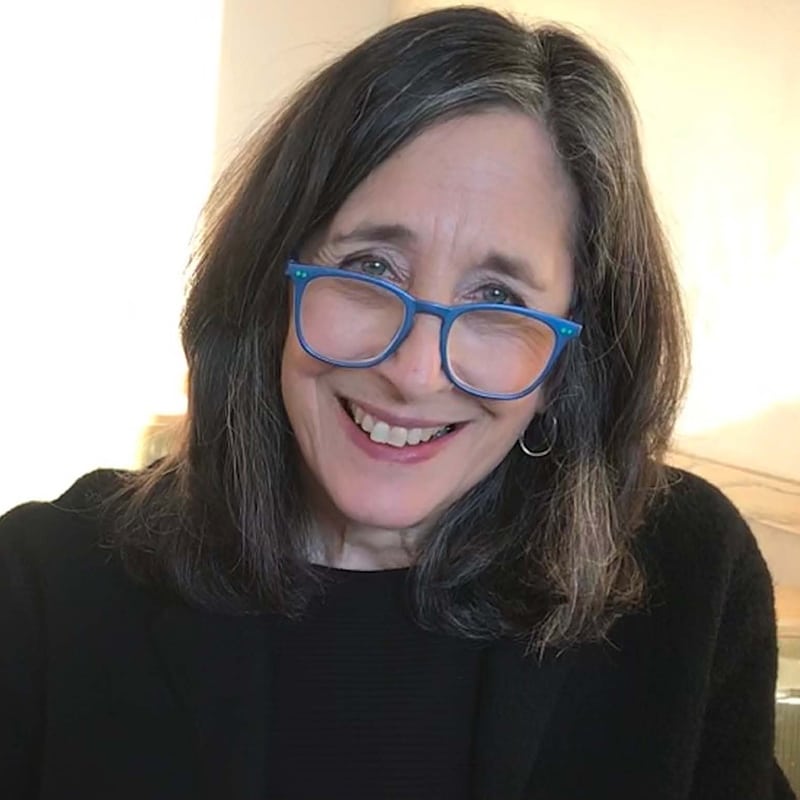
“Really, the trick is to sit down and write, which people don’t seem to understand that really sit down and do it. People have so many. So that’s the hard part of doing it, is getting started. Sit down and do it.”
~ Lorie Kleiner Eckert
Lorie Kleiner Eckert thinks of herself as a cheerleader with the message: life is difficult, but you can handle it!
For ten years, she worked as a motivational speaker, addressing more than 22,000 people during more than 250 appearances in 11 states. She’s spoken to every sort of group from PTAs to Procter & Gamble. What makes her programs unique is that they’re illustrated by her artwork, quilts with words and symbols pieced into the design.
For three years, she wrote an award-winning motivational column that was syndicated in regional newspapers across the United States.
Lorie also sells her motivational quilts on Etsy. In all formats – the spoken word, the written word, and the quilted word – Lorie uses the same M.O. She tells the stories of her life, hoping that her audience will glean life lessons from them.
Her fifth book, Chai on Life, was published by Bancroft Press in April 2025. I’ve read Chai on Life and found it to be deeply inspiring in how I think of my life and how I can be a better me. I highly recommend Chai on Life to you.
WEBSITES:
IF YOU LIKE THIS EPISODE, YOU MAY ALSO ENJOY:
- Samuel A. Simon, Playwright-Actor-Advocate, #353
- Ana Benitez, Co-Founder-President of Storyrocket.com, #330
- Jeff Leisawitz, Musician-Producer-Writer-Teacher-Session 2, #325
- Richard Walter, Author-Legendary Teacher-Session 2, #323
- Maria Baltazzi, TV Producer-Teacher-Author, #297
- Michelle Danner, Actor-Director-Coach, #285
- John Vorhaus, Comedy Writer-Author-Session 2-Episode #284
- Amy Powers, Author-Songwriter-Producer-Coach, #262
- Leigh Marz, Leadership Coach-Author, #243
- Valorie Kondos Field, Champion Gymnastics Coach, #122
- James FitzGerald, Actor-Teacher, #90
Steve Cuden: On today’s Story Beat.
Lori Kleiner Eckert: Really, the trick is to sit down and write, which people don’t seem to understand that really sit down and do it. People have so many. So that’s the hard part of doing it, is getting started. Sit down and do it.
Steve Cuden: This is Story Beat with Steve Cuden. A podcast for the creative mind. Storybeat explores how masters of creativity develop. And produce brilliant works that people everywhere love and admire. So join us as we discover how talented creators find success in the worlds of imagination and entertainment. Here now is your host, Steve Cuden.
Steve Cuden: Thanks for joining us on Story Beat. We’re coming to you from the Steel City, Pittsburgh, Pennsylvania. My guest today, Lori Kleiner Eckert thinks of herself as a cheerleader with the message, life is difficult, but you can handle it. For 10 years, she worked as a motivational speaker, addressing more than 22,000 people. During more than 250 appearances in 11 states, she’s spoken to every sort of group from PTAs to Proctor and Gamble. What makes her programs unique is that they’re illustrated by her artwork. Quilts with words and symbols pieced into the design. For three years, she wrote an award winning motivational column that was syndicated in regional newspapers across the United States. Laurie also sells her motivational quilts on Etsy in all formats. The spoken word, the written word and the quilted word. Laurie uses the same MO she tells the stories of her life, hoping that her audience will glean life lessons from them. Her fifth book, High on Life, was published by Bancroft Press in April 2025. I’ve read high on Life and found it to be deeply inspiring in how I think of my life and how I can be a better me. I highly recommend High on Life to you. So for all those reasons and many more, I’m truly honored to have the motivational force better known as Lori Kleiner Eckert join me today. Lori, welcome to Story Beat.
Lori Kleiner Eckert: Thank you, Steve. That was a lovely introduction. I appreciate it.
Steve Cuden: Well, it’s for, a lovely person and you’ve got a lovely message. So let’s go back in time just a little bit. How old were you when you realized you could actually motivate people with your life and your thoughts? What triggered you to become a motivator?
Lori Kleiner Eckert: Well, when I was in high school, I used to have all of the underdogs call me and, and talk to me and cried to me and I would give them pep talks. And my dad, though, said to me, you know, when I’d get off the phone crying over their Problems. If you can’t help on the phone without crying, then you can’t talk on the phone anymore. So I’ve always been, I’ve always been giving pep talks and it can be draining. I mean I’m not trained as a psychologist, I’m trained as an elementary educator. But when I became a motivational speaker what I realized was that I was doing the same thing from the stage. I was the same rah rah girl. I’m not saying anything that’s brilliant or original. I’m just reminding you of what you know, which is what I did with all these friends who were suffering from no dates. One friend’s mother passed away. You know all those kinds of things. I was just up there doing what I did on the phone, encouraging people.
Steve Cuden: Do you think of yourself in general as a teacher first?
Lori Kleiner Eckert: I guess so. when I, as I’m sure we’ll get to My journey started out, my professional journey started out as a result of divorce. And at that time I went and took ah, tests to see where my interests lie again. I had a degree in elementary education but I had not taught except for my own kids. And the test came back this kind of educator, that kind of educator was like, like 12 different ways they thought I should be a teacher. And the only other thing they said was bus driver if you’ll believe that.
Steve Cuden: Bus driver.
Lori Kleiner Eckert: So I guess I’m a teacher. I guess that’s what I am.
Steve Cuden: Were you always a reader and a writer? Was this something that’s followed you throughout your life?
Lori Kleiner Eckert: My mother was a big reader and I tried to be like her but I I bought a lot of books when I was a kid and in high school and I never read them. And then my never, never and then my ex husband and I moved from LA and San Diego back to the Midwest where we had grown up and I thought okay, now I’m going to take up reading. And I did. So when we got to a slower paced live and we had two kids at home at that point I started to read. So that’s where reading came from. And then but always following in my mother’s footsteps and as far as writing go at my grandma’s house I used to, she had orange paper for some reason and I used to 8 and a half by 11 sheets of orange paper and I used to cut those into quarters and then I would like sew them together to make a book. but I never wrote in it. I created the book but I never.
Steve Cuden: Got around you Created a blank paged book.
Lori Kleiner Eckert: I did a blank page book and I never wrote it. And I bet I did that all the time. All the time at my grandma.
Steve Cuden: All the books that you started to read, were any of them about motivation? Were they self help books? Were they something like that? Is that what gave you the notion to go on and do stuff like that?
Lori Kleiner Eckert: Oh, God. I have a nasty confession to make is that I don’t like books like that. And even though I was a motivational speaker and I really gave a wonderful, unique program, I really did. I really did a great job patting myself on the back. I would never go to a class like the one I taught. I just don’t do things like that, you know, But I don’t. I don’t know. It really stems from being a high school student giving pep talks to other people and that. I was good at that. And, as far as writing. Oh, my God, everyone loved my thank you notes. So that was my background in motivation and in, writing.
Steve Cuden: I have to imagine that you got some of your motivational concepts from being a mother as well.
Lori Kleiner Eckert: Oh, sure. Well, you’ve read my book, so you know that it’s just full of stories about the kids and. Yeah. A slice of life that I. Then I hope I’m not real obvious in how I turn it around and tell you what you may take away from it. I hope that that just happens naturally.
Steve Cuden: Yeah, no, I don’t think so. I think. I think you lay it out as this is the way you see it and that means that the reader can take away. Well, yeah, I see it that way too. Or what a great way to think about something.
Lori Kleiner Eckert: Uh-huh. Or this lady’s crazy. I think xyz, which is also fine, you know, hey, go right. Go write it down and verify who you are.
Steve Cuden: You know what, Laurie? I don’t think anybody who’s ever succeeded in a little bit crazy.
Lori Kleiner Eckert: Yeah, Yeah.
Steve Cuden: I just think that’s part of the thing. It makes. It’s what makes you you. It makes you unique and different. If everybody were exactly the same and no one was a little bit different or offbeat or whatever they are, then it would be a very boring world we’d live in. So I. I think that’s what makes people in the entertainment industry unique, is that they’re a little bit, offbeat in some way.
Lori Kleiner Eckert: Yeah. Well, we always have to go to Lucille Ball, who, you know, when she was on a talk to show, was the least fun, funny person you ever heard speak. So, yeah. So we. We are what we are. Yeah. I live inside my head, so I’m kind of aloof when I’m out in the world and stuff like that. But if you call me one on one and you got a problem, I got broad shoulders, and I’m willing to listen. And if. And the true gift, in my opinion, is if you need to tell me the same thing three times, call me three times and tell it to me. Because that. Sometimes you have to do that, you know? So, I’m. I’m your girl.
Steve Cuden: All right. So who do you think is most likely or would be most benefited by your work? Who do you think this should appeal to your work? And we’ll talk about the book more in a bit. But who do you think is your audience?
Lori Kleiner Eckert: Well, I really think women. So when I was the motivational speaker, most of my audiences were women’s wellness events and stuff like that. But then really, Procter and Gamble had me come speak, and I had all these professional men in my audience, and they did fine. But, most, yeah, I think my audience is women. I actually think you’re not supposed to say that your writing is for everyone. But I really think that any age group, kind of like Sesame street, you might hit it on a different level if you’re in your 20s than if you’re in your 40s or whatever. But I think women of any age.
Steve Cuden: And especially folks who may be having a little bit of difficulty getting through life on their own terms, that you’re giving them inspiration as to how to think about the way to proceed throughout life. Yes.
Lori Kleiner Eckert: Oh, definitely. But I think that everyone is having difficulty getting through life. I think that it is a given that life is difficult. That’s my starting point. I don’t know. Is my cup half empty or cup half full or is it just what it is? I’m not sure, but life is difficult. As a mom, I went to my daughter’s, breakfast for seniors. It was opening day of school. And I knew what trauma my daughter was going through at that moment in her life. I mean, traditional kinds of trauma. But as I stood there serving donuts and orange juice, I thought, oh, that kid probably thinks his outfit isn’t right. And that kid’s, you know, face broke out overnight. Oh, my God, look at that kid’s hair. And I was bleeding for all of them. So I do think life is difficult, but you can do it. And I think I’m ahead of happy person. I think I have it all, but I just understand that it’s A challenge. And it’s okay to be a challenge.
Steve Cuden: It is a challenge. And there’s no doubt that even people who appear to have perfect lives or close to perfect lives somewhere behind the scenes, it really, they’re struggling in some way, because everyone does. And that’s what is helpful about what your message is, is that you can get through this by thinking in one way or another. So how long have you been quilting?
Lori Kleiner Eckert: Oh, I started quilting, right after my youngest child was born. And I used to make the joke that if I took up quilting a year earlier, I wouldn’t have three children. I’d only have two. But I’m so glad that it happened the way it did because I adore my Lisa. But I took up quilting and, so that would have been like in 80, 1983 or 4. Quilting has just changed dramatically through the years.
Steve Cuden: The business of quilting or your quilting, or both.
Lori Kleiner Eckert: the quilting world. When I started quilting, it was a crime and a sin to do anything at all on a sewing machine. You cannot piece the pieces together. God forbid you would quilt the quilt sandwich together using the sewing machine. No, no, no. It was all done by hand. And then I kind of took a 10 year hiatus from quilting when I was having grandchildren. Well, I should say I just made baby quilts at that point instead of the kind of stuff I did quilts with words pieced into the design. And in that time period, there was just an entire blossoming of, of machine quilting and very beautiful artistic machine quilting. And now there are long arm quilts, quilting machines that are programmed. And you just put the quilt in, I think, and it’s dances around over the quilt. Quilting it by machine, that was, like, I say it was a crime and a sin. Back in the 80s, you would not do that. And now it’s an art form, so it’s changed dramatically. And when I started, where I. What happened with me in quilting is that I had, you know, made quilts for every bed in the house, every wall in the house had quilts. And then, oh, my. I got divorced. And so it’s like, okay, so we have to have some kind of a, paid profession here. And I thought I’d turned my hobby of quilting into a paid profession.
Steve Cuden: So how did you learn to quilt in the first place? How did that come about?
Lori Kleiner Eckert: Yeah, I took adult education at Sycamore High School and we made a sampler quilt. So it was, five rows of five blocks and with each block you learned a different technique. You learned to piece and to applique and to string piece. And I think that was all at the time. There are other techniques now now, and I think it was like a 10 week class. So every week we must have made two blocks and if we got our whole quilt together, we won and the whole class helped us piece it. So after you make the top of a quilt, you still have to layer it with the batting and with the backing and you have to pin that or sew that all together and then with teeny tiny stitches, hold it together. So your reward for finishing your quilt was that the class helped you baste it together. So I won. And that was my first quilt. It was a king size quilt and every single stitch in it is by hand.
Steve Cuden: Wow. And so you quilted for a while, then you stopped quilting for 10 years or so, except for baby quilts. And then you started to use quilts. I guess at some point in your motivational work, what prompted you to think to do that?
Lori Kleiner Eckert: Well, so again, I needed to get a job and I thought since there are quilt guilds, quilt shows, quilt seminars, all over the world all the time that there was a quilt lecture circuit. There is not. But I thought that if I made a dozen quilts, I could take my show on the road. And, and I was going to, gave myself a real stiff goal. I was going to make a quilt every two weeks, but I was making wall hangings. I wasn’t making bed quilts, but I was doing that because my goal was to take my show on the road. And, and I’m a tall woman, but I’m, kind of, you know, weakling. And I couldn’t. There’s no way to schlep a dozen bed sized quilts around the country with you. So they were wall hangings. And though I’m a very good quilt technician, meaning that if it’s a star, I don’t chop off the points accidentally. If the fabric has Christmas trees on and all of them stand upright, none of them lie down on their side. so I’m a great technician, but I didn’t think I was a great quilt artist, so I wanted to do something different. So I started to make quilts with words pieced into the design because no one was doing that. And so I, again, very stiff goal. I’m going to make a quilt every two weeks. And I did that. And at the end of six months, I had 12 quilts. And they said whatever I wanted them to say bloom. Soar Come as you are. You’re lovely. Whatever. Whatever came to me. And. And where do ideas come from? Who knows? And then after creating the 12 quilts, I woke up one day in a slightly more poetic version of the words on the quilts were running through my head. And it was vows you would make to yourself as you start a new portion of your life. I was divorced, looking for a new portion of my life. So at that point, I. I didn’t say I wrote a book, but a book wrote itself, and I submitted it to 22 publishers. Months until I finally found Pelican Publishing Company, who created an adult picture book. So it was the picture of the quilt on one side and the words of the vow on the other.
Steve Cuden: Now I’m very fascinated. Always when, artists discover something in the process, you were making quilts with no real intention of having them become motivational, concepts or anything like that, and you woke up one day and had an epiphany. This is something. It works in a different way or it works in a special way or a better way, and off you go to the races. But you didn’t set out to do that. You discovered it.
Lori Kleiner Eckert: Yeah. Did not set out to do that at all. Yeah. I take full credit for making the quilts, but I kind of think that I channeled the book. The book happened. So the beginning of the, vows you would make to yourself is I love you is the sequel. With acceptance and love of the self, the story that must come first, and towards this lofty goal. I, you know, wander forth today, making these vows to myself. And then there were the vows, that went with the quilt. And I really think it’s a beautiful book. I’m very proud of all the things I’ve done. I am.
Steve Cuden: you know, I think that there’s a hallmark in creative people. There’s something that runs throughout many, many tales of creativity. That the work comes through you, that you don’t actually create it. It’s coming from the universe, from God, whatever, what people want to say. and that’s what it sounds like it is for you, that it. The book came through you, that you didn’t sit there and cogitate over it for hours and days. it happened exactly.
Lori Kleiner Eckert: Exactly. And also my message was one of the journey towards self acceptance and love. And that isn’t a message. That’s just for quilters. I mean, my goal was to go to quilt groups, but it was like, wait a minute, this is not just for quilt groups. And guess what? Quilt groups paid like, $125 for a program, and Procter and Gamble paid a whole lot more. So I really thought that I was an inspirational speaker, but that smacked of religion, so I called myself a motivational speaker, and then I booked myself with every kind of group from PTAs to Proctor and Campbell. Yeah.
Steve Cuden: So do you find that work, when you’re doing it, fulfilling? Is it fulfilling in any major way?
Lori Kleiner Eckert: I did it for 10 years, and then I gave it up.
Steve Cuden: Did you get tired of it? Is that what happened?
Lori Kleiner Eckert: I guess I would be. there’s been two times in my life where I’ve been aware that my brain was doing the two things at the same time. One, I was trying to learn piano, and I was very aware that my left hand and right hand were doing different things. And, oh, my God, that was very confusing. And, towards the end of my speaking career, as I was sitting there being charming and telling my stories, my brain was saying, I don’t want to do this anymore. Run. So, like I say, I didn’t have a memorized speech, you know, but I had these 12 quilts, and you knew what made people laugh, so you made sure to tell the story that way so you’d get the laugh. So I m. Knew the whole shtick, you know, and it came out automatically as my brain said, no more. Get me out of here.
Steve Cuden: So what do you think motivates you? How do you motivate yourself?
Lori Kleiner Eckert: I’m gonna go back to. Oh, this is going to sound conceited. I go back to a Charlie, Brown poster when I was a K kid that said there’s no greater burden than a great potential. And I think that I have that. I can tell you a lot of things that are wrong with me. Like, I get brain farts and stuff like that. but there’s a lot that’s right with me. I feel I’ve got a lot of gifts, and so I’ve always felt like I have to make the most of them. So that’s where I am.
Steve Cuden: So you. You know that you have talents and skills, and it’s not a, secret to you. And you have set out in your life to give them to the world, so to speak, to use them for yourself and others can benefit from it.
Lori Kleiner Eckert: Yes. But give me also the part of me that I know, all of the things that I don’t do. Well, some of my friends who read my, the blogs that I put out, put out two blogs a month these days on my website, and they’ll say to me, you need to get motivated. I know a good book you can read. And they’re suggesting my book to me, you know, kind of thing. So there’s the part of me that thinks I’m, a screw up, and there’s a part of me that knows I believe I have a spark. I believe we all have a spark of the divine and so make the most of it.
Steve Cuden: I think that that’s a very good way to look at it. So let’s talk now for a while about High on Life. It’s your fifth book. What inspired you to write it and why now?
Lori Kleiner Eckert: It was my fourth book that inspired me to write my fifth book. So my first three book were published by Pelican Publishing Company and then they changed course. Dr. Calhoun, who owned it, I think, passed away and the company was sold to a different publisher and they changed gears. So they weren’t interested in my fourth book, which is, Love, Loss and Moving On. And it’s a story about getting past the loss of a loved one. But when you’re going through a hard time, you sometimes do really weird things. Like some people turn to drugs or to alcohol or to promiscuity. No, not me. I got a big crush on British actor Bill Nye instead. So I. So this is it started off, the working title of the book was Loving, Bill Nye, A Fan’s Fantasy. And by watching all of his movies over the months was part of my healing on that journey. So anyway, couldn’t find a publisher. Actually, from listening to your shows, I see how many people are self published, but that didn’t feel real comfortable to me. But my fourth book is self published. So a guru in the self publishing world, Jane Friedman, was a paid consultant, for me. And so she was telling me, well, you need an author’s website. Okay, did that. And then my website guy said, okay, now you have to get people to your website. It’s like, what? I thought, I’m done, you know, oh, no, you have to write something. You have to write a blog. So they come. So it’s kind of like having a baby, you know, you think you’re done, you give birth and then you have to raise this child. and my oldest child is 49 and I’m still the mom, you know. So I created this website and I started writing a blog twice a month and to get people to my website and I was writing my slice of life stories exactly what I’ve always done, telling the stories of my life, hoping you can glean life lessons from them. And, so I think I’m currently writing number 166 or something. So somebody do the math on that. How many years I’ve been at this. And some of the stories, I mean, none of my stories are like, newsworthy. Well, I shouldn’t say they’re not newsworthy. There’s some that I was really reacting to, the pandemic, for instance, so those maybe aren’t as evergreen as everything else, but, oh, my gosh, I was writing evergreen stories. So I thought, let’s m. Put them together. Let’s put it together and call it a book.
Steve Cuden: So High on Life is a compendium of articles you’ve written. Is that what it is?
Lori Kleiner Eckert: Yes. It’s 36 stories that I wrote. For anyone in your Jewish audience, hai is a, mystical word in Hebrew that means life or whatever. and it can be pronounced as hai. So my book is Hai on Life, with a Jewish slant. But chai is also a number in Hebrew. It’s 18. And Jewish folks often give gifts in multiples of chai. So you give $18 instead of 20, you give $36 instead of 25 or whatever. and so when I submitted it to the publisher, I actually gave him 18 stories because it was high. It was 18. And he said he was loathe to print such a short book. Could I make a double high? So sure. I mean, I had all these stories, so I plucked some more stories out, but I plucked them with the. I, that’s. I have 10 grandchildren and these are, the things I want them to know. These are important things that I’m telling them about.
Steve Cuden: So before you actually put the book together, you had a pretty good sense that it had an effect for people, that it would work in various ways for various people. Is that true? You already knew that it would work?
Lori Kleiner Eckert: Yeah. So before I was writing my blog, let’s see, I have two books out that are. The first two books are Illustrative with Quilts. Okay. The first book was just a series of vows. The second book was a picture in a thousand words. So it was 12 quilts, and each one had an essay of about a thousand words. And it was after writing that that I realized I like to write. So I started to write a weekly column back then. This is in the late 1990s. And I self syndicated that across the country. Some papers were weekly, some were monthly. You know, and I just say, pay me whatever you pay for one time writes. And this one newspaper in Connecticut. The lady wrote me a personal check for $25, you know, for my story, because she used it. That was when I started to write. And the response to it was very gratifying. I would hear from people, I was writing mostly about being single in midlife, kind of saying, I know you don’t want to be single, but you can do it. You know, my same basic rah, rah, you can do it. And I heard from a woman who said, you know, I just love your column. She was in Houston, and Houston published me weekly. They were a weekly paper. I just love your column. And it may surprise you to know that I’m not a single woman. In fact, I’ve been married for 53 years. But somehow when I read your stories, I think you’re sitting here in my family room talking to Jim. And I have heard that so many times. And so my writing is very chatty. It’s not formal, it’s chatty.
Steve Cuden: You’re doing what all great writers do is you’re writing in your voice. It’s as if you’re speaking to the audience and they can hear you speaking on paper or on the screen, whatever they’re reading it on. And so that’s the key to being, I think, a, successful and well read author, is that you’re able to come out with a voice that people hear in their heads.
Lori Kleiner Eckert: I agree. And I think that what I’m doing is, safe from AI because how AI doesn’t have stories to write about their grandchildren.
Steve Cuden: I don’t mean to be pessimistic on that note, but I will be for a half a beat because I think AI is at the very, very, very earliest stages as we’re having this conversation. And I do think that at some point it will become smart enough to be able to do what we do. That’s what worries me the most about AI And I don’t want to go off on a tangent, but I think right now you’re correct. I’m not so confident that down the road that that will hold true. so I do want to talk about the development of the book. Obviously, you had most, if not all of it in hand before you started. You didn’t sit down and write the book. The book was already basically written, but you then needed to put it together in a way. And did you then sit down and say, okay, I want these stories before those stories. How did you do that?
Lori Kleiner Eckert: Let’s see. So my first two books are illustrated with quilts. And after I did that first series of quilts and did a lecture. People liked my program. They wanted me to come back. But you can’t come back with the same program. So I made another 12. 12 quilts that then made another book. They wanted me to come back, so I made another 12 quilts. So I have 12 quilts that are not in a book. So I started out to write about those 12 quilts. And so there are 12 stories in the book that have never been published before. And those are the 12 quilts. But it didn’t coalesce, it didn’t go together to tell one story. My first, my first book is the journey towards self acceptance and love. My second book is having the courage to say yes to your life. This one was just hodgepodgenous, you know. Anyway, so I had now these new stories and we as writers know. Well, I guess things are different now. But in the old days when I was submitting story by story by story, it’s a very tedious task with lots of pink slips. But I guess these days you don’t even get the pink slips. But, but anyway, so I had some news stories and indeed my. My favorite story in the book is a story about my mom. The more I look for my mom, the more I find her in my heart. That’s my very favorite story. And that. That’s one of the new ones. So I had 12 and I submitted 18 to Bruce Bortz, my publisher. He wanted 36. So I went back and I figured out, you know, looked through all my writing, what’s evergreen, what’s not, and plucked it out. And I said to him, go to my website and read it and tell me which stories you want. And he said, no, you take the first pass at it. So I never thought that this was the finished project. I Even the illustrations, I didn’t, I didn’t know if I was. I did the illustrations. Each story has an illustration that goes with it with a one line takeaway. And I, didn’t even know if he was going to use my illustrations. I didn’t know. And then suddenly, here’s the book. He didn’t give me an edited version. He gave me, what’s it called? An arc. A, advanced reader’s copy. That was the next thing I got from him. So I just picked them by hook or crook and I scattered them all over the floor, trying to see how they might go together. And I did group them into life lessons.
Steve Cuden: How long did that process take you once you started to piece it all together? How long did it take to put the book together.
Lori Kleiner Eckert: It was very brief because I had a publisher willing to publish and I wanted to get it to him. And again, I didn’t think it was the final project I thought he was going to have.
Steve Cuden: What you’re talking about is highly unusual. Most of the time there’s this big long ordeal that authors go through with a publisher where you’re back and forth and there’s editing and all the rest of it.
Lori Kleiner Eckert: Yours just flew through, you know, really, Even with Pelican, that’s the way it was. They kind of moved commas around. My son is, has many degrees. One of them is an English teacher, so he has since given me a lesson on commas. But my first two books I really moved commas around. My third book, I wrote a story about my friend’s 80 year old father and they wanted to call him elderly. And I said he’s not elderly, he’s 80. That was the editorial comment on my third book. So I’m not saying I’m a great writer, but I must pick publishers that like what I do. I don’t know.
Steve Cuden: Well, yes. so you’re not writing, you know, thousand page tomes. You’re writing things that are very specific, quite pithy, very, easy to absorb, easy to read, easy to get through. And all of that, believe it or not, from my opinion, is extremely difficult to do well. That’s maybe m. It’s like doing haiku. Well, it’s 17 syllables, but it’s extremely hard to do well. And so I think that that’s, you’re obviously doing something right. If the publishers take it and just, just go with it, that’s a pretty good sign. I want to ask you some things very specific from the book because I’ve got a bunch of questions from the book itself. You say that quote, your mind believes what you tell it, so tell it positive things. Where’s that come from? Why do. I mean, I know why you’re saying it, but where does that come from?
Lori Kleiner Eckert: it comes from my morning exercises when I’m trying to do 100 crunches. And if I, I get to 70 or 80 and I start going, I can’t get to 100. So I just make sure that I don’t groan and grunt. I just do 100 sit ups. It’s so clear to me. I mean, that is the perfect example. Yeah, I can do this. Piece of cake. Yeah.
Steve Cuden: So it’s the positive mindset and do you have in your life negative thoughts that you must overcome oh, my God.
Lori Kleiner Eckert: Yes. This is like I say, don’t. Yes. Oh. Oh, my God. So you just told my daughter the 25,000 things I’m, upset about in life. One of them being that I went from a coffee maker to a Keurig because I hated washing the coffee pot. I mean, this is, you know, a dozen years ago, but now I hate putting water in the water reservoir. I just hate when the light goes on that it needs water. And so my daughter is just really. I do take an, anti anxiety drug, but she does want me to up my dosage, which I don’t want to do. So I said to her, I forgot I can’t tell you my problems because then you want me to go on drugs. And she said, okay, tell me your problems. I won’t say that anymore. So thank you. When I tell my problems to my son, which is usually something not working in the house, he wants me to move. So, you know, and I don’t know if he wants me to move, downsize, or move to assisted living, you know, but I’m not going there. So. Okay, I’m not telling him my problems. Yes, I have lots of problems. I’m so crazy.
Steve Cuden: So the book that you wrote is applicable to you. You’re not just being, an advice giver. You are actually living in that world of needing the advice yourself.
Lori Kleiner Eckert: Oh, definitely. The story that is going to post on next Tuesday, it’s called, appetizers and main dishes and desserts. Oh, my. And it’s about making the Rosh Hashanah meal. We just had the Jewish holiday, and I’m having almost 20 people to the house for dinner. And I’m usually very organized. Everything happens well in advance. And here it is, nine o’ clock in the morning, the day of the party. They’re coming at 5. And I have only made one dessert and I usually serve four. And I really didn’t quite know what to do with myself. And I went to the bakery and I bought baked goods.
Steve Cuden: Well, that works.
Lori Kleiner Eckert: It works. You know, and I quoted. I can’t think of his name. He’s a chef like Dave Buck Kiss or something like that. I don’t know what.
Steve Cuden: I don’t know.
Lori Kleiner Eckert: He was quoted. He was quoted in, He’s Neil Patrick Harris’s spouse. Okay, that helps. But anyway, he was quoted in Parade magazine, which has been out of print forever, you know, a million years ago, as saying that when he gets himself in trouble creating a party, it’s because, he tries to make everything from Scratch. And so his one word answer is, is outsource.
Steve Cuden: Did you get any complaints that it was bought at a store?
Lori Kleiner Eckert: Nobody complained. As long you have a lot of options. There’s just so happy. Of course. So that. So that’s the story. But I know my friend in New York is going to object to this story. He’s going to tell me, you’re too hard on yourself. Because three quarters of the way down I say, I guess I’m feeling guilty about this or I wouldn’t be writing about it. It, you know. But in this crazy world where you don’t even have time to get to the grocery store, much less cook, it’s a good thing to still have parties and have the family together. And amen.
Steve Cuden: If I show up at somebody’s house for dinner or a party and they have served pre made food that they didn’t make, I don’t care, as long as it tastes good.
Lori Kleiner Eckert: Yep, yep, yep. Well, we had a raspberry cheesecake and we had a chocolate mousse cake and we had a box of chocolates to go with, with the cookies that I had made earlier in the week.
Steve Cuden: There you go.
Lori Kleiner Eckert: Everyone loved it. Loved it. Yeah. So, yeah, all of these things that I worry about, I really worry about. I really, I really do. And I get aggravated over. I wrote a story about sports socks that they have an L and an R, so you have to put it on the right foot, which means at my age, you have to go get your glasses to put your socks on. Am I right? You know, so these are the things I write about, but then I turn it around somehow and make nice.
Steve Cuden: Well, that leads me to then say in your book, you also talk about acceptance. And so that that’s partly what you’re talking about here. To accept yourself as you are, to accept the fact that maybe you didn’t make five desserts or four desserts that you can accept for yourself, that you went out and bought desserts or that you’re treating it differently, that’s part of the process of embracing yourself. Is that acceptance? Am I correct?
Lori Kleiner Eckert: Oh, definitely. And by me saying it’s okay for me to do it, I hope you understand I’m telling you it’s okay for you to do it.
Steve Cuden: So I am a naturally obsessive person. I’m not ocd, but I obsess over things. I even perseverate, which is a big word, but I’m a perseverator. And I’m wondering from your point of view, how can one Overcome that and still succeed.
Lori Kleiner Eckert: I don’t know. I did a little bit of cognitive behavioral therapy. And so when you start thinking this, you’re supposed to stop and think that. And so that does help a little bit. And so I came up with a great acronym that works for everybody, but best for me. So my oldest grandchild is Tilly T I L L I E. And my pep talk is think instead like life is excellent. This is when the Keurig needs water. Think instead like life is excellent. And in my case I can say think instead like Laurie is excellent. So it’s okay Laurie, that this bothers you, but just fill stupid reservoir. So I don’t know. Cognitive behavioral therapy. I don’t know.
Steve Cuden: Because much of what we obsess about in life ultimately is small, meaningless, not really that relevant or important. It just is at the moment it seems important, but it really over the grand scheme of things is not explain what you mean in the book by the word flossom.
Lori Kleiner Eckert: Yes, we are all flossum. We have, have flaws, but we’re awesome just the same. So I was that that story came about from a class that I took on wise aging. And it was a great exercise. We had to write a love letter to a part of our body. So I’m a thin person, but I have a belly. But I also had three kids. So I wrote a love letter to my belly. And you know, because I’m flossomed, my belly is flawed, but I’m awesome just the same. And really where I came around to was the only thing I ever wanted in life was to be a mom. And I’m a mom. And so you know what a big gift my Bella gave me. Scott, Shane and Lisa. And so of course it’s big. Amen. I, really would like to use amen more often than I do in my stories. Almost all of them. I want to say amen at the end. End. But anyway, there you have it.
Steve Cuden: So that is also a part of another part of the book which you talk about traditions. And the word amen is a very frequently a religious word used in, prayers and so on. What do you believe about traditions and what do traditions do for us?
Lori Kleiner Eckert: Oh, just traditions are so comforting. So the cookie that I had made in advance for Rosh Hashanah is Jewish. biscotti. We call it mandelbread or commish bread. Our family calls it commish bread. And when I had moved my dad here from St. Louis, I’m in Cincinnati, moved him here for the Last, as it turned out, 10 months of his life, and he didn’t have anything. He couldn’t even watch Cardinals baseball, you know, I mean, he had nothing. He didn’t have anything that was familiar to him. And so here came the Jewish holiday. And I thought, you know what this cookie recipe is? A famous cookie that my dad’s sister made, my Aunt Tilly, for whom my granddaughter is named, and I’ll make that cookie. I’m going to give him tradition, just like in Fiddler and the Roof. And I’m going to give him comfort through tradition. And so that’s what I did. And that first year, I actually had my little Tilly, she was probably three years old, help bake. And in subsequent years, that has become a tradition. Same, way we have a tradition that I make fudge for Hanukkah for. No, I make it for Thanksgiving. We eat half the recipe for Thanksgiving and this other half of the recipe for Hanukkah. So these traditions are great, and it’s something to look forward to. Oh, my gosh. I love tradition. Yeah. Shall we sing like Tevye?
Steve Cuden: It has. I think that we probably don’t want to do that, but we could, but we’re not gonna.
Steve Cuden: I think that what you’re also talking about when you’re. It’s similar when you’re talking about in the book, and I’m quoting here, when you go to a birthday party, be sure to eat the cake. That’s a traditional thing. But why do you say that? What is the purpose of making sure to eat the cake?
Lori Kleiner Eckert: Well, that story is about unusual lessons that I learned in the gym. So, Whereas, yes, you would always eat the cake at a birthday party. You know, that’s part of the fun, but it was more significant. So my personal trainer, I have turned in a food diary to this man for almost every week, for almost 20 years. And so one time, I turned in the food diary, and I said to him, I failed. I went to birthday party, I ate the cake. And he said, no, not at all. If you didn’t eat the cake, you would have failed. You’re not on a diet. You’re living your life. You’re making wise choices regularly. But at a birthday party, you eat the cake. By the same token, at the state fair, you eat funnel cake. You know, you just do it. These are things that you do. And then, my father, who, if you read anything I write, you know, I adored my father, when he was dying, Rob, the personal trainer, always encouraged me to have Ice cream every night, because I love ice cream. And he said during this period of time, you should eat ice cream twice a day. You’ll get back to your normal diet. So that’s the significance of eating cake in that story, that you’re not on a diet, you’re living your life. And amen. Oh, I did it again.
Steve Cuden: Well, you know, there’s that old cliche, everything in moderation. and so there’s a reason why you should enjoy your life and let. Unless it causes you some kind of harm. You can, should eat pretty much anything you want to eat. Unless, it’s definitely going to create a different problem for you. you also write about. Life isn’t about waiting for the storm to pass. It’s about learning to dance in the rain, which I think is a great phrase that’s similar to eating the cake, isn’t it?
Lori Kleiner Eckert: Yeah. Oh, oh, yeah. I mean, if you’re waiting for everything to be perfect, you know, the, great example is having children. You know, if you’re waiting till you can afford it, until you have the right house or whatever, it ain’t never going to happen, you know, so you just have to really live life right now.
Steve Cuden: You also say having everything is not equal to having everything. What do you mean?
Lori Kleiner Eckert: Well, so when I got divorced, I moved out of the family house and my ex and took very little. I bought a new house and bought everything to go in it. But so we wanted the family house to look like it had always looked. And it was a little bit heartbreaking to leave behind all my collections and all these millions of things, which at the time included a four cup coffee maker. Coffee’s important. But anyway, so it was a little bit achy and in pain for leaving everything behind, but I realized that clearly those things never made me happy or I wouldn’t be getting divorced. And so I, I’ve been fortunate all my life. Maybe I have low expectations or something, but I have always had everything. I have the basics, you know, and it’s not things, it’s everything else.
Steve Cuden: Things are, things are less important than family and emotion and the way that you feel and all those things. That’s what I think.
Lori Kleiner Eckert: Oh, definitely. Oh, definitely. Yeah. I mean, really.
Steve Cuden: so I love that you also have a quote in here that goes, you don’t have to have it all figured out to move forward, just take the next step. I think that’s really great.
Lori Kleiner Eckert: Well, so I have some very basic themes that I work on a lot and one of them is self express Acceptance. And one is on personal reinvention, which is really what my fourth book was when I was, you know, going through the loss of Big Irv, as we called him after Big Irv died. So we have all reinvented ourselves many times when we graduated college, we had to reinvent ourselves. You know, you think again, you think you’re done, you had the baby, it’s over. But, there was a Broadway music, what was it called? Avenue Q maybe. And this opening line is a guy comes out on stage and says, I just got a bachelor’s degree in English. What do you do with a bachelor’s degree in English? And so even when something good happens, like graduating from college, you’re reinventing yourself. You get married, you’re reinventing yourself, or, you know, empty nest. A sad reinvention. There’s happy and sad reinventions, but we do it all the time. And so I have a two step plan for reinvention which I lay out specifically in high. In life as a two step plan. Whereas in love, loss and moving on, I modeled the behavior over 200 pages. but it involves having a healthy routine. So you have to get dressed every day, you have to eat nutritiously, but ice cream every night, and cake at birthday parties. But then you have to take, take one step a day. Even if it’s teeny tiny, you have to take one step a day in the direction of your new life. Yeah. So the smallest step is going to move you forward. There’s lots of quotes like that in the book. You didn’t mention that. So every story, so the 36 stories each have a one line takeaway. So that’s what you’re giving us, some of the one line takeaways.
Steve Cuden: Right, That’s.
Lori Kleiner Eckert: And my favorite story for its takeaway is, 30 reasons to be Grateful at my Granddaughter’s soccer game. And one of the reasons was that some other granny had her shirt on inside out, but it wasn’t me. And then the takeaway from that is there’s always something to be grateful for. Which there is. There’s always something to be grateful for. One of the stories in the book is about my dad’s death. But that’s a very sweet story of a beautiful moment that my son had with my dad right there, literally the day he was going to hospice, you know, so there’s always something to be grateful for.
Steve Cuden: Well, every day is a new opportunity. and sometimes I think it’s very hard to see it while it’s happening. But it’s nice when you can see it that every day is this opportunity for a new start of sorts. And I, think that that’s part of what the inspiration in the book is. Even though you don’t like the word inspiration, but motivation, I think that that’s a very good motivator, is that you can look at every day as a new start. you also. It’s very important to me, this concept of listening. Right now we’re having a conversation, and I’m doing my best to listen to you. And I think there’s two levels on listening. There’s listening and there’s hearing. And, hearing, is an autonomic response. Everybody that has hearing and aren’t deaf, you’re hearing all the time, whether you want to or not. But listening, it takes active notion in your brain. You talk about listening being vital. Why?
Lori Kleiner Eckert: Oh, what? Wow. Because everybody wants to tell their story, don’t they? I mean, so I’ve been the broad shoulders that people want to tell their stories to, and I think that’s a gift I’m giving people. So listening is a wonderful thing. And I’ve said it, said it before. If somebody has to tell their story three times, okay, I can hear it three times. So I. I don’t know. I just think listening is extremely important. Extremely. You know, we’re not that good at it anymore. We’re kind of, like, distracted by our phones, what’s buzzing in our pocket. It’s all that kind of stuff. So. Yeah, even more so now than ever.
Steve Cuden: Yeah, I. I agree. And I think listening has become not quite a lost art, but it’s. We’re losing that, because people are buried in their phones and their computers and on their televisions and whatever, and not paying attention to others. And that’s what listening requires, is paying attention and not just hearing, which is just passing by you. I think that that’s, really vital. I’m glad that that’s in the book. So I’ve been having just a wonderful, enlightening conversation for almost an hour now with Lori Kleiner Eckert about, her book, High on Life and Life and How It Works. And. And we’re going to wind the show down just a little bit now. And I’m wondering, you’ve been telling us all these great stories. I’m wondering over your career and your writing career and your publishing of books and teaching and so on. Are you able to share with us a story that’s either weird, quirky, offbeat, strange, or just plain m funny more than what you’ve already told us?
Lori Kleiner Eckert: yeah. well, I have a story that goes towards the concept, that the best laid plans kind of thing. So I m am a person who lives inside of my head. And so I was, This was towards the end of my speaking career that I was going to have my biggest audience in Texas. So I’m, again, I’m in Cincinnati. It was cheaper to fly out through Columbus, which is an hour and a half away. So I, drove to Columbus on the day that I was flying to Texas. And the next day was going to have, I think 800 people in my audience would have been amazing and wonderful. So, I, but I don’t like, listen to the radio. I don’t listen to music. I just inside my head. So I get up to the Columbus airport and it’s strangely quiet up there. There’s a McDonald’s on the way down towards the long term parking lot. And so I had planned to go into the McDonald’s to have lunch before going into the airport. So I went into the McDonald’s, I said, what’s wrong? It’s so quiet here. And they pointed up to TVs that were, you know, in the restaurant and they said, that’s New York, the twin towers. So it was September 11, 2001 that I was supposed to fly to Texas for my biggest audience on September 12th. But the best laid plans, as you know, airspace, was closed.
Steve Cuden: Oh yeah.
Lori Kleiner Eckert: And that’s why there was no one at the airport. And then I did turn on the radio to drive home and there was the the one plane that went down where in Pennsylvania, which was a little too close. Yeah. And it was like, oh my God, am I even safe to drive home? So that was, was real freaky. And another time when I, when I was speaking, I, I was at a women’s wellness conference in Colorado. And I like to say that I was Wayne Dyer’s warm up act. But in reality there were many speakers on the venue. He was the keynote, but I was one of the other speakers and I had gotten there the day before and I came down the day of the event. I’m having breakfast with the various things ladies at this event and I say, I’m from Ohio. And one, said, oh, Cincinnati. Yeah, well, you know, what about the tornado? It’s like, what tornado? So there had been a tornado. I ran back up to my hotel room and here are the aerial views of Cincinnati and it’s literally the shopping center across the street from My house.
Steve Cuden: Wow.
Lori Kleiner Eckert: That had been. Hit it. Yeah.
Steve Cuden: That’s, close.
Lori Kleiner Eckert: Yeah. So, I don’t know. Maybe I learned don’t leave town for speaking engagements.
Steve Cuden: But. But you certainly dodged a few, potential bad scenarios there.
Lori Kleiner Eckert: I did, dodged a few bullets there. We’ve all dodged a few bullets, haven’t we? Yeah.
Steve Cuden: Yes, I have dodged a few in my life, too. No question. So our last question for you today, Laurie. you’ve shared with us a massive amount of advice throughout this whole show, but I’m wondering if you have a single solid piece of advice or a tip that you like to give to those that are just starting out as either writers or motivational speakers or whatever. or maybe they’re in a little bit trying to push to the next level.
Lori Kleiner Eckert: Yeah. well, I’m definitely one step at a time. I definitely tell people to get a new notebook. That’s an accountability log, so that you just write down the one thing you do a day. so I definitely think that’s the case. And if you have trouble getting started, a tip for add kids is to set a timer. So set a timer for 15 minutes and do whatever, and maybe you’ll get on a roll and want to do more, but at least do one something and write it down in your notebook to get started. But for writers, really, the trick is to sit down and write, which people don’t seem to understand that. And they go to writing conferences, and they. I don’t know what they do. Sit down and write. so I do talk about a friend of mine in High on Life. I talk about a little bit plus a little bit equals a whole lot. And my friend Mike Kahn has, a boy that I went to high school with. We’re really not dear friends, though he did blurb my book for me. I’m very appreciative, but I don’t want to suppose that we were dear friends or anything. Anyway, Mike Kahn is the father of five and a trial attorney, and he wrote during those years, like, I don’t know, a dozen novels, I think Rachel Gold was his detective. And all of his stories were set in St. Louis, where he lived. And he did it by writing one page a night when the kids went to bed. And if you write one page a night, and we’re not talking Monday through Friday, we’re talking one page a night over a year’s time, you’ve got 365 pages, which is the average size of a book. So really, sit down and do it. People have so many so that’s the hard part of doing it, is getting started. Sit down and do it.
Steve Cuden: That’s very, true and wise advice. And it is a one step at a time process. as a teacher, I used to teach my students, when you look at a whole screenplay or a whole book, if you’re trying to think about the whole thing, it can sometimes be so daunting and so overwhelming that you just can’t get started. So you have to break it down in your head into little teeny steps to get where you’re going. I think that’s very, very wise advice. Lori Kleiner Eckert. This has been a really tremendously fun story, beat for an hour. And I, I can’t thank you enough for your time, your energy, and for all this wisdom that you’ve, given to people over all the years. Thank you so much.
Lori Kleiner Eckert: Thank you. And I thank you for doing this podcast because I’ve learned so much from listening to other people. Really, everyone’s process is just a little bit different, and everyone has something to really teach us. So that’s great. Thank you.
Steve Cuden: And so we’ve come to the end of today’s Story Beat. If you like this episode, won’t you please take a moment to give us a comment, rating, or review on whatever app or platform you’re listening to? Your support helps us bring more great Story Beat episodes to you. Story Beat is available on all major podcast apps and platforms, including Apple Podcasts, YouTube, Spotify, iHeartRadio, TuneIn, and many others. Until next time, I’m Steve Cuden and may all your stories be unforgettable.










0 Comments