
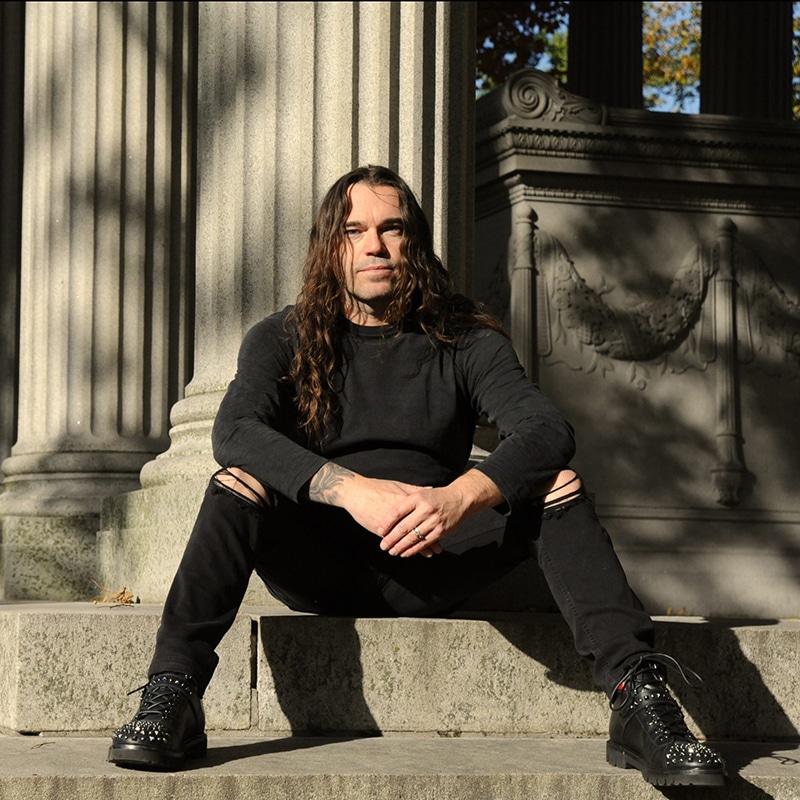
“And what I encourage people to do is be you and aim high. You never know what will happen. But do what you love. Even if you work a day job and you’re busting your ass and you’re making ends meet, at the end of the day, go do what you love. Because that’s what I did. Steve. I worked day jobs for so long until 2010 when I got my book deal for the Armageddon Chord And I’ve been able to, and I’m very grateful and blessed rightful, uh, time. But you know, I never forget where I came from. But I worked hard at it and I just parted part of it’s luck too. But if I still had a day job and didn’t become published, I’d still be writing.”
~Jeremy Wagner
Jeremy Wagner writes gritty, chilling novels, non-fiction, short fiction and scripts. He also writes music and lyrics for the bands Broken Hope, Earthburner, and Lurch. And he’s the co-author of world-renowned, Michelin-starred Chef Curtis Duffy’s bestselling memoir, Fireproof.
Jeremy recently published the intense crime-noir, splatterpunk novel, Wretch, which I can tell you is one of the most well-written, blood-filled, science-based monster stories I’ve ever read. The horror is surreal in a truly realistic landscape of riveting and relentless carnage. If you like graphic horror, I can highly recommend Wretch to you.
Jeremy’s past published works include the novels The Armageddon Chord and Rabid Heart, and numerous acclaimed short stories that can be found in various anthologies.
Outside of writing, Jeremy is the CEO of the TV and film company, Aphotic Media, and the independent publisher, Dead Sky Publishing.
WEBSITE:
IF YOU LIKE THIS EPISODE, YOU MIGHT ALSO ENJOY:
- Chad Boudreaux, Novelist-Episode #422
- John Vorhaus, Comedy Writer and Novelist, Session 3-Episode #414
- Haris Orkin, Novelist-Screenwriter-Game Writer-Episode #385
- Paul Chitlik, Screenwriter, Novelist, & Director—Episode #373
- Kit Karson, Novelist—Episode #366
- Tim Quinn, Writer, Editor, & Illustrator—Episode #362
- Ed Driscoll, Emmy Winning Writer-Comedian—Episode #355
- Adam Tex Davis, Screenwriter-Producer-Podcaster-Episode #337
- Max Kinnings, Novelist, Screenwriter, & Playwright—Episode #308
- Stephen Games, Author-Publisher-Episode #275
- Christy Marx, Screenwriter-Author-Game Designer—Episode #097
Steve Cuden: On today’s StoryBeat…
Jeremy Wagner: And what I encourage people to do is be you and aim high. You never know what will happen. But do what you love. Even if you work a day job and you’re busting your ass and you’re making ends meet, at the end of the day, go do what you love. Because that’s what I did. Steve. I worked day jobs for so long until 2010 when I got my book deal for the Armageddon Chord And I’ve been able to, and I’m very grateful and blessed rightful, uh, time. But you know, I never forget where I came from. But I worked hard at it and I just parted part of it’s luck too. But if I still had a day job and didn’t become published, I’d still be writing.
Announcer: This is Story Beat with Steve Cuden. A podcast for the creative mind. Story Beat explores how masters of creativity develop and produce brilliant works that people everywhere love and admire. So join us as we discover how talented creators find success in the worlds of imagination and entertainment. Here now is your host, Steve Cuden.
Steve Cuden: Thanks for joining us on Story Beat. We’re coming to you from the steel City Pittsburgh, Pennsylvania. My guest today, Jeremy Wagner writes gritty, chilling novels, nonfiction short fiction and scripts. He also writes music and lyrics for the bands Broken Hope, Earth Burner and Lurch. And he’s the co author of world renowned Michelin starred chef Curtis Duffy’s best best selling memoir, Fireproof. Jeremy recently published the intense crime noir splatter punk novel Wretch, which I’ve read and can tell you is one of the most well written blood filled science based monster stories I’ve ever read. Bordering on surreal horror in a truly realistic landscape of riveting and relentless carnage. If you like graphic horror, I can highly recommend Wretch to you. Jeremy’s past published works include the novels the Armageddon Chord and and Rabid Heart, as well as numerous acclaimed short stories that can be found in various anthologies. Outside of writing, Jeremy is the CEO of the TV and film company Ephotic Media and the independent publishing company Dead Sky Publishing. So for all those reasons and many more, I’m truly privileged to welcome the acclaimed, uh, novelist Jeremy Wagner to Story be today. Jeremy, welcome to the show.
Jeremy Wagner: Steve. Thank you. Uh, that, that was a hell of an intro. You already made my day with that. Thanks for having me on Story Beat, bro. I’m happy to be here.
Steve Cuden: Well, it’s a great pleasure to have you here. Trust that. So let’s go back in time just a little bit. At what point in your life how old were you when you started thinking about storytelling and story and especially bloody or graphic or crime filled storytelling.
Jeremy Wagner: So, uh, I can tell you right off top of my head, uh, as far as I can remember, say, three years old. So I just uh, turned 56 last month. So back, way back, 1973, uh, I was uh, living in my family. Well, my family’s, both sides are from Chicagoland area. But when I was three years old, my parents decided to move to central Wisconsin, um, because my maternal grandparents retired up there and they fell in love with the country. And so we, I grew up on a farm, basically, you know, America’s Dairyland, Wisconsin. But, uh, you know, I sound like old man Wagner, Steve. Uh, we didn’t have cable T. Tv, we didn’t have a color tv. We had a black and white tv, got maybe four channels and we had, uh, you know, a stereo system. My parents had a lot of vinyl. So I got into music at a very young age. But I also got into books from my mom. She has always been a voracious reader. She had a big library and all her tastes were horror, dark crime, mystery. So everything from Agatha Christie to Alfred Hitchcock anthologies to uh, oh, you know, along comes Stephen King with Carrie. You know, my mom was on top of that, like that. And I was like a kid who, as I got between age 3, 3 and 5, I can remember I was reading, you know, Dr. Seuss, Marie Sendax, you know, where the Wild Things Are, things like this. And I went from, I was so into reading and books and you know, as kids books for one. But then at home, like the covers of my mom’s books like, drew me in and I was always into the macabre and scary stuff and Halloween and it really appealed to me. And before long, uh, 1975, when I turned five, uh, I always tell this story. The Jaws came out in theaters in the mass market paperback of Jaws was literally everywhere you’re talking, I know millions of copies what were sold back in the day. And as a kid I, I was so transfixed by that cover. It’s the same cover. The paperback cover is the movie poster. So I just saw this giant shark coming up and there’s a, you know, a, a woman who’s, you know, swimming, uh, naked. And I’m like, oh my God, that giant shark’s gonna eat that woman on the COVID And yes, I couldn’t, I couldn’t get that out of my head. And, and the thing, Steve, is not only was it everywhere when I, my mom would go, take me To a grocery store or a pharmacy, uh, a gas station. You. I would see that, not novel, everywhere. And then on top of that, my mom, uh, had Jaws paperback. My aunts, my uncles. And that’s the first adult novel, if you will. I read. I tackled that at age five, age six. And, um, there are things in the novel, uh, of an adult nature like, that aren’t in the film. Like, in the film, um, if anyone knows the film, the. The character Hooper, has an affair with Chief Brody’s wife. That’s not in the movie. But as a kid, you know, I’m m. Reading, and I asked my mom or my aunts like, hey, what’s this mean? And they’re like, I don’t know if you should be reading that. You know, But I. I loved it. And then, uh, I, uh, started writing my own short stories at.
Steve Cuden: At five.
Jeremy Wagner: At five? Yeah, five. And my maternal grandmother, Catherine, uh, she was awesome. One. One day thing is, in around 76, uh, around my birthday, she gave. I still have this to this day. She gave me this hardcover, uh, book, if you will. And. But it wasn’t a book. Follow me on this. It was hardcovers. It’s called My Book. And it had, like, a denim cover, and it had blank line pages inside, almost like a notebook. But it looked like, uh, a. It looked like a, uh, mass, uh, market. Market or trade. Uh, hard cover, if you will. All right, so I started writing my own stories. So the first one I wrote was actually an adaptation off a memory of a TV show.
Steve Cuden: Moo.
Jeremy Wagner: Uh, a, uh, movie, uh, on tv. Like I said, we had like, four channels out in the country, black and white tv. And there’s this really, uh, looking back, I call it cheesy, but back in the day, I was so into dinosaurs, and I thought it was the greatest movie ever. It’s called the Last Dinosaur. You can look it up. Anyone listening this interview, look up the last dinosaur. And I. I wrote like, the adaptation, the movie adaptation off my memory, right? And then from there I wrote Jaws 2. Before there’s even a Jaws 2 movie. For real. I did. And I just. And then. And then. Then that also became like, part diary too. So outside of short stories and stuff, I’d be writing stuff like, you know, uh, I was like this grade school romantic guy. One week I’m like, oh, I love Shelly. And I next day, oh, I love Lynn, and I love Amy. You know, so it’s a part diary, part short series. But really, Steve, that’s where I got my start. And what was great too is my grade school librarian really encouraged me to write.
Steve Cuden: Were you able to get to libraries or did you read your mom’s other books or were you a reader at that point?
Jeremy Wagner: The great thing about the way I grew up was I had my mom’s books, which I started reading, you know, as I became, I, um, don’t know what you call it. More literate, more. More of a bookworm at a very young age. And then I was so in the books. I’d beg my mom the outside, outside my grade school library. I’d be like, can we go to the library in town? Uh, and during the summer I, my mom was a single mom raising my younger sister to me. So we, we’d be with my maternal grandparents on their farm during the summer. And what was cool about that is they had a program where you could uh, like somehow, like there’s no Internet, right? In the 70s, I don’t know, I can’t remember how they did it, but somehow we were able to order uh, like check out books from this town, Stevens Point, like two hours north of the capital, Madison, Wisconsin. And, and we were in the country outside Stevens Point. But we were able to select books and the library would put them in a zippered cloth pouch and mail it to my grandparents. So all summer I’d be reading, you know, and uh, it was great, you know, and that’s how I grew up. And uh, I’m really big on literacy just from that experience. Like I’d like to see kids please read, teachers, whatever. Like books are amazing.
Steve Cuden: So what for you makes a good story good? Why are you attracted to one story over another?
Jeremy Wagner: There’s two things. Let’s talk fiction and nonfiction. Fiction over the decades have been around. Um, what I love is a character that’s got layers and even if it’s ah, not just a protagonist who like the good guy good girl that you’re like rooting for. When a uh, storyteller fiction wise gives you a character, uh, like an antagonist, a bad guy, but gives you a backstory in layers. It’s really magical when you sympathize with the bad guy. And I think that’s the strength of a, of a good storyteller or novelist.
Steve Cuden: It’s a great marker is that when the audience can empathize with the antagonist as well as the protagonist.
Jeremy Wagner: Exactly Steve. And in non fiction fiction, uh, as you mentioned in the intro, I wrote that memoir, Fireproof Memoir of a chef about Curtis Duffy. I wrote that entire book. I interviewed him for 60 hours and went. And I Hadn’t done a non fiction book, uh, before. And that actually turned out to be my most popular, biggest book, uh, I’ve ever done. Came out last August 2025. And. But what appealed to me was that human journey, the actual being in the shoes of someone. It doesn’t matter if it’s a Michelin star chef, a rock star or whatever. It’s a experience none of us would have normally. Right. And, but we’re in their shoes. And um, there’s a lot of memoirs, bios and whatnot that uh, bore me to tears unfortunately, because people don’t tell the dirt, they don’t really share the struggle. That’s just my experience reading memoirs and bios. Maybe I’m reading the wrong ones, but a lot of them just are like, all right, there’s nothing here. It’s a fluff piece. So, um, the ones I like in, in the way it would inspire me to write Fireproof, uh, for Curtis Duffy was the brutal honesty. Brutal honesty, like take all the rocks off what the sun exposed, the good, the bad and the ugly and give the reader your real experience, you know, not a fluff piece. And that fascinates me. And, and again, it’s that whole, whether it’s fiction or non fiction, Steve, if it’s like we’re, we’re reading about people, whether it’s fictional characters or real life people that say most of us just regular people wouldn’t have that experience and but uh, to be drawn into that world, to be put in those shoes with that point of view, really tight, again, fiction and non fiction point of view really tight pulls you in and you’re like that, you’re blown away. So for me, those, that’s paramount. You know what I mean?
Steve Cuden: I do. You know, every night, uh, there’s, and every day there are stories in newspapers and on TV and so on and they’re called stories. So the news is a form of storytelling and it still has to follow a form of some kind in order for the audience to understand it. And you can’t just randomly throw facts out. That doesn’t mean anything. You have to form it into a story. And so that’s what you’re talking about. Did you get training anywhere? Did you go to school to be a writer?
Jeremy Wagner: What I did was I was on a huge learning curve and part of it was I did do, uh, a college course. Gosh, I must have been late 20s, uh, there. Uh, so I’m, I moved back to Illinois when I was 16, by the way, from Wisconsin. So. And I Kept writing. And as you mentioned, I have, you know, the band Broken Hope. And being the writer that I am in love writing, I always wrote the lyrics for Broken Home. I don’t sing, I play guitar. I wrote all the most of the riffs and songs for Broken up and I wrote all the lyrics. And our uh, singers, I’ve had two in Broken Open. They’re always cool with, you know, whatever I wrote, you know, and that, that, that kept me going. But what as far as, you know, uh, skills if you will, as a writer, the craft. Right. And I’m writing short stories. But I did take a college course on writing and publishing in my late 20s. And then around 2000, 2001 I think, I went to my first major writers conference. It was the Maui Writers Conference in Maui. And I met all these agents and publishers and I had my first novel that I wrote. And I always say back then I thought my first novel was like a band’s first demo. You think it’s the greatest thing on the planet, of course. And God damn, you gotta learn a lot. You got a lot to learn. And I was fortunate enough that I met this um, super agent, I’ll never forget her name, Elizabeth Pomada. She was from San Francisco and, and Steve, she, she probably sold, I don’t know, 10,000, 20,000 books in her career. And she is really well known and she kind of took me under a wing. She read my first starter novel if you will. It was called the Thing that Should Not Be. I, it never got published but she’s like, basically like, hey, you got a lot of promise kid, but you need to learn editing and Point of view and this and that and what she did for me. And this is a thing Steve, about people. When I mentioned my high school library, our uh, grade, uh, school librarian, uh, or Elizabeth Pomada, the super agent agent or whatever you really, I’m really grateful and blessed that I had people in, in my life that cared, you know, and encouraged me. So Elizabeth Pomada did me one of the best things. She hooked me up with this great editor named Ed Stackler. And he was a freelance editor, but he had started uh, or had a career I think at St. Martin’s Press, New American Library, um, and a couple other major publishing houses if I’m not mistaken. And um, if you ever, you or any of your listeners ever heard of this huge best selling author, Greg Isles. Ed Stackler is the editor who acquired, discovered Greg Isles and published him. And, and then he, he, Greg Isles, unfortunately, I think passed away last year or the year before. But um, he was a heavy duty best selling author.
Steve Cuden: Ah.
Jeremy Wagner: So the point of telling you that is Ed Stackler, because of Elizabeth Pomada referring me, he took me under his wing and we went through the, the thing that should not be novel. And that’s where I learned how to tighten up character point of views. You know, don’t, don’t do multiple point of views in a, uh, chapter. You know, it confuses a reader and as a big learning curve. But I learned so much and, and really adhered to what Ed taught me. So after uh, I worked with that on that the Armageddon Cord came along. Well, I should. The Armageddon Corps. I was, I was already done. But my first, I guess, big break if you will, that put me on the map was a short story I wrote for an anthology called Hungry for your Love by, published by St. Martin’s Press. So I was at the short story published by a major publisher and my story is the first story in the anthology and that kind of put me on the map. And I already had the Armageddon Cord finished and I hired Ed Stackler to edit that and then I got an agent and it got published. So um, a little bit of college to answer your question on writing and publishing. But my real, my real education came
Steve Cuden: from Ed Stackler, from a mentor and from just doing it. You’ve just written and written and written. It didn’t come overnight to you either. You had to work at it?
Jeremy Wagner: No, I had to work at it. And the thing about writing, like anything doesn’t matter if you’re uh, in the making, you know, uh, bird houses or quilts or anything, writing music, if you’re passionate about it, it really, it’s not like work, like all the editing and revising and whatnot. Um, it’s just part of the craft, part passion and it’s just what I love. And I just worked hard and. But I loved it. I loved learning, getting better at the craft of writing. You know what I mean?
Steve Cuden: Well, you, you, Yes, I do. And you were uh, clearly from what I read in the one book that I’ve read, uh, you were clearly a natural at storytelling. That’s something that just came to you naturally though. You have to refine it and get it better and better and better. But you, you already were good at telling a story. And that’s evident from what I read in Retch. Let’s talk about Rich for a moment. Tell the listeners more about what Wretch is about. Tell, tell us what we’re expecting to
Jeremy Wagner: read when we read it, if you don’t mind. Uh, I want to start at the beginning of How Rich came about. Like, what inspired me. So, for example, Steve, I have such an overactive imagination. Okay, So I could go to a grocery store, pull a box of cereal off a shelf, I’ll see something or whatever, and it’ll be like, I got a crazy idea for a story, and I get on my phone and I’ll email myself. Hey, there’s a story. Steve. I got a, uh, folder in my, uh, email folders called Story Ideas. So it could be short stories, or they could be novels, and there’s hundreds of them. I’ll never be able to write them all in my lifetime.
Steve Cuden: But that’s what’s called a good problem to have.
Jeremy Wagner: That is. Yeah, that’s a good problem to have for. For sure. I. With Ratch, you know, uh, the Wretch came together from actual real life things. So in Retch, uh, for those who haven’t read it, you got a. It takes place in my hometown, basically Chicago. It’s the first novel I wrote that like, you know. Right. They say write what you know. This is one of the times where I really wrote what I know. So one the settings in Chicago. But the. You have a detective, uh, uh, who. He’s, you know, uh, got. Got some issues. He’s got a little bit complicated, but he’s a really good guy. He’s very progressive. And, uh, that. That guy was inspired by actual detectives and police people that I knew. Like, some were friends with my dad. My dad, growing up, was friends with the chief of police in a town called Libertyville, Illinois. Libertyville, by the way, uh, is where, like, a Rage Against Machine fans. Tom, uh, Morello is from Libertyville, Illinois. And uh, Marlon Brando actually grew up in Libertyville for a little bit too. So I knew these police chiefs and other cops growing up. And. And then, uh, I became friends with actual Chicago detectives and stuff. So I had this idea for a real strong protagonist, but again, complicated. And that goes back to what we were discussing earlier, where you have this empathy, uh, that. That just says like, oh, hey, it’s a good guy. We’re rooting for the good guy to win. It’s like sometimes I. I like good protagonists, good guys that you. You love as a reader. It might sound a little twisted for some, but I’m, um. Like, I like to see him go through hell. Like, I don’t want to. They come out the other end unscathed.
Steve Cuden: You know, you want your protagonist to Absolutely be under pressure at all times. And that’s what makes it fascinating for the audience and allows us to keep, keep paying attention, reading, watching, whatever.
Jeremy Wagner: Exactly. So that that protagonist was drawn from real life and uh, um. And then as I as retro forming and whatnot on the protagonist side, I got connected with a retired police detective named Peter Kokonis, a Greek guy. And he had, I swear if I remember ready. He was on the force for like 35 years. And he had done it all from beat cop to becoming a detective, uh, doing organized crime surveillance on the Chicago outfit, which is the mob in Chicago, to internal affairs, gang task force. And um, I rode around with him and I learned so much about you know, police procedures, forensics, what it’s like to be a cop in today, you know, and what you have to deal with. Especially in Chicago where the police force is spread thin and there they don’t have enough cops to be on the scene for all, you know, whether it’s shootings, gang stuff, whatever. Unfortunately they’re spread thin. So I, I learned a lot from Peter is like that. That’s what I wanted the reader to feel being in their shoes. But then on the antagonist side, the main antagonist, Derek Hoffman, who’s uh, you know, six foot something, steroid abusing maniac. I um, knew a guy like that who directly uh, inspired Derek Hoffman. He was uh, a guy who actually worked with my dad. And I ended up bec. In my twenties becoming a roommate with this guy and, and he like was it on the side, on this B circuit if you will this of professional wrestling, you know, like, like if you ever saw the movie the wrestler, uh, Mickey Rourke, this guy was like that, you know, hitting the tanning bed and on weekends going to these wrestling matches around the Midwest. And they’re, and they were brutal. Like they’d be like, they’d slam guys in the broken glass, barbed wire. So. And this guy took steroids all the time. Like uh, when I was a roommate with him, I was like 21, 1991. That’s like right around time Broken Home’s first album, Swamped and Gore came out. I remember that. And I would like see this guy is strutting around, uh, he’s ripped, tan and out of his mind. He was like, had a fuse, like microscopic. He looked to beat the hell out of anyone. His girlfriend, I, I be like eating my free and Cheerios or Lucky Charms and I just watch him walk in the kitchen and you know, it’s like uh, practically a thong flexing in front of a Mirror. His girlfriend will be shooting steroids in his butt cheek and he’d be taking pills. And this guy was so, uh, hair, trigger, temper. I mean, it was like that. And that, that got me.
Steve Cuden: And, and that’s how you describe Derek. I mean, that’s. He’s.
Jeremy Wagner: That. Yeah, that’s. That was like a real person I knew in my life that, that inspired. And then I gotta give credit to Thomas Haris because, um, uh, in Red, the novel Red Dragon, um, Francis Dollar Hyde, the main antagonist. Um, that’s what I’m talking about where you empathize with an antagonist. When I, I’ve read. Read Red Dragon numerous times. It’s one of my favorite novels. And that dude in the book Red Dragon I really empathized with. Because when you get the backstory of how he grew up and it’s like he wasn’t just born a psychopath, he was kind of made that way by the way, you know, he was raised and things. He was like, brutal. So, uh, that always stuck in my head. So I’m like, I’m going to craft this guy, you know, this way.
Steve Cuden: And you did. Although you crafted, uh, Derek. Derek’s not a good guy, but he. You can, you can empathize with some of his upbringing, which was not great. Um, you know, Tolstoy, um, that Russian hack. Tolstoy once famously said that the best stories come from good versus good. So that’s what you’re talking about. Because Derek’s upbringing clearly was, um. He had a terrible upbringing, but he turned out to be a bad guy. And, and that is for sure. And then, and then. Go on. Because he then gets amped up even further.
Jeremy Wagner: Yeah, exactly. So. And that’s where another real life thing can’t comes in. So, um, in the novel again, for anyone listening. Uh, no. Try not to spoil anything. But Derek’s in a situation where he needs money for. He’s got a long track record of, you know, violence and being locked up, uh, for beating the. Out of people. Right. Derek has a younger brother. And you made a good point about like, how someone’s raised and, you know, they still turn out bad. But some people, there’s adults who have had brutal upbringings, but they know right from wrong. And for example, Curtis Duffy, Fireproof, that’s a guy who was raised and basically like a Hell’s Angels household and was beaten every day and had guns pointed at his head. And then he found out he loved cooking and got a scholarship to culinary school. And right when he started, his parents died in a murder of suicide that could have derailed his whole life. I mean, it’s really brutal, really brutal upbringing. But Kurt stuff, he’s probably the nicest, most level headed, kind people I know. He’s like a brother to me. And I say that I’m biased, but the point is, you know, you can have a brutal upbringing, but you know right from wrong, you don’t have to turn out to be a psycho or.
Steve Cuden: That’s the old argument between nature and nurture. Which is it? You know, um, you can grow up in a, as a, as naturally one thing, but your nurturing turns you into something else and vice versa. You can grow up in a horrible environment and turn out to be a very level headed, good person. Like Curtis Duffy, like you say.
Jeremy Wagner: Yeah, exactly. And in a ratchet, you know, uh, Derek Hoffman has a younger brother named Sid who actually went on to get a college education. Didn’t have, you know, like, uh, oh, you know, I was brought up this way and brutal things happen and I guess I, you know, life, uh, sucks. I’m just going to be degenerate. He went on to, you know, had a successful career and works at pharmaceutical colony. So they’re in. Here comes Derek needing money and he’s like hitting his brother up, kind of extorting, blackmailing his brother, little brother, because he’s got dirt on him. Uh, the readers can read about that, but he goes into a pharmaceutical research program for this experimental ED drug because it’s going to pay him, you know, $5,000 or whatever and he can, what
Steve Cuden: did you call it? Libidinol. Libidinol, yeah, libido.
Jeremy Wagner: I did a lot of research on Viagra and all these ED drugs and how they were made and how it was really fascinating too. Like there’s what certain, um, I, I kind of loosely referenced a couple things in Retch based on, um, some things I read about these huge, you know, big pharma companies and rush. The underlying tone is the horrors of big pharma, by the way. Right. So, uh, like I. There was a, uh, some company that made a, like a self tanning kind of pill that the FDA approved, but when they found out, people took it. Yeah, you could get tan without tanning, but it also became this arousal kind of drug. So they market. So they ended up marketing, marketing it this way. I can’t remember the name of it, but I’m thinking Ratch. I call it like Sun Fun, something like a fake show version of that. So there’s this fictional pharmaceutical company called Pathos Labs. Derek, through his brother gets in there and basically, you know, Derek being a steroid abusing monster, uh, violent temper and also a guy, a guy who use every recreational drug you can think of. He’s got all that in his system and then he’s got this new non FDA approved ed drug and that uh, you know, uh, with pharmaceutical research programs, they put people in there, they pay them to be basically be human guinea pigs. And that leads me to writing what I know because in my 20s, up here in the northern bourbons of Chicagoland is Abbott Labs, one of the biggest pharmaceutical companies in the world, period. And back in the day you could sign up to be in a pharmaceutical research program for whatever and they would tell you how long you’d be in it, what you get paid. So in my 20s I had a job, I had a band, I tour. But I had this job which I was lucky enough anytime I tour I’d come back to work, but it didn’t pay a lot. And uh, and I would get two weeks vacation for my job, right? So. And I was on this mailing list for Abbott Labs, pharmaceutical stuff. And one, one day I got a letter in the mail again pre Internet and it said, oh, we got this research program. You got to be in there five or six days, but it pays $3,000. So back, back in the mid-90s for me that was a lot of money. So I’m like, I’m gonna take a vacate paid vacation, get paid for being on vacation, but I’m m gonna go in that program. And I did it. And that’s where I learned what, what it’s really like to be in a pharmaceutical research program. And they’ll give you either the real pill or a placebo. And I can’t tell you, Steve, what that program was for, I don’t remember. But uh, I just, that never left me. So there’s that and then Tico the meat grinder Tertaglio, who’s basically another antagonist. You got two primary antagonists and Wretch and a protagonist, right? So Tico, um, is based on one, my fascination, deep fascination for organized crime. So there’s the New York Five Families, Mafia mob, I, I’m really interested in. But right here in Chicago, you know, we have a long history of the outfit. Sorry, you know Al Capone.
Steve Cuden: Yes, you do.
Jeremy Wagner: And then, and then on and on, Mad Sam’s, Dafino and uh, all these guys. I mean some people see good fellas or the Godfather. There’s guys here in Chicago that were so brutal, man. Like uh, the, what they did to people and stuff, it’s, it’s like terrifying. Uh, so, but that always fascinated me. And then when I mentioned I had that job back in the day in the 90s, I was a freight manager and a purchasing manager. So I was in charge of getting, I worked at a, uh, skylight manufacturing company. So I’d have to get uh, freight companies to come in and ship skylights to job sites around the country. You know, it could be a, you know, uh, you know, Trump Tower to, you know, the Bear, Chicago Bears, uh, practice place in Lake Forest, on and on. But a lot of these trucking companies were mobbed up and their sales guys came in, would wine and dine me and you know, try to give me kickbacks and all kinds of stuff. And they were all Italian, all Sicilian. And I, you know, I, I would go out to lunch with them and even dinners and stuff. And I’d learn all these things. I’m like, oh my God, these guys are connected in a way. You know, like it was like, like real life, like real life. And I hear stories and stuff. I’m like, holy cow, this is uh, a little bit crazy. It was hitting a little too close to home. But that stuck with me. So by telling you about the detectives and steroid abusing thugs, uh, the pharmaceutical research programs and the mob, um, that’s all part of kind of what. Right, what, you know, I just drew from, from that, you know, and it gets kind of wretched. And then I, uh, I’ll just tell you straight up. I just have uh, not only an overactive imagination, I have a real effed up imagination.
Steve Cuden: Well that’s. So I’ve read many, many books in my life and this is about as intense and bloody and graphic as anything I’ve ever read. Uh, and it’s like one of those, uh, you know, one of those, uh, throw the Christians of the lions kind of thing. You can’t take your eyes off it. And so you just keep reading and reading, reading and you think to yourself as you’re reading this can’t get bloody or worse. And then it does. So that’s what you’re talking about. This is in the genre that I’m not all that familiar with other than it’s obvious, called splatter punk. So define what splatter punk is for the listeners.
Jeremy Wagner: Sure. Um, a couple things on, ah, the subject as splatter punk and Wretch is splatter punk is where basically you take horror, take traditional horror, say Stephen King, uh, Peter Straub, uh, great storytellers and. But you, you, you like, uh, amp it up to 11, so, you know, you can have horrifying scenes. But what I think I love about splatter punk, at least for me, my, my style of splatter punk is I really want to put the reader in the shoes of a character. So what you see as a, you know, through the character’s eyes is what you see. And it could be absolutely gruesome, but it’s, it’s there, you know, I mean, yeah, you could say another writing thing is less is more. But with splatter punk, I want to really, you know, show the. Like, if, like I, I’m Steve, you know, from Story Beat, and I walk into that apartment, if you remember, where, uh, the prostitute sees Derek Hoffman with the pimp, and she sees the remains of a. Another prostitute, like, that’s what you would see. And to be clear, um, I don’t like. Right. To intentionally shock. Maybe with Broken Hope lyrics, I do. Those are like micro splatter punk stories. It’s death metal. Right. It’s an injection. Like, oh my God, that’s really insane. But with my novels, um, like, uh, I know you’ve read a lot, Steve. You told me you read like 165
Steve Cuden: books just for the show.
Jeremy Wagner: Yeah, just for the show. Right. So I don’t know if you’re in the Cormac McCarthy.
Steve Cuden: Oh, yes.
Jeremy Wagner: But he’s one of my favorite authors of all time, brother.
Steve Cuden: Blood Meridian is about as bloody as it gets.
Jeremy Wagner: Yeah. And then the blood meridian is super bloody and effed up. And then you got like, you know,
Steve Cuden: um, no country for Old Men.
Jeremy Wagner: The.
Steve Cuden: The road.
Jeremy Wagner: The road, exactly. So the way Cormac McCarthy, he never pulled any punches.
Steve Cuden: No.
Jeremy Wagner: You know, they call it. They call Cormac McCarthy literature, but that dude is as dark and horrifying as you can get. Am I right?
Steve Cuden: I agree.
Jeremy Wagner: So my, I have a Cormac McCarthy approach to splatter punk, if you will. It’s just like, here it is in your face. It’s not meant to shock. You’re just seeing what the character’s point of view, that tight point of view is always. That’s what I learned from Ed Stackler back in the day. Tighten up that point of view. And, um, so it’s not for shock value. You got to give something a label. So I guess splatter punk. But what I like about. For me, I’m, um, being unbiased. I’m just saying I love that people, the readers and reviews and Stuff who’ve embraced wretched. Also love that dark crime mesh mashup with splatter punk. Because I’m really into dark crime. You know what I mean? So for me, um, you know, my approach to Wretch was, uh, you know, I guess on a splatter punk level that I, uh, wouldn’t hold back. But again, it wasn’t meant to intentionally shock. Like, I’m gonna write this to, you know, make someone vomit or go, oh, I got to throw. I can’t. I gotta put this book down. It’s just. I’m telling a story. It’s that natural flow through the character and that type point of view. And I’m just, uh, I’m just not holding back. You’re just seeing what they see, if that makes sense. You know what I mean?
Steve Cuden: I would call the storytelling operatic. It’s. It’s big and operatic. It’s on a big stage with sort, uh, of endless amounts of, uh, intense action that happens in it. And so there’s nothing wrong with any of that unless somebody is. There are obviously people who don’t like that kind of thing, and so they’re not going to be your audience, uh, but there will be plenty who do. Uh, and I think that that’s where it comes off. All right, so describe your process in developing the book. Where did you begin with plot or the characters? You started with stuff that you knew from your life. Was it those characters that, uh, triggered the. The telling of the tale?
Jeremy Wagner: All those real, uh, life things I mentioned, I drew from. I wrote down these ideas for characters. I was first fleshing out Wretch, and I recall putting, you know, uh, the detective, Derek Hoffman, Tico, the meat grinder, Tartaglio, kind of almost writing down where they came from, what they do, and how are these lies, uh, going to cross paths. And from there, um, then I had the idea for the pharmaceutical research program, right. And that all got tied up. And then I just started writing. And then once. Once I got anything I write, once I got a hook in me where I know where I’m going, I just start writing.
Steve Cuden: So you don’t outline?
Jeremy Wagner: I do loosely outline. Like, I’ll be like, okay, this will happen, this will happen, this will happen. Um, it’s not too in depth. It’s kind of a road map. But what, What I always say, Steve, the magic. The magic of writing fiction. When you get in, for me, I like. It’s almost like I’m channeling the characters, if you will. And. And when I’m in that zone, Um, I won’t stop right out. I’ll try to write 1500-2000 words a day, try to get a first draft done in three months.
Steve Cuden: That’s what, like, uh, six, eight to ten pages, right?
Jeremy Wagner: Yeah. Yep, exactly. So, yeah. And. But that’s part of the passion, and I’m really into what I’m writing. But here’s the magic. Here’s the magic for me, with that loose outline or a heavy outline, you’d be like, oh, this will happen. This will happen. No, the magic is your characters start telling you what they’re gonna do, and that outline goes out the window, man. And it’s awesome. You know what I mean? That’s great. Yeah. Yeah. So, and then, so and then I get a first draft done, and then what I typically do is set that work in progress, first draft to the side, work on something new instead of jumping right back into it. Right. So I got a new book. I’m. Right. So I’ll do two books at a time. Typically, uh, like right now, I got another novel. I’m about 120 pages in, and I’ve got more books. I I on the table. But, um, when. When I switch gears to another book and then go back to the novel, like Wretch, I had these fresh eyes, this fresh mind, because I’ve been in this other world. And that’s also magical, Steve. And it’s brand new to me. And I’m like. I’m like, holy shit. I wrote this. Like, wow, this is cool. You know what I mean?
Steve Cuden: I do. It’s called artistic distance. And it’s a perfectly valid, viable thing to do. And you should.
Jeremy Wagner: I never heard that term, by the way. I, uh, like that. Oh, wow.
Steve Cuden: So you actually are able to step away for a while and come back at it and read it almost as if, well, who wrote this? And then you can see it with fresh eyes.
Jeremy Wagner: Exactly, exactly. Artistic distance. I gotta remember that. I never heard that term before.
Steve Cuden: I don’t think it’s helpful to write and then immediately start to rewrite, though. Rewriting is where the art comes in. Uh, you’re a rewriter. How many revisions did you do to the book?
Jeremy Wagner: I’d say about 5.
Steve Cuden: 5.
Jeremy Wagner: Just to tighten some things up. And then, uh, going back to that police detective that I worked with, um, he came along later, so around revision 3, 4. And I learned so much from him that I overhauled, uh, Detective Donnie to be more realistic. And that’s the other thing Steve, I want to mention is it’s fiction. And a Lot of people who write novels and whatever. Any novelist can have liberties. You know, you. You could write, uh, about a brain surgeon or a landscaper and with no. Anything about those careers, and just write it, and the reader wouldn’t know any different. But for me, I’m kind of like, uh, not. Not too over the top Tom Clancy, where you got every nut and rivet of a submarine named over 20 pages. You know what I mean?
Steve Cuden: Yeah.
Jeremy Wagner: But I want to be as close to what the careers of these people are or their lives. And there could be a police officer, there could be a. You never know, a guy in organized crime or something where they’re like, oh, uh, wow, this guy got it. You know, I try to get it right for both the reader. You know what I mean?
Steve Cuden: You already said that you do research and deep research, and you.
Jeremy Wagner: And I love the research, by the way. I love it.
Steve Cuden: What’s the most challenging part of doing all that research? Is there part of it that’s like, this is challenging to overcome, or is it all just easy for you?
Jeremy Wagner: It’s pretty easy. Uh, m. The only thing about research for me is it’s time consuming because I, uh, I will. I’ll go down rabbit holes and make notes and, uh, you know, print, uh, things off the Internet. And then, um, and then I’ll go to people that are in those worlds, like that detective or people, um, I knew that are, you know, bad guys. And, uh, some of them will read what I wrote, some won’t. But, like, the detective, Peter Kokonis from Chicago, I had him read it just to say, see if I got things right with procedures and being in the shoes of a Chicago police officer, you know, in 2024, 2025, you know, did you. Yeah, he. He said, you nailed it, basically. You nailed it, kid.
Steve Cuden: That’s cool.
Jeremy Wagner: Everything from the. Not just the police procedures and crime scene stuff to, um, what it’s like to be a cop in Chicago today. You know, there’s sensitivity, ah, training, you know, I touch upon people and characters in the LGBTQ community. And, um, you know, there’s a lot. Cops can be crass and not as progressive as my main character, but I learned that from Peter Coconis, you know, and he. He’s old school. He’s like, yeah, you know, they got this going on and this and trying to keep up with the times and. And whatnot. And. And then there’s the politics, too, involved with being a police officer in Chicago, too. And, um, I really learned a lot. I went. And when I went, uh, in the parts of Chicago where you never want to go, you know, just to see it and have things pointed out to me, like, I really was floored by that. And, and that inspired me, Steve, to get it right. So, um, so I write, and then the people that m again, may or may not be in these careers. I try to have other, uh, you know, all authors, uh, will have beta readers. For me, I’ll have beta readers, but there’s also beta readers who are in these fields, if you will. You could be a director, uh, of a pharmaceutical research program. I want you to read Did I get this right? Or a detective or this or that.
Steve Cuden: So you want your beta readers to actually be experts in that particular subject too, Correct?
Jeremy Wagner: Yep.
Steve Cuden: I think that makes a lot of sense. I think you’re. You’re also very good at writing dialogue. Is there something you do to train your ear to try and get the dialogue right?
Jeremy Wagner: For me, personally, as a person, um, I’m the type of person who. It doesn’t matter what personality someone might have, who I meet, if you will. I try to ask people about themselves. It, uh, doesn’t matter if you’re a cleaning lady, garbage man, to a doctor, you know, a fireman, whatever. I like to ask people about themselves, learn a little bit about their background, and therein lies the dialogue. Everyone’s got a different way of talking and whatnot.
Steve Cuden: How do you record it? Is it all your memory or do you write it down? What do you do?
Jeremy Wagner: Yeah, it’s in my memory, you know, and I gotta go back to my band, Broken Hope. I mean, I’ve toured the world for decades. I met a lot of people, a lot of different people of all kinds of races, colors, genders, personalities. And I mean, look, I live with that as a roommate with a steroid, uh, abusing thug in real life, you know, to the, to, to my mom and everyone. And, And I, I just adhere to personalities. Try to have a connection, no matter who you are. Right. I. Very respectful of people. I don’t, you know, it’s not like I, you know, don’t talk to the help or don’t talk to, you know, why talking to that person. I’m not like that. I’m like, I. I’m really about the human experience. And there, that’s where dialogue comes in. And I, uh, really know personalities. That, that experience of meeting so many different individuals over my time, um, I think it’s just benefited me and, and dialogue, to me, bro, is super important. I mean, just. It’s just so important. And um, one guy, um, Elmore Leonard. You ever read Elmo?
Steve Cuden: I. I know Elmore Leonard, certainly.
Jeremy Wagner: He’s. He was like the king of dialogue for me. That guy. You could tell if someone was from, uh, uh, you know, a criminal on the street to someone. Someone who’s a billionaire.
Steve Cuden: Yeah, he was, he was known for his, uh, rapier dialogue that. It was outstanding. I mean, he wrote Get Shorty among many other books.
Jeremy Wagner: Exactly. So in all of his books, I mean, you got, you know, uh, protagonists, antagonists from different backgrounds and different ways they, they grew up and wound up where they are, and they have these distinct dialogues. And that always inspired me, Steve. Elmore Leonard’s way of being a king of dialogue. And I, I adhere to that and just use my own experience to like, go like, okay, you know, this is the way someone like this character would talk or this character. And, um, uh, that’s important to me too. Dialogue. Super important to me.
Steve Cuden: Well, it carries the day. Obviously in a movie you want to try and limit the dialogue somewhat because it’s about a visual medium. But when you’re writing a book, the dialogue becomes incredibly important. Although you could obviously write a book with zero dialogue in it if you chose to. That would be, uh, something that would not be unknown to have a book that was dialogue free. But I think it becomes very important. Um, you’ve brought up several times, including a moment ago, you’re writing music and touring with band. Uh, and so tell us about Broken Hope and what is death metal music? For those who don’t know.
Jeremy Wagner: Sure. So when I was around, uh, Senior High, age 1988, I had been playing guitar for a few years, um, didn’t have a band, was, uh, writing my own music, had guitar lessons. I had a great guitar teacher. And, um, almost like. It’s almost like ying and yang for me, Steve. Like, uh, the way I started writing as a kid. When I gravitated to guitar as a teenager and being really into heavy metal, um, I took guitar lessons. I was fortunate enough to have this brilliant guitar teacher who is both, uh, classically trained, um, guitarist who had a degree in music, but he’s also a thrash metal guitar. So I got to learn how to do my, like, play power chords and heavy riffs. But I also got like this music theory kind of thing out of them and I just started writing my own music. I never wanted to be. I knew, like, as a, even as a teenager, I’m not going to be in a cover band. You know what I mean? I want to write my own music. I wanted to be original. I was writing my own lyrics too. Back then I didn’t even have a band. I was like 16, 17, finally senior high. I’m like, yeah, uh, you know, I was trying to form bands and I jam with people and finally I found the right guys and drummer, ah, Ryan Stanek, singer Joe Thought Check and me. The three of us were basically the founding fathers of Broken Hope. And I actually, the name Broken Hope came from a poem I wrote in high school. And, and we’re like, we wanted to have a name that wasn’t like, we wanted to be super heavy. We want a name that conveyed heaviness. But we didn’t want to also be like this is where splatter punk comes in. Like, we didn’t want to name like Cannibal Corpse, you know, or you know, you know, uh, Zombie Vomit or whatever. You know, we’re like Broken Hope. That’s heavy. That’s heavy as hell. We thought that name was heavy. So that’s how Broken up was formed and named from a poem I wrote. And, and from there we were just off and running. We’re recording demos and stuff. And right after, not long after I graduated, we got signed our first record deal and we’re all our. Our first five albums came out on Metal Plate Records and then uh, the last two are on Century Media Records. But um, death metal, for those that don’t know if. I’ll give you an example. If you took most people know Metallica or Slayer, if he took those bands early albums from the 80s and just magnified them by 10 with guttural vocals that you can’t understand, people say sounds like Cookie Monster thing, you know. But the riffs and everything are over the top with tactical, uh, you know, musicianship, but also super heavy riffs. Um, that’s, that’s death metal. You know, it’s like anyone that basically if anyone knows thrash, like death metal, thrash on steroids is what I would say, you know. And I always wanted to, I was always in the thrash, you know. When I started, uh, Broken Hope, thrash was the big thing and death metal was just starting to come into its own. And then death metal now is I think more popular than ever. It became the Tsunami wave. And I was always like, I want to be heavier and heavier and heavier, Steve, you know, and that’s, that’s, that was like my goal as a guitar player.
Steve Cuden: What, what attracted you to it in the first place? Why did you gravitate that way?
Jeremy Wagner: Oh, uh, I just. The way I can explain it, bro, Is like you don’t want a, a song hits you. Right. Like I have very eclectic taste. So I love the Bee Gees to, and Duran Duran, the Morbid Angel, Terrorizer and on and uh, on anything in between even outlaw country. And what, what’s important to me is a riff and uh, something that hits me right. The thing about metal and wanting to play death metal is I’m a sucker for really super heavy and catchy riff. And the heavier, the more as we say in death metal, the more brutal the better. And that just always appealed to me and I just, it’s still this day uh, from right. And I, I’ve got Broken Hope and I have a grindcore band called Earth Burner. And it was all about being one part extreme super heavy but also catchy at the same time. Those are the elements that appeal to me personally and that from other bands that I, I love and have been inspired by. That’s what I wanted to be. You know what I mean?
Steve Cuden: I do. So, so what do you think the influence that your band has had on your novel writing and vice versa?
Jeremy Wagner: Oh, the going back to before I was ever published as a uh, as a author, short stories or novels. Uh, again I was always the lyricist for Broken Home.
Steve Cuden: Somebody else was writing the music.
Jeremy Wagner: Yeah, I, I was predominantly the, the chief songwriter musically. So I’d write riffs, work with the drummer and we’d make a whole song. Sometimes I could write a whole song on my own. Sometimes I’d use a drum machine if I’m at was at home. Otherwise I’d write riffs and bring it to the drummer and we, we just bam, just hammer out song after song. And lyrically I would just write whatever was on my mind. Like I told you, I had that I, that folder with story ideas and whatnot. Same thing with lyrics. I have a thing for lyric ideas and I would just hash them out. Some lyrics are based on real life things like serial killers like Ed Gein or what, uh, you know, Jeffrey Dahmer are um, just again my own F up imagination. But I, I, I write the lyrics and, and basically I just gave him the singer and said hey, here’s 15 songs. Lyrically you do the phrasing vocally, apply them to whatever music, song, music, songs we wrote. Like as, as a band, put them to whatever you want. That’s kind of the how the process has always been, you know what I mean?
Steve Cuden: And you’re composing everything on a guitar or do you also play piano or
Jeremy Wagner: some other instrumental, uh, just, just guitar.
Steve Cuden: Just Guitar. So you’re. You’re playing lead guitar in the band.
Jeremy Wagner: Rhythm harmonies, a little bit of lead. We have a lead guitarist who’s really good at leads, but I’m like the. I’m like the riff guy. The riff rhythm guy. Harmony guy. Yeah. You know, the. The backbone of the songs, you know, from start to finish.
Steve Cuden: And. And do you think that, uh. Well, it’s interesting that thematically it plays hand in hand with your writing, your. Your prose writing.
Jeremy Wagner: It does. Because when I started writing lyrics as a teenager, before I had a band, they’re. They’re pretty cheesy. I mean, it was like, you know, kill the posers and the hair metal guys. You know, it was like I discovered that I’m like, all right, we’re gonna get real now. And then, um. I think writing lyrics, Steve. No, I actually not think I truly believe writing lyrics over the years made me a better writer. And I’ve written. And I’ve got hundreds of lyrics now published through music publishing, but I just worked harder. And like I said, you know, you’re working with. In the framework of songs that are, like a few minutes long. So when I sit earlier, uh, in the interview, I mentioned, uh, uh, uh, a, uh, phrase like micro horror. My lyrics are like quick doses of micro horror because I’m working the framework of a few minutes, so I’m just going for the jugular. And that’s like, almost like splatter punk lyrics where I’m intentionally. Unlike my novels, like, I’m going for the jugular. If this shocks people. Yeah, Even better. Yeah. Or a death metal man, you know, But. But the lyrics I really take seriously, you know, not. Not just for the shock value. I do like to tell a story, of course.
Steve Cuden: Uh, and like anything else, it is a form of discipline. You have to be disciplined in what you’re doing. And the more that you write the songs, it gives you a form of discipline that then I think bleeds over into writing the novels, which then gives you a discipline that bleeds back over into writing the songs. It’s all of a. Of a piece, wouldn’t you say?
Jeremy Wagner: Yes, absolutely.
Steve Cuden: Writing is writing. It’s just different forms of it.
Jeremy Wagner: Before the interview, you and I were talking about, you know, screenwriting and screenplays, and you got, um, that. That thing on Broadway that you did.
Steve Cuden: Yes, that. That thing called Jekyll and Hyde. Talk about.
Jeremy Wagner: Talk about splatter punk, you know. Yeah. The great thing about. Having said in the interview, you and I talked about it before we started, but I. I write A lot of scripts I’ve been paid to, and that writing scripts is a different animal. You know, it’s not like writing a novel.
Steve Cuden: Oh, not at all.
Jeremy Wagner: And you were talking about how like there’s a little dialogue and there’s more of, you know, fleshing out the scenes and whatnot. And um, I love that because I same as writing the memoir, like fireproof memoir of a chef. That was a different animal. Uh, it’s nonfiction. And what I love is flexing and broadening my horizons as a writer and having these different animals that I get, you know, try to just like write a novel. Like the craft, if you will, of writing a script, screenplay or memoir. It’s really cool. And it, it’s a new way to write, if you will. For me, I like having those tools, you know? You know what I’m saying?
Steve Cuden: It’s like, uh, absolutely. When you work from one discipline to a different discipline to a different discipline, you are actually giving yourself artistic distance. And so that helps you to breathe new life into, in one, into the other. I think that’s a very, uh, valid way to think about it. Well, I’ve been having just a fantastic chat with Jeremy Wagner and we’re gonna wind the show down just a little bit now. And I’m wondering in all of your experiences, Jeremy, whether as a book writer or whether as a short story writer or a songwriter or anything else, can you share with us a story that’s either weird, quirky, offbeat, strange, or just plain funny?
Jeremy Wagner: Yeah. So I went to a writers conference once, uh, called Killer Con. They have it every year and they actually had splatter punk awards. And they have this really cool thing. Well, it cool that depends on who you talk to, called the gross out contest. And they have people who write up these little things to be grosser than anyone. Right. This is a splatter punk writer’s conference. And uh, I, you know, I’ve been to a couple killer cons. And the one I’ll never forget is people were like telling like really like the kind, like the most cringiest gross out stories they made up. Like they’re just reading like, you know, it’s only a few pages long. They’re, they’re getting up and reading and people are like, oh my God. Ah. You know. But this one author who I love, um, she’s a great writer, great gal. Her name is Christine Morgan and she’s a real trooper. She’s battled cancer and all kinds of surgeries and stuff. And her, her thing about the gross out contest. Wasn’t even writing. She’s a really great writer, really great. But she popped out this vial with like some cancerous tumor thing that had been cut off her and had everyone pass it around. I can’t remember if she won the Grosso contest, but she should have because he’s like, here’s my contribution. Said that I’m not reading anything past this. Uh, so that sticks out in my head as far as like, um, I mean, I’ve got, uh, I got other stories. I, you know, like, uh, God, being on tour, God, there’s so many crazy things. But that on a writing related level, that was like the most over the top thing. And I’m like, God bless you, Christine. You’re, you’re sharing a, uh, literally sharing a part of yourself. And I. No one’s going to compete with that. So I remember that. Yeah. So that’s one thing off the top of my head, Steve. I, I can think of right now.
Steve Cuden: Well, that will do because that’s, that’s pretty weird. Weird and quirky.
Jeremy Wagner: Yes, it is. It fit the bill, bro.
Steve Cuden: So throughout this whole show, you’ve given us, uh, just a ton of very useful advice throughout the whole thing about how you come about your business of being a writer and a songwriter and playing in a band and all the rest of it. But do you have a single solid piece of advice that you like to give to people when they come up to you and say, uh, Jeremy, how do you become a novelist? How do you become a songwriter? Is there a piece of advice that you give to people?
Jeremy Wagner: Absolutely. I can tell you right now what I’ve been telling people for years, just based on me being a young person going after, uh, a band and a record label deal to being an author who wanted a publishing deal. What I learned early on, and I want to be clear. Anyone listening? I’m telling you, I love, love, love encouraging others to do what they want in life. I always believe, Steve, we get one lap around the track. Make it count. All right? I learned at a young age there’s a lot of naysayers. People will go, you’ll never do that. You’ll never do that. You’ll. You, you need to work a full time job and have something to fall back, back on. You’ll never be a recording artist. You’ll, you’ll never be a polished author. I mean, I, I heard that since I was 15. And, um, not just from like people in my family and adults, you know, people my age, you know, like that, uh, didn’t, didn’t didn’t believe anyone could do anything. And what I learned is naysayers have no ambition. And anybody in life, all of us take a step back and look, there’s a reason there’s a Stephen King, there’s a reason there’s a Eric Clapton, there’s a reason there’s a Steven Spielberg. You think these guys, people, ladies, gentlemen, Lady Gaga, uh, whoever, they work their asses off for it. And they had ambition and passion. And if you have ambition and passion about anything, again, going back to what I said earlier, if you want to build bird houses and your passion about making quilts or writing or music, don’t listen to naysayers. Focus on doing what you want in life, because passion makes life richer. And naysayers have no ambition. They’ll never do anything with their life. And I encourage everybody to stick to your guns. Part of passion too, is you might not get be a published author, you might not be a recording artist or whatever, or a business person, but the passion, the thing about passion is you do it because you, you’ll love it. You’re not doing it to be successful or make millions of dollars. That’s all a bonus if you’re passionate about something, even story beat. Steve, look what you’re doing.
Steve Cuden: Yep, it’s. That’s right.
Jeremy Wagner: And what I encourage people to do is be you and aim high. You never know what’ll happen. But, but do what you love. Even if you work a day job and you’re busting your ass and you’re making ends meet, at the end of the day, go do what you love, because that’s what I did, Steve. I, I worked day jobs for so long until 2010 when I got my book deal from the Armageddon Court. And I’ve been able to, and I’m, uh, very grateful and blessed to, uh, write full time. But, you know, I never forget where I came from, but I worked hard at it. And I just. Part of it’s luck too. But if I still had a day job and then didn’t become published, I’d
Steve Cuden: still be writing in the entertainment industry, which you’re certainly a part of as a writer and as a, as a musician. Uh, it is a passion industry. If you don’t have the passion for it, other people will blow you aside because you’re just not pushing at it. And you need to have that fire in the belly. If you don’t have that fire in the belly, it might not be for you. It might be something that you find that you’re Passionate about, that’s different. But you, you need to have it or it’s unlikely that you will continue to work it.
Jeremy Wagner: Yep, exactly. You’ll know. You’ll know inside your heart if something isn’t sticking and you want to move on to something else. But, but, and for me, you know, I, I’ve had nine irons in the fire for so long, uh, between, uh, writing full time to, you know, dipping my toes into, uh, a photic media, my film production company, doing films, and uh, founding Dead Sky Publishing. Uh, and I didn’t even want to be a publisher. I just want to be a creator. Same with being a musician. I want to be a record label guy, but it just happened. But the point is, I’ve tried things over the years and I learned my limitations. Like, all right, you know, I tried that. It’s not for me. This is for me. And that’s also, uh, part of the fun of, of living your life is trying, testing what you’re into. And you’ll find, you’ll find your, your path, you know, I believe it.
Steve Cuden: Well, I think you’re 100% right, and that’s extraordinarily excellent advice. And uh, I think that this, you know, you’re, you’ve, you’re on your path. You’re on the right path because you found it and that’s what you do. And you’re very good at it. And I just want to thank you very much for being on the show with me today. It’s been a lot of fun for me to chat with you and, um, you know, I think anyone that’s interested in reading, intense work, go out and check out the book Wretch by Jeremy Wagner. Jeremy, thank you so much for being on the show with me. I appreciate your time, your energy, and for all this wisdom that you’ve shared.
Jeremy Wagner: It goes both ways. Uh, Steve, uh, I’m very grateful, uh, and happy to be on Story Beat. It means a lot to me. Thanks for having me. And also thank you for the love of Wretch. That also goes straight to my heart. I, I’m the most grateful friggin dude you’ll ever meet. And that, uh, that means a lot to me. And I just love talking to you, bro. So thanks. Thanks for everything. I really appreciate you.
Steve Cuden: And so we’ve come to the end of today’s Story Beat. If you like this episode, won’t you please take a moment to give us a comment, rating, or review on whatever app or platform you’re listening to. Your support helps us bring more great Story Beat episodes to you. Story Beat is available on all major podcast apps and platforms. Platforms including Apple Podcasts, YouTube, Spotify, iHeartRadio, TuneIn, and many others. Until next time, I’m Steve Cuden and may all your stories be unforgettable.











0 Comments