
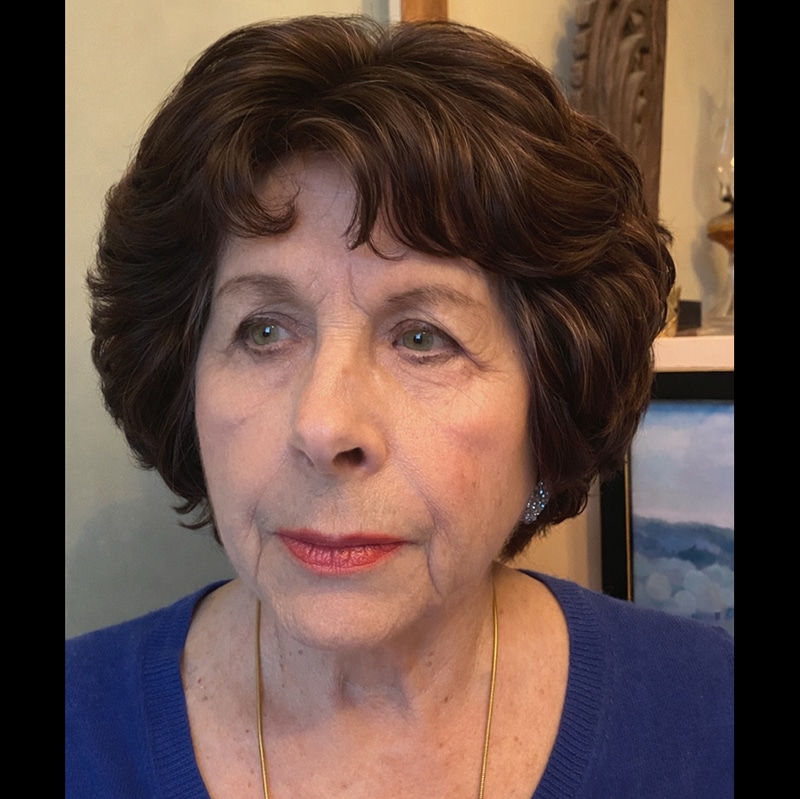
“I think for the less experienced writer, thinking always about the five senses and to try and include them as much as possible. Also, it’s very important to not let the editor inhibit you and just allow yourself to write and write. And the more you write, the easier it gets. And then there’s always time to go over it and edit it. But initially when you’re trying to get the work out, it’s best not to be critical. Just let it flow out of you.”
~Jane Herschlag
The poet, Jane Berger Herschlag, is a graduate of the Fashion Institute of Technology. She has been an apparel designer, textile designer, and model home decorator. Jane also received a B.A. in Creative Writing and Women’s Studies from Hunter College, and an M.A. in Creative Writing from City College of New York. Her writing has won numerous awards.
Jane curated open mic readings at New York’s West Side YMCA for seven years. She also ran a peer workshop for 10 years, taught creative writing at New York City schools and at ESCAPE to the Arts at the YMCA of Western Connecticut.
I’ve read Jane’s full-length poetry collection with her photographs, When the Mouth Can’t Speak the Body Will, and found it to be powerful and insightful. Readers travel with Jane through the pain of discovery and joy of regaining a self free of victimhood. Jane believes going public in writing and at readings frees one from the captivity of abuse. Hopefully, it seeds that growth in readers and listeners. If you like potent, no-holds-barred poetry, I highly recommend Jane’s book to you.
She’s also written a Docu-Poetry chapbook, Bully in The Spotlight. And she’s contributed prose and poetry to two anthologies of resistance from Awatum Press, in which Jane is one of six authors.
So, for all those reasons and many more, I’m privileged to welcome the author, poet, designer, and teacher, Jane Herschlag, to StoryBeat today. Jane, welcome to the show….
WEBSITES:
IF YOU LIKE THIS EPISODE, YOU MAY ALSO ENJOY:
- P.S. “Pat “Conway, Poet-Episode #395
- Cleo Childs, Poet-Author-Episode #343
- Tom Stein, Author-Episode #339
- Robert Monroe, Author-Photographer-Episode #338
- Adam Rosenbaum, Author-Episode #336
- L.A. Starks, Author-Episode #334
- Jimmy Roberts, Composer-Lyricist-Poet-Episode #287
- Martin Dugard, Author-Episode #328
- Richard Walter, Author-Legendary Teacher-Session 2-Episode #323
- Joseph B. Atkins, Author and Teacher-Episode #311
- Megan Woodward, Author-Episode #301
Steve Cuden: On today’s Story Beat.
Jane Hershlag: I think for the less experienced writer, thinking always about the five senses and to try and include them as much as possible. Also, it’s very important to not let the editor inhibit you and just allow yourself to write and write. And the more you write, the easier it gets. And then there’s always time to go over it and edit it. But initially when you’re trying to get the work out, it’s best not to be critical. Just let it flow out of you.
Announcer: This is Story Beat with Steve Cuden, A, podcast for the creative mind. Storybeat explores how masters of creativity develop and produce brilliant works that people everywhere love and admire. So join us as we discover how talented creators find success in the worlds of imagination and entertainment. Here now is your host, Steve Cuden.
Steve Cuden: Thanks for joining us on Story Beat. We’re coming to you from the Steel City, Pittsburgh, Pennsylvania. My guest today, the poet Jane Berger Hershlag is a graduate of the Fashion Institute of Technology. She’s been an apparel designer, textile designer and model home decorator. Jane also received a BA in Creative writing and Women’s studies from Hunter College and and an MA in Creative Writing from City College of New York. Her writing has won numerous awards. Jane curated open mic readings at New York’s west side YMCA for seven years. She also ran a peer workshop for 10 years, taught creative writing at New York City schools and at Escape to the Arts at the YMCA of Western Connecticut. I’ve read when the Mouth Can’t Speak, the Body Will, Jane’s full length poetry collection with her photographs and found it to be powerful and insightful. Readers travel with Jane through the pain of discovery and joy of regaining a self that’s free of victimhood. Jane believes going public in writing and at AH readings frees one from the captivity of abuse. Hopefully it seeds that growth in readers and listeners. If you like potent, no holds barred poetry, I highly recommend Jane’s book to you. She’s also written a docu poetry chapbook, Bully in the Spotlight, and she’s contributed prose and poetry to two anthologies of Resistance from a Wadam Press in which Jane is one of six authors. So for all those reasons and many more, I’m privileged to welcome the author, poet, designer and teacher Jane Hershlag to Story to Beat today. Jane, welcome to the show.
Jane Hershlag: Thank you so much. It’s a pleasure to be here.
Steve Cuden: Well, it’s a pleasure to have you. So let’s go back in your history just a little bit. At what point in your life did you first start Start thinking about words, reading, writing poetry. When did that begin for you?
Jane Hershlag: Actually, I was extremely withheld and withdrawn until my son developed some mental problems and history hit me. Until then, I barely read. And then it became a compulsion to read and write. It really only started when I was 45.
Steve Cuden: That’s quite amazing. And in your work seems like you’ve been writing for much longer than that. So I think that that’s remarkable, what you write in your poetry. And we’re to talk about your book extensively shortly. But you suffered dearly as a child, clearly.
Jane Hershlag: Very, very, very catastrophically.
Steve Cuden: Catastrophically. And it all comes out in the poetry. I mean, that’s what the book is really all about. Uh, and so the fact that you were unable to connect with reading and writing is understandable. That’s what makes it even more remarkable when you tell me you were 45 when you started to think about this kind of thing. Um, so when you were going through the first 45 years of your life, were you. You had a blockage to even think about it at all about storytelling?
Jane Hershlag: I did, but. But the visual was available to me. I was unafraid of fabric and design and flowers and nature. I wasn’t as recept. Anywhere near as receptive to it as I am today, but they were my comforters. They really offered me something to do when I was interested in art.
Steve Cuden: Always you were visually oriented, more than verbally oriented.
Jane Hershlag: Exactly.
Steve Cuden: That’s very interesting. Well, clearly, if you went and got a degree and did work in designing, you had to have some sort of visual acuity for that. So what ultimately then attracted you to poetry? Not just writing prose.
Jane Hershlag: It is amazing because, um, that was the first thing that I, ah, connected to, I think maybe because of the emotional intensity of what I was experiencing. And that poetry is so condensed and often very concentrated emotion.
Steve Cuden: Well, that is the beauty part of poetry is it’s basically emotional.
Jane Hershlag: And then I was also a compulsive rhymer originally, I think, because it had to be predictable. Um, I still was afraid of letting my mind have free rein. And so if I rhymed, then it was safer than not rhyming.
Steve Cuden: Well, most of your poems are not. They’re not rhyme festivals at all.
Jane Hershlag: No, I threw that away when I got a little bit safer in life. Then I threw away the rhymes.
Steve Cuden: So what, in writing, what fulfills you about it? What do you enjoy about it?
Jane Hershlag: I particularly love free writes. Just letting my pen go down. It’s usually on my pen, not the computer, um, to just keep going and not let any Filters inhibit anything from happening. Let it surprise me.
Steve Cuden: Do you feel like you’re doing what they call automatic writing or autonomic writing?
Jane Hershlag: Sometimes. Exactly.
Steve Cuden: You’re just letting it come through you?
Jane Hershlag: Exactly, yes.
Steve Cuden: Does it come from a spiritual place, do you think?
Jane Hershlag: Probably a little bit, yes. Particularly when it’s the nature. I’m actually surprised by my metaphors that appear on the page.
Steve Cuden: Mhm.
Jane Hershlag: And then sometimes, um, it’s just surprising. It reminds me a little bit of dreams when you do the free write or the, as you say, automatic writing. Um, because when you dream it also doesn’t make necessarily a lot of sense. But then when you um, inspect it, then it seems to have a logic to it.
Steve Cuden: Well, there are many creators who I’ve spoken to and I’ve done a lot of reading and research on creativity. And one of the things that’s a, uh, hallmark of many creative people is that they will say to you, when asked the question, where does it come from? The answer is, I don’t know. It comes through me and I’m a conduit for it, or I’m a sieve and it flows through me. Is that how you feel?
Jane Hershlag: Yes, definitely. Not all the time, but I think the best writing comes from there. When it just comes through you, you’re
Steve Cuden: just uh, the messenger, so to speak.
Jane Hershlag: Yes. It’s like, you know, you can’t control your dreams. They just do what they do.
Steve Cuden: Right. That’s a very good analogy, is that it’s like dreams. I think that’s an excellent to see it. Do you have a sense in your head what makes a good poem good?
Jane Hershlag: Usually I don’t like things to be too florid. I like them to be accessible and um, succinct. I think maybe because I was so confused in early life that I like to be able to access things. If a poet is very, very difficult to access, uh, like some of the language poets, I don’t have the patience to pursue the diligent efforts required.
Steve Cuden: Do you find that the act of writing poetry for you personally is a healing thing?
Jane Hershlag: Wonderfully healing. Wonderfully healing. There was a poet who, um, I read just recently who said that poetry is a conversation between the unconscious and the conscious mind. And I think that that’s really accurate.
Steve Cuden: Do you think that the people that are reading it are also being healed by it?
Jane Hershlag: I think so, because there’s a camaraderie. For instance, when I go to readings and there are incest survivors in the, um, audience, they come up and they tell me that it really Helped them.
Steve Cuden: So we should say right now at the top, because we haven’t said it yet. There’s an enormous amount of material in your book about incest, about physical and sexual abuse, um, that you were a very little girl when this, what you’re writing poetry about, when this happened to you. And it’s somewhat graphic throughout any number of the poems. Um, and I think perhaps some people would have a hard time getting through it because it’s challenging to read. It’s challenging for me to read and I’ve never experienced what you’ve experienced. So, um, that makes it of interest to me, um, from an intellectual standpoint and an emotional standpoint. Is that your intention?
Jane Hershlag: I hope there’s enough nature poems in there to bring some relief, because I don’t want the reader to suffer. I do want the reader to understand. Because I think if people really understand the impact that abuse has on a child, that maybe they could apply themselves to trying to prevent it if there’s more awareness.
Steve Cuden: But a child would not have read your book you’re talking about. Adults would have to have read it, right?
Jane Hershlag: Right. No, this could not be for a child. It would be much too scary.
Steve Cuden: And that a child like you or anyone else that would have to go through it, that’s just, um, you know, horrific to even contemplate, let, ah, alone to experience. So, um, what do you think it is about the impact of poetry as opposed to prose? Because you’ve also written some prose as well. What do you think the impact is that makes it unique compared to writing literature or prose?
Jane Hershlag: I think the fact that it’s so concentrated, you get to the whole story very quickly in a poem. I mean, it’s usually only one to four or five pages. It’s learning the beginning, the middle and the end very quickly.
Steve Cuden: Did you go to school for it at all? Did you when you were in school?
Jane Hershlag: When I went back to school as a, uh. In my mid-40s, then I took. That’s when I studied English lit and uh, women’s studies. Before that I just had art school. I mean, you know, I was a graduate for textile design and apparel design.
Steve Cuden: What do you think the best piece of advice you got as a, you know, in terms of writing poetry when you were in school? What did the teachers tell you that helped?
Jane Hershlag: And any writer will tell you that the five senses are the most important thing to be very acutely aware of and to feel them and write them. If you don’t include the sensory stuff, you don’t get the reader to join you in what it is that you’re working on or creating.
Steve Cuden: Well, that is, uh, abundantly clear when you read your work, that the power is in the way that you’ve laid it out so that it’s undeniable. It’s not like, uh, you don’t candy coat it and it’s not hidden, it’s right out in front of you. So that just has a powerful impact. As I said in the bio, I
Jane Hershlag: think part of the healing mechanism is also exactly that. Because I can be very assertive and I don’t. There’s no mamby pamby. I don’t let anybody lie. I say if I could really is
Steve Cuden: you do you tell it exactly like it is.
Jane Hershlag: You can’t imagine how many years of therapy it took to be able to reach that stage where I could just say it like it is. Um, because everything was so taboo that to. I’m positive if I revealed to anyone what actually went on in our house, I would be dead. He would have definitely killed me, no doubt about it.
Steve Cuden: Wow. Well, so part of what you went through was a sense of, uh, fear for your own life beyond just the abuse itself?
Jane Hershlag: Very much so. Um, I mean, he did very serious things, like very seriously choking me, so the doctor had to come to the house and, um, things like that so that my life was in threat.
Steve Cuden: Like I say, it’s really horrible for me to contemplate having never gone through it. It’s just, uh, awful. The book is called when the Mouth Can’t Speak, the Body Will. What does that mean? What does that title mean?
Jane Hershlag: I wasn’t allowed to express anything. Nobody did. Everyone is blind and everything was hunky dory. But I had terrible autoimmune problems. My body was in constant sickness, uh, really, really bad illnesses. Um, and I think from extreme repression and living in terror, it wore out the immune system. So that I was, you know, in the hospital numerous times and had very serious illnesses. I mean, typhoid and, um, infectious hepatitis and on and on. It was just my. When I had recall, my immune system became normal. Until then, I didn’t have an immune system.
Steve Cuden: That’s interesting. So as soon as you had the understanding of what happened to you, a lot of the issues underlying your medical issues went away.
Jane Hershlag: Yes. Right.
Steve Cuden: That’s incredible. That’s really quite incredible. So when you were sitting down and deciding to write a book, was it a book or did you just decide to write a series of poems and then put it together?
Jane Hershlag: Just. Just poetry writing? There was no book intended originally Actually, I have something like 12 or 1400 poems. I mean, have like, uh, six volumes of poetry. But I’ve only, um, tried to get a couple of them published. But now. Now I’m m. Seriously seeking publication.
Steve Cuden: Well, I think that’s you. You know, um, hopefully people will read the book and it will catch on. And that way, um, it will. They’ll demand more, you know, because that would be good. It would. It would be good. Um, how did you make a decision once you gathered the poems up, how did you decide what order they would go in?
Jane Hershlag: Well, I would actually. The first couple manuscripts, I just laid everything. I took about 80 or 100 poems and laid them down on the floor. And I wanted to group similar things together so that there was a little bit of, um, a pattern. Then on one of my most recent manuscripts, I have all my poems in an alphabetical order. After taking like 40 poems, I just suddenly realized it makes sense to do it. One manuscript that’s alphabetical, and I just did the last one alphabetically.
Steve Cuden: It doesn’t have a, um, textual flow to it other than it’s alphabetical.
Jane Hershlag: Right. Well, you know, because my writing is either very into, um, abuse or the astounding nature of the way it just heals everything. And is. Is so incredibly enjoyable. Um, and then sometimes some philosophical things are interspersed. But mostly those are the two themes in my books.
Steve Cuden: Well, I know you’ve been told this before, but I think you’re very brave to put it down on paper and then release it to the public. So it’s one thing for you to put it in a private journal or something like that and never show anybody, but you’ve now published it. Um. Do you think of yourself as brave?
Jane Hershlag: I never did, but I think I’m beginning to. Um. You know, I was just telling my husband today that the first few times that I read publicly, first of all, I was an incredibly shy person because of my history. I just had to hide all the time. So talking to more than two people, I basically didn’t do. But when I started to read my poetry in public, I would stand there and I would shake. And I didn’t know why, but now it’s no problem at all. But I was apprehensive.
Steve Cuden: You’ve gotten past that. The stage, uh, fright part of it where I don’t know. I don’t know how this is going to turn out, whether people will throw things at me or I’ll collapse. You don’t know what’s going to go on. But then once you get through it a few times. And you’ve also been a teacher too, right?
Jane Hershlag: Yes. Yes.
Steve Cuden: So you’ve stood in front of people and spoken to them. Uh, but it is a little different when it’s your own actual work, Definitely.
Jane Hershlag: Especially when the work is so, um, Nasty to hear, then that. It makes it. Yeah. Then it makes it harder to share.
Steve Cuden: So I think most poets, which you are, um, don’t go into it for the money, to put it mildly.
Jane Hershlag: Never.
Steve Cuden: Very little in the world of poetry actually makes money. Um, is it possible to make money, do you think?
Jane Hershlag: It is, but there are very few. I mean, Sharon Knowles, I’m sure, makes a lot of money. And, um, you know, there are others that are. And Billy Collins. My goodness.
Steve Cuden: So as you sit down to work on a poem, I know it’s coming through you versus you’re contriving it. Um, about how long does it typically take you to write a poem?
Jane Hershlag: Sometimes it’s very fast and it doesn’t need a whole lot of editing. And sometimes I can go back to it and it requires editing over and over. I’m not sure what the difference is, why that happens.
Steve Cuden: Well, how do you know it’s done? How do you know it’s ready to be given to someone, to look at?
Jane Hershlag: When it makes me happy.
Steve Cuden: When it makes you happy. So, uh, it’s a gut level, then?
Jane Hershlag: Yes, exactly.
Steve Cuden: There’s nothing, um, academic about it. It’s quite, uh, in the pit of your stomach.
Jane Hershlag: Right.
Steve Cuden: And do you feel like. Well, I think we’ve actually said it, but I’m going to say it this way. In storytelling, I’m a firm believer that the. For lack of a better word, the storytelling drug, the thing that brings people back time and time again to stories is this notion of catharsis or emotional purging. And I think all of your work is gigantically cathartic. I assume that it is for you. Yes.
Jane Hershlag: Oh, completely. It’s amazing. It’s like taking vitamins or, you know, or antibiotics. It’s just. It’s amazingly healing.
Steve Cuden: All right, so let’s talk about some of the poems in specific. As we’ve said, your work is sexual. It’s graphic. Uh, it’s somewhat offensive to some people. I’m sure people will be offended by some of it. Just be just by the nature of it. Not as if you’re trying to offend people. It’s just the nature of it. Um, I’m not offended by it. I found it challenging to read, but I’m not offended by it. Did you have Any intention of shocking people?
Jane Hershlag: No, never.
Steve Cuden: I didn’t think so. Uh, what is it that you want the reader to feel?
Jane Hershlag: You know, many people have trauma, even if it’s not that specific type. I mean, many people go through war, divorce, illness. There’s a lot of trauma in life, and it doesn’t. You share so many of the same emotions. It doesn’t have to be the same trauma. I, um, mean, my friend. I had an older friend who lived through the Second World War. She was very young, but, you know, the bombs dropping and.
Steve Cuden: Well, let’s talk about that for a moment, because your very first poem before the Burning of Fall Leaves, you talk about, and I assume that this is from reality, that your father was in a concentration camp.
Jane Hershlag: Yes, that’s true.
Steve Cuden: Was it Mauthausen? Yeah.
Jane Hershlag: Yes. Yes.
Steve Cuden: And, uh, what do you think that did to him in turn? He did things to you. Do you think it’s part of it?
Jane Hershlag: I would imagine it had some impact, but he was a very weird guy before he was in concentration camp. Um, I mean, in retrospect, I was surprised that my mother married him because he was so weird. He was very, very obsessive and very accusatory. He would. If a child on a bus looked at my mother, he would get very angry and say that she enticed him. I mean, he was very paranoid, so. But. But it somehow made her feel loved. You can’t pick your people out.
Steve Cuden: Well, that’s, you know, as my father used to say, there’s no accounting for taste. And. And so you, uh, don’t know why people like one another or fall in love with one another, even when it’s very abusive or strange or whatever. Um, in your bio, you say going public in writing. I’m quoting now. Going in public in writing and at readings frees one from the captivity of abuse. How does that do that? How? How what, what does speaking it out loud, what does that do to free you?
Jane Hershlag: Because when an audience hears it, and especially because they respond so well, um, there’s a camaraderie that forms. Even if they didn’t experience the same kind of trauma. When you share, it’s always a beneficial effect for the share of all people involved. I think that has a lot to do with why people would come up to me and open up to what happened to them. It somehow reduces the barriers. It makes it easier for them to come forward and talk about their experience.
Steve Cuden: Sure. I think that that’s a very good way to put it, is it breaks down the barriers between you. If you were just to walk up to somebody and say, hey, let me tell you what happened to me as a kid. And you started talking about what you’re, you’re revealing in the poems, they might look at you like, why are you telling me this? But in a poem, somehow I think it softens it, the, the impact where you can, you can make it m. Palatable for a reader. Uh, you know, and I also have spent my, a lot of my career in writing scripts for the screen, uh, and for the stage. And uh, you know, I think if you told this in a, your story, in a movie, it would be a whole different kind of impact. I think the fact that you tell them your story in poetry makes it a little easier for the audience to absorb.
Jane Hershlag: Yes. Wow, that’s interesting. I suspect that you’re right. Um, because just to think seeing the visual is like too overwhelming.
Steve Cuden: It is too overwhelming. The visual that you create is in the reader’s mind’s eye. It’s not on a screen. You’re not seeing it. Interpreted through the vision of a director and actors and designers, uh, it’s all within the reader’s point of view. Um, and so that has a different impact entirely, uh, than a visual image. Um, in the poem, an unusual Appetite, you use the metaphor of a hunger crazed lion to explore sexuality. How did you come up with that metaphor?
Jane Hershlag: It just popped out. It’s just the unconscious speaking.
Steve Cuden: When that occurs to you. When you’re having it flow through you like that, do you ever resist anything or do you just go with the flow?
Jane Hershlag: I go with it and I wait till later, you know, there’s plenty of time afterwards to stop it. But I don’t want to stop. Stop it during the process.
Steve Cuden: So the time to stop it is when it’s a, uh, finished something.
Jane Hershlag: Right? Right. When my pen stops.
Steve Cuden: And do you then let it sit for a while? Do you give it some distance?
Jane Hershlag: I usually do, yes.
Steve Cuden: What is a typical length of time before you go back and look at?
Jane Hershlag: Um, depends. It varies so much. Sometimes it could just be like an hour later. Sometimes it’s a week. Sometimes I don’t go to it for six months.
Steve Cuden: And. And when you go back to it, does it impact you differently than when it came through you?
Jane Hershlag: Um, believe it or not, sometimes I’m surprised that I wrote it. It doesn’t sound like me. I think it doesn’t sound like me.
Steve Cuden: I don’t think that’s surprising. Well, you know, you look like a very sweet, gentle person and the stuff that you’re writing is not sweet or gentle. So. So it doesn’t. You’re correct. It doesn’t look like you. It doesn’t sound like the way that you might approach. Um, you write in another writer’s retreat that your fellow writers called you brave, as we’ve just talked about. And I’m just wondering, when you get up in front of people and speak, does that then require you to get your courage up to do that? Or now? Is it easy?
Jane Hershlag: Not anymore. Not anymore. It used to a lot, but that was only, like, the first year or two after I got unafraid of their reaction. Then, um, I was okay with it. And then because people wanted to share so much, so that made me feel good. It was reassuring.
Steve Cuden: Do people then come to you as if you’re an expert on it Sometimes, Yes. Like you. Almost like you have a doctorate in it and you can be their therapist.
Jane Hershlag: I do have a doctorate in abuse, it’s true.
Steve Cuden: Not an actual doctorate, though.
Jane Hershlag: No, no, no.
Steve Cuden: But you have a life doctorate in it.
Jane Hershlag: Exactly.
Steve Cuden: Yes. Yes, you do.
Jane Hershlag: A metaphorical doctorate.
Steve Cuden: You believe through the abuse, and you say it in the poem, Dear Dr. Oliver Sacks, that you have lost a certain amount of your memory function through your damaged hippocampus.
Jane Hershlag: Yes.
Steve Cuden: How was that diagnosed?
Jane Hershlag: Um, it was many years ago when I wanted to get my doctorate and I needed. I was told by the professor that if I could get, um, confirmation of my memory problem, that I could have an open book exam for my doctorate. Uh, and that was why I went and it was like a four or five hour exam. This was maybe 40 years ago. It came out that I have an incredibly high iq. I won’t even say what it is, but it’s. And that my memory functions at 50% capacity.
Steve Cuden: Do you find that frustrating?
Jane Hershlag: Oh, you cannot imagine how torturous it is. It’s mind blowing, just incredibly mind blowing. It’s like being somewhat blind. Really, really blind.
Steve Cuden: Uh, but at the same time, you’ve been extremely productive, and so you fight through that.
Jane Hershlag: Obviously, it’s not with memory. It’s a different part of the brain. Um, it’s like I have very excellent intuition, and, um, I really pick up on vibes and know what’s happening around me. Um, but the memory capacity is just a whole different section of the brain.
Steve Cuden: I have to imagine that your, uh, senses are extremely heightened from the experiences you had as a kid.
Jane Hershlag: Exactly. Yes. That’s so true.
Steve Cuden: And all that stress did that to you, too.
Jane Hershlag: In my sleep, I can hear any sound I was so attuned to when he would enter the room. I mean, everything was, uh, very, very, um, sensory aware.
Steve Cuden: In the poem, I have a passion for purple. You write that early on I learned the trick of starfish will grow whole again.
Jane Hershlag: Yes.
Steve Cuden: What does that mean?
Jane Hershlag: I, uh, felt so truncated and so damaged. And especially during the process of retrieval, when it seems to you so confusing, it can’t possibly be real that all this happened. But then as it comes out of you, you gain strength and you discover that you are able to be alive. And, um, it just gives you confidence.
Steve Cuden: Am I correct that you’ve had a very long marriage? Yes.
Jane Hershlag: Oh, my God. I’m married since I’m 19 and I’m 84, so, wow. We have a fantastic marriage. I mean, if I didn’t have psychotherapy, I don’t think it would be this great because we both were in therapy. And, um, we just have an amazing marriage. We’re just very, very lucky.
Steve Cuden: Well, good on you. I think that that allowed you to be able to not only have this come out, but then write about it and talk about it.
Jane Hershlag: He is so supportive. It’s astounding. When the book came today, he was so happy for me. And, um, he made me read him all the poems that are in there that published. And he’s just. He has such an amazing support. He’s just wonderful. And he’s also an artist, which is so great.
Steve Cuden: Well, then he understands in a way that just the average person might not.
Jane Hershlag: He’s a sculptor and painter, um, and was also, um, a professional artist for ABC Television. So he. We just groove on a lot of the same things.
Steve Cuden: You were also a designer so that you had that in common?
Jane Hershlag: Yes, definitely. Definitely. He was working professionally, and then, um, I was working in the textile field, and it became so lucrative that he left there and we just worked together, and we designed home furnishings and wall coverings and everything together. Was. We found 24 7.
Steve Cuden: I’m, uh, glad you brought that up, because that is a kind of a discipline, that artistic discipline and that design discipline. How do you think that being disciplined in that way helped you to become a writer, ultimately a published writer?
Jane Hershlag: Wow. That’s a great question. I never thought about it. I, um, think, um, applying yourself diligently to the art field and you have to meet deadlines, and, um. And I enjoyed the work so much. So it just, uh. We worked, I mean, 60 hours a week, the two of us, each of us. And I now do the same thing with writing. It’s like I could write forever.
Steve Cuden: So. So having done that, had you never done anything like that. This might have been a different experience for you to be a writer.
Jane Hershlag: That’s so true. Yes.
Steve Cuden: Because you understand the nature of waking up in the morning and going to your desk and doing something. Nobody’s forcing you to do it. You’re not punching a clock at a factory. Right?
Jane Hershlag: No. Right. We were, um, on our own. We were freelancers. So you’re right. Well, I mean, with you, with all your. The amazing amount of work that you’ve achieved, you have to have been doing the same thing.
Steve Cuden: That’s correct. And I understand the process of, uh, there’s nobody lording over you, you and saying, cracking the whip. You’ve got to get that done. Uh, you develop an internal mechanism of, I have a deadline, I’m going to be a professional, and I’ve got to meet the deadline. Though when you wrote your poems, there was no deadline, but you just knew you had to get it out, right?
Jane Hershlag: Well, it was cathartic, so it was relief to get it out.
Steve Cuden: So ultimately, when you got this published, did you work with an editor?
Jane Hershlag: No. I mean, they didn’t really edit anything. They accepted it as it was.
Steve Cuden: I think that it’s much more difficult for a publisher to edit someone’s poetry than it is for them to edit, uh, any kind of like prose. Because prose, prose, there’s so many. The sentence structures can be screwed up, and the way that people spell things can be wrong and so on. But in a poem, it’s sort of what’s coming out of the poet is what belongs.
Jane Hershlag: It’s interesting because, um, actually, I have a memoir that I’ve written that I would like to get published. And I definitely hope to get, um, editing, you know, to improve it.
Steve Cuden: See, I think in that case you probably will go through editorial and somebody is probably going to say to you, you know what? You should put this in front of that. You should eliminate this sentence and that word. You’ll get all those kinds of notes. Are you used to in your, uh. Both in your design work and elsewise, are you used to people giving you notes?
Jane Hershlag: Um, when I was working in an art studio, the head of the studio would occasionally give me some direction. But, um, since I was most of the time freelance.
Steve Cuden: Ah, no, you’re not used to having notes. So I will say to you, it’s just a half. A bit of advice is relax when they come at you, because you very well might get some notes in your. You may go, what are they talking about? And you may disagree. Um, it’s best to My advice to all writers, especially when I’ve taught, is to take the notes. Don’t fight the notes. Fix what you think is viable and valid and let the rest go. Um, but don’t fight the notes when you get them.
Jane Hershlag: You know, I know that the, uh, memoir is nowhere near the same quality as my poetry and some of my essays. So I will be grateful for the comments and the critiques.
Steve Cuden: Well, you say that now, but wait till you get the notes. You may not be so grateful, but you never know, right? Hopefully they’ll be great. Hopefully they’ll be very helpful. Sometimes people give you notes and you don’t know what they’re talking about.
Jane Hershlag: Oh, you know, in school when you have a really good professor and they critique the work, it’s thrilling because it really improves the work, right?
Steve Cuden: Because, well, again, I think there’s a significant difference between poetry and prose. Uh, when someone is giving you their thoughts, you’re getting, um, hopefully their expertise and hopefully their real feelings and opinion about the work itself. But it’s different in prose because it’s more straightforward. It doesn’t have any kind of abstraction to it. It doesn’t have any kind of, um, odd structural stuff to it. And poetry can go the other way. So I think that makes a huge difference. Uh, tell us about your chapbook. What is that, uh, you just had published. What is that?
Jane Hershlag: That’s an anthology. It’s called Resistance An Anthology of Overcoming. So it’s about, um, different types of overcoming. I was just so thrilled because they took 14 of my poems in here.
Steve Cuden: Are you planning to write other books of poetry? Are you going to take a lot of the hundreds that you have and make more books?
Jane Hershlag: I have, um, four more books that I’m going to be submitting and, um, I have started to submit.
Steve Cuden: You’ve already started to submit to the same publishing house or different places?
Jane Hershlag: Finishing Line Press isn’t that big a publication, a publisher, so, um, looking for maybe bigger publishers. And I’ve had so many other pieces now put into, um, online and in other anthologies so that I think there’s a better chance. And I was just nominated for Best of the Net, so I’m hoping that, um, a publisher that has more prominence will be interested.
Steve Cuden: Well, I wish you well in finding that, uh, it’s truly challenging today in the publishing world because so many books are self published and so many books are out there and it’s tough and you’re writing and if you’re publishing poetry, obviously there is a market for it, but that market is much smaller than it is, say, for Stephen King.
Jane Hershlag: Absolutely.
Steve Cuden: And now with AI and now with AI. Well, are you reading AI poetry?
Jane Hershlag: No. No. I love AI to help me with medical questions or, like, when I’m stuck on my computer. They’re fantastic. But I, um, don’t want to read anything literary written by AI.
Steve Cuden: Well, what’s scary is you. You may get to. We may all get to a point where there’s AI published stuff and we don’t know it’s AI.
Jane Hershlag: Yes.
Steve Cuden: And I do think, if you think about it this way, I do think it will be easier to fool a reader in a poet poem than it will be in a long story.
Jane Hershlag: Wow. Uh, that is probably true. How sad.
Steve Cuden: Well, it is kind of sad. But if you think about it, poems frequently don’t. They’re. They’re not like somebody speaking in a straightforward, natural way.
Jane Hershlag: Right. They’re not linear.
Steve Cuden: They’re not linear. They can be a little. The wording can be a little odd, and. And you go, oh, what a wonderful poet. But in fact, it’s AI. You won’t know.
Jane Hershlag: Oh, my goodness.
Steve Cuden: So what do you do to refresh your. Well, is there anything you do? Do you go for walks? Do you, um, watch tv? Is there anything.
Jane Hershlag: I have physical problems, so I really don’t go for walks. But I love flowers. And we live on a reservoir, and we have a deck attached to our house where we look at the water and we see water birds. And, um, I have a lot of flower pot plants, a lot of flower pots that I’ve hand painted and their flowers everywhere. So just. Even when it’s too cold to go out, but if they’re still blooming, I’m in heaven. Because we have glass windows floor to ceiling, and we just see nature everywhere all the time. So even when it’s not blooming, you know, in the winter, it’s still gorgeous.
Steve Cuden: Do you think that, uh, seeing that is what inspires you to continue to do stuff?
Jane Hershlag: Definitely. It helps. It really does. It just. It nourishes. It really does. You know, sometimes I can be really down in the dumps because I’m not feeling well or just feeling overwhelmed in certain ways. And then when I look outside, it’s just so amazing. And then I’ll see a heron. You know, it’s just. It’s unbelievable.
Steve Cuden: There is something about nature that brings us back to who we are as humans. And if you’re stuck in a house all day long, that’s not such a good thing, I don’t think.
Jane Hershlag: No, no.
Steve Cuden: Yeah. So I’ve been having just the most marvelous conversation with Jane, uh, Hirschlag about her poetry and about life and about the, uh, challenges she’s faced. And we’re going to wind the show down just a little bit. And you’ve, uh, obviously been working on this material for a long time and you’ve taught and you’ve been a designer. Are you able to share with us a story from your experiences that’s either weird, quirky, offbeat, strange, or. Or just plain funny?
Jane Hershlag: Actually, we had a very weird experience when we were newlyweds. We were living in a walk up apartment. Uh, we were on the third floor and it was kind of a railroad flat. And we were sleeping. We didn’t, uh, even yet have the box spring. We had only the mattress on the floor and it was very cold. And I hear this loud rattling window at night waking up me up. And I was wondering what kind of crazy storm it is. And then I heard, let me in. Let me in. Don’t be, uh, afraid. Let me in. And so I woke up Herb, and he’s amazing. He can sleep through anything. I woke him up and then he got up. I said, what are you doing? He said, well, I have, have to let her in. She’s on the fire escape. I said, well, what if it’s a ruse and she has somebody with her? He said, I can’t leave her out there. So he lifts up the window and she climbs over the, into the room and she has a giant gash on her leg and she’s bleeding. And she walks through, onto our mattress, through the bedroom, through the living room, into the kitchen, and sits down like it’s her apartment. I and Herb followed her and I hear them talking in the kitchen. And this was before cell phones, so there was, uh, the only phone we had was in the kitchen. And I couldn’t call the police. And then we hear this raucous pounding on the door. And it’s the police let us in. And she pleads with Herb not to let them in. And Herb says, I can’t. I have to let them in. And he opens the door and these three big guys come in and they say, okay, everybody go back to your apartments. Everything’s okay. And then they try the, uh, police try and convince her to come. I said, how did you know to come here? He said, there was major fighting and screaming and the neighbors called us and so that’s why we came.
Steve Cuden: Wow.
Jane Hershlag: And they were very patient. It was really nice to see how patient they were to convince her to Go with them. I don’t know if they would be so nice today. They really tried to make her unafraid. It turned out her ex husband was in the hospital, and she brought boyfriends in there, and he was very drunk, and he was trying to kill her. And so it was very lucky that Herb let her into the place.
Steve Cuden: No kidding. Uh, but I mean, the idea of being woken up out of your sound sleep and letting a bleeding person into your house, not knowing who they are, that’s weird.
Jane Hershlag: You can’t imagine how dirty she was. She’s the dirtiest person I’d ever seen. Wow.
Steve Cuden: She living on the streets?
Jane Hershlag: Yes, exactly.
Steve Cuden: You know, that that would be very scary.
Jane Hershlag: Of course I wrote about it. Called the Night Intruder.
Steve Cuden: Yes. Yes. As well you should. All right, so last question for you today, Jane. Um, you’ve shared, uh, an enormous amount of wonderful advice along the way here for anyone thinking about, uh, writing poetry or just being a writer in general. And I’m wondering, are you able to share with us a piece of advice or a tip that you like to give to anyone who has said to you, well, how do you do this? Well, how do you write poems? How do you do it?
Jane Hershlag: I think for the less experienced writer, thinking always about the five senses and to try and include them as much as possible. And also, it’s very important to not let the editor inhibit you and just allow yourself to write and write. And the more you write, the easier it gets. And then there’s always time to go over it and edit it. But initially, when you’re trying to get the work out, it’s best not to be critical. Just let it flow out of you. That’s what I would recommend.
Steve Cuden: I think that’s wonderful advice and valid for anyone that’s trying to write anything. Just purge the material out.
Jane Hershlag: Purge is the perfect word.
Steve Cuden: Well, that’s what we call. We call them purge drafts. Sometimes people call them puke drafts. Just get it out on paper or on your screen and then worry about coming back and fixing it later. Because I’ve long said to people, and that’s not my theory, but I believe and subscribe to the notion that the art is in the revision. The art is not in the initial draft. That’s the craft. And then you add craft. You keep the craft, but you add to it art by being a reviser and editor, your own editor. Uh, so I think that’s really terrific advice.
Jane Hershlag: It reminds me of when you’re doing the final parts on a sculpture, when you’re really, um, refining the stone.
Steve Cuden: That’s exactly what it is. Well, I’ve said to people in classes that I’ve taught that I think of the first draft, I’ll say to them, have you ever made a clay piece of art in school? And they say, yes. And I said, well, first you’re given a, you know, an unformed piece of clay, and you have to turn that into something initially before you refine it. And I say, that’s you’re actually making your first draft is that lump of clay that you’re. You’re actually creating that clay, and then everything else is the refinement of it.
Jane Hershlag: I was going to say it’s amazing how the. All the arts have relativity, Right?
Steve Cuden: Well, I think that’s actually absolutely true. Art is art, and how you approach art is a personal thing. But I think at the end of the day, most people who commit their lives to art are doing similar things. There’s a discipline to it. There’s a repetition to it. There’s a, uh, you learn more as you go. It’s a. You get stronger and stronger. Um, so I think that, yes. That there is a lot of similarity across all the disciplines.
Jane Hershlag: Yes, definitely.
Steve Cuden: Jane Hershlag, this has been an absolutely terrific show today, and I can’t thank you enough for your time, your energy, and your wisdom. And I’m so sorry that you’ve gone through what you’ve gone through. But look, at the end of the day, you’ve turned out something absolutely wonderful for people to enjoy, and I thank you for being on the show with
Jane Hershlag: me today, and you’re a wonderful host. You just put me so at ease. It’s a pleasure. Thank you very much.
Steve Cuden: And so we’ve come to the end of today’s Story Beat. Uh, if you like this episode. Episode, won’t you please take a moment to give us a comment, rating, or review on whatever app or platform you’re listening to. Your support helps us bring more great Story Beat episodes to you. Story Beat is available on all major podcast apps and platforms, including Apple Podcasts, YouTube, Spotify, iHeartRadio, TuneIn, and many others. Until next time, I’m Steve Cuden, and may all your stories be unforgettable.









0 Comments