
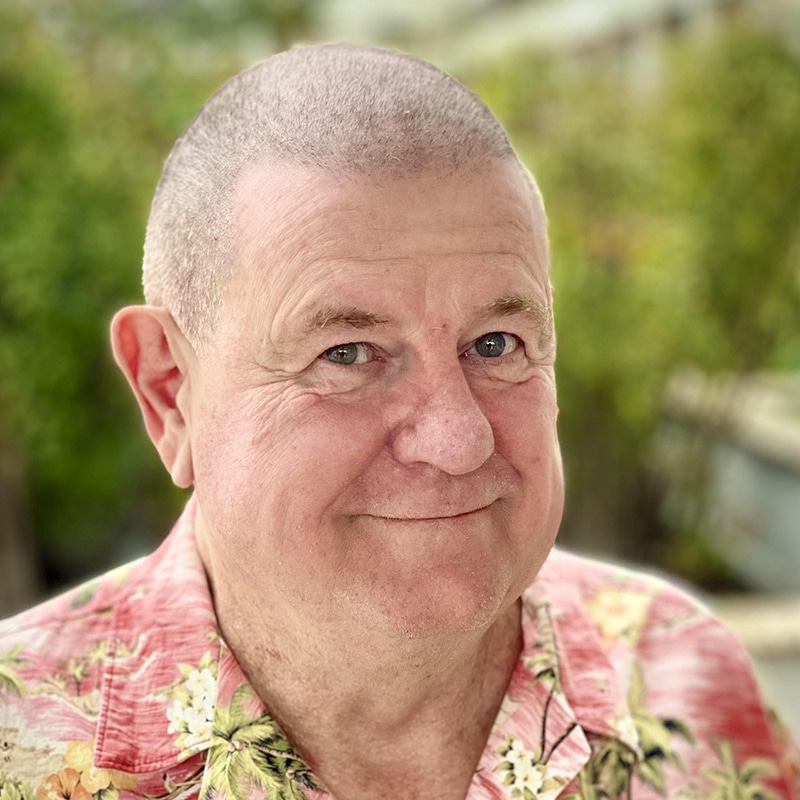
“Yeah, like I said, we like to say with scripted, you write the script and then shoot the show. With reality, you shoot the show and then write the script. And that’s kind of how it works. So you just, you have to just hone it down and hone it down and hone it down. And you start with 400 hours, you get to 300 hours, you get to 200 hours, you get to 100 hours, you get to 50, you get to 20, you get to 10, you finally get it down where you need it. And that’s, that’s a big, that’s a big part of it is just, just having the time and the mental acuity to be able to hone that down and really focus on what you need.”
~Rusty Austin
Rusty Austin was a reality TV show producer for over three decades and is now the author of six published books, including an illustrated children’s book series.
Rusty broke into Hollywood as a freelance electrician on dozens of movies, including Terminator 2. After a few years, he decided to give up movies because everything in the lighting and grip department weighed no less than 50 pounds.
He then spent 35 years producing reality TV shows like Real Stories of the Highway Patrol, Big Brother, Survivor, Nanny 911, COPS, and Hell’s Kitchen, which he worked on for 16 seasons, and from which he retired in 2018.
His books include: Baseball’s Unlikely: A Constant; Dave and Me; and four children’s books: The Carrot Is Orange, The Unicorn Has One Horn, Beware The Grizzly Bear, and An Awesome Bird: The Pelican. I’ve read An Awesome Bird: The Pelican, and can tell you it’s a wonderfully charming compendium of Rusty’s short and sweet poems about lots of different animals set against whimsical artwork created by middle schoolers from Cathedral City, CA. If you have kids and are looking for a truly entertaining and educational book, I highly urge you to check it out.
WEBSITES:
rustyaustin.com
IF YOU LIKE THIS EPISODE, YOU MIGHT ALSO ENJOY:
- Laura Gabbert, Documentary Filmmaker-Episode #335
- Tim Stepich, TV and Movie Editor-Episode #315
- Okema T. Moore, Emmy-Nominated Producer-Episode #314
- Richard Bakewell, Writer-Director-Cinematographer-Episode #282
- Mark Nichols, Producer and Designer-Episode #179
- Kit Steinkellner, Writer-Producer-Episode #115
- Scott Guy, Emmy-Nominated Producer-Episode #73
- Rocky Lang, Writer-Producer-Director-Episode #67
- Christopher Lockhart, Producer, Story Editor-Episode #13
Steve Cuden: On today's Story Beat.
Rusty Austin: Yeah, like I said, we like to say with scripted, you write the script and then shoot the show. With reality, you shoot the show and then write the script. And that's kind of how it works. So you just, you have to just hone it down and hone it down and hone it down. And you start with 400 hours, you get to 300 hours, you get to 200 hours, you get to 100 hours, you get to 50, you get to 20, you get to 10, you finally get it down where you need it. And that's, that's a big, that's a big part of it is just, just having the time and the mental acuity to be able to hone that down and really focus on what you need.
Announcer: This is Story Beat with Steve Cuden, A, uh, podcast for the creative mind. Story Beat explores how masters of creativity develop and produce brilliant works that people everywhere love and admire. So join us as we discover how talented creators find success in the worlds of imagination and entertainment. Here now is your host, Steve Cuden.
Steve Cuden: Thanks for joining us on Story Beat. We're coming to you from the Steel City, Pittsburgh, Pennsylvania. My guest today, Rusty Austin, was a reality TV show producer for over three decades and is now the author of six published books, including an illustrated children's book series. Rusty broke into Hollywood as a freelance electrician on dozens of movies he was including Terminator 2. After a few years, he decided to give up movies because everything in the lighting and grip department weighed no less than £50. He then spent 35 years producing reality TV shows like Real Stories of the Highway Patrol, Big brother, Survivor, Nanny, 911 Cops, and Hell's Kitchen, which he worked on for 16 seasons and from which he retired in 2018. His books included Baseball's Unlikely, A Constant, Dave and Me, and four children's books, the Carrot Is Orange, the Unicorn Has One Horn, Beware the Grizzly Bear, and an awesome Bird, the Pelican. I've read An Awesome Bird, the Pelican and can tell you it's a wonderfully charming compendium of Rusty's short and sweet poems about lots of different animals set against whimsical artwork created by middle schoolers from Cathedral City, California. If you have kids and are looking for a truly entertainingly educational book, I highly urge you to check it out. So for all those reasons and many more, I'm greatly privileged to have the multi talented producer and author Rusty Austin join me on Story Beat today. Rusty, welcome to the show.
Rusty Austin: Thanks for having me on. And It's a beautiful afternoon.
Steve Cuden: Well, that it is. Um, so let's go back in time just a little bit. At what age did you become interested in show business? Why the movie business? Why tv?
Rusty Austin: Well, I was a. Dropped out of high school when I was about 15 and became a roofer. And I did roofing for about seven years and it was good money and fun. But then I started looking around and I realized that anybody that was a roofer either moved up or they used up their body. So I didn't want to go down that road anymore. So I went back to film school, which I graduated from in uh, 1988. UCLA film school.
Steve Cuden: UCLA undergrad. Undergrad or grad undergraduate.
Rusty Austin: Uh, I got a BA and I did movies for a while. I was in the lighting and grip department and I realized the same thing again. Everything is just way too much and it's too hard on your body. So that was just at the beginning of reality TV where Cops was coming along and Survivor and whatnot. And I just kind of rode that wave all the way through till now.
Steve Cuden: So. All right, you uh, started after school somehow in being a gaffer basically, right?
Rusty Austin: Yeah, electrician actually.
Steve Cuden: Electrician. And so how did you get to that? I mean what led you to doing that in the first place?
Rusty Austin: When I was at ucla, I worked in the equipment office and so we would check out to the students all the lighting and all the cameras. And I learned how to do all the technical stuff with the Nagras and like that. And so I just happened to have a know a person that knew a person that knew a person that got me on the uh, uh, on the lighting crew of Terminator 2. And that's kind of how I got started.
Steve Cuden: Got it. So you, you were working in the cage in Melnitz Hall?
Rusty Austin: Uh, exactly right. In Mellon. Yeah.
Steve Cuden: I haven't told you, but I uh, am a graduate student of ucla, so I get it.
Rusty Austin: Oh good. Yeah. So you remember Melitz, with all the very well that rooms on the second.
Steve Cuden: Floor and very well. It's been a couple of years, there's no question.
Rusty Austin: Yeah, me too.
Steve Cuden: So then how in the world after you realized, well, your body's not going to take this very heavy lifting work, how did you transition then into producing tv? That's a big leap.
Rusty Austin: Well, I was again, I had met a guy in film school and he got a job on a show called Real Stories of the Highway Patrol, which was a very early on reality ride along show, kind of a competitor to Cops. And he got me on that as A script supervisor. And I did that for a couple of seasons or a season or two. And then, uh, the nighttime online supervisor got laid off or didn't come back. And so they gave me the nighttime job, which was like a 3pm to midnight shift. And so I did that for a few years on various shows. And then finally one day I just said, I'm not working nights anymore. And I didn't work for six months. And then somebody finally called me for a day job. And from there it just kind of took off and I was, I was like a more of a post producer really. I did oversee, like the gathering, uh, of the tapes and the editing and the music. And I would be on set for some of the stuff, but mostly I would do the post production for like, you know, four to six months after, after shooting.
Steve Cuden: So.
Steve Cuden: So you weren't really a producer, uh, that created episodes or anything like that?
Rusty Austin: No, it's post, uh, producer for, uh, reality shows. You're more of a, like a. Well, we like to say for a scripted show you write the script and then, uh, shoot the show. And for reality, you shoot the show and then write the script. So what we do was, you know, we go through 400 hours of footage to find that the 45 minutes that works best for TV.
Steve Cuden: So explain that a little bit for the listeners who don't know what you just said. We. When you are a post production supervisor on a reality show, you're gathering a lot of information before you know what that episode is gonna be, right?
Rusty Austin: Uh, sort of. We produce it. Like for example, I was on hell's kitchen for 16 seasons and we made sure when we cast the show, we get 12 people that can't cook a lick and four people. So, you know, going in, who's gonna be the four finalists?
Steve Cuden: Are you saying that you're casting a reality show?
Rusty Austin: Yes. So you pick out, um, oh, you get, I don't know, a thousand reels on the Internet of people that want to be on the show. And you kind of, you go through it and you go through it and that takes a few months of pre production. And you go through it and you pick out people and then you rent the studio and set up the stage. This is per house kitchen and set up the whole kitchen and everything. And each show has a dinner service and has a team of producers that go through and figure out what they're going to serve at the dinner service and what the punishment and the rewards are going to be in like that. And so those are, those are like associate producers. And then I'm part of that whole thing to just kind of go along to make sure that everything's going to work out in post production. And then, uh, for Hell's Kitchen, for example, we shot a 400 to 1 ratio. So you have 400 hours of tape for one hour of TV.
Steve Cuden: Wow.
Rusty Austin: So you spent, you spend the first three months just transcribing everything and looking at it and going through it and comparing it with what you thought you were going to get and what you actually got. And you're always surprised by storylines that you didn't think were going to exist that turned up. And sometimes you lose a storyline that you had planned on and come up with a better one, but you can't.
Steve Cuden: Actually plan it out. You don't tell the contestants what to do, they're doing what they do.
Rusty Austin: No, it's real in the sense that they're not fed lines or anything, but it's not real in the sense that we set up the situations. So for example, if they're going to Las Vegas for whatever, they're going there for a challenge, we would set that all up.
Steve Cuden: Mhm. And you cast people, I guess, correct me if I'm wrong, you cast people that have certain types.
Rusty Austin: Yes. So we try to get, for, uh, Health Kitson, for example, we had eight men and eight women. And you try to get some introverts and some outgoing and some people that quite frankly are not very nice and you know, you don't get a lot of time with them. So you have that. We have a whole casting department that kind of knows, has a real feel for it. And after, you know, I was on it for 16 seasons, I think it's still on now in season 25. And so you get a real feel for it.
Steve Cuden: One of the reasons why they cast people who are, as you say, not so nice is because the only thing that really holds up in storytelling and you are telling stories with these people, the only thing that holds up really is conflicting. And so you need people who are conflict makers.
Rusty Austin: Yes. You have to have conflict in every scene, every minute of the show. It has to have something. Even the softer, more slowed down stuff, they're still dealing with conflict.
Steve Cuden: What kind of tools or, uh, devices did you use to keep track of everything 400 hours? What'd you do?
Rusty Austin: They have a thing called an Avid, which is a digital, uh, editing system that has a one ginormous big server that holds all the, all the, all the footage is digitized to that server. So every Avid station can access all the footage that they need. And so the first part of the. Nowadays, it's all done electronically, but back when I was doing it, you had to hire a team of about 15 or 20 transcribers to come in and just transcribe everything. And that took a couple months to get all that done. And then as they were doing that, they would give it to the associate producers, who would look through it and start to tag what they liked and what they didn't like. And they would also have access to all the footage so they could actually watch it. Um, it's just. It was all done with computers. And when I first started out, I was on, like, Real Stories, and then I was on Cops for a while, and that was all on tape. And you would have to dub one tape to another tape to get into a format, to get it into the edit bay. And so the producers would watch a VHS tape, which you would make, and the editors would use the beta tapes, which were the source tapes, which were better quality than VHS.
Steve Cuden: If you have 400 hours of material and even if you've had it all transcribed into some written form, that's a lot of stuff to remember. What was when, where, why and how. How do you do that?
Rusty Austin: Well, there's, um, on every show. So in Hell's kitchen, there were 16 shows, and every show would have four associate producers, two supervising producers, and one executive producer. So what's that? Seven producers on each show that would keep track of all that stuff. And my job was actually to hire all the editors and keep track of all the editing and also watch all the shows to make sure that they make sense and the stories work.
Steve Cuden: Did you ever. 16 years you did that. Did you ever find, like, it was so crazy that you, uh, were going to tear whatever hair you had out?
Rusty Austin: Yes. And I'll tell you a story about that. I was on a show called Nanny911 Before Hell's Kitchen, right? And what happened with that show was there was a British show called Super Nanny, and ABC and Fox got in a bidding war over Super Nanny, and ABC1 won the bidding war. And so Fox says, the guy at Fox, Fox executives or something, but he says, okay, we're going to do nanny 911, and we're going to get it on the air before Super Nanny. So I literally, anybody that walked through the door, I would hire him and put them to work. And it just went around the clock. And I discovered if you work three weekends in a row, that's 26 days in a row. And it's just m brutal. Yeah. And generally when I finish a show like that, a season like that, I sleep for about two weeks.
Steve Cuden: Because you're basically not sleeping at all.
Rusty Austin: No. Well, it's a 247 operation. So the graveyard shift from midnight to 8am you're lucky to get 30 to 40% of what you get done during the day. And that's just something you live with. Because the Fox executives are saying, give us the show, Give us the show. Give us the show. And you're like, well, if we can get 30 to 40% farther down the road by working all night, that's what we're going to do.
Steve Cuden: What do you think, in your experience makes a good reality show good? Why does it work and why don't they work?
Rusty Austin: Uh, it goes back to the conflict between the characters. And the more that on, uh, Hell's Kitchen, for example, the more that Gordon has to yell at people and understand. On Hell's Kitchen, we have a two to two and a half hour dinner service. We show you ten minutes of it. And the way we've casted this show, we make sure there's people that can't cook a lick. So he has something to get m mad about. And he knows his part. He's very good character. After about two seasons, he knew exactly what was expected of him.
Steve Cuden: Well, obviously, he's very popular. Um, I have to be honest with you, I watched a couple of seasons early on of that show and then I just couldn't watch it anymore. He was too much for me.
Rusty Austin: Too much. Um, I can't say that he's mellowed over the years either.
Steve Cuden: And so the script, such as they are, are really made in post.
Rusty Austin: Yeah. In editing. Yeah. Like I said, we like to say with scripted, you write the script and then shoot the show. With reality, you shoot the show and then write the script. And that's kind of how it works. So you just, you have to just hone it down and hone it down and hone it down. And you start with 400 hours, you get to 300 hours, you get to 200 hours, you get to 100 hours, you get to 50, you get to 20, you get to 10, you finally get it down where you need it. And that's a big part of it, is just having the time and the mental acuity to be able to hone that down and really focus on what you need.
Steve Cuden: All right, so when you say what you need, um, I'm willing to bet and you'll tell me if I'm Wrong. That you know your audience well enough to know what's going to work for them and what won't.
Rusty Austin: Yes. And if we don't nail that, we hear about it from the executive. So after 16 seasons, you really, really know the audience very well.
Steve Cuden: How do you determine the chemistry between the contestants, the cast? Do you actually bring them in in casting ahead of time and have them work against each other?
Rusty Austin: Out of a thousand people, we hone it down to maybe 50, and then we come in for like, interviews, uh, personal interviews with them, hone it down to 20, and we finally get it down to 16. And like I said, we try to get the good girl, the bad girl, the good guy, the bad boy, uh, the ditz, like those kind of character types. And you mix them all together and you get a mix, I guess you could call it. And then a lot of the show also is built with music. You don't realize it when you're watching it, but if you watch without music, you're like, this doesn't make any sense at all. But then you add all the music and all the little stings and cuts and cymbal crashes and stuff, and it really built on sound.
Steve Cuden: It's fascinating how the music dictates the way you should feel as an audience, and that's what it's about, dictating how the audience should feel.
Rusty Austin: And honestly, the head of the music, the music composer, is the highest paid guy on the show after Gordon, really. He lives in a mansion in Calabasas, you know, flies a helicopter around and. Yeah, that guy's rich.
Steve Cuden: All right. Are there places where one can go to learn how to do what you did? Is. Are there schools for it?
Rusty Austin: I don't know that there is, because when I was in film school, we mostly just studied film and we did have a TV studio and we did some three camera television. But like I said, when I graduated in 1988, that was just at the very beginning of reality. And so, like after I. After I did Cops and Real Stories, uh, I did a lot of different, like what we call presentations, which are like five or ten minutes pieces that you show to the networks. And we didn't have any idea what we were doing. We were just kind of feeling our way along and. And then Survivor came along and I got on the first couple seasons of that, and that was really the first reality competition show where you had those kind of characters pitted against each other.
Steve Cuden: Because prior to that you were working on reality shows about things that were happening in the field.
Rusty Austin: Yes, Cops, we did Cops. And we did a show about a hair salon, I remember, for a while, and that was kind of interesting. But, you know, how far can you go on a hair salon, really?
Steve Cuden: But then along comes Survivor, and that's now a competition, a game show, basically.
Rusty Austin: Yeah. And like I said, I was. I was a post producer on that, but that was a show where they had. We were still shooting tape, and so they would take the tape and put it on a boat and send the boat out to the ocean and transfer it to another boat and bring it back into port and get it on FedEx and fly it to us in Los Angeles. Oh, my goodness. And the fear was always, oh, my God, we're going to drop all the tapes in the ocean. And that's the end of the. Of this show. But got through it, and never. It never happened that way. We never lost a tape.
Steve Cuden: What did you learn from Mark Burnett?
Rusty Austin: He was two or three levels above me, but I learned a work ethic. You have to do whatever it takes to get it done. So if you have to work, like a lot of times when we were outputting or getting ready to give a show off to the executives, I would not leave at the end of the day until I actually had it in my hand and into the Courier's hand. Because if you leave and you leave the editors or the associate producers or whatever still working on it, you get a call the next morning. I never got the show last night.
Steve Cuden: I want the listeners to pay very close attention to what Rusty was just talking about. There is something that's happened. I know from teaching for a while. There's something that's happened in today's, uh, students and people that want to be in the business that they don't want to work those extra hours for whatever reason. Some do, but a lot don't. It takes whatever it takes to get the show done.
Rusty Austin: And especially when you're first starting out, you want to just. Just always have a smile and a good, positive attitude. You never want to be negative about anything because we're all working too hard to put up with any negativity at all. We all have. None of us are any happier about it than any of the rest of us, but we know it has to be done. I guess that's how I'd put it.
Steve Cuden: So it's a, um, stoic attitude as you go in.
Rusty Austin: Yes. You really need to just put your head down and grind through the week and get through it. And the other thing about it, the season of Hell's Kitchen, this too shall end and you'll get to sleep for two weeks.
Steve Cuden: Would you say those are the fundamentally most important lessons that you learned from Survivor was you just put your nose to the grindstone and go, yes.
Rusty Austin: And Cops was pretty cut and dried to daytime and afternoon shift. But Survivor was the first 24. 7 show I worked on and realized there's always something. It doesn't matter what it is. We're always worrying about the next tape coming from the ocean, from the port, from the FedEx or whatever. And the music guy is late with the music. And then you're in the edit bay, and there's footage that, you know, that you have that's missing that you got to go find, and that actually, uh, that problem kind of went away a lot once we started digital editing. But when you had tape, sometimes a tape just didn't get digitized. And the producer will be telling you, I know we shot this, but it's not. It's not in the system. So then you have to go find it.
Steve Cuden: So explain how the digital world changed everything. Not just. I'm not talking about the editing world. We know that pretty well. I'm talking about how did that change the direction, uh, of things, as you didn't need to ship tapes onto boats.
Rusty Austin: Yes. It made it both easier logistically and harder creatively, because all of a sudden, you could shoot 400 hours. Nobody cared. With tape, they were always like, well, we only shot 12 tapes today, so that's, you know, 12 hours. But with digital, you can say, well, we're going to shoot 150 hours today. And we have, uh. Like with Hell's Kitchen, we had robo cams all over the dorms and all over the Kitchen. And so all that stuff was on 24 7. So it all had to be gone through. And then just the editing and the producing of it, of the writing of the show was much easier with everything all in one server.
Steve Cuden: Well, and are they able to then upload things through the. Through the satellite now nowadays?
Rusty Austin: They are, yeah. Um, when I. When I retired back in 2018, we were right on the cusp of still using disk drives, but they were just getting into solid state disk drives that held all the footage on them that you could just. You could upload to the cloud and download. And we had a thing called Media Silo, which was one of the very first systems that actually did that.
Steve Cuden: And you're saying that you had discs that then still needed to go onto a boat?
Rusty Austin: Yes. Uh, well, Hell's Kitchen, we shot in Los Angeles. So we just, we collected the disks, but if, you know, somebody was shooting in the jungles of Borneo, they would have had to have shipped the disk back. So, like, 20, 15, 16, 17 was just the start of getting everything, uh, directly to disk and up to the cloud.
Steve Cuden: What would you say were the. You may have already said it, but I'm just curious. Is there any one single thing that repetitively was the most challenging thing you.
Rusty Austin: Had to get through the transcripts and getting. Getting everybody their footage in a timely manner so everybody can work. Because you can't just shoot the show and then lay everybody off and then come back and do post. You've got to just keep going every day, every day, every day. And so the challenge was to figure out what to prioritize to get done, because you can't do everything at once. Obviously. You don't have the manpower, the resources.
Steve Cuden: Do you. Do you ever miss the grind?
Rusty Austin: I do not miss it. I miss my friends. I had a lot of good friends. Sure. As far as your grind goes. No, I'm glad to be retired.
Steve Cuden: I get it. Uh, the grind can grind you sometimes, that's for sure. And there's been a theme throughout your entire career, which I find fascinating, that you've gone into things to get away from causing harm to your body. And then you also. Then at the end of your career, you were also in a grind on your body, but it was more time than physical labor.
Rusty Austin: Yeah. Uh, there's probably a quote that goes along with that. Something like the Morse, things change the more they stay the same. That's kind of what I learned. But it was an easier, uh. I won't say it was easier. It was just different.
Steve Cuden: What do you think you learned at UCLA that you applied throughout your whole producing career?
Rusty Austin: Uh, uh, ucla, we learned the whole thing again about getting it done in a. On a deadline. Because at ucla, you had. It wasn't. It wasn't. It was quarters, not semesters, and quarters are 10 weeks long. And so you had. The first thing we did, we had 10 weeks to make an 8 millimeter film, and then we had 10 weeks to shoot our. Actually, I did a student soap opera at ucla. Funny story. We had to pitch it to the faculty committee. And, uh, you've taught, so you know how faculty committees are. So they argued and argued and argued for about three hours and then dissolved and never said anything to me. And so I was in the lobby with my. With my faculty advisor, and he said, I don't know what to tell you. And I said, well, screw it. We're just going to do it. So we did you.
Steve Cuden: By the way, you've aged yourself a couple different ways in the show already, but you really aged yourself by saying Super 8 film. That's a dead tip. That was a while ago.
Rusty Austin: That was our first. That's what they called Project one and you had to do it with no synced audio. So it was all visual storytelling. And that was. That class was a lot of fun. Although the way they did it was you had to take 12 hours to take a full load and the project one was only an eight hour class. And so you had to take. I uh, think I took philosophy or psychiatry or something else. And it was just, it was just nuts for 10 weeks. But again, this too shall pass.
Steve Cuden: Well, that's, uh. Yeah, that this two shall pass is exactly the way you got to think about a lot of things in life. But in particular when you're. When you're on a show, even when you're on a show for 16 years, you know there's going to be a back door. You know that all those things are short lived. Even again, if it goes on for years. Almost nobody works on a show for an entire career of 40 or 50 years because they don't exist. So unless. Unless it's like a news show, perhaps. Sometimes that can happen.
Rusty Austin: The Simpsons. The Simpsons is a perfect example. All the guys that invented the Simpsons were in film school the same time that I am, and they're all still working on it. I wasn't in the animation department though, but they were.
Steve Cuden: But how rare is that? That's really rare.
Rusty Austin: It's uh, a once in a lifetime, one in a thousand. I don't know. That's one reason I stayed on hell's kitchen for 16 years was because the way the money works is you work for about five years and your salary doubles and you work for another five years and then it goes up again and again. And at my age I just decided, this is it. I'm going to just ride this out as far as I can and get as much money as I can put away, which was great.
Steve Cuden: So also a very important point for those starting out in the industry. Um, it can happen and it does happen for people. I don't know if you think of it as happening for you too, but it can happen where you get into a piece of the industry that you weren't intending to get into and you get sucked down the rabbit hole where they keep. You're good at it and they keep offering you more and more Money, uh, and Step up in prestige.
Rusty Austin: That's the story of my life right there.
Steve Cuden: And the next thing you know, your whole career is gone, and you didn't do what you set out to do.
Rusty Austin: Although I gotta say, I worked on a few fun shows over the years, too, that weren't as much of a grind. Like, we did a show called that's Incredible, which was a remake of an 80s show. And that was really a lot of fun because I got to go into the archives of the show. So those kind of things that you would discover were just. Just amazing. And I worked on another show called Celebrate the Century, which was, uh, based on a guy named. A producer named David Wolper. Had a film library of everything from the 20th century. And we got to go through and watch all the old Busby Berkeley musicals, and. Oh, that was so much fun. Yeah.
Steve Cuden: Oh, wow. Who were your hosts on your version?
Rusty Austin: Uh, we had. Roy Scheider was the host on Celebrate, um, the Century, and we did one called Legends, Icons and Superstars, which was Christopher Lee.
Steve Cuden: That must have been fun.
Rusty Austin: It was fun. Yeah. The Superstars thing was fun, too, because we got. We went all the way back to the 20s. We did, like, George Gershwin, and we, uh, did Michael Jackson, which was a big thing. He sent us a big bouquet of roses that was, like, could barely fit through the door. So that was pretty cool.
Steve Cuden: So I am curious after all of that, how in the world did you get into writing books and books for kids?
Rusty Austin: Yeah, what happened was long about 2014 or 2015. And you probably remember this. There was a guy that did a story on Facebook called Go the F to Sleep, which was kind of the first viral thing that happened. And he told a million copies. And I had been writing these little short poems about animals just as a hobby and for about a year before that. And my friend said, you know, you should put these in a book. And so I did. And when I write my poems, uh, I try to make them always between three to five lines and 12 to 15 words. So they're very short and sweet.
Steve Cuden: Well, now let's back up a step. How did you start writing poems?
Rusty Austin: I don't actually recall. I just. I just. Facebook had just kind of gotten started back then, and I was just casting around for something to do. And I've always kind of been a writer my whole life. And so I thought, well, these are kind of fun. I wrote a poem about a porcupine, and I wrote a poem about, Beware, uh, the grizzly bear, he'll give you A scare. Unless it's a female, then she will and fell. I started putting those onlines, and I got positive feedback from all my friends, and that's how it kind of came about.
Steve Cuden: So you've been a writer your whole life. Did you, uh, take writing classes at UCLA or elsewhere?
Rusty Austin: Uh, I took a screenwriting class and wrote a couple of scripts that didn't get sold. And I've kind of been writing short stories my whole life, which I kind of pulled together in my book Dave and Me, which is a memoir of my friend Dave, who died young and we kind of grew up together and so.
Steve Cuden: But you were applying your, um, lifelong desire and skills to write?
Rusty Austin: Yes, and I actually, when I was in high school and in early college, I was the editor of the school newspaper.
Steve Cuden: Oh, wow.
Rusty Austin: So I did a lot of writing that way, and then it doesn't seem like it, but there is actually a lot of writing on reality tv. Even though you're writing from video, you just have to write it. It doesn't just come naturally.
Steve Cuden: You're still telling a story.
Rusty Austin: Yes, absolutely.
Steve Cuden: And so your storytelling skills had to have been very valuable. Uh, really valuable on a show like a Hell's Kitchen or Survivor.
Rusty Austin: I think that was a big part of why I was successful at it, was because I had that. That background in the newspaper stories. And you know how with newspaper stories, you gotta. You gotta hone it down and hone it down and hone it down. You don't have the luxury of a novelist that can just write 300 pages. A newspaper story is, you know, 1500 words. If you're lucky, 500 words, mostly. So.
Steve Cuden: Yeah. And that's a very good skill to have as a screenwriter as well.
Rusty Austin: Yes, absolutely. Because especially with screenwriting, you get 120 pages, maybe. And of those pages, 60, 70% of the page is actually blank. So you better be able to hone it down.
Steve Cuden: Um, that's correct. And brevity is the soul of wit still. So. Yeah. The more that you're able to whittle it down to its essential, as long as it's colorful and terse and entertaining, then more power to you if you've got a good story to tell.
Rusty Austin: Although the guy that won the Nobel Prize this year wrote a novel that was 467 pages long, and it was all one sentence.
Steve Cuden: It was one sentence. I did not know that. Wow.
Rusty Austin: I love that kind of stuff. It took me 10 years to read Ulysses, uh, by James Joyce, and he was like that, too. He would write a three, uh, pages that was all one sentence. And you have to go back and read it like three times to figure out what the heck he was about. Talking. Talking about.
Steve Cuden: I. I must confess I have never read any James Joyce, much to my chagrin. But I have heard things like just what you just said. And I thought, do I really want to read James Joyce? I don't know.
Rusty Austin: It's very dense. And the reason I, I got into it was because we were on. We were going on a vacation to Ireland one time, and I thought, huh, huh, I should find out more about this. And the funny thing is, their main claim to fame is Jim Joyce, James Joyce. There's like, statues and tours of his neighborhood and the bars, and it's amazing.
Steve Cuden: How much they venerate that he's. He's renowned, you know. Uh, but again, he also has this reputation for being, uh, verbose.
Rusty Austin: Verbose. I would call it dense. It's very dense. And I'm actually glad I did read, even though it did take me 10 years. The reason it takes so long is you read three or four pages, you go back and read them again. Um, you go back and read them again, then you think about it for a month or two, then you go back and read the next 10 pages. At least that was my experience.
Steve Cuden: I like reading a book and being done. That's just where I come from. Let's talk about your book, An Awesome Bird, the Pelican. Uh, it clearly is not written like James Joyce. Very short and sweet and very easy to, uh, um, digest quite quickly. Tell the listeners what An Awesome Bird, the Pelican, what it's all about.
Rusty Austin: Well, with that book, what happened was I had been making a donation on a website called DonorsChoose, which is like a GoFundMe for teachers. And a teacher wanted to buy poetry books for her. I think they were seventh graders at the time, sixth and seventh graders. And so I gave them like, a couple hundred dollars for that. And I started talking to her, and she said, well, why don't you come in and read your latest book? Which at the time was the Unicorn has One Horn. And so I figured I'd come in and read for about 10 minutes and the kids would get all fidgety and, um, and, um, you know, bored and. But it was the opposite. I read the book, and they were just wrapped the whole. For the whole hour. They loved it. And so I asked the teacher, I said, you know what? Why don't we get these kids to illustrate my next book and awesome Bird the Pelican. And she was all for it. And so they would do the illustrations every Friday for about an hour. And that took about six months. And we got all the illustrations together, and I had to choose the best pictures for the poems because I only had 44 poems, but there was, you know, 87 kids. But just to make up for it, I put in sections of just pictures. So every kid that actually did a picture got in the book. And then I had to make a deal with it with the Palm Springs Unified School District lawyers to do it. And so what they made me do was I gave each kid $20 on a bag of chips. And then as royalties come in, I've been kind of donating to the school, but there's no contract for it. It's just something that I do well.
Steve Cuden: So how old were these kids?
Rusty Austin: They were seventh and eighth graders. And some of them were so talented, like this one kid, his name was Andres. He drew a picture of a scorpion with pen. And the teacher said he didn't even use a pencil. He just used a, uh, pen. So he didn't erase anything. He just drew it right up. And it's an amazing picture.
Steve Cuden: Well, most of the pictures are very whimsical, and they're very colorful, and they're a joy to look at. Um, they are clearly not. Although I shouldn't say that. But they generally don't look like they were drawn by professional artists, which makes it even more enjoyable to look at.
Rusty Austin: They're very whimsical, like you said. And you can really tell that it's not done by one professional artist, but by a whole group of kids. And I'm very proud of that, actually. I had a really good time with those kids.
Steve Cuden: This concept of going to a school and having them basically become your illustrator. Uh, a whole bunch of kids become your illustrator. I think that's probably a first. I'm not sure that's ever happened before.
Rusty Austin: I know, right? And that was in 2023. So that's been about three years. And I actually hadn't talked to a teacher for a while, But I had some of the royalties built up. So I just talked to her the other day, and we might do it again.
Steve Cuden: And so now you'll have an industry.
Rusty Austin: Yeah, I guess. I mean, uh, I do readings at a lot of the local schools, too, not just that school. So maybe I could do another school. I don't know.
Steve Cuden: Why. Why would you, in the first place, think that that would then appeal to an audience of kids? Because it's kids.
Rusty Austin: Well, uh, I'll Tell you another thing about my books. Uh, if you notice, I put a do it yourself section at the back of every book.
Steve Cuden: Yes.
Rusty Austin: And the kids love that. I get more feedback about that than just about anything. And so I figured, why not give the kids a chance to show what they can do. And, uh, it really turned out well, I think.
Steve Cuden: All right, so do you think of your poems as comedic or serious and educational? How do you think of your poems?
Rusty Austin: Well, all the above. Um, like I wrote a poem, ah, the dog likes a truck and that's a fact. And he'll ride all day, front or back. And so I put a tea at the end of the back. So that one was a humorous one. But I try to always do something about how the animal lives or what it has. Like I wrote a poem about a caiman which goes, the caiman has a membrane that nictitates do better underwater. See her days. And I figured for kids, they're going to want to know what nictitates mean. First of all, it's fun to just say it. Ah, nictitates.
Steve Cuden: I want to know what nictitates means.
Rusty Austin: And what it is. It's a membrane that goes over their eye that protects them when they're underwater. And all amphibians have it. But I try to do that with all my poems. And like I said, I try to make them no more than three to five lines and no more than about 12 to 15 words so that you can go through them quickly.
Steve Cuden: Well, I didn't count the exact number, but it looks like there's maybe 40 or 50 different animals.
Rusty Austin: I, ah, do about 44 to 50 animals on each book.
Steve Cuden: And there are a number of them, not, not a lot of them, but a number of them are animals I've.
Rusty Austin: Never heard of before. And I try to do that too. And the way I research that is when I'm on the Internet and there's something about an animal on Facebook or whatever I'm on, I'll just grab a screenshot of it and save it for later. Right now I think I've got a thing called a serval cat. And there's a amoeba that lives in Lassen Volcano national park that broke all the records for heat because it lives in. It lives in a 250 degree environment which they had never thought possible until they discovered that last year. So I want to write something about that.
Steve Cuden: What is an Egyptian Uromastyx?
Rusty Austin: That's a lizard that only lives on the Nile. And, uh, I forget where I probably Saw that on Facebook at some point. Uromastyx.
Steve Cuden: And what's an axolotl?
Rusty Austin: An axolotl is a Mexican salamander that has kind uh, of a lion's mane. And the funny thing about the axolotl is the kids loved it. I had more axolotls because the teacher, she let the kids draw whatever they wanted. And so I got like, you know, 25 axolotls and two prairie dogs. But the kids just love the axolotls. And the toucan was the other one. They did a lot of.
Steve Cuden: Well, so how did you guarantee that all these animals would be drawn?
Rusty Austin: Uh, I just played the numbers. 80 kids, I figured they would somehow get it done and they did. And in fact, one of the animals, which is the mollusk. The mollusk will undulate under the sea. And if you want to see it, that's the place to be. And only one kid did a mollusk, so I had to use his. But it was fine. It was a good picture, I thought.
Steve Cuden: So then how did you decide which of the animals would be in the do it yourself section? Because you assigned the animal.
Rusty Austin: Those are ones that I try to. I think in this book I did a rhinoceros. Uh, I try to get animals that kids.
Steve Cuden: You did a rhinoceros, a duck billed platypus, a ladybug and a tarantula.
Rusty Austin: Yeah. And so those are all animals that I'm sure kids are fascinated by. Right.
Steve Cuden: When you developed the book, did you have a rhyme and a reason, no pun intended, a rhyme and a reason as to the order of animals as you produced it?
Rusty Austin: Sort of. Because if I had birds, I'd want them to be five or six or seven pages apart, one bird to the next. I think I did an eagle and a toucan and a chickadee and. And like that. So you try to spread it around that way. And then I pick my favorite poem and make it the first poem and make that the title of the book. So my poem about the pelican was an awesome bird, the pelican, um, he holds in his beak his food for the week.
Steve Cuden: So you just answered a question I had for you, which is, how did you decide the pelican was the title of your book? It's because that's your favorite animal.
Rusty Austin: That was my favorite poem, actually. Yes. And actually, beware the Grizzly bear was just called that because that's the first poem I ever wrote.
Steve Cuden: Wow. So when I first received the book, before I ever read it, I thought the whole book was going to be About a pelican.
Rusty Austin: About a pelican, yeah, but it isn't.
Steve Cuden: It's about all these many animals. And so how many of these animals did you already know enough to write about or how many did you in fact need to do research on?
Rusty Austin: I would say about half. So the other half I did your research. And also for the kids because they haven't heard of a lot of them. They needed to have access to the Internet so they could call up Wikipedia or whatever and see a picture of the animals so they knew what to draw.
Steve Cuden: And did you spend a lot of time with them, talking to them before they started to draw?
Rusty Austin: I would come in about. Well, uh, like I said, the first time I came in for an hour. The second time was about a week later. I came in for an hour and then after that I'd come in about once a month just to see how they were doing. And it literally took six months for them to. Because she would only have work on it for an hour on Fridays.
Steve Cuden: Yeah, but you weren't paying for it, so.
Rusty Austin: Yeah, it was great. And it was so much fun. It was so much fun just being back at school and how much it's changed and nowadays everything's locked down and you know, when we were in school, everything was wide open, nothing like it is now. So that was fun to see.
Steve Cuden: So. So how did you do a lot of rewriting and removing things, moving things around and so on?
Rusty Austin: Uh, a little. I don't do a lot because the poems are so short and sweet. If I. What I'll do is, uh, I'll remove a word like, and. Or with, uh. Or I'll add a word like the. Or something like that, or take it out. And just like I said, I try to hone it down and hone it down and hone it down and just get to the very essence of the 12 to 15 words.
Steve Cuden: You're back to your work. On all those shows where you're honing it down and honing it down. Did you edit your own work or did you hire someone to edit for you?
Rusty Austin: I edited it myself.
Steve Cuden: You did, and, and I believe, am I correct, that you self published this?
Rusty Austin: Uh, they're self published and they're doing well. So I don't think there's. There's not near as much of a stigma on self publishing as there was when I first started 10 years ago.
Steve Cuden: Yeah, nothing wrong anymore about being self published. There are probably more books self published than through a publishing house at this point.
Rusty Austin: Yeah. And you know, I thought about Getting a publisher. But then I thought, I don't want to go through all the trouble of query letters and rejections, and I'm just too old for that.
Steve Cuden: Trust me when I tell you I understand.
Rusty Austin: Yeah. And, um, because I'm retired, I'm not really in it for the money. So if I sell one to two to four books a week, that makes me happy.
Steve Cuden: And you're doing it because you enjoy doing it.
Rusty Austin: Yes, exactly. Right. And the other thing is, uh, it's not a job. If I don't feel like writing today, I won't write today. If I feel like writing today, I will. Some days I'll work for six hours, and some days I don't work at all.
Steve Cuden: I would say if you are not enjoying what you're doing in the arts, you might be in the wrong place.
Rusty Austin: You're absolutely right about that. And, um, just to give you a quick quote, Stephen King said, the art of riding is the art of applying the seat of the pants to the seat of the chair. And that's probably true for the kind of writing he does. But the kind of writing I do, I can do knock through, you know, five ones to go pawns in two hours and go sit by the pool for the rest of the day.
Steve Cuden: And so how much work did it take to assemble the book and get it ready for publication?
Rusty Austin: Yeah, I use a program called Blurb, which is for formatting the book. And it's kind of what you see is what you get. So you go through and you can choose a font and you can resize the pictures as you go and choose page numbers and. And like that. And then after you get that all done, uh, you buy a PDF, which then you can upload to Amazon. Barnes and Noble, actually. There's so many more on Amazon these days, Ingramsparks. There's probably 30 or 40 different places that you can upload your book and sell it through. And I only got through a few of them.
Steve Cuden: Are they available in brick and mortar stores?
Rusty Austin: You have to order it from Ingram Sparks. I don't have any kind of a distribution channel for that. You can go on and order it.
Steve Cuden: Well, yeah, that's right. You can go to almost any legitimate bookstore and order almost any book. Uh, but because you don't have a distribution channel, uh, you're not sitting on bookshelves somewhere.
Rusty Austin: No. And, uh, I don't think I'm in the point in my career where I could have a warehouse full of 10,000 books to distribute all over America.
Steve Cuden: No. And you wouldn't Want to have that? What's the point? And your books are all print on demand, I assume?
Rusty Austin: Yeah, yeah, that's what we call it. It's called Print On Demand Business Model. And like I said, I don't need to sell a million. If I sell 2, 3, 4, 5 a week of each title, that makes me happy.
Steve Cuden: Sure, sure. Do you get feedback from anybody that's read them?
Rusty Austin: Yes, I did. I have on my website, rustyaustin.com, i have a section of just all the reviews and the feedback that I've gotten. And you get a lot of it.
Steve Cuden: Uh, so what do you do? Where do you go for inspiration? Does it just come to you, or do you do something to make it happen?
Rusty Austin: It'll come to me. Like, I was driving out in the country one time and I saw a herd of sheep. And so I wrote a poem right away in my head. The ram will ram you so too that you if either finds itself with nothing better to do or, like I said, I'll see an animal on the Internet. Like, I read about a frog called a pedophile. Amuensis.
Steve Cuden: Yes.
Rusty Austin: Which is the world's smallest frog. It's smaller than your thumbnail. And so I wrote paedo fraud. Amuensis is hard to rhyme. It's just a tiny frog with the name sublime.
Steve Cuden: Now, in some cases, there are multiple panels on a single animal. Now, I'm not talking about, ah, at the end, where there's lots of them that are, uh, without poems attached. Uh, um, for instance, the penguin gets two panels. Why is that?
Rusty Austin: Yes. Uh, I just felt that the drawings with two panels, one panel just wouldn't really do the color and the lines justice. So I try to stretch them across two panels. It's the same drawing, but only across two pages.
Steve Cuden: Do you think that there's anything that, um, you've done. Do you do a little marketing or whatever that helps you to stand out amongst the massive amount of competition there is in the children's book field?
Rusty Austin: Well, sort of, because locally I do as many schools and I've read at the Barnes and Noble once or twice for Children's Hour. And so that's the kind of stuff I do. I haven't gone national. I mean, I suppose, like, I don't know if I'd want to travel that much, to be honest with you. Uh, I kind of like being a homebody, so. But, yeah, I do that stuff locally a lot.
Steve Cuden: You get out and at least give an experience to the audience about what's in the book.
Rusty Austin: Yes. And I always make sure at every reading that I point out the do it yourself at the end. And honestly that's the thing I get the most feedback about is do it yourself. So I'm glad I thought of that.
Steve Cuden: Yeah, indeed. Uh, are there things that you. If you were going to do another book, are you planning to write any more books?
Rusty Austin: Yeah, I'm working on one right now called the Two Headed Snake. Which is. The Two headed snake wants to turn left but needs to turn right. And he better decide or I'll be here all night.
Steve Cuden: Are there things that you will do in this next book that you've learned from your previous books that you want to repeat and things that you know that you won't do again because they didn't work out so well? Anything like that?
Rusty Austin: Yes, there's some, there's some animals that just, just don't really lend themselves to the, the process. Like every kid knows what a horse is. So I don't know what to write about a horse. Um, I did write about a giraffe in the first book. That was fun. And kids love giraffes.
Steve Cuden: Well, I mean, now Rusty, a horse is a horse. Of course. Of course. Unless of course the horse is Mr.
Rusty Austin: The.
Steve Cuden: The fabulous talking Mr. Ed.
Rusty Austin: Right. Yeah, I guess, I guess there's really no animals that I wouldn't broach if you put it that way. So, um, one thing I have, have really worked hard on though is like I said, the honing down and getting rid of the circular thes and ands and withs and buts.
Steve Cuden: Sure. Well, that, that's making it tighter.
Rusty Austin: Yes. To making it tighter. Yes, exactly.
Steve Cuden: What do you use when you're out on the road road to capture your thoughts? Do you say it into your phone? Do you write it down?
Rusty Austin: I, I put it into my phone as soon as I can because otherwise I'll forget it. Like the poem about the U. I forgot that and remembered it several times before I had a chance to write it down. And I honestly don't know if that's the way I originally wrote it or if that's just the way I remembered it.
Steve Cuden: And, and you don't draw yourself, do you?
Rusty Austin: My first book, I had the Beware the Grizzly Bear. I had my nephew Graham do it and he did it on, uh, I guess it was like a Commodore 64 maybe something that he had left over when he was a kid, a super old computer. And I really like the way it turned out. Um, like you said, it's not, it's not A real professional look, but it is whimsical and fun.
Steve Cuden: Well, in the case of what you're doing, it should be that it doesn't want to be slick and refined.
Rusty Austin: No, I agree. It's, it's, it's, it's too, uh, too complicated. If you get a professional artist and all that, and then they make it so slick. And I prefer to be much more raw, I guess you would say.
Steve Cuden: Well, it, it, it's not crude. It is, it is, uh, it has, it's full of energy and it's youthful and it, it's, it's fresh. And the truth is, in some cases, not all of them, but in some cases, if you took that work and put it in a frame into a museum and put a famous artist's name on it, everyone would think it was museum quality.
Rusty Austin: In fact, some of the pictures the kids did, uh, I put in frames and put on the wall just because I like them so much.
Steve Cuden: So I want to talk to you for half a minute about collaboration, because your whole career has more or less been collaborating, including now when you're working with kids in a school and teachers, you've been a collaborator throughout your entire career. And producing TV in general is a highly collaborative job.
Rusty Austin: If you ever watch a TV show, the credits at the end, there's hundreds of people, and that's what it takes.
Steve Cuden: My question to you is, what makes a good collaboration work? How do you make collaboration work? What makes it happen?
Rusty Austin: It's communication. Everybody has to talk to everybody and know what everybody's doing to make the deadline. Because if Joe's off doing his own thing and he's still going to make the deadline. But I don't know what, I'm going to worry about it because I'm thinking we're not going to make the deadline. But if he just tells me, yeah, I've got to have this done in time, then I don't have to worry about it. One less thing on my plate.
Steve Cuden: So in other words, it's that the old saw about. It's like a marriage in the case of a producer. It's a lot of little marriages.
Rusty Austin: It is. And you always have to give more than you get, or at least it feels that way when you're doing it.
Steve Cuden: Oh, that's a great way to say it. You've always got to give more than you get.
Rusty Austin: Yeah.
Steve Cuden: And not mind it.
Rusty Austin: Everybody probably feels that way, but that's just how you feel when you're doing it.
Steve Cuden: So, uh, even when you're the boss, even when you're over a crew, you've got to give more than you get.
Rusty Austin: And a big. A big part of my job as a producer was just protecting the people under me from the. From the crazy people above me. There are some nuts. Oh, people. Well, that's fun.
Steve Cuden: What would you say was the biggest disaster that happened to you, uh, throughout your whole career? And how did you get out of it?
Rusty Austin: One thing that particularly stands out, and I'm glad you give me the opportunity to tell the story, is we were on 9911, and we were just desperate, desperate, desperate to get it on the air. And it was going to air on a Wednesday night, and the Wednesday before it was going to air, all the power in the studio went out. So we had to move the whole operation up to Burbank and work on it up there for five days. And then the power on the studio was going to come back on at midnight on Friday or 12am Saturday. And so I called everybody in for a meeting at quarter to 12 into the lobby, which we literally was lit up by the street lights outside the lobby and candles. And some of those people was their first day. And I'm sure they all thought, this guy's completely black, or what am I doing here? But we got it on the air and we made it.
Steve Cuden: And as they say, the show must go on.
Rusty Austin: The show must go on. And the other thing I say about editing is you never finish editing. You just run out of time.
Steve Cuden: Well, uh, that reminds me of Lorne Michaels famous adage about Saturday Night Live. You don't go because you're ready. You go up because it's 11:30.
Rusty Austin: That's exactly right. And I don't know if you've seen that movie about the birth of Saturday Night Live, but it was. It was really good. I really enjoyed it.
Steve Cuden: So last question for you today. Uh, Rusty, this has been an absolutely marvelous conversation. Can you. You've already shared with us a tremendous amount of really excellent advice throughout the whole show. But I'm wondering, do you have a single solid piece of advice that you like to give to those who are just starting out, or maybe they're in a little bit trying to get to the next level?
Rusty Austin: Yes. And it's a Winston Churchill quote which says most of the work of the world is done by people that don't feel very well, and you're going to feel sick every day. You go in sometimes, and a lot of times a director, he's be the guy throwing up in the corner, you know, because those guys have really the most pressure of all. I think just smile on your face and a positive attitude will get you through so much, so much in your life.
Steve Cuden: I couldn't agree with you more. That's a, uh, great way to say it. And I think that that's extraordinarily valuable advice, and I thank you for saying it.
Rusty Austin: And it's simple, too. It's like, you don't have to work at it. You don't have to think. Well, you have to work at it. You don't really have to think about it, though. You just have that positive attitude and that smile and you'll go far.
Steve Cuden: But it doesn't cost you anything.
Rusty Austin: It doesn't cost you anything. And you can learn it in school or you can learn it outside of school. You don't have to go to college for that kind of thing. Going to college definitely helped me get my head on straight about deadlines and whatnot. And so, um.
Steve Cuden: Well, Rusty, Austin, this has been a fantastic hour on stage Story Beat. And I can't thank you enough for your time, your energy, and your wisdom. I thank you kindly.
Rusty Austin: It's been great. Thanks again and again. It's rustyaustin.com. gotta get my plug in.
Steve Cuden: And so we've come to the end of today's Story Beat. If you like this episode, won't you please take a moment to give us a comment, rating, or review on whatever app or platform you're listening to. Your support helps us bring more great Story Beat episodes. Story Beat is available on all major podcast apps and platforms, including Apple Podcasts, YouTube, Spotify, iHeartRadio, TuneIn, and many others. Until next time, I'm Steve Cuden and may all your stories be unforgettable.











0 Comments