
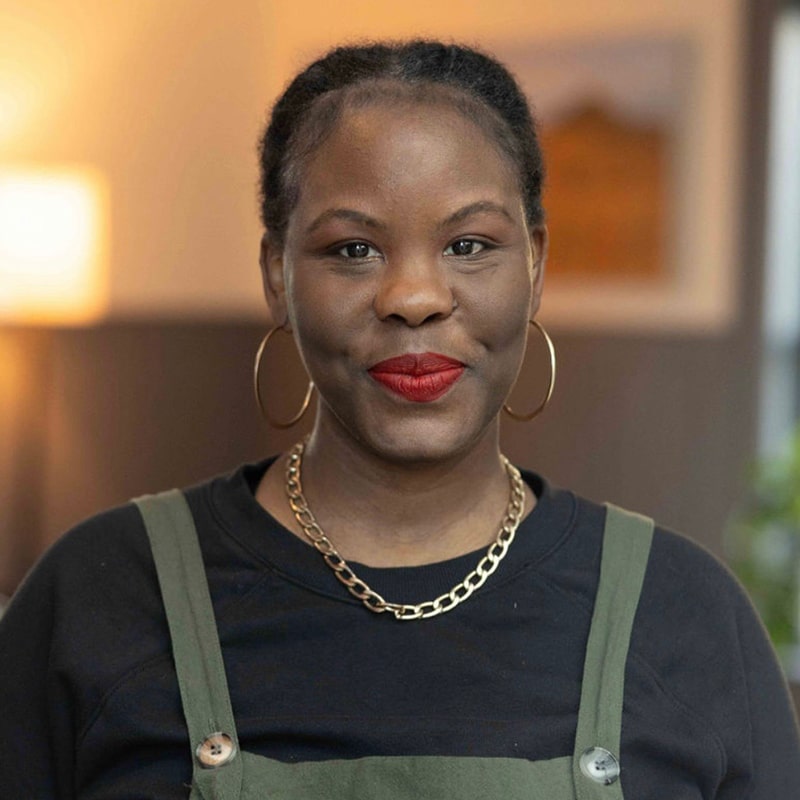
“I would advise you, I would in fact implore you to take a step back and look at your specific career ambition and put that in line with everything else you want and figure out how to have a full life. It makes you a better writer. It makes you a better storyteller, it makes you a better partner. It makes you a better friend. It makes you a better everything. And then make a big life, a beautiful life, the life that you desire with your career existing inside of it. But if you make it your life, it will be responsible for 100% of your happiness. And it is not fair to your career. It’s unrealistic, and it is a benign thing that cannot have a will. So figure out what makes you happy.”
~ Spade Robinson
Spade Robinson is an award-winning screenwriter, producer, and director, with experience that spans feature films, documentaries, TV, commercials, and theater.
Spade is the owner of the full-service production company Spade Ink Media, producing and developing a slate of film, television, and podcast projects.
In 2015, Spade founded Atlanta Film Project to support storytellers more democratically, around the world, with labs, workshops, and bespoke consulting, helping storytellers and companies tell the most compelling versions of their stories.
Spade began curating screenplays, films, and documentary projects during her time at the Sundance Institute, where she worked with the Feature Film Program, Documentary Film Program, and Sundance Film Festival. During that time, she helped hundreds of filmmakers.
Other companies with whom she’s consulted include: The Sundance Institute, Film Independent, FOX Networks, Disney, and HBO, among others!
WEBSITES:
https://www.atlantafilmproject.com/
IF YOU LIKE THIS EPISODE, YOU MAY ALSO ENJOY:
- Leslie Rasmussen, TV Writer, Author-Episode #398
- JJ Nelson, Screenwriter-Episode #388
- Haris Orkin, Novelist-Screenwriter-Game Writer-Episode #385
- Paul Chitlik, Writer-Producer-Director-Teacher-Session 3-Episode #373
- Tom Ruegger, Animator-Producer-Writer-Episode #369
- Alexandra Hainsworth, Pop Artist-Novelist-Advocate-Episode #365
- Alretha Thomas, Novelist-Playwright-Actress-Episode #364
- Ed Driscoll, Emmy Winning Writer-Comedian—Episode #355
- Steven L. Sears, Screenwriter-Producer-Author-Episode #351
- Hal Ackerman, Screenwriter-Novelist-UCLA Professor-Session 2-Episode #333
- David Paul Kirkpatrick, Former President of Paramount Pictures-Episode #332
- Max Kinnings, Novelist, Screenwriter, & Playwright—Episode #308
- Brian Gunn and Mark Gunn, Screenwriters-Producers—Episode #272
- Rick Hawkins, Emmy Award Winning Screenwriter—Episode #49
Steve Cuden: On today’s StoryBeat
Spade Robinson: I would advise you, I would in fact implore you to take a step back and look at your specific career ambition and put that in line with everything else you want and figure out how to have a full life. It makes you a better writer. It makes you a better storyteller, it makes you a better partner. It makes you a better friend. It makes you a better everything. And then make a big life, a beautiful life, the life that you desire with your career existing inside of it. But if you make it your life, it will be responsible for 100% of your happiness. And it is not fair to your career. It’s unrealistic, and it is a benign thing that cannot have a will. So figure out what makes you happy.
Announcer: This is Story Beat with Steve Cuden a podcast for the creative mind. Storybeat explores how masters of creativity develop and produce brilliant works that people everywhere love and admire. So join us as we discover how talented creators find success in the worlds of imagination and entertainment. Here now is your host, Steve Cuden.
Steve Cuden: Thanks for joining us on Story Beat. We’re coming to you from the Steel City, Pittsburgh, Pennsylvania. My guest today, Spade Robinson is an award winning screenwriter, producer and director with experience that spans feature films, documentaries, TV commercials and theater. Spade is the owner of the full service production company, Spade Ink Media, producing and developing a slate of film, television and podcast projects. In 2015, Spade founded Atlanta Film Project to support storytellers more democratically around the world with labs, workshops and bespoke consulting, helping storytellers and companies tell the most compelling versions of their stories. Spade began curating screenplays, films and documentary projects during her time at the Sundance Institute, where she worked with the feature film program, documentary film program, and Sundance Film Festival. During that time, she helped hundreds of filmmakers. Other companies with whom she’s consulted include the Sundance Institute, Film Independent, Fox Networks, Disney and hbo, among others. So for all those reasons and many more, I’m truly delighted to have the gifted writer, director, producer and consultant Spade Robinson joined me today. Spade, welcome to Story Beat.
Spade Robinson: Hi. Thank you. Thank you for having me.
Steve Cuden: Oh, it’s a great pleasure. Believe that. Um, so let’s go back in time just a little bit. When did you first begin to have some kind of interest in this thing we called show business or the entertainment industry?
Spade Robinson: Um, early, early, uh, since childhood. Um, I sort of got my start in theater, like local theater. I can’t remember how young. I remember the, the first thing that I was involved in before any kind of performance or, uh, putting anything on his Feet was just writing, making up stories all the time in the car on a trip, you know, that kind of thing.
Steve Cuden: So you’ve always been a sort of a natural storyteller?
Spade Robinson: Yeah, I have and it was, it was encouraged. Um, and so I think that really, uh, made me feel comfortable pursuing it as a way of life.
Steve Cuden: And you like me? I was, I started when I was very young too, and I was immediately hooked. And it’s never left my bloodstream. Um, is it that way for you or it’s like in your blood and you can’t help it?
Spade Robinson: It’s in my blood.
Steve Cuden: Mhm.
Spade Robinson: I would say that the business side of things is so incredibly sobering that it is. I find myself going in waves, to be honest.
Steve Cuden: What do you mean by waves? What does that mean?
Spade Robinson: I find myself in times where I’m very inspired and I love the work and I don’t care who made it. I want to see what is obscure and weird and awesome and good and so wonderful. Um, well made and impactful. Um, and then I find myself in times where I am under inspired. And that doesn’t mean that the work isn’t good. I’m just, I, I feel that I need to have distance from it, um, in order to like, tend to my bitterness.
Steve Cuden: Tend to your bitterness? What does that mean for me?
Spade Robinson: I think I’m in a, a lifestyle of having waves of excitement and then waves of like, calm satisfaction and then waves of grief with, um, having to renegotiate what I’m expecting out of my life in my career.
Steve Cuden: Does that have to do with what your expectations are of others, or is it mostly just on you?
Spade Robinson: Gosh, I would say it’s, it’s mostly on me, but it’s, to be fair, it is something that I get to tend to in conjunction with understanding, um, with coming of age at all these different stages. Right. So, um, in one hand I can feel as though there are all these things that I wanted to say that I haven’t been able to say in
Steve Cuden: the way that I. Oh, but you’re so young and you’ll be able to say what you want to say.
Spade Robinson: Well, I, I think that I also, along with that, I also have to negotiate, um, what my dreams were built on top of or where they came from. Um, and so the more I understand about life and myself as a human and what this human experience is all about, then I get to dismantle what my fantasies were even created out of, like what the substance of those things were. And so I find it interesting to um, be in this sort of cycle of finding another little nugget of something that I thought should have happened or would have happened or a person I would have been, or a way that I would have been working or living and confront that. And either I grieve that and become grateful for the stories I tell and the artists that I work with and the life that I have, or I hold on to that other thing and it makes me bitter. And so when I say that I’m like tending to my bitterness. And those are the cycles where I feel like I can’t love this art form because I feel as though it hasn’t given me everything I’ve given it. Those moments and where they come from.
Steve Cuden: Do you think that all of that is helping you to become you?
Spade Robinson: It’s the work that everybody’s doing. I mean, so for me it has to do with building a life on top of storytelling, but everybody is confronting the little nuggets of what they thought would be and the substance of uh, what those dreams were made out of. I mean, hopefully we’re negotiating that and not just taking our forecast. 14 year old dreams.
Steve Cuden: Right. Well, you know, you’re, you and I are both in, I think one of the more difficult businesses to be in where you’re not, you don’t really work at a company, you’re working for yourself. And uh, it’s, you’re dealing with one of the most business oriented businesses that also applies to the arts. And so that all of it, all that combined creates a whirlwind of, of how you approach things and how it impacts your life. So it’s not, there’s nobody feeding it to you, you have to go out and, and dig in all the time, don’t you?
Spade Robinson: I have discovered that so many ideas of what I thought I wanted were built on things that I have matured out of. And so dreams have to mature as well. But to your point, I think this industry put such a magnifying glass on that human experience. I don’t think that there’s anything super unique about my life trajectory in terms of the day to day human experience. I think more so that wanting something badly, and you know this is a storyteller, wanting something badly is something that every character has. I’m just navigating, um, life as someone who wants something badly. And that thing that I want badly changes as, ah, as I, as I grow.
Steve Cuden: Well, I think once you stop having that want, which I think you’re not likely to have, but if you were to stop having that Want, uh, you would stop doing this because it’s just way too difficult to do without that drive. And I think you know enough people, like many people who, um, say they have the drive, but they actually don’t. So, uh, that’s really key. I think part of it, it’s a passion business. It’s not, uh, you know, you just can’t sleep your way through it. You have to really want it. Is that partly what you’re talking about?
Spade Robinson: What’s interesting about being a teacher is that you end up teaching the gamut of people who are along the spectrums of one.
Steve Cuden: Absolutely right.
Spade Robinson: And what I learned is that we’re all longing for something really badly. And sometimes we mistake it for what we think being a storyteller or being known for a storyteller will, like, accomplish or, um, make us feel or solve. And then sometimes the art is the thing that is the solve. And so the passion, I think, is there across the board. I find that when I’m working with someone or when I find myself as someone who. Whose life is fed, well fed, then the want being the work, the artwork, and the want being the thing that we think the artwork will deliver for us becomes so clear, it’s almost like dunking it in water and bringing it up and you’re able to kind of see what.
Steve Cuden: Well, isn’t that the most fun part of it when you get to there, where everything is sort of in sync?
Spade Robinson: Um, I hope so.
Steve Cuden: Well, from everything that I’ve read and seen about you, I think that you’re already in it. Maybe you just don’t recognize it yet. And eventually it will become much clearer for you, I think. Um, where did you get your training? Where did you go to school for all this?
Spade Robinson: I started out in theater. So the theater major for undergrad at what school?
Steve Cuden: Where’d you go to school?
Spade Robinson: I went to Georgia. Georgia Southern. So Georgia Southern has a campus in Savannah, and I went to school there for theater. I cannot express the joys of being a theater nerd other than just say it’s delightful. Um, and then I went to film school at the University of Southern California.
Steve Cuden: Um, that’s my alma mater. Only my alma mater at US. Only my alma mater is in theater. My undergraduate alma mater.
Spade Robinson: Shut up. Really?
Steve Cuden: Yeah. Mhm. And then my graduate degree in theater in screenwriting is from ucla. So I don’t know what I am. I’m either a truant or a Brogen. I don’t know what I am.
Spade Robinson: A Brogian. That’s funny. I also I took a film business class at ucla, though I would claim to be a Bruin because it was one class. But um, I very much enjoyed it’s gorgeous campus. Um, very, very talented faculty.
Steve Cuden: So. So you trained as a screenwriter, as a director, as a producer. You got all that fundamental at, at fundamentals at usc, right?
Spade Robinson: I got fundamentals at usc. I don’t think there’s a training ground for that. But to do it in the field, I really, no question, I would say the biggest education I got about storytelling was working at Sundance. And, and that really just comes from sitting in a room surrounded by really smart people, talking about story, talking about are we going to fund this or support this or whatever and why. Um, and having a limited budget to be able to do so. So really having to make your argument about these things.
Steve Cuden: For young people that are thinking about making this their life, would you recommend that they go to school or do you think that it’s more important that they just go work?
Spade Robinson: It is the question I get all the time. It is the most common question I get. And it is, um. It’s difficult to answer Concret. But I will tell you what I think is true. You don’t have to go to film school to be a filmmaker. You can get a job on a set, you can work your way up. It’s a very apprentice type business, very much so, especially on set or working in television. However, I would not be where I am without it. Because relationships, more than the experience, more than education, more than anything else. I am in a cohort of people who all want to do the same thing, who are extremely motivated, who are paying all this money to be here and who are very ambitious. And so what we all decide to do afterwards ends up being along the same paths. And I wouldn’t be able to find that collection of the same thing and take time to experiment and find a voice and not have to worry about money. Be, um, bad, really bad at something without embarrassing myself. Where there’s, you know, a budget involved. That’s the value of it.
Steve Cuden: I think you’re saying some of the most truly valuable things that we could say to anyone who’s considering again going out and making this a career, especially a very young person. So I’ve told people forever that school is important. If you think that you are in need of growing up a little bit and meeting people and then as you say, that’s your cohort. And those people will, if you remain friendly with them, you’ll follow them and they’ll follow you for the rest of your life. And, and I’m still friends with people from when I went to undergraduate school and graduate school. So that’s. I think that that’s a really big key. I think if you’re already a mature person, um, school may not. May be just a good thing to do to get a foundational education, but it’s not critical in terms of any part of the entertainment industry. Doing it is more important than school. But it gives you that foundation, right?
Spade Robinson: It gives you that foundation and it gives you some structure to. To learn things that are unspoken. So, um, I just became the director of a film summit that’s, uh, happening in September. And earlier today I had a meeting with the facilitator who’s going to be doing our mock writers room and, um, doing our writers room bootcamp. And so one thing that I was talking to her about is, you know, the cycle of not being able to get hired to be in a writer’s room because you’ve never been in the writers room. And part of the reason is there’s a very specific structure and culture that nobody’s going. Nobody’s going to teach you that. Right. But, um, usually that’s why writers come up through being, you know, support staff in a writer’s room. And so in school you have the ability to have both professors who, their job is to pull you aside and tell you some of the intangible things and set you up for opportunities that you may not know. Like, I did not know what a water bottle tool was before I moved to la. I did not know the difference between an agent and a manager. I did not understand market. I did not know the things that have nothing to do with making a movie. The percentage of time that filmmakers spend making a movie is so minimal to what it takes to make a movie or to be in a position where you are being hired to make a movie. The kind of mentorship that tells you, don’t wear that, wear that. Um, don’t say that. Did you study the show? Have you watched every season? Every episode. Now, how are you going to answer the question about your voice? Because they want to know. So, like, that kind of stuff, you’re not necessarily going to learn by being on set. And so that is why I encourage some kind of community building, even though traditional school may not be for everybody.
Steve Cuden: Well, as you well know, I’m not telling you anything you don’t know, but it’s all about connections. It’s not really about your talent, though. You better have some, uh, but it’s all about how do you interact with people? How do they want to work with you? Because if they don’t want to work with you because you came in and you were obnoxious or too shy or whatever the problem is, uh, then you’re probably not going to get the gig. But if you know how to work with people and connect with people, that’s a huge advantage.
Spade Robinson: It is a huge advantage. And there is a language that people speak and a way about going about things. Um, that’s just, it’s important to know how to navigate.
Steve Cuden: So what do you think of yourself as these days? Are you a writer, a director, a producer, a consultant, a teacher? Or, or are you, uh, some combo of all those or something different? What do you think of yourself?
Spade Robinson: As if I had to nail it down, I would say I’m probably primarily a storyteller. And so such a small part of my life is storytelling for the screen. Today I’m a storyteller, um, for the screen because I still write, I still am, um, taking meetings and pitching shows and still doing all of that. Most of my time is spent working with young writers, or young is probably the wrong word. Working with writers who, well, I would say just understand that support is helpful. So I have, uh, most of the writers that I work with are just older women who are um, retired and always wanted to write a script. Or um, women who are now empty nesters and they’re like, I’ve always wanted to do this, now I have time or whatever the situation may be. So you know, but even in building a film summit and building it into a film festival, so much of it is storytelling, right? So much of it is explaining why this is the program telling a story about this vision and understanding what it should be, um, over the next 10 years, what it should grow into and um, how it’s going to support artists and create pathways, blah, blah, blah. All that stuff really comes down to um, telling a compelling story, understanding language, having a way with words and loving words because they are powerful and they all mean something. Um, I think in some way my life has both been distilled down to, but opened up at the same time to feeling like the title of Storyteller really encompasses it all and frees my sense of self, but also it frees my ego in this way where I’m not tied down to having to show up in a role to be a storyteller.
Steve Cuden: Right. Again, we’ll go back to what we said earlier. You are already a natural born storyteller. You’ve Been telling stories since you were a very little person. And so, uh, this is something that you do. You do it innately. It’s not, it’s not something that is a burden to you. Certainly you seem to enjoy doing it. Is this all that we just talked about? Is this all part of Atlanta Film Project? Let’s talk about that for a moment. Tell the listeners exactly what Atlanta Film Project is and how you fit into it and what the purpose of it is and so on.
Spade Robinson: So I see it as a consulting firm, even though it sort of operates in a more, I guess, less, uh, firm like way. Um, but I started when I first left Sundance. I was working with writers, uh, who were just sending me their scripts and I was giving them feedback and certain organizations that I was like reading scripts for them and stuff like that.
Steve Cuden: Do you give them notes? Is that what you do? Or do you have conversations? What do you generally do with folks like that?
Spade Robinson: So with individual, uh, screenwriters, I will take whatever their materials are. So it can be anywhere between, um, like a, a treatment, just like a page treatment, all the way to a full feature script. It could be a pilot or could be a, uh, work in progress for a documentary. So a teaser all the way to a full rough cut or fine cut. Usually after that they’re looking for, um, one on one meeting to go over what my feedback is and then me to send a set of notes afterwards. So that’s usually how it goes. Although I can just send a set of notes. What I like about working with someone is really getting their intent. So if I can talk to you, I can look in your eyes and figure out what story you’re trying to tell. I have a better understanding of how to help you in that direction. And we can have a few breakthroughs that may be standing in the way of you getting to the most compelling version of your story.
Steve Cuden: Mhm. And. And what is it that you most enjoy in working with writers? What is the thing that gives you the greatest joy?
Spade Robinson: Oh, it’s therapy every time.
Steve Cuden: Oh, is that right?
Spade Robinson: Oh, for them it’s therapy. For me it’s like, it’s therapeutic in a different way. I would say, um, I cannot tell you how many times I’ve told people, okay, so your second act isn’t working because you haven’t forgiven your mother. That’s probably the thing that I say the most. And it’s true every single time. I mean, so much of our story blocks and why it’s a, um, interesting plot, but it’s not working on the Page has to do with the level of emotional bravery of the writer and vulnerability to create full characters out of people who even, um, may have been hurtful. So. Or situations that may have been hurtful or whatever. Getting to the. The nitty gritty of that is very satisfying for me because what can happen after that is wonderful and satisfying. And I’m, um, my client’s biggest cheerleaders and just want to see it happen. Uh, I want to see you win Emmy. I want to see you get into that program. I want to see all of that happen. It’s just like Christmas, and it’s awesome.
Steve Cuden: Um, it sounds to me like you’re. You’re in large part a psychologist.
Spade Robinson: I mean, well, I can’t claim to have any real.
Steve Cuden: Of course not.
Spade Robinson: Knowledge. But what I will say is what my superpower is, is like digging in and figuring out, even sometimes subconsciously, what it is that you need to say. What’s in the way of that and unlocking, um, that is. It’s satisfying. And then for me, going through the writing process. So for me to write a script, it takes, however long, long time. Right. But I can read your script in afternoon and have notes for you and a, uh, meeting in the evening, and. And I went through the entire creative process and I didn’t write a word. So like, that, I think, is how it’s. It’s very fun for me.
Steve Cuden: And so the joy for you, it sounds like, is being able to take what’s in front of you and sort of, um, dissect it or pull it apart and analyze it in a way that makes it go to that next level, a much higher level. Is that accurate?
Spade Robinson: Yes, that is the goal. To push it to as far as it can go when it comes to the craft.
Steve Cuden: What do you think that, um, writers that you deal with, generally speaking, um, have the most trouble with it. Is it emotion? Is that the biggest problem that you see, or is it finding conflict in a story? What is it that really you find is, ah, the most common issue with storytelling.
Spade Robinson: I’d say it’s probably voice. Once a writer has structure down, it’s sort of creates this equalizing effect. Like, obviously, I can teach you that, but then once you’re there, we’re not worrying about any of that technical stuff. The thing that sort of takes more surgery to massage out because I can rearrange the plot in a way that makes it funnier or more interesting. Right. But that’s not necessarily going to get you into the fellowship you’re looking for what’s going to push you over the edge. It’s not because you have the most interesting, surprising plot that nobody ever thought was going to happen. It’s just surprise, right? The thing that’s going to push you over the edge is your voice as a writer. And it’s not something I can craft you through. It’s something that you have to trust me to talk about your life with. You have to embrace the kind of storyteller you are as opposed to the kind of storyteller that you’re a big fan fan of, because they are oftentimes very different. And you just have to feel safe enough to get there. And that could be quick, it could take time. But that’s usually the factor that matters
Steve Cuden: the most for me personally, you know, I’ve written for decades at this point. It took me a good 10 years of writing and being paid for it before I felt like I knew what my voice was. It took a long time. And, uh. And I. It’s just writing and writing and writing. I don’t think you. I don’t think I could. Or you can give somebody their voice. They have to develop it themselves, right?
Spade Robinson: It is a muscle. And. And it’s almost like. I don’t know if this has ever happened to you before, but if you’ve ever, like, tried a new workout or you’re like, all of a sudden walking downhill and you feel yourself working a new muscle that you kind of didn’t know was there, it’s kind of that thing, right? Like, it’s a muscle. You know how to build muscle. But this is like building a new one that you have to nurture. It’s.
Steve Cuden: It is. Again, I can only go off of my own personal experience, which is when I realized I had a voice. It was. It was an epiphany, and it was like, oh, now I understand what it is to have a voice. Before that, it was like, I don’t know what this means, or I don’t know how I’m supposed to get there. And I think that, like, as you say, it’s like working out. You have to just do it and do it and do it. You can’t go down to the corner story store and buy yourself a script or a voice, right? It would be nice if you could, you know, if you had the money, you could go buy your. Buy it. But no, you can’t. You just have to do it.
Spade Robinson: Steve, when I tell you that is really eerie to talk about not being able to buy a voice and, like, be like, oh, it’s it’s, um. It’s something that you have to work on and cultivate and all of that. And meanwhile, we’re all having this interesting conversation about the concept of that just invading our lives in a way, and turning that on its head. And we’re watching it, we’re watching it, we’re monitoring it and figuring out what it will look like. And, uh, I’m so curious to know how this all works out.
Steve Cuden: Hopefully you never actually arrive. You’re always on this journey. You will have discoveries. I think for any writer, myself included, that the learning never stops, that the growing never stops, that it’s always about pushing yourself onto that next part, that next level, and. And getting stronger or getting more broadly based or getting more specifically based or whatever it is, but that you continue to grow in a way. And that, uh. What is the old adage that, uh, you never actually. It’s all about the journey. You never actually arrive. And I think that that’s true even for really, really famous, successful writers, screenwriters and so on. They’re always pushing to the next level. And sometimes they get there and sometimes they don’t. It’s just art. It’s part of that problem. What, what for you, makes a good story good?
Spade Robinson: Can I give you a boring answer?
Steve Cuden: Oh, give me any answer.
Spade Robinson: Sure. Structure.
Steve Cuden: I don’t think that’s boring. That’s. That’s my specialty. That’s what I live for. Structure is everything. Without it, what do you have? Yeah, a sloppy. A sloppy mess. Right? So structure is everything. Do you know, um, he’s been a guest on the show, was one of my favorite professors at ucla. Do you know, uh, Howard Suber’s book the Power of Film?
Spade Robinson: Oh, I don’t.
Steve Cuden: I would highly encourage you to check out the Power of Film. There’s also a documentary series in which he’s the narrator of it. He’s the. The person on camera who talks about how films are, how stories are made, how stories exist. And it’s all about him recognizing patterns in storytelling over, um, literally generations, thousands of years. Um, and it’s all about structure. And his definition of structure is. Structure is the relationship of the pieces and parts to each other and to the whole. And that’s. To me, that’s the E equals MC squared of storytelling. That. It’s all about that structure. So I’m glad. I don’t think that’s a boring answer at all. I think that’s an absolutely perfect answer. Um, that’s what makes story great. Because if you don’t have that good beginning, middle and end. And if you don’t have it all interrelate and it doesn’t all, you know, all fit together perfectly, it falls apart somehow.
Spade Robinson: It does. And it doesn’t incite the thing. I mean, human beings, we have this mechanism inside of us that tells us, you know, when something should be changing or shifting or when something should be swelling. I think obeying that really is what, like, acts the bonding part of film. Right. The part that, you know, we sit in the theater and we have this experience with all these other people and we feel alive and a part of this other thing. And I think structure is a big part of that.
Steve Cuden: What, what kind of clients should come to you who, who would most benefit from your, um, expertise in consulting?
Spade Robinson: The most beneficial would probably be someone who has an understanding of, um, where they want to go in their career, has some experience writing, Right. So you don’t have to be great, you don’t have to have awards, but you have enough experience to know, um, how helpful it is to have somebody hold your hand. You have an idea of what you want your projects to do in the world. Um, you get the most out of it. Because now we’re not just talking about a siloed sort of hundred pages or whatever. We are talking about how this plays into the overall strategy for your career and, like, what it’s set up to do for you out there when it’s out there. So then we can talk about the kind of meetings that you should have or the approach you should have or, and reverse engineer that back into the script. So I can say, okay, based on what you’re looking for, because you’re looking for this route, um, that ending is not going to work based off of your goals. So now we need to go back and address that. And I think that’s who gets the most out of it.
Steve Cuden: Do you ever have clients that fight you on what you’re saying? They just can’t quite get there. Yes. And what is your approach to dealing with someone who is, um, clearly eager and interested and has talent? And that’s, that’s an important key word there. If they, you can recognize that the talent is there. Um, is there anything that you do to inspire them to listen to what you’re saying? Maybe a little more closely.
Spade Robinson: Um, so two main things. One, I soften my approach. I find that usually if you are having a reaction to what I’m saying, it’s because it is probably true. And you’re not interested in forgiving your mother because she was A horrible person. So as opposed to fighting you on that, I think what we end up doing is talking about the relationship, and then the other approach, um, just has to do with understanding that every bit of advice or every route for notes isn’t right for this draft or where this writer is right now. So, um, sometimes I try to start off and ask what would be most helpful for you right now? Because if you are in a position where you are two weeks behind and your manager is trying to figure out where your draft is, and they’re trying to send you out for staffing meetings, so you’re, like, rushing and rushing and rushing. That is not the time to do foundational notes.
Steve Cuden: No, that’s the time to pull it together somehow so that it makes sense.
Spade Robinson: Right, so then how do we make sure the important thing happens? Right, so how do we make sure the first few pages make your voice shine? Even if the story doesn’t make sense? We could possibly, possibly fix that later. So if there’s a big pushback, it could be coming from the frustration that this is not the help I need right now. And so then I try to task that with understanding the bigger picture of, like, okay, where does this script or this cut fit into what’s happening in your business? You know? Um, and then I can better set you and your project up to at least get past that deadline or whatever’s happening.
Steve Cuden: Well, I know you’ve never met any writers that are neurotic. No.
Spade Robinson: What do you mean? Goodness?
Steve Cuden: Um, how much of what you’re talking about do you think is driven by or, um, you know, over or is overcoming fear or insecurity? Is a lot of it that, or is it anything else?
Spade Robinson: Uh, so I find most of the career stuff, people are either really sure or playing it really small. When it comes to the fear part, it usually shows up on the page, which is the whole premise. So sometimes it is. I’m not brave enough to talk about this thing, so I’m going to write a script about a completely other thing and mask it. But it’s in there. The theme of being not in control of my life, or the theme of grief, of not accomplishing whatever, or the theme of, you know, feeling power, whatever the theme is, shows up. But you are grappling with the story because you’re like, no, this needs to happen, and it doesn’t make sense for this story. The fear of being seen is the biggest fear I run into with writers, and they mask it with plot. Right? So then we have to pull off all the plot that doesn’t make sense.
Steve Cuden: Is that, is, is that related to fear of success? That people are, you know, they’re. They see themselves as having success, but then somehow that stops them. It makes, makes them nervous, uh, or afraid?
Spade Robinson: Well, it’s definitely fear of being exposed emotionally. When it comes to fear of success, I usually find that happens right after the first big thing. So I’ll have a writer that I’m working with that, uh, finally got their show greenlit or at least a pilot ordered or whatever. And that’s when the kind of like, more sabotaging behavior starts with, like, missing deadlines and doing things. And I’m like, well, have you thought about this? Or have you met with such and such? Or like, now that you’re about to be kind of doing this creative thing and there’s a lot of eyeballs on you, you need to save your money because none of this is paid worth. Right? And so they’ll do something wild where you’re like, so now you’re going to be paying. You’re going to be writing, like, taking all these notes in and doing a rewrite and rewriting, rewrite, because you finally have a producer, which is great, but you’re not getting paid for any of these rewrites. But it’s going to take time. So when I ask you to save money so you can make this work. And so that is usually when I see that kind of like, behavior show up.
Steve Cuden: You know, I think, uh, I have certainly known any number of people that are on the verge of great success and they do something to sabotage it, or they, um. They’re. They’re like you say it’s about exposure. So the exposure that they’re afraid of is both in the script and in their career. They’re. They’re afraid of the exposure in both ways. Oh, somebody’s going to realize it’s. What is, um. It’s that, um. I’m forgetting the, uh, phrase. But they’re actually afraid of, uh. People will figure out that they’re not good enough or that they think that they’re not good enough. So, uh, that, I think is what happens to a lot of people. Oh my God. People are going to read my stuff. They’re going to see that I don’t know how to write. But in fact, you do know how to write.
Spade Robinson: It’s scary because a lot of people in our profession, I’m trying to. I’m trying to think if I can include myself in this, I probably can find themselves in situations where they are the hustle of it satisfying because they get to experience trying and be seen m trying and the identity becomes trying and the world is against you and blah blah blah, blah, blah blah blah. It’s so hard, it’s impossible. It’s never going to work. Less than 2% blah blah blah blah blah. Right? Which is, I’m not saying it’s wrong or incorrect. I’m saying that can become this, the story that is satisfying and it never forces you to come to the man. It’s a comfortable life. You never have to actually prove it if you’re just saying trying forever because it’s so earnest and it’s so like there’s so much virtue and trying and hustling and going after your dreams and so you get a lot of like social capital for that. And um, actually having to come to the mat and meet a deadline and writing on a show that you don’t actually like and like keeping relationships with people and not, you know, wasting time, but actually still writing even though you’re getting a show made, writing something else and emailing that showrunner back. And like all of that is so unsexy. And really what it looks like, that there’s a fear I’m not going to be able to hang here, but I can get enough and convince myself that I’m actually trying. And so I think a lot of fear comes from that.
Steve Cuden: Well, there’s the fantasy of being a writer and then there’s actually being a writer. And they’re sometimes overlapped and sometimes they’re very, very different. And in fact in the world of Hollywood. So if you want to be, if you want to be a self sustained writer, go be a novelist. But if you’re going to work in the entertainment industry where you’re a writer in Hollywood, you’re going to be told no a lot. You’re going to have your work changed a lot. And it is a form of employment, it is work in a way. And hopefully you can bring your best artistic sensibility to it. But at the end of the day it’s still called show business, not show art. And that’s, I think that’s part of what you’re talking about is that people get hung up on the fact that they’re not getting to do the exact thing that they exactly want to do. But, but in fact that is what they want to do. They just don’t get it. That’s how I see it. Uh, I was for years and years and years an absolute working mercenary. You want to, you want me to work for you? I’ll work for you. You want to give me a check, I’ll take your money. I may not like the show that I’m working on, but I’d be happy to take your money and I will give you 110% of my best effort, whatever that winds up being. And I think a lot of people don’t understand that there is that give and take, that collaborative thing. What do you tell people about collaboration, collaborating with studios, networks, other writers, producers, et cetera? What do you tell people?
Spade Robinson: Well, I tell people to figure out exactly the kind of life that they want to live inside of, then figure out what kind of work is going to suit that. So if you want to write all the time and you want more consistent work, you want kind of a time where you’re on and then you’re off at a certain time, you go home and there are your, you know, people you live with, um, and it’s regimented in that way. The thing most like that is probably going to be writing for television and you should put, um, an enormous amount of eggs in that basket and figure out exactly how it works and how to hired and what, how you want to work in that way and what your voice is and what Germans you want to work in. Do you want to be network? Do you want to be capable? Like, figure that part out and. But then if you’re like, no, what’s most important to me is having this auteur voice and being able. Great, wonderful, love it. Um, so let’s figure out how you’re going to, um, maintain that vision and then the rest of your life, because there’s a lot of times so much space in between getting those opportunities, if and when they come. You want to balance that out with figuring out, okay, so then my personal life, how comfortable am I committed to that being and what do I want to bring home? And am I comfortable if I just make, if I make fewer projects, but they’re more potent or whatever. Like, I’m agnostic on whatever you decide your dream is, your dream is, your dream is very personal. And that’s for you to decide and for me to have no judgment on. All I’m asking for you to do is understand the mechanisms of the business you want to be in. So that when it comes to you deciding, okay, what format am I going to work in or what, um, kind of work am I going to be making, it should really be reverse engineered and backed up by, okay, what are the systems that are operating and how do they work so that I Can go after the thing I want in a way that’s actually going to be, um, effective.
Steve Cuden: Do you mostly work with people that are sort of in the door a little bit trying to sell something or they’re already selling things. Is that the majority of the folks you work with, or do you also work with people who are completely unproduced, unknown, don’t have an agent, that kind of thing too?
Spade Robinson: Uh, I would say it’s probably half and half. Um, I mean, the students that I work with, uh, have usually no experience. I’m not teaching graduate school. Um, so usually they’re sort of new. I’ll say. Most of the feature writers I work with are unproduced. Um, writers who are still working on getting their first manager or their second manager who are working on sort of getting something produced. Um, and a lot of feature writers are self financing, packaging, putting together their projects and stuff like that.
Steve Cuden: Do you advise people on packaging that,
Spade Robinson: uh, their work too, if they want to be the ones producing it? Yeah. I mean, um, everyone has a different dream. So if you’re saying, no, I only want to work through the studio system, that’s fine. Here’s how you should go about it. If you are thinking that you want to get the work produced and you want to have more say so over certain elements, or even if you want to move into the studio system but you’re not already operating with the relationships, that way you can just go pitch your agent, sets up a meeting and you take it around town or whatever. The other way is to package it yourself. And at the very least you have the ability to say, okay, it’s not just a script that I wrote. It is, this is my script. This is such and such attached. I’ve brought such and such on board. And now we are self financing or financing partly through, um, our own avenues, and then bringing on other producers and
Steve Cuden: you know, all right, so we’ve, we’ve talked about voice and development and all of those good things. Uh, what do you think are the things that someone who is unproduced has never worked with a studio or a production company. What do you tell them in terms of making their work sellable, aside from having a good story, which is clear, aside from, I hope, developing good, compelling characters. Uh, but what, in terms of the script itself do you tell people that makes a script more sellable than those that don’t?
Spade Robinson: Um, genre and roles that high profile attachments would be interested in.
Steve Cuden: So when you say, you’re saying genre, right? If it’s genre, that’s Knowing the tropes of a genre and maybe breaking those or. What do you mean operating a genre
Spade Robinson: that does good business. So yeah, if you’re saying I’m an independent filmmaker or independent writer and all of my scripts are dramas, all of them, and I have no relationships at all and I want to get something produced, you have. Because of the genre of it, you have more of an uh, a stretch because you’re gonna have to bring it. And it’s not impossible. People do it. People do every day. Everything I’m talking about, people do every day. So.
Steve Cuden: But some things are harder than others, right?
Spade Robinson: Some, some things are more challenging than others. And when you’re talking about a uh, genre like dramas, they’re harder to finance because there’s so much in the relationship, blah, blah. So they don’t necessarily always travel as well. Like there are all these business reasons why having operating in certain genres that travel better are easier to do good business.
Steve Cuden: Dramas don’t tend to make as much money. So that’s the thing you have to overcome. And here we have this incredible uh, drama that’s out right now based on a several thousand year old poem called the Odyssey that’s out in theaters as we’re talking on this show. And, and it’s a, it’s a drama. But they’ve, Christopher, uh, Nolan has also turned it into a big action piece with a, you know, a little bit of sexy. So uh, that’s how that works in terms of movies. But what genres do you think are the ones that sell the best? Is it horror? Is it sci fi? It’s horror. That’s the, that’s the easiest one to get in on, isn’t it?
Spade Robinson: The big thing just has to do with how small the budgets can be and how much money you can make. So hora. Because it’s so thrill driven that you don’t have to have this super high profile cast for people to want to see it and spend money on it. And with that you can bring the budgets low and still make more money.
Steve Cuden: And as a writer you can then prove yourself with that. But let’s say for instance, you’re a writer and you just hate horror. It scares you. You don’t like horror. If somebody’s got a horror movie on, you walk out of the room and so on. Uh, what’s the next thing that’s sellable besides horror?
Spade Robinson: I would say the next element is going to be your package. So just to make it crystal clear, your attachments make or break the movie. Well, the script makes or Break explain
Steve Cuden: to the listeners that don’t know what you mean by attachments.
Spade Robinson: So being able to attach, uh, actors, high profile actors, directors, sometimes even like sexy cinematographers.
Steve Cuden: Sexy cinematographers, right.
Spade Robinson: But like, you have someone who, like, shot all the, you know, big whatevers. Oh, he shot, you know, Transformers 29. You can then have a conversation about, like, this script is worth more than just a paper, right? This person opens consistently at this level of box office, and this cinematographer brings in, or this director brings in this much. And that is how you’re looking to kind of leverage the value of your overall package, which is the script with all its attachments and all of that and the location. So tax incentives and all of that play into that and then kind of maybe the inexperience of the writer.
Steve Cuden: So you’re talking about the, the complete sales package for a particular property. Uh, and that putting that package together becomes super critical in terms of getting financing and distribution. Clearly. Uh, do you think that most people today are able to get, uh, financing without distribution sitting there? Or is having sort of distribution in your back pocket one of the critical elements today?
Spade Robinson: Obviously, getting financed for your film is easier with distribution. It is difficult to get distribution sightings. Um, and when I say set on scene, I don’t mean that you didn’t go to the market and pitch it and bring your, like, sexy deck or
Steve Cuden: whatever, but you don’t have a finished product. You’re just selling something.
Spade Robinson: Especially if you’re someone who, coming like, this is my first major credit and I don’t have anyone to catch it on the other end. So it’s a bigger risk. But that doesn’t mean don’t go after it. That means go after different kinds of finances. Because if you’re talking about, I’m gonna go to this savvy producer who’s produced 13 films and they’ve all made X amount of money. And unless the subject matter or something else makes them want to do it, it’s not a good business deal for them. Right? So forget telling people it’s going to make so much money. And you have actually no proof of that. Like, forget that. What you need to do is you need to be approaching a different kind of financier or an investor. Um, and there’s a whole world of that. I’m not going to say it’s easy, but I’m going to say it’s available and by the way, more available, I think, democratically than it has been before. So there are websites where you can, like, post a film and then People can invest in them kind of like, oh, I invested 3% by, you know, donating 150 or whatever. So there are those websites where you can do campaigns. There’s obviously crowdfunding, which is a different side of that, which I think is less, you know, SEC overhead kind of thing. But the investment websites are legit for real. Um, and then you have people, just high net worth individuals in the world who want to invest in a film or be a part of film. And working with emerging filmmakers is a way to do that. I, um, would just say to never lie to these people and to not take advantage of their desire to be in the film industry and allow them to get involved in a business deal where they don’t know what they’re doing. You should be extremely savvy about their waterfall and what they can expect and be very transparent about that. And if you do it well, even if they don’t make a ton of money, this could be an investor that you work with again and again. So, um, I think you should know the business like the back of your hand. If you decide to go the more independent route, um, and just be honorable. And I think you can find access to financing.
Steve Cuden: All right, so tell the listeners your take on pitching. What’s the best way to pitch a story, A whole, uh, production? How do you pitch? What’s the best way to do it?
Spade Robinson: Uh, so it depends on what format you’re pitching in. If you’re pitching a feature, you have sort of an hour meeting and a pitch is usually like 40 minutes. It takes a while. Um, if you’re pitching, ah, a television show, it’s a slightly different format that has more structure to it because you’re not just pitching the pilot episode, you’re not just pitching the show. Right. You’re pitching, um, the genre of this, it’s more like structure, right? Like a, more of a box that has to fit in, I would say. And so, um, you just want to make sure you hit the points. You want to say why the pilot is awesome. Also what you can expect for the rest of the season and then what the rest of the show can look like if it lasts. Um, and that should really be grounded in character. And so, um, those are kind of two different approaches. But then you also have the elevator pitch where you meet somebody in person and you really have to get to the heart of it very quickly. And I would also say, um, it’s less character there you are pitching somebody mostly plot when you do that, um, and seeing if that works with them. Um, and so sometimes there is like a more official thing where you’re there and you’re pitching with the production company you’re working with, and you kind of have a shtick where they talk a little bit, you talk a little bit, you know, um, which is very different than, like a pitch. If you go to a studio and you’re doing a take on IP that’s not yours, so your agent sent you a book and they sent you to the studio to do a take on intellectual, uh, property the studio already owns, and you’re competing with other people who are pitching the same very thing. It’s not original. That’s a different pitch. So it really depends on what you’re pitching and why you’re pitching it. But the heart of it, I think, is to understand what the buyer is looking for and to connect why you’re the person to tell this story in a way that’s, like, memorable. And I. My advice to that is always just to be really honest. Like, I don’t think that the sort of performance of pitching goes a long way. I think for people who hear pitches all the time, they are longing to have a real human connection with someone. And that doesn’t mean the show is gonna go. It could be like, well, that’s not really in our mandate, but thank you, that’s fair. But, um, I think it’s what keeps your career going, because your, um, reputation over time, because the volume of you pitching is gonna end up being so much. You’re gonna end up pitching so much in your career that it’s not about an individual pitch. It’s about every time she comes in, she has something interesting to say. Every time I send her off on a meeting with somebody I know, they also had a good time with her. And it’s never like a thing like, please don’t send me any more writers, because they’re always terrible. It’s that kind of ecosystem that you’re building by pitching. Um, and I think of it very similar to auditioning M for actors, where you’re not really married to this one role being everything. But it’s about creating relationships with cast and directors so they continue to.
Steve Cuden: So going all the way back to the beginning of this conversation, it’s about connections. It’s about making those relationships. And the more you get in front of the same people, the more likely it is if they continue to invite you back, that eventually you will sell something. And so that’s really important. I find pitching nerve wracking. And I think a lot of people do find it nerve wracking. Do you have any suggestions for people that are really nervous about those kinds of things, how they can get through it?
Spade Robinson: Yes. Memorize your pitch.
Steve Cuden: Then it’s stuck in your, in your mind’s eye rather than you trying to figure it out.
Spade Robinson: You get stuck or frozen, uh, you have a few places that you know you’ll always come back to. So if you get stuck, you know you’re always going to start a sentence with, my father used to raise chickens. And you always start, I’m, um, stuck. I have to start with the chickens. I have to say the chicken line. But also researching the person that you’re pitching to before you get to the meeting helps you to have some kind of common ground. You have a little chit chat beforehand and it just creates an environment.
Steve Cuden: Every, every meeting has that chit chat up front. And you better be prepared to have a little chit chat because, uh, to me, the secret is two things. When you go into pitch, they want you to succeed because they want you to bring something that makes them money. That’s the first thing they want you to succeed. And the second thing they’re looking at is do we want to work with you for three months, six months, a year, two years, whatever they’re, they’re, they’re looking at. Do they want to work with you? Do they want to spend time in a room with you? Those are the two most critical parts of the psychology of it, I think. Of course the story has to be right, it has to be right for them, et cetera, et cetera. But that’s the stuff that they don’t really teach you when you go into pitch is that how do you go in and become a person to them that they want to interact with? And so I, uh, to me, that’s always been the hardest part of the game for me because I get nervous. And I know most writers that I know do, we’re all very good writers, if they’re any good at all. They’re very good at being alone in a room with a computer. But then getting out and having to speak to people, that’s sometimes challenging.
Spade Robinson: Yeah, I mean, it’s another one of those muscles and it’s not something that you really get the opportunity to practice very often because you don’t have control unnecessarily over how, how often you’re meeting with people. Um, here’s, here’s my hack though. And I, I truly think that this helps everybody’s career. In my opinion, you should probably be pitching all the time 1. Because the more people, strangers or not, who know what you’re doing, the faster your career can move. You just never know how. Who’s like grandsons, uncles, next door neighbors, mailman’s brother, um, know somebody at CAA and is looking for fresh new talent because they’re so tired of blah, blah, blah, right? So there’s that. But the other thing is, there are two communities that will teach you how to pitch really, really well, and that is little kids and old people. Both of those groups do not care about your. Not your grandma. Your grandma cares. I’m talking about other people.
Steve Cuden: Your people. Strangers in particular. Right?
Spade Robinson: Strangers, old people, uh, strangers over 70. They are not trying to spare your feelings. That doesn’t make sense. You know what? It doesn’t make sense. And you can say, oh, it’s too deep for you. You don’t get it. It’s kind of like, you know, it’s like a genre bending. And they’re like, yeah, that doesn’t make. Listen, listen. And when you talk to little kids, and they’re like, okay, so there’s this kid and there’s this train and there. Then there’s this girl and then there’s like a teacher who, like. And the kid is like, I don’t. I don’t know why they would do that. Listen, sometimes we get really caught up in the mechanisms that make something spectacular or we think is a twist that’s really unique. And we don’t understand that we’re not doing the first rule of storytelling, which is like, makes sense. And those two groups of people will tell you, and they’re. They’re so candid that it just kind of frees you up your ego up to. To listen and have a real conversation. And then I find it easier to pitch, um, after that because you feel less tied to, like, big, fancy words to explain things. And more can simply talk about your story. And I think it really humanizes you in the room.
Steve Cuden: You’re talking about nothing less than m. Market research. And you’re doing it with people that don’t have any attachment to you. Because if you pitch to your mom or your dad or your brother, your sister, your husband, wife, whatever, if you pitch to them, they’re likely to say, aren’t you wonderful? And isn’t this wonderful? This is fantastic. What you want is you want that market feedback from people who don’t care about you. And so they’re going to be hopefully honest. And that’s helpful. I’ve been having the most marvelous conversation with Spade Robinson. And we’re going to wind the show down a little bit. And I’m wondering in and all of your lengthy experience, are you able to share with us a story, uh, that’s either weird, quirky, offbeat, strange, or maybe just plain funny?
Spade Robinson: Oh, gosh, yes. Okay, so I’m not going to go into specifics here, but I, I think it can be helpful. So I was working on this one project. I’m not going to say which one, but I was at a major, in a meeting in major studios and marketing movie. So it was. I was working on the film. I was a director. Nothing like that. I was just like, um, support staff on this movie. We were in a marketing meeting at the studio. The head of the studio was there, um, and the marketing people, interns, blah, blah, blah, head of marketing, whoever, uh, you know, executive on the movie. And I was so low on the totem pole, I wasn’t even at the table. I was like, there are seats around the table, the main conference room. So I was like, periphery with all the rest of the people who get coffee. And I remember listening to the marketing team pitch their idea for how they were going to do the rollout for this. And it sounded like the most ridiculous like, like out of touch thing I’ve ever heard. Like, y’ all aren’t really gonna do that, are you? That, wow.
Steve Cuden: You.
Spade Robinson: Wow. Everybody here needs to test grass because it’s very offensive what you’re saying. They thought it was brilliant. And I remember watching, like, some people who I assumed are interned, like, shifting, being like, like, okay, here we go. Um, then the head of studio chimed in and you know, he has some thoughts. What about this? What about that? Blah, blah, blah. And they’re throwing around the most, I think just rudimentary ideas, to be fair. It’s not like these are smart people. It’s not that they aren’t intelligent or whatever, or good at their jobs. It’s. It was more of a reflection for me that first of all, the take was just a miss. Right? I’m pretty sure they get it right all the time. This was a mission. I remember really realizing, okay, so nobody, nobody really knows what they’re doing. Um, not in a way that’s predictable. So there, there, there are people who are very good at their job. And I’ve been with executives, um, who are very, very smart with story and very good at their job. But really, it’s kind of, you know, we’ll see.
Steve Cuden: So, so. Have you ever read William Goldman’s book Adventures in the Screen? Trade.
Spade Robinson: No.
Steve Cuden: Do you know who William Goldman was?
Spade Robinson: I do.
Steve Cuden: He wrote Butch Cassidy and the Sundance Kid and All the President’s Men and a whole, the Princess Bride and a whole bunch of very great movies. He one of the most famous things he ever wrote. People quote liberally, um, and have for many years in Adventures in the Screen trade. He writes three words about Hollywood. Nobody knows anything. That’s, that’s came from him. And that’s true. I mean it’s. Nobody knows anything. People are trying really hard and sometimes they figure it out and sometimes or even most of the time they don’t figure it out and they move on to the next whatever. So I think that’s what you’re saying and I think that’s really important that even experts sitting around a table who are being paid a huge amount of m money to be experts, um, may not hit it. Uh, and that’s important for people to know that it’s not perfect. What people don’t realize Steven Spielberg, who’s arguably the most successful director, producer Hollywood’s ever seen. What we don’t know that’s not in the trades are all of the multitude of projects he can’t get through the door. M. We don’t know. And he’s the most successful guy there is. So what you only know are about are the ones that, that succeed. Right. So last question for you today, Spade. Uh, you have shared with us a gigantic amount of very helpful information and advice throughout this whole show. But I’m wondering if you have a single solid piece of advice or a tip that you like to give to those who are struggling or just starting or trying to figure out what to do or get to the next level. Um, do you have a piece of advice that you give them?
Spade Robinson: Yes. And this applies to everybody at, ah, any given stage in your career. It doesn’t. It, I mean any stage. Okay, you have to invest in the life you want. I mean 360°. The whole shebang. The whole shebang. And you have to look at your life that way. I would advise you, I would in fact implore you to take a step back from your ambition. Um, I’m not saying be less ambitious. That’s ridiculous. I’m saying take a step back and look at your specific career ambition and put that in line with everything else you want and figure out how to have a full life. It makes you a better writer, it makes you a better storyteller, it makes you a better partner, it makes you a better friend, it makes you a better everything. Uh, everything about what is communicated to us, especially in our industry, but overall is going to push you to rush. It is going to try and convince you that the only important things you do in your life you will do below a certain age. I don’t know what that age is. Whatever it is, whatever that is for you, or it only exists at uh, Emmy Oscar level, or it only is real. If I make this kind of credit, I’m working at this budget level. Here’s what I need for you to do for me, for you. Decide that all of that is arbitrary because it is. Figure out how much of your career you want to envelope your life and then make a big life, a beautiful life, the life that you desire with your career existing inside of it. But if you make it your life, it will be responsible for 100% of your happiness and it is not fair to your career. It’s unrealistic and it is a benign thing that cannot have a will. Okay, random and sometimes cruel and sometimes wonderful. But it should not be responsible for your happiness. So figure out what makes you happy and then make a career that will, um, that will still survive inside of that.
Steve Cuden: Well, that is, ah, really wonderful advice because at the end of the day you’re still living a life. You’re not just in a career. And so I think that that is, makes you a well rounded person. And I’ve always said to people, have a life beyond your career because that’s where the interesting things will come to help you with your career. So I think that is absolutely spectacular advice. Spade Robinson. This has been, uh, just a m, wonderful, wonderful, marvelous show today. Anybody that wants to know more about Spade or what she does, please check out theatlantafilmproject.com and I cannot thank you enough for your time, your energy, and for all of this great work wisdom that you shared with us today.
Spade Robinson: Thank you for having me, Steve. I appreciate being here.
Steve Cuden: And so we’ve come to the end of today’s Story Beat. If you like this episode, won’t you please take a moment to give us a comment, rating or review on whatever app or platform you’re listening to. Your support helps us bring more great Story Beat episodes to you. Story Beat is available on all major podcast apps and platforms, including Apple Podcasts, podcasts, YouTube, Spotify, iHeartRadio, TuneIn and many others. Until next time, I’m Steve Cuden and may all your stories be unforgettable.










0 Comments