
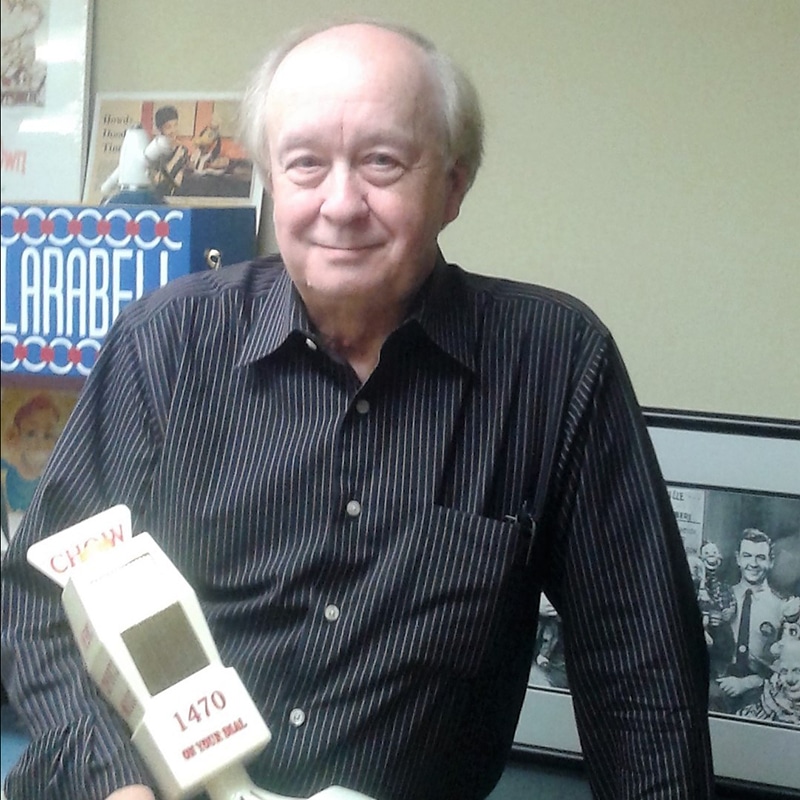
“My philosophy, three words. Always say yes. When somebody asks you, do you want to move to la? Yes. Do you want to be production director? Yes. Do you want to do television documentaries? Yes. That’s the way you’re ever going to learn or grow, say yes.”
~Doug Thompson
Doug Thompson started his broadcast career at CHUM Radio Toronto in the mid 1960’s. Since then, he’s worked in New York, Los Angeles, and London, England. He’s created programming for the Canadian Broadcasting Corporation and Telemedia Network Radio in Canada as well as ABC Radio, NBC Radio, and the Unistar network in the U.S.
Doug has written, produced, and directed over 1000 hours of network and syndicated radio programming that’s been heard by millions around the world, as well as creating several thousand radio commercials and promos. He’s worked with major celebrity hosts like John Candy, Ringo Starr, Grammy Award-winning music producer David Foster, and Rock & Roll Hall of Fame member Graham Nash.
In television, he wrote and directed over 30 documentaries, including “Hi-Fi Salutes” and “Hitsville U.S. Eh!” about Motown with a Canadian perspective.
Doug has won 154 awards for his work in both radio and TV. He’s taught broadcasting at Seneca College in Toronto for 10 years, and he’s currently the chair of the Canadian Broadcast Museum Foundation.
WEBSITES:
rockradioscrapbook.ca/dougt.html
IF YOU LIKE THIS EPISODE, YOU MAY ALSO ENJOY:
- Christine Pedi, Broadway Performer-Impressionist-Radio Host-Episode #400
- Rick Sebak, Documentary-Filmmaker-Episode #357
- Laura Gabbert, Documentary Film Director-Episode #335
- Mark J. Harris, Multi-Oscar-Winning Documentary Filmmaker-Episode #324
- Doug Pray, Documentary Film Director-Episode #306
- Skye Fitzgerald, Documentary Filmmaker-Episode #279
- Andrew Conte, Journalist-Author-Episode #247
- Hilary Sloane, Journalist-Documentary Photographer-Episode #236
- Joel Drucker, Journalist-Author-Episode #215
- Jon Krampner, Journalist-Author-Episode #197
- Jeff Werner, Feature and Documentary Director and Editor-Episode #142
- Laura Boyd, Documentary Film Producer-Episode #58
- Steve Mitchell, Film Journalist & Filmmaker-Episode #31
Steve Cuden: On today’s Story Beat,
Doug Thompson: My philosophy, three words. Always say yes. When somebody asks you, do you want to move to la? Yes. Do you want to be production director? Yes. Do you want to do television documentaries? Yes. That’s the way you’re ever going to learn or grow, say yes.
Announcer: This is Story Beat with Steve Cuden. A podcast for the creative mind, storybeat explores how masters of creativity develop and produce brilliant works that people everywhere love and admire. So join us as we discover how talented creators find success in the worlds of imagination and entertainment. Here now is your host, Steve Cuden.
Steve Cuden: Thanks for joining us on Story Beat. We’re coming to you from the Steel City, Pittsburgh, Pennsylvania. My guest today, Dou Doug Thompson started his broadcast career at CHUM Radio Toronto in the mid-1960s. Since then he’s worked in New York, Los Angeles and London, England. He’s created programming for the Canadian Broadcasting Corporation and Telemedia Network Radio in Canada, as well as ABC Radio, NBC Radio and the Unistar network in the U.S. doug has written, produced and directed over a thousand hours of network and syndicated radio programming that’s been heard by millions around the world. And as well as creating several thousand radio commercials and promos, he’s worked with major celebrity hosts like John Candy, Ringo Starr, Grammy Award winning music producer David Foster, and Rock and Roll hall of Fame member Graham Nash. In television, he wrote and directed over 30 documentaries including hi Fi Salutes and Hitsville USA about Motown with a Canadian perspective. Doug has won 154 awards for his work in both radio and TV. He’s taught broadcasting at Seneca College in Toronto for 10 years and he’s currently the chair of the Canadian Broadcast Museum Foundation. So for all those reasons and many more, it’s a true honor for me to welcome the extraordinary award winning writer, producer and director Doug Thompson to Story Beat today. Doug, thanks so much for joining me.
Doug Thompson: Steve, it’s my pleasure to be here.
Steve Cuden: Well, the great privilege and pleasure is mine. Trust that. So let’s go back in time a tiny bit. How old were you when your interest in she business and uh, programming and radio, when did that all begin for you? At what age?
Doug Thompson: Well, uh, the interest part started when I was 13, but prior to that my mother and uh, father and I, when I, uh, was a young kid, would sit around the radio and listen to people like Charlie McCarthy, Edgar Bergen and Charlie McCarthy, Jack Benny, the Lone Ranger, of course, from Detroit. Uh, but I didn’t really understand music and radio until 1959 when I heard a song called the Battle of New Orleans by Johnny Horton, which was being played at. That was a big hit at that time. And that was. And I couldn’t figure out. I liked it so much, I couldn’t figure out why radio stations weren’t playing the damn song every hour. But now I now obviously later found out about formats and all the rest of that. So that was it. And I started. I found I was living in a city just outside, uh, well across the border from Watertown, New York, Kingston, Ontario at that time. And then we moved to, uh, Oakville, Ontario, which is about 25 minutes, 30 minutes outside Toronto. And I discovered Chum in 1959. And they were playing Johnny Horton. So I said, well, I gotta listen to this. So basically I listened to that station from that time until 61, when we moved to Ed. Uh, my father was in the army, so he moved around a lot.
Steve Cuden: My question for you, Doug, is you grew up in the era where TV existed. You didn’t grow up in the era where it was radio and there was no tv. So why did you get fascinated by radio?
Doug Thompson: No, it was just. It was a case of, uh, once I started listening radio like full time in 59, it was like, I loved the disc jockeys on Chum, uh, and I loved some of the other stations I listened to. When I got to Edmonton, I’ll tell you a real quick story. When I got to Edmonton, uh, that’s way up there in Alberta and it’s real north. But I was able to get WLS from Chicago on a skip and Wolfman Jack coming up from Mexico. So it’s like, this is fascinating stuff. Now I. I never want to be on the air. Uh, I really don’t have the kind of voice for that. But I was always in my, uh. In my high school we had a radio club. So I joined that and for some reason quickly became the president. I guess nobody else really wanted to do it. And I was producing promos for the show and we would actually do broadcast to the whole school when I was like 15, 16.
Steve Cuden: So in other words, you’ve been after this for quite some time. This was a fascination for you early on. And, um, did you. Were you also into listening to radio plays or was it mostly about music and that kind of content?
Doug Thompson: It was mostly about. Actually, the music was secondary for me. It was actually what the disc jockeys would say and. And ironically, the commercials.
Steve Cuden: The commercials.
Doug Thompson: I truly love commercials. Yeah.
Steve Cuden: What fascinated you about them?
Doug Thompson: It was just how they made them. Uh, m. Literally. I remember a jingle from an A&W restaurant from 1961. I could sing verbatim. I won’t because I can’t sing, but I remember the words all the way through. And those, uh, the commercials kind of stuck in my head for some reason.
Steve Cuden: Then you’ve always loved promotion and commercials and marketing and that kind of thing.
Doug Thompson: Yeah, absolutely. I started in Edmonton as an intern, um, back before there was such a term as an intern. And basically I answered the phones when people would call in request songs and the disc jockey showed me how everything worked. And eventually uh, I got hired in 64 to be a board operator on their early FM which was just playing classical music at the time and do the remotes on am. So that’s, that’s really when I got my first start. But I had always loved Chum and I back in the early 60s before we moved to Edmonton. Chum used to go to the Canadian National Exhibition every year and have a trailer. All their disc jockeys were there and all of that. And I said to one of the disc jockeys one time, I’m gonna work there one day. And he patted me on the head and said, sure you are kid. And when I got there four years later, he was still there. And I reminded him that he says, I had a lot of people say that to me, you’re the first one who ever got here.
Steve Cuden: Wow. Well, you were determined, that’s for sure. And clearly it held you in good stead. You didn’t go to school to learn radio, did you? That was your school, chum. Yeah.
Doug Thompson: Well, CJCA in Edmonton, which was the top 40 station there? Uh, that was my school. Yeah.
Steve Cuden: So you have no formal training?
Doug Thompson: Absolutely none. Only what I self taught or what I was taught by uh, engineers at the time.
Steve Cuden: I think that’s one of the beauty parts of the business of show. Show business, uh, that I’ve been in for a long time as well. And it’s that you school I think helps in some ways. I think it helps to mature people but it’s not critical to having a life and a career in the business. Uh, it doesn’t require a degree of any kind to do what you do. How did you then learn to write for radio and commercials? What did you, did you just by doing a lot of it?
Doug Thompson: No, I was writing way back when I was like 13 again I was, it wasn’t poetry but I was writing stories and I didn’t realize you could actually buy books back then. I was so naive. There uh, was a book for some reason I’m fascinated with the Lincoln Assassination. And there was a book by Jim Bishop called the Day Lincoln was Shot. And I borrowed it from the school library. I didn’t know you could go out and buy books at the time. I didn’t have the money. Anyway, I was a kid. So I started rewriting that, taking that book and writing it out in longhand. It took me months to do it, but I actually did it. Yeah.
Steve Cuden: So I believe Hunter S. Thompson, the writer Hunter Thompson actually hand typed. I think it was either Hemingway or Faulkner or something like that. He hand typed an entire book and then he learned how the rhythm of the language worked by retyping it. Which is something. What you’re saying you did.
Doug Thompson: I guess all Thompsons are kind of weird.
Steve Cuden: I don’t know that that’s so weird as it’s very, um. Determined to learn how it works. Um. Is the usage of language for radio different than standard plays or movies or tv? Is the way that people use words different because it’s an audio only medium?
Doug Thompson: Oh yeah. I mean if you look back at famous people that told stories like Gene shepherd wor in New York, you know, the Christmas Story movie was his. People would just be fascinating. Just sit there and listening. I mean back when I was an early, early young kid and we listened to Edgar BERGEN and Charlie McCarthy, I mean, come on, I’m listening to radio. How do I know he’s not moving his mouth? Exactly right. So yeah, radio, uh, language is definitely different. You have to, uh. I remember one time I was at a seminar and then whoever was giving that seminar said if you don’t catch the listener’s ear in the first five seconds, they’re gone. They may not leave, but they won’t be listening.
Steve Cuden: That’s very important. I think that’s one of the critical factors of the difference between radio and tv. In TV or film, you need to be able to catch them in the first minute. But you’re talking about in the first five seconds.
Doug Thompson: You have to hook them in a commercial. Absolutely. Yep.
Steve Cuden: And so what is the trick for that? Was there some kind of a technique or tactic that you used in order to hook an audience in the first five seconds?
Doug Thompson: Well, yeah, you could have a unique, uh, sounder like uh, uh, just a music piece of things Stan Freeberg used to start in the middle of a sentence. You said what again? You know, that kind of thing. Uh, and it worked for him. Everybody has their own different technique.
Steve Cuden: The great Stan Freeberg, one of the great voices of all time.
Doug Thompson: Yes. When I was living in LA working with John Candy, his office was on Sunset. And I’d always been a huge Stan Freeberg fan. I had all his albums on Capitol, and I had his book. And so one day I just, uh, drove down. We were up in, uh, Breadwood, up at San Vicente in Wilshire in la, which is quite far from where he was. So I just drove down to his office one day, walked in cold, and I said, Was Mr. Freeberg here? Could he sign my book? And by golly, uh, he came out and signed the book.
Steve Cuden: Wow. Well, today they think you were a stalker.
Doug Thompson: Yes, that’s right. I would have had me shot.
Steve Cuden: Do you think of yourself as you’re creating these promos and ads and so on? Do you think of yourself as a storyteller? Are you telling a story?
Doug Thompson: Sometimes. I mean, sometimes. But sometimes it’s dialogue, too, and you’re still telling a story. Then, I mean, there’s different techniques for everything. It depends on what the. What the product is they want to say. So you got to take all of that into consideration, what the client wants. So it’s really. Every commercial is different, and a lot of them are bad, but some of them are really good.
Steve Cuden: Well, if you’re gonna churn out, you know, hundreds of them, some of them are not gonna be great. That’s just the nature of that beast.
Doug Thompson: Right When I was actually production director at Chum in the late 60s, at one point around Christmas time, because you have to produce a lot of commercials for Christmas, and then Christmas Day, bam, you got to go back to the old ones. I think I produced one day. It was close to 45 different commercials, so not many of those would I ever put on a reel. They weren’t that good. You just have to get them out.
Steve Cuden: And that’s just a matter, um, of quantity, not quality. And so are you trying to make them good at the same time, or is it just not possible to do?
Doug Thompson: Oh, yeah, you try and make them as good as you can, but sometimes it’s just. You just got to put a piece of background music under it, and away you go and move on. But, I mean, I used to pick. Normally during a production day, I would pick and choose the ones that I thought were written better and that could maybe use a little more time. And then I’d take a couple hours or three hours or sometimes take half a day, uh, to make them as good as I can make them.
Steve Cuden: And I assume most of the commercials that you did had both voice and music of some kind. Would that be true in radio?
Doug Thompson: Not always.
Steve Cuden: Sometimes it’s Just cold voice, just voice and so. All right, so what for you then, in your experience makes good radio good? Why is radio listenable? What, what is it that, uh, you know, causes a person to turn on a channel?
Doug Thompson: It depends on what their interest is. I mean, if you’re listening for music, I mean, there are plenty of stations up that play 24 in a row, and you never hear an announcer at all. Maybe an ID from the station, but that’s it. And then there are people that like announcers, like in, uh, the major markets like New York. I used to love listening to a guy named Dan Ingram on wabc. He was. I mean, he was very. The wittiest disc jockey probably in all of North America. Uh, he was fabulous. Wolfman Jack was just. I was a young kid listening to him over the airwaves all the way from Mexico. And it’s like, who is this guy? What the heck is he doing? It’s crazy. Same with Dick Biondi in, uh, WLS in Chicago. When I hear that he was just a wild, fast talking disc jockey. That this. Just didn’t want to not listen to this guy.
Steve Cuden: So it was all about personalities, wasn’t it?
Doug Thompson: Oh, my radio was all personalities back then. The problem was, unfortunately, when they got to. When you start doing broadcast schools. I mean, I taught for 10 years and I told every student all the time, you have to be yourself. Don’t copy anybody else. Don’t use anybody else’s style. Be yourself and find what you do best.
Steve Cuden: I think that that’s true for anybody that’s creating almost anything, but in particular for radio. But I think that if you’re a, uh, painter or you’re a writer of television sitcoms or whatever it is you want to write, you know, in your voice somehow, even if you have to communicate it in characters that aren’t your voice.
Doug Thompson: Yeah, well, for example, for, um. I mean, with John Candy, I did. We did a bunch of commercials early on in his career. Uh, SCTV had just started in Canada, but we did three complete radio shows together. One was 26 Hours, which is a history of rock and roll. A 30th anniversary one, which was just called that radio show with John Candy, which was just him and me. And I’d write some of the bits and he’d ad lib some of the others. But when we did the Radio Candy in LA with the, uh. That was on, uh. I believe it was originally with a company called transtar, and that merged with Dick Clark’s company, United Stations, and became unistar. And we were, we had, for the first year it was a two hour show. John was a disc jockey, but he wanted to make it like an SCTV on radio. So we had fake commercials and fake promos and all that. And John and I, when we were starting to write this thing at the beginning, beginning said, well, if I have. The uh, premise was that he owned the most powerful transmitter in the world and could override any radio station for two hours. So that’s how he did it. So we said to each other, well he’s doing that. You got to have an engineer. And we both looked at each other and went, Scotty from Star Trek. And so I called Jimmy Doohan’s agent, who also frankly happened to be Canadian, uh, Jimmy Doohan that is, and uh, said would he come in and do this show every week with John Candy? And he said, absolutely. So he was Scotty, our chief engineer. And I got to write over a hundred pieces of dialogue between him and John. They had lived a bunch, but I wrote the basic premise for them to do some of that and it was just magic. I’d never written dialogue before like that, ever.
Steve Cuden: What inspired the show itself was it just, I mean it was obviously comedy, but was there a particular show that already existed that inspired it?
Doug Thompson: No, not at all. The only thing, um, I mean we did, we did the first series, the Rock 30, which is the history of rock, in 1985. And John, John always loved radio. I mean he grew up listening to radio in Toronto. And uh, he loved radio all the way through. And you know, when he’d do interviews and things with people, he was doing a lot of radio interviews. So once he did that, that first one the next year he said, well, can we do some more? So that’s when we created that radio show at John Candy, which was a 90 minute show every week that ran for a year here in Canada. And when he finally moved to LA in 87, he called me up one day and says, let’s do some more radio. So, uh, I had a contact at Unistar, transtar at the time and I called him and said, would you be interested in a weekly John Candy? And it started from that. But what John said to, to me at the beginning was I’d like to do. He played the music that was. We didn’t pick the music that was picked by Transtar and later Unistar, but he said, I want to make it like an SCTV on radio with comedy, comedy, commercials, comedy, uh, promos, that kind of stuff. So that’s what we did.
Steve Cuden: So I’ve had uh, the great privilege of knowing Phil Proctor of Fire Sign Theatre and he’s been on the show twice.
Doug Thompson: I love Fireside Theater. Love Fireside Theater.
Steve Cuden: It’s all audio and it was quite brilliant. I think Fireside Theater actually, um, might have inspired Monty Python. Um, and so, uh, because they were before Monty Python and so it sounds to me. And then sct, of course came out after all of that and I believe that uh, one thing is leading to the next.
Doug Thompson: Yes, absolutely. By the way, speaking of Fireside Theater, I mean I was uh, a fill in disc jockey. My only time I really went on the air, other than doing bits on commercials and things, uh, every Saturday night and I never used my name, I went by the disembodied voice in the night. And I did midnight till like 7 or 8 on Sunday morning. And I would play all the Fire Sign Theater albums. All of them, you know, uh, every one of them. It was. I love that stuff.
Steve Cuden: To this day I still don’t know how they get from the beginning of the, the record all the way through the second side. I have no idea how they did that. It’s just one sort of stream of consciousness that leads one to the next. Uh, it’s brilliant. It’s all brilliant stuff.
Doug Thompson: No, I mean some of the bits, like the Nick Danger was a whole thematic kind of thing, but the rest of it was just very free form. Yeah. And there’s nothing like it today.
Steve Cuden: No, no. And not even. It’s interesting that you’d think there would be considering how much streaming there is now in podcasting. You think somebody would have a show like that or many shows like it. But there’s almost nothing that I know of.
Doug Thompson: I agree with you. I listen to a lot of podcasts and I haven’t heard anything like that at all.
Steve Cuden: What is it about today’s radio audiences that they don’t understand the way that
Doug Thompson: it was the attention span. I mean with MTV and all of the things that are out there, that everything’s quick cuts. The attention span of the average listener has shrunk from maybe a minute to maybe 15, 20 seconds. If you don’t do something different in those time, they don’t want to be engaged.
Steve Cuden: I think that that’s accurate and I think that uh, that is the effect of both the Internet, computers, um, all of the podcasting that’s out there on streaming. Do you think that we’ve lost something in there?
Doug Thompson: Absolutely, 100%. Well, I mean, first of all, when radio was really in Its super heyday of top 40 radio and rock and roll and all the rest of it. There really wasn’t television doing that. Uh, Dick Clark was there with American Bandstand. And each probably local town had its own Bandstand TV show. But there was nothing like radio to really get your man hear their songs first. Now you got Spotify, you got all these other places that they can hear music. They don’t need radio for that. So radio has to keep reinventing it. I mean, they’ve been calling for radio to die since the, uh, since television came in. And it hasn’t died yet. But it’s getting close.
Steve Cuden: But the day and age of the disc jockey is more or less gone.
Doug Thompson: I agree with you there. Yeah, 100%. There are a few, but. But not many. I mean, Howard Stern, for example, is not really a disc jockey, but he’s popular, right?
Steve Cuden: I don’t think of, I mean, uh, early in his career he was a disc jockey, but I, I don’t think of him as a disc jockey anymore. I think him of a, as a shock jock. He’s just a talk talk guy.
Doug Thompson: Well, he’s changed since he’s gone to Sirius xm. He’s not quite as shocky but as he was on in New York radio. But, uh, yeah, I mean, he doesn’t play music at all, except if the artist is there that plays music. They do songs.
Steve Cuden: Exactly. And most, I mean, I listen to Sirius XM all the time and I listen to a bunch of different stations and there’s almost never anybody announcing anything because it pops up on your, on your screen. If it’s in your car, it pops up on your screen. You don’t need a disc jockey anymore. And in a way that’s kind of a, uh, sad loss, I think.
Doug Thompson: Yeah, well, the disc jockey was more than just back timing or back selling the song or telling you what it is. I mean, they, they were. Like I said, Dan Ingram was very, very witty. And, uh, Cousin Brucie, everybody was listening to him in New York. Uh, Robert W. Morgan and the Real Don. I loved the Real Don Steele on KHJ when I lived there. I would only listen to him all afternoon, 3 to 6. And he was again, he didn’t say much, but man, he was just.
Steve Cuden: He pulls you in and that’s, again, that’s not something that you can teach someone to do. That has to be innate to that particular person.
Doug Thompson: Yeah, it’s impossible to teach creativity like that.
Steve Cuden: Yeah, it really is. Um, and you know, I know that you’ve worked with some of the great artists of all time like Ringo Starr and so on. How is it when you’ve got a celebrity in your presence, how do you work with them? Is it something you do different to bring something out or do you just let their personality be?
Doug Thompson: No, you got to let their, you got to write for their personality. First of all, when I wrote the Ringo show, which was called Ringo’s Yellow Submarine for ABC Radio Network and that was 20, 24 hours and basically ABC had talked to Ringo beforehand because they were paying him to do it and he said well I just want to be the disc jockey and I’ll tell some of my stories and then we’ll go from there. So I had to write bits around the songs using all my Beatle information because I’d produced a bunch of Beatles documentaries over the years and the rest Ringo uh, kind of uh, figured out. But the beauty of working with Ringo was that ah, prior to doing the radio show he had done a TV show as uh, an actor called uh, Shining Time Station where he was the station master. So he had done so and he’d been the acting in Magic Christian and things like that. So he could, he knew how to read. He didn’t, he didn’t, uh, he brought the words off the page as opposed to just reading them flat.
Steve Cuden: Well speaking of personalities, I mean does anybody have a uh, more interesting and fun personality than Ringo Starr?
Doug Thompson: No, he was, he was a riot.
Steve Cuden: Oh absolutely, he’s well still a riot. He said, I ah, mean he’s true, a true character. He’s one of the great characters in all of rock and roll.
Doug Thompson: We had to record him uh, for a couple of weeks during January of 83 and then we had to come back and do some more in February of 83. And he was still drinking at the time. He no longer does that. But uh, he said well don’t show up at the house before noon. That’s how long it took him up. And he was living at the time in Tittenhurst park, which was that white house that John Lennon and Yoko Ono own. So uh, it was an hour’s drive out of London anyway. So we usually left about 11 and the last day we did it in February. He still wasn’t quite ready for us. So he took Tom, uh, rounds of ABC and I on a tour of the grounds. And Tittenhurst park is an interesting place because first of all Lennon had put in a Man Made Lake in there. Uh, it’s in one of his videos or one of his songs. But the guy that owned it beforehand had been a, um. What’s the thing? A tree? Is it a botanist if you’re a tree guy.
Steve Cuden: An arborist.
Doug Thompson: Arborist. You’re an arborist. An arborist, right. He had trees, uh, imported from all over the world, planted everywhere. And Ringo said to us, he said, you know, I got to sell this place. He said, well, why? I said, well, I guess you get a lot of Beetle fans. He said, yeah, but we get a lot of Beetle fans that show up at the gate. But then we get all these Japanese tourists that just want to see the trees.
Steve Cuden: They don’t care about Ringo, they just want the trees.
Doug Thompson: No, they want the trees.
Steve Cuden: So you have also done a pretty fair amount of TV work as well, am I correct?
Doug Thompson: Uh, yeah, that was later in my career. Yeah. I did 30 documentaries here in Canada. Yeah.
Steve Cuden: And when you did those documentaries, did you miss, um, having an audio only setting or was there something about the documentaries that drew you to them?
Doug Thompson: Well, here’s the, here’s the thing again. Uh, it’s basically I had not planned to do it, but I’d always wanted to do it. Okay. TV people are probably going to shoot me for this. But it’s basically radio with pictures. Okay. If you’re doing documentaries anyway, not necessarily movies themselves because there’s all kinds of intricate stuff in that. But, uh, I had, I met a guy that had a television network here in Canada, uh, and he said, I love some of the radio things you’ve done. Do you ever think about doing it on television? I said, well, I’ve always wanted to. And he said the same thing to me. Well, it’s just radio with pictures. So you just gotta cover whatever you’re talking about at the interview. Find something to cover it if you don’t have him on screen or whatever. And basically that’s what I did. I’d never done television before that, ever, except for commercials.
Steve Cuden: Well, let’s talk about documentaries for a moment because I’m fascinated by them, you know. Did you also do audio, uh, documentaries for radio?
Doug Thompson: Yeah, that’s the thousand hours that I did. Yeah.
Steve Cuden: Uh, those are documentaries.
Doug Thompson: Those are all documentaries. Well, music, specials, documentaries.
Steve Cuden: And so when you were doing those, were you coming up with the ideas or was somebody giving you the ideas to do?
Doug Thompson: No, I was coming up with them when I worked at Telemedia, which was the largest radio syndicated network in Canada at the time. Time, um, I had to come up with ah, six, six hours holiday specials every year to fit the, the holidays like Christmas, uh, Easter, July 4th, July 1st for us, July 4th for you. Uh, Thanksgiving, which we have in October, by the way. We beat you by a month. Um, and, and maybe sometimes Halloween. But, uh, so I had to cover, I had to come up with ideas for all of those. And after a while it got crazy, but I somehow managed to do it.
Steve Cuden: So when you’re making a documentary for radio, for audio only, how long does it take to figure out how to make one of those? Does it take a long time or do you have to crank them out pretty quick?
Doug Thompson: Uh, well, I’ll give you a good example of the difference. Um, when I first, when I was at Chum, I was production director in 60 the A6970 they wanted to do in 1970. They wanted to do the Chum program director said, look, the Beatles are breaking up. We should do a, uh, documentary on them. 12 hour documentary. Okay, let’s do it. Um, they gave it to one of the writers at the station. He took three months to write it. This was early of 70. And then, uh, when we got it, actually the script, we recorded it, we basically put that together inside of two and a half, three weeks. When I did a special on, um. Yeah, it’s crazy. Uh, uh, I ended up in the hospital actually at the end of that because, uh, it was already on the air. I was doing eight of the 12 hours. The one of the other producers were doing the middle four. I had done my first four and I was working on the last four, but, um, there was no time. It literally was going on the air that weekend. And so I started on the Monday morning at 8 o’, clock, went into the station and did not leave until Saturday morning. Except I’d go home for an hour and have a shower, then go right back and work. And my foot swelled up somehow like twice the size. I did something to it. So on that Saturday morning when I finished the last edit, uh, my friends drove me to a hospital where I was in. They had to, you know, put stuff in to let the swelling go down. I was in there for three or four, four days.
Steve Cuden: Now that’s dedication.
Doug Thompson: But I didn’t sleep all that entire time. Yeah, well, I had to get on the air, you know.
Steve Cuden: Okay, so let me ask you. That’s what I would call serious pressure. How would you deal with that pressure as you were going along? What would you do? Was there anything that you would do psychologically or physically to keep yourself, you know, uh, on some kind of an even keel? What would you do? How do you handle it?
Doug Thompson: For the particular Beatles one. I mean, I don’t drink coffee, I don’t take pills. So it was just adrenaline that just kept me going. It had to get on the air.
Steve Cuden: Just pure adrenaline.
Doug Thompson: Yeah, I had to make it as good as possible. Yeah, I think I was dragging a little bit. A couple guys told me for the last couple of days when my foot was swollen up, they could hear me coming down the hall, clumping.
Steve Cuden: You must have sounded like a pirate.
Doug Thompson: Exactly, yeah.
Steve Cuden: What did you. Did you do literally everything? Did you gather the materials? Did you m. Write the shows? Did you edit the shows yourself? Did you do all of that?
Doug Thompson: Everything? Technically, I didn’t. The particular one, the Beatles one Chum, I did not write. That was written by a brilliant, brilliant writer who eventually became my partner named Bill McDonald. And, uh, Bill eventually ended up in LA working with Chuck Bloor, who is one of the greatest commercial producers ever. Uh, and he still. He lives in Colorado now. But, um, I did not write that one. But everything else since then I did write. Yep.
Steve Cuden: Do you also. In a documentary for radio, do you also have to, um, hook an audience in the first five seconds? Is it the same problem as a commercial?
Doug Thompson: No, no, that’s a little different. But you do have to have a great opening. And I’ll give you a good example of that in. See, John Lennon was killed in December of 1980. So in 81, I wanted to do a special on John, which is three hours at the time. And I went in and sold it to NBC, the Source Network in the US And Telemedia, the company I was working with in Canada, ran it. And basically I took the entire summer to do interviews with people to go all over New York, LA, London. And then it took me another three months to write that show. Just to write it. And then I went in the studio and engineered. I engineered myself and produced it. And we hired, uh, an announcer from la. And what I did at the beginning of that show was I wanted to recreate John’s murder again so that people would understand what happened to him. And, uh, I. So when I was in New York one time, I went to the Dakota where he left, lived and died, uh, at about 11 o’ clock at night one night and just kind of had my tape recorder and just taped the sounds of traffic. And I brought that back and there’s a. There’s a song that Yoko had done called. Oh, I’m gonna forget the name of it. Uh, anyway, there’s. At the beginning of it, there’s the two of Them, uh, just laughing and walking through Central Park. So I used that, that audio from that. Then um, I had the somebody call out. Actually I did it. I call out Mr. Lennon, which is what Chapman did at the time. And then I used uh, a gunshot, gunshot modified by Yoko on her album, um. Oh God, I’m bad with names here today. Anyway, whatever album she released after he died, Seasons of Glass I think it was. Um, and there’s a gunshot that just goes, goes bam, bam, bam, bam, bam. Decode back. I used that and then I had all the reaction from the people that were there. Oh my God. You know. And I had quick interviews like Harry Nelson saying somebody will, you know, if somebody wants to kill you, they’ll kill you. And I had their first manager, Alan Williams, say he uh, was the most interesting person I’ve ever met in my life. That kind of thing all the way through. Now that ran in the US on um, about 150 stations in Canada, 65, we’re a smaller country, you know. Um, but the only station that would not run that little 12 minute intro was the station in New York City. They just thought it was too much for New York listeners. So they didn’t, they did something else. I don’t know what they did, but they didn’t run that.
Steve Cuden: So when you go to put a ah, documentary together, audio documentary I assume, correct me if I’m wrong, and if it’s about the Beatles or John Lennon or whoever, uh, there’s going to be a lot of music in it.
Doug Thompson: Oh, of course, yeah. Same with the Ringo’s Yellow Submarine. Same with Radio Candy. Same with all of the shows who do. There’s music in there. Yeah. Music. Elements of it. Yep.
Steve Cuden: And is that. Are you. When those shows happen, you’re not having to obtain rights to play the music, you’re just paying them through the collection societies.
Doug Thompson: That’s correct. Because they were run on radio stations. Yep. What you had to do was give the stations a cue, uh, sheet which lists all the songs and all the publishers and then they paid through their annual royalties.
Steve Cuden: So when you went to make visual um. Documentaries. Tv, TV documentaries, did you have to do clearances at that point for that kind of music?
Doug Thompson: Oh yeah, for sure. I’ll give you a good example. One, one of the series I did was ah, that hi Fi Salutes which was basically about uh, early pioneers in Canadian radio and Canadian music. Canadian, not too much television but. And one of the shows we did there was um. Neil Young had lived in a small town in Ontario and he Wrote a song that started like that. There’s a small town in Ontario, um, that’s Helpless song is called Helpless. And we wanted to license that because it’s perfect because we were in this little town where there’s a museum on him and we asked if we could do it and he said nope. So we had to had it in there originally in the, uh, in the show I had to take it out and put something else in. But everything else, uh, all the other pieces of music for anything had to be cleared totally.
Steve Cuden: Yeah, that’s. That’s one of the big difficulties with doing any kind of. Any kind of show, let alone a documentary, uh, with legal clearances of material that you want to put on your show. And I assume that over time there were things just like that that you wanted to use but couldn’t because you couldn’t clear the rights.
Doug Thompson: Exactly. That’s it. I mean, some people. Neil Young has never, uh, ever allowed any of his songs to be used for commercials or in documentaries, as far as I know. Unless he put it together. Unless he’s involved in it. Sure, sure.
Steve Cuden: Well, you know, that’s the. I guess that’s certainly his right to hold those rights back. Um, when you plan out an audio documentary versus a visual documentary, a TV documentary is the planning of those different.
Doug Thompson: Oh yeah. Ah, yeah. The uh, Hitsville usa, which is the Canadian version a. We all say a How you doing? Eh. So it’s eh. Uh, that’s because there were a lot of Canadians at Motown during over the years. But uh, that particular documentary took over a year to do because we had to go to LA and go to Detroit and we had to go through all the interviews and listen to them and I uh, had to decide what to use and all that stuff. So it took a year to actually put it all together. And totally from the beginning to the very end, final edit, final cut, you
Steve Cuden: include a camera in that work. Whereas, um, for a radio you don’t need the camera.
Doug Thompson: Yeah, absolutely. And you have to have a good cameraman too. Uh, make sure you get the angles and the shots that you need.
Steve Cuden: Absolutely. Well, that’s part of what makes it work, uh, one way or another. So do you have a preference between having worked in, um, a visual medium versus an audio medium? Do you prefer one over the other?
Doug Thompson: Um, not really, no. Um, uh, I like doing television now. Um, but it does take a long time, a lot longer than radio does. And again, in radio you can do it all yourself. All you need is a, an announcer or an actor or Whoever’s going to be in it and the interview pieces, so. But I’ve been doing interviews. God, I’ve done over 1500 interviews, uh, over the last 25 years.
Steve Cuden: So that’s a lot of interviews. I’ve, I’ve done over 400 of these and it’s a, uh, it takes a lot of work. So I really admire that. If you’ve done 1500 of them, that’s a lot of work. When you start to work on a subject, do you then discover a lot of things in your work to put it together that are surprising to you? Do you discover things?
Doug Thompson: Oh yeah, because you’ve got to do a lot of research. If you’re going to do a profile on somebody, massive research. If there are books written about them, you got to read them all. Uh, you got to write down your notes. If you’re going to do an interview with them, you’ve got to be able to find little things that have a. Been told before. Uh, like for example, when we did the, the Ringo show, this was again 83. Um, Ringo played, um, hey Jude for us. He said, do you know Paul’s swearing in there? No, no he’s not. And he played us the track and said, listen here, right here. And he said, oh, effing hell is what he said. And it’s there, it’s been there all along. And I think everybody knows it now, but I think it’s. It’s in the last verse before the final na na na chorus comes in. Uh, yeah, I think Ringo said Paul played a wrong note on the piano and John insisted that they leave it in. No one will ever hear that. But if you listen closely, once you heard it, you’ll never not hear it every time they play the song.
Steve Cuden: Exactly right. Well, I think that’s. Listen, there’s no one, in my opinion, that’s ever exceeded what the Beatles did and they would leave things like that in. Uh, and that just made it, it gave it its character. Um, and listen, I think the Beatles are the greatest thing that’s ever happened in music. Um, and the fact that you got to work with Ringo, that’s a, that’s a pretty cool, uh, thing to say. Um, what, what are the single. I shouldn’t say single, but what are the most challenging aspects of working on new material? Is it the research or is it something else?
Doug Thompson: It depends on what the subject is though, Steve. Uh, yeah, there’s a lot of research on, on anything. If you’re going to do it particular, say a documentary, radio or television on One person, if you’re doing a genre like rock 30, was, uh. You just have to have a lot of different areas. And Ringo’s, for Ringo’s, was all about the Beatles. And the weird thing was, um, we did. We did the, uh. It was a whole summer series that ran all through the summer across the US And Canada. It, uh, was two, three hours a week, I think, or two hours a week. And at the end of it, he was going to do a live show from, uh, KABC in Los Angeles. And he said, I hadn’t, they hadn’t planned to have me there. And Ringo said, was Doug going to be there? Said, well, no, he hadn’t planned. He knows more about the Beatles than I do. I was just there. Like, he didn’t know about how the songs are written or things like that. He was just in the studio making them.
Steve Cuden: Uh, that’s a very interesting perspective, you know, more than he does, even though he was there. But that may be truth to that because you’ve dug, uh, out a lot of information on things that he might not have even been aware of at the time. Um, so when you set out to make a documentary, be it audio or in visual medium, you can’t really plan it out ahead of time, can you? You can kind of sort of go down a certain road, but you ultimately have to figure it out once you have all the material gathered.
Doug Thompson: Yeah, uh, what I do when I was doing radio, what I do is I take all the interviews that I was going to use and listen to them all and then just pull the clips and not write until all those clips were pulled. I wouldn’t write the script at all until they were done. I wouldn’t try and fit the. The interviews to the script. I had to write the script to the interviews so that it made sense, you know, um, television is kind of the same way, but not, not exactly the same.
Steve Cuden: But would you know in advance that you were trying to get certain things from. From people, certain information?
Doug Thompson: Oh, yeah. Oh, yeah, of course. If you want specific information about a specific event or what happened or something, you. And if they didn’t give you the answer you wanted, you’d ask them again in a roundabout, different way. Or come back at the end and say, remember when we talked about this, uh, what really happened there? And then by then they usually open up and give you what they want and give you what you want.
Steve Cuden: M and so what then for you is the most satisfying thing about making, um, either documentaries or programming radio? What satisfies you? Finishing them, you like to be done.
Doug Thompson: I do. I don’t like an empty page. I don’t like a blank page or a blank screen on a computer. I want to be able to play the final thing, and I’d rather not have to do it. But unfortunately, I do have to do it.
Steve Cuden: Yeah, well, you and I are birds of a feather on that. I’m, uh, you know, I. I always say there are basically two major kinds of writers. Writers that are either that love to write or those who love to have written. And I’m in that latter category. I like to have written. And that’s what sounds like you are, too. You like to be finished.
Doug Thompson: Absolutely. 100%. Yeah, exactly. But I do enjoy the writing process, though.
Steve Cuden: Well, you’ve done an awful lot of writing and producing, so clearly you, um, couldn’t have hated it that much. But you loved the process. But you liked it more when it was past time, when it was done.
Doug Thompson: But the thing of it is, Steve, uh, even with all the ones that I’ve done and you’ve done, it doesn’t get any easier. You know what I mean?
Steve Cuden: Oh, no.
Doug Thompson: When you see. Start a new one, Start from scratch.
Steve Cuden: Oh, yes. Never gets.
Doug Thompson: Never gets easier.
Steve Cuden: What’s that old cliche? It’s the tyranny of the blank page.
Doug Thompson: Exactly. Yeah. Now it’s the blank screen, but yeah, yeah.
Steve Cuden: Yes, exactly.
Doug Thompson: Tom Hanks apparently, uh, wrote that thing you do, the movie that he wrote and directed about this fictitious rock group on a typewriter, a manual typewriter.
Steve Cuden: He’s a typewriter junkie.
Doug Thompson: I know. I know that. Yeah. But it’d be a lot of whiteout. A lot of Mike Nesmith’s mother’s whiteout.
Steve Cuden: Oh, my goodness. I, uh, went through gallons of whiteout when I was a young man. Uh, and I’m so happy I don’t have to do that anymore. Yeah. I want to ask you for a moment about teaching, which is part of your history. Um, you taught broadcasting for many years. Even though you had no formal education yourself, you then were teaching in a formal setting. What would you say are the common mistakes that novices that you’re teaching that don’t know what they’re doing, what are the main mistakes that they typically do early on, and how can those mistakes be avoided?
Doug Thompson: It’s interesting. Uh, the school that I taught at, which is Seneca College here in Toronto, um, basically for broadcasting, didn’t hire professors. They hired people that had been in the industry a long time so that they knew what the hell they were talking about. Uh, a lot of people that start out as teachers. Like, for example, my brother, my younger brother, seven years younger than me, actually started out as a teacher, and he knew all the book learning and all the rest of that. But he eventually ended up in the Northwest Territories of Canada, which then became Nunavut, one of the provinces, uh, up there where it’s very. And he had to relearn everything because the students were not regular. They weren’t students like had been down south. So he had to completely teach himself how to teach again from using the students you have to take. Uh, what I felt for teaching the broadcast students was every year they were around 19, 20, I think the oldest I ever had was 36. Basically, you feed off of their energy, you know, almost within the first couple of weeks, once you’ve talked to them and just kind of got the feeling for them who’s gonna make it and who’s not, and you just try and get them all to the same point.
Steve Cuden: There’s certainly truth to, uh, being able to tell in a classroom those who have a spark to it and those who don’t. Uh, but my experience has been that that doesn’t necessarily tell you whether someone’s gonna make it or not. It just means that at the moment, in that classroom, they’re the ones with the interest. And of course, as a teacher, you might want to plum on them.
Doug Thompson: I always told them the first day of the first, uh, semester, look, if you don’t have a real, real, honest, good passion for this, where you’re going to go out into a small town and make no money but work 28 hours a day, then please don’t think about this career at all. And they drop off slowly, bit by bit. But the passion was the absolute keyword.
Steve Cuden: And it is for me too, and that’s what I teach as well, that if you don’t have a passion for this business, uh, it might not be for you. Otherwise, uh, you’re going to get trampled on by all the people that do have passion.
Doug Thompson: Exactly, exactly. Absolutely 100%.
Steve Cuden: So aside from passion, what should beginning broadcasters or podcasters or documentary filmmakers, what should they concentrate on in order to be produced that many don’t do? What do you think that they should be focusing on?
Doug Thompson: Boy, that’s a hard question. I had no formal training in anything.
Steve Cuden: Is it storytelling?
Doug Thompson: Yes, absolutely, 100%. Yeah. You have to, you have to tell a story from beginning to end, even if you’re not doing it chronologically.
Steve Cuden: Well, that’s for sure. You have to understand how a story works. Because at the end of the day, what you’re doing is. And please correct me if I’m wrong.
Doug Thompson: You’re.
Steve Cuden: You’re right. You’re telling stories even in a documentary.
Doug Thompson: Oh, 100%. Yeah. That’s the only thing that interests me in doing that is. Is telling stories that are interesting. I don’t think I could do a story on a walrus, for example. That would do it justice. You know, you gotta have. You gotta get the stories that. Oh, my God, really, Did that really happen? That kind of thing?
Steve Cuden: Uh, tell the listeners about the Canadian Broadcast Museum Foundation. What’s that all about?
Doug Thompson: That was founded in 2001 because a couple of people, there was no real sense of history here. Like in. In the US You’ve got the Smithsonian. You’ve also got the, uh, uh, Hollywood Museum of Radio and Television out there. Uh, and also in New York, you’ve got the William Paley Museum. And I’m sure there’s some across the country too, where certain museums or certain universities get people’s archives and things like that. There was nothing like that in Canada, except we had. The government had Library and Archives Canada. But they really weren’t collecting a lot of the things from private radio. CBC mainly, which is a government institution much like the BBC. So it was formed by the. I wasn’t there and I didn’t join till 2008. Um, but it was formed to collect the material from private broadcasters that would just get tossed in the garbage at the end of the year, you know, and we have managed to save enough. We’ve got over 160,000 items at this point, which is not a lot when you consider it. It’s a museum, uh, and we’re not going to have a brick and mortar museum. We’ve been working with the government on that to make a, uh, virtual museum so that anybody in the world can go in and look at all the artifacts we have. For example, when CBC Television Radio, sorry, CBC Radio, was closing down their dream drama department, they had all these physical sound effects, like doors and, uh, elevator hinged doors, and they were just going to toss them in the dumpster. So we went down and got them, and we’ve saved all of that. And then we’ve saved air checks and things from various radio stations that when they get bought, the new owners don’t give a crap about their heritage, because they don’t. They just want to make money and they throw everything out. So we’ve saved so much of that that’s gone by the wayside.
Steve Cuden: And so what Is your function as the chair, is it to make sure that those things happen and to raise money? What do you do?
Doug Thompson: I couldn’t raise money if you gave it to me. And go right in front of me right now. Now we have people to do that. But I, uh, only ended up being the chair. Originally I was working on the collections committee, which I still do a lot of that. Uh, but, uh, unfortunately our chairman passed away and I was on the executive committee at the time, and there were six of us. No one else wanted the chairmanship, so. Well, Doug, you have it. Okay. So basically I make sure that we’re still collecting things and working with the fundraisers to make sure we’re still getting. Because it’s not like it’s. It’s not like it’s a sick kids charity and our cancer charity or anything like that. This is. This is kind of an esoteric charity that has to be shown. So over the years, we don’t have philanthropists like William Paley, uh, to be able to put the millions into something like that. So we just have to, uh, beg and borrow and do what we can do.
Steve Cuden: And that’s what you’ve been doing. And I take note that there’s a bookend in your life where, uh, you were sort of the volunteered chair or you ran, uh, the club or the group that you were in when you were in high school, and now you’re running the Canadian Broadcast Museum Foundation.
Doug Thompson: Right? Yeah. Well, in high school, though, we weren’t saving broadcast history. We were just trying to get the students to go to lunch properly, you know.
Steve Cuden: But, but you’re still, you’re doing the same thing essentially, where somebody has volunteered you and you’re in. And there you are.
Doug Thompson: Ah, yeah, exactly. Exactly. Exactly. Right. And the organization has lasted till now. So that’s 25 years. 20. 60. About 25 years, yeah.
Steve Cuden: And is there a place online where we can find. Find it or is it still being developed?
Doug Thompson: It’s still being developed, but there is a site, Airium. Airum. Um, so it’s Air Museum. Airium. Uh, ca. I think there. There’s a video there. There’s some things up there which is a prototype we did years ago, but we’re probably by the end of next year we’ll be ready to put everything online because obviously you have to film it or shoot it, photograph it, and then write descriptions about it and that kind of thing. If it isn’t a video or a film or a movie or whatever, if it’s radio or audio, you got to write A description of what it is, who the person was. Because a lot of these people that would be going there wouldn’t know who some of these people were from that were on the radio in the 40s and 50s and 60s even or 70s or 80s even at this point.
Steve Cuden: But there will be no physical museum anywhere.
Doug Thompson: No brick and mortar museum?
Steve Cuden: No, no brick and mortar. Well, I have been having just an absolutely fascinating conversation with, with uh, Doug Thompson who has spent many years creating radio, um, programming as well as documentaries. And we’re going to wind the show down just a little bit. You’ve clearly met and worked with huge numbers of people throughout uh, your time in the industry. And I’m wondering if you’re able to share with us beyond what you’ve already told us, a story that’s either weird, quirky, offbeat, strange or maybe just plain funny.
Doug Thompson: I have a couple. Um, when we were doing the Beatles show at chum in 1970, uh, we called around and got a lot of interviews with people and Ed Sullivan agreed to do an interview with us because Beatles first appeared in America on the Ed Sullivan Show. And uh, Ed Sullivan had done like A thousand Sundays. He’d done, he was on the air for some 20 something years. And so this was a phone interview. And the way the phone system, I think if you remember back to 1970, those phones had like buttons on them with multiple lines. And in order to record it the way we had to do it, we’d have to put the person on hold and then let them go. You wouldn’t be on the other line with them for example. So uh, I told uh, we did the interview with Mr. Sullivan, it was great, fabulous. But before we started I said okay Mr. Sullivan, uh, I’m going to hang uh, up the phone here and then you’ll start. And he goes, you want me to hang up on this end too? Uh, no sir, please don’t do that. He didn’t quite get that. The other, the other one was with John, um, with Candy. I was on a lot of the movie sets. We were in England one time he was shooting, he uh, had a one day shoot on the Little Shop of Horrors with Rick Moranis. And uh, the director of that was Frank Oz who I had worked with when he was doing Fraggle Rock in Toronto, uh, which is a TV series. And he was also co directed the movie the Dark Crystal with Jim Henson. And so I knew Frank and I knew Rick. Uh, and uh, John and I went to, said we’re going to dinner at the St James Club. Very posh club. I said, john, I didn’t bring a suit. Oh, don’t worry it about. They’ll be fine. We get to the restaurant, and this is like a very exclusive British restaurant. And they. I didn’t have a suit. I was just wearing a jacket. And, uh, didn’t have a tie. Oh, sorry, sir, we can’t let you in. Uh, well, I was a guest of John, so they were going to have to let me in. So basically they gave me a waiter’s jacket, which was like, the sleeves were 3, 3 inches beyond my fingers, and a tie. Now, around the table was Frank Oz, who is Yoda, and Miss Piggy and all of those people on the Muppets. Rick Moranis, who’s an incredibly funny guy. Steve Martin and his then wife, Victoria Tennant. Uh, John Candy, John’s two agents and Rick’s two agents and Steve’s two agents from la. And it was the singular most morose night of my life. Everybody was just depressed. Why nobody not. I think the waiter was actually funnier. Nobody said anything funny at all.
Steve Cuden: Oh, my goodness. Why was everyone so depressed?
Doug Thompson: Well, I think it was near the end of the shooting, uh, of the film, and I think they were just all bone tired. But, uh, uh, I had some of the greatest comedians ever around this table, and nobody said anything funny. That the other one, the other one with John real quick was that we went to this very, uh, famous Studio 54 type club in London called Stringfellows. And now John had not had. He’d had Blues Brothers out, but not Uncle Buck or any of those big ones yet. So we went to go there, and so I walked up to the bouncer, the doorman, saying, I’ve got John Kennedy here. He’s, uh, a movie star. Uh, can we come in? The guy looks over at John, looks him up and down and goes, don’t recognize him. Sorry. But he’s been in Blues Brothers. He’s been in this. Not gonna let you in. So I. I hang my head and I’m walking back to tell John. It’s like, oh, God, how am I gonna tell him he can’t get in. Uh, and this American couple come out of the club and they spot John and they go, john, Katie. Oh, my God. And they rush up to him. The doorman goes, you know this bloke? Yeah, he’s John Candy. He’s a movie star. Oh, come right in, gentlemen. So that. That was a save for. Thank goodness for that.
Steve Cuden: Yeah, well, the advantages of being famous, huh?
Doug Thompson: Huh. Absolutely. Yeah. It helped a Lot. The last documentary, radio documentary I did with John about, about John Lennon. Uh, we hired Graham Nash to be the narrator. And Graham was a fabulous reader. He was so, so good. And he knew John too, so he knew all the Beatles. So, uh, we, we did it in two parts because there were two, three hour specials on it. One for his birth date and one for his death date. And, uh, he had the first one we recorded in Chicago on an off day on a Crosby, Sils and Nash tour. Off day, that was fine. That was in a regular studio and all that at the. By the time we got to do the second show, the tour was over and he moved back to his place in Kauai, which is the small island of the Hawaiian Islands. And when I called him to say, uh, can we go to Hawaii or Honolulu or anywhere to record? Said, nope, I’ve just been on tour for 18 months. I’m not going anywhere. You want to record me, you got to come to Kauai. So I found a guy that had a pro tool set up digital recording setup in his garage in Hawaii in Kauai. So I said, graham, we found it. So I literally flew to Kauai, got there at night, we recorded the next day, and then I got off, uh, on a plane the next morning. So literally I was in paradise for less than 48 hours. That really pissed me off.
Steve Cuden: Were you able to go back and have a proper vacation?
Doug Thompson: I absolutely did. I went back for two weeks with my then wife for a second honeymoon.
Steve Cuden: There you go. Well, at least you got to do that. All right, so last question for you today, Doug. Um, you’ve shared with us, uh, just a tremendous amount of advice and information throughout this whole show. But I’m wondering if you have a single solid piece of advice or a tip that you like to give to those who come up to you and say, how do you get into this business? How do you make this work? Uh, or maybe somebody’s in a little bit trying to get to that next level.
Doug Thompson: Actually, yeah, it’s pretty simple. Uh, my philosophy, three words always say yes when somebody asks you, do you want to move to la? Yes. Do you want to be production director? Yes. Do you want to do television doctor entries? Yes. That’s the way you’re ever going to learn or grow. Say yes. Jim Carrey did a great movie about that called the Year of Yes.
Steve Cuden: The Year of Yes. I think that that is really outstanding advice. It is simple. It sounds simple. It’s actually hard for some people to do because like you say, do you want to move to Los Angeles? Yes. Well, that then suddenly requires a certain amount of effort, uh, and money and time and all the rest of it. And that scares people off. But I think that that’s what separates the successful people from, uh, people who struggle and struggle and struggle. Uh, so I think that’s really fantastic advice. Just say, yes, that’s it.
Doug Thompson: That’s how I’ve lived my whole career.
Steve Cuden: And look at how it’s worked out. It’s worked out spectacularly well. Um, Doug Thompson, this has been an absolutely wonderful, um, show, uh, today, and I really can’t thank you enough for your time, your energy and your wisdom and all this interesting, um, history that you’ve shared with us about radio and making documentaries. Thank you so much for being on the show with us.
Doug Thompson: Me, Steve. It’s my pleasure. Thank you very much.
Steve Cuden: And so we’ve come to the end of today’s Story Beat. If you like this episode, won’t you please take a moment to give us a comment, rating, or review on whatever app or platform you’re listening to? Your support helps us bring more great Story Beat episodes to you. Story Beat is available on all major podcast apps and platforms, including Apple Podcasts, YouTube, Spotify, iHeartRadio, TuneIn, and many others. Until next time, I’m Steve Cuden, and may all your stories be unforgettable.









0 Comments