
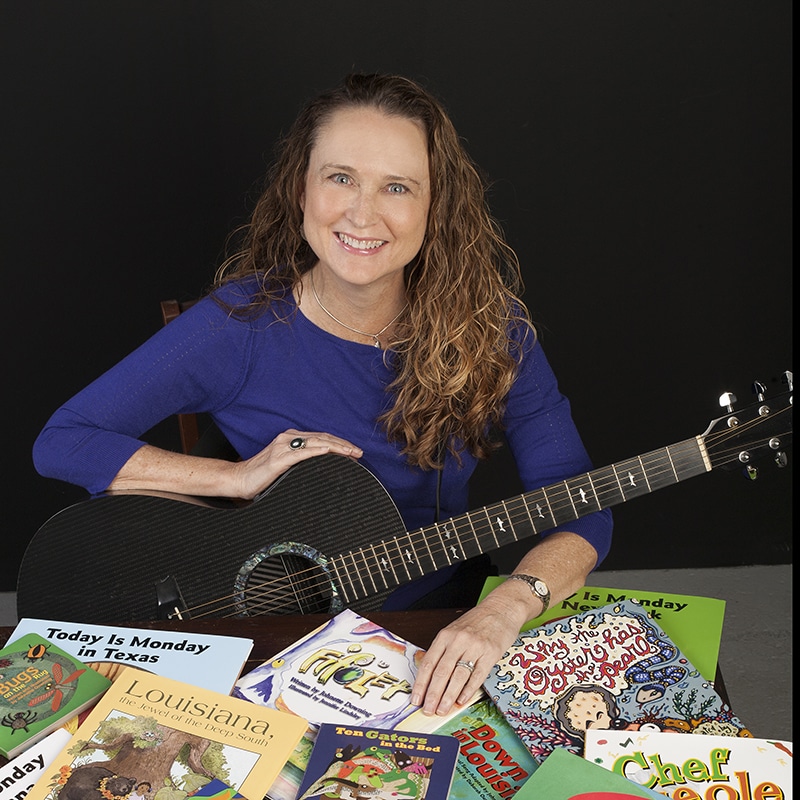
“It’s about the audience. You know, that’s my advice. It’s about the audience. It’s about you. You need to stop, go somewhere else. It’s not what you’re supposed to be doing. Because I feel like we’re all put on this planet to be in service of others. And I just happened to find out what that was. For me, everything else falls into place. And I was saying earlier too, about being authentic. Leading with your heart. When you’re leading with your heart, your work rings true to others because they can feel the love. You know they can. They know that you’re being authentic and the love surrounds what you do. Whether they like it or not, they can feel that it was done with your heart.”~Johnette Downing
Johnette Downing is a musician, author, illustrator, and poet with thirty-three books, thirteen recordings, and dozens of awards to her name, among them the 2017 Louisiana Writer Award, the ASCAP Plus Award, and numerous Parents’ Choice Awards.
Called the “Bard of the Bayou,” this New Orleans culture bearer has presented her Louisiana roots music and books for children on five continents.
Her latest releases for kids are the album My Little Snap Bean, Zydeco for Children, the picture books My Parrain is the Loup Garou and New England Animals A to Z. And grown-ups will enjoy the biography Irma Thomas, Soul Queen of New Orleans, which Johnette co-wrote with Scott Billington.
Dedicated to celebrating childhood, nurturing cultural exchanges and fostering literacy through her music and books, Johnette’s presentations speak to a child’s interests in an engaging, interactive, thought-provoking, educational, entertaining and culturally respectful way, which has earned her a reputation for being the Musical Ambassador to Children and the Pied Piper of Louisiana Music Traditions.
Johnette is also a haiku and senryu poet, and the co-founder of the New Orleans Haiku Society. Her poems have been widely published in numerous anthologies and publications. She’s also the author of Singing Waters, A Selection of Haiku, Senryu, and Haibun, which comprises over one hundred of her previously published poems.
Please be sure to stick around at the end of the show because Johnette has generously lent us one of her great Zydeco songs, My Parrain is the Loup Garou.
WEBSITE:
IF YOU LIKE THIS EPISODE, YOU MAY ALSO ENJOY:
- Laurie Berkner, Singer/Songwriter of Music for Kids-Episode #418
- Tricia Gardella, Author-Episode #410
- Amy Pollack, Author, Teacher-Episode #396
- Rusty Austin, TV Producer, Author-Episode #390
- Debi Derryberry, Voice Actor-Episode #384
- Joe Wos, Cartoonist-Illustrator-TV Host-Episode #380
- Scott Christian Sava, Artist-Animator-Illustrator-Episode #372
- Tom Ruegger, Animator-Producer-Writer-Episode #369
- Adam Rosenbaum, Author-Episode #336
- Megan Woodward, Author-Episode #301
- Leslie Tall Manning, Novelist-Episode-#112
- Kelly Ward, Actor-Writer-Director-Choreographer-Episode #66
Steve Cuden: On today’s StoryBeat
Johnette Downing: It’s about the audience. You know, that’s my advice. It’s about the audience. It’s about you. You need to stop, go somewhere else. It’s not what you’re supposed to be doing. Because I feel like we’re all put on this planet to be in service of others. And I just happened to find out what that was. For me, everything else falls into place. And I was saying earlier too, about being authentic. Leading with your heart. When you’re leading with your heart, your work rings true to others because they can feel the love. You know they can. They know that you’re being authentic and the love surrounds what you do. Whether they like it or not, they can feel that it was done with your heart.
Announcer: This is Story Beat with Steve Cuden, a podcast for the creative mind. Story Beat explores how masters of creativity develop and produce brilliant works that people everywhere love and admire. So join us as we discover how talented creators find success in the worlds of imagination and entertainment. Here now is your host, Steve Cuden.
Steve Cuden: Thanks for joining us on Story Beat. We’re coming to you from the Steel City, Pittsburgh, Pennsylvania. My guest today, Johnette Downing is a musician, author, illustrator and poet with 33 books, 13 recordings and dozens of awards to her name, among them the 2017 Louisiana Writer Award, the ASCAT Award and numerous Parents Choice Awards. Called the Bard of the Bayou, this New Orleans culture bearer has presented her Louisiana roots music and books for children on five continents. Her latest releases for kids are the album My Little Zydeco for Children, the picture books My Parrain is the Loup Garou and New England Animals. A to Z and Grown ups will enjoy the biography Irma Soul Queen of New Orleans, which Jonette co wrote with Scott Billington. Dedicated to celebrating childhood, nurturing cultural exchanges and fostering literacy through her music and books, Jonette’s presentations speak to a child’s interests in an engaging, interactive, thought provoking, educational, entertaining and culturally respectful way, which has earned her a reputation for being the musical ambassador to children and the Pied Piper of Louisiana music traditions. Jonette is also a Haiku and Senru poet and the co founder of the New Orleans Haiku Society. Her poems have been widely published in numerous anthologies and publications. She’s also the author of Singing Waters, a selection of haiku, Senru and Haibun, which comprises over 100 of her previously published poems. Please be sure to stick around at the end of the show because Jonette has generously lent us one of her great zydeco songs My Parrain is the Loup Garou So for much more about Jonette, please check out jonettedowning.com and for all those reasons and many more, it’s a tremendous honor for me to chat today with the exceptionally multi talented, award winning Jonette Downing. Jonette, welcome to Story Beat.
Johnette Downing: Thank you so much, Steve. It’s such a delight to meet you and thanks for having me on your show.
Steve Cuden: Oh, well, it’s a great pleasure to have you with me today. So let’s go back in time just a little bit and tell us a bit of your history. How old were you when the songwriting and singing and music bug first bit you?
Johnette Downing: I was a child. My parents were both musicians and singers in the church. Uh, my dad played tuba and violin and my m. Mother played piano and saxophone. So those are very wide. And they were singers, you know, so we would sing together all the time in the, in the car and at church. And so I knew very early on when I was a child that I wanted to be a singer. And I started writing poetry and stories. Um, and about the stories came in about the seventh grade and the poetry too. Uh, my aunt had given me something called a nothing book. And it was, um, a big, large bound book with nothing in it. You know, it was just white pages. So she said, okay, fill it up, you know. So, um, that was very much encouraged by the elders in my family too.
Steve Cuden: So you were surrounded by creativity and the arts and singing and writing and all that from a very young age,
Johnette Downing: correct? Yes. And that’s, you know, that’s the importance of, uh, exposing your children to different things because you never know what’s going to catch for that child and what’s going to hit, you know, and like, wow, that’s what I want to do.
Steve Cuden: Do you think of songwriting as a form of storytelling?
Johnette Downing: Yes, I do. What is a song without a story? You know, you have a hook and a groove. That’s it. You know, I mean, you can make, you can make a hit with a hook and a groove, but a story, those songs that those storytellers, like when I was a kid in the 70s, you know, James Taylor, Carole, uh, King, those story, uh, the people who wrote songs with stories to them, we’re still listening to those. We go back to those over and over again. There are plenty contemporary musicians and songwriters who have stories, but those are the ones I remember
Steve Cuden: M. Well. So who were your earliest inspirations and influences in the arts? Not necessarily your parents. Now we know they definitely inspired you, but who were the Artists that inspired you?
Johnette Downing: Yes. Just like I saying at that time, um, around the seventh grade, there was all the, there was all the singer songwriters coming out. You know, they, like I said, James Taylor, um, Rita Coolidge and Carole King, Elton John, all of those types of people who were musicians and songwriters and they were beautiful vocalists and they wrote songs that were told a story and that really influenced who I, you know, what I do now.
Steve Cuden: Well, who influenced you in writing for children? Why, why did you choose that route?
Johnette Downing: I don’t know. When I was in high school, I wrote, uh, several poems about, um, like a wasp, you know, there was a wasp in the room, flying around the room. So. And then my aunt gave me that book because I started writing poetry. And then later on, um, and I was those two, like the Lost Story was for, was for children. And I don’t know, my mother was a child caregiver and we always had children, you know, in the house. And my parents were, uh, avid readers and singers. So and we had a lot. My dad had this library in our house and we would go into that library as a family and we would read and sing. So for me, this, because I have many books that are songs. So that singing, reading connection really kind of was the foundation of what I do now. You know, it was the foundation of where I got started. So, um, just making literacy fun and singable for children. So. So I guess was just kind of always in there as I grew up.
Steve Cuden: And as you were growing up, when did you start to train as a musician? You had to have had thought, okay, I’ve got to get, Somebody’s got to teach me how to do some of this
Johnette Downing: right? Uh, we had a piano in our house and my sister was given piano lessons, but I would just sit there and turn the PA for her while she played. And then again in the seventh grade, it was this pivotal time because I’m from New Orleans, but my fan, my dad wanted this farm and he moved us out to the country and I wanted a guitar and because I was, wanted to be like those singer songwriters that I liked so much. And so I taught myself, I got a book out of the library and I taught myself how to play guitar.
Steve Cuden: Wow, really?
Johnette Downing: Yes. That’s when I started really composing a lot and writing, um, for children and writing for adults.
Steve Cuden: That’s fascinating to me, people that. And I’ve had a few guests on this show who are self taught in how to play different instruments and how to write songs and so on. I’m always fascinated by that because I’VE been in the music business for a long time, but I don’t know how to do any of that. So I, um, marveled at people who are able to do what you do, and I marvel at your being able to do it. Um, what do you think of yourself primarily as a songwriter, a singer, a performer, a poet, a storyteller? Or is it some combination of all of those things?
Johnette Downing: Well, I think it’s a combination because my background is music and writing. But I think who I am at the core is a haiku poet. Um, haiku is sort of very Zen, and you have to get in, and it kind of all works together. To answer your question, I think I’m all of those things because haiku makes you, uh. Or it calls upon you to see things with the eyes of a child and to notice the little nuances in nature. And it’s the. It’s the art of poetry and nature, like the juxtaposition between nature and human nature and how they are juxtaposed. So you have to take time and really notice things like children do. Oh, there’s a centipede. You know, as adults, we just walk on, you know, walk on through. But the children, there’s an earthworm. There’s this. And, um. And I think that’s who I am at the core. Like kind of a Zen. I don’t child.
Steve Cuden: So I think, personally, the most difficult things to master in the arts are short things. You write songs, they’re three minutes long, they’re four minutes long, they’re two minutes long. They’re short. They’re not, um, operas that go on for hours. Um, and also haiku, correct me if I’m wrong. Is 17 syllables correct
Johnette Downing: fewer than. Yes. Fewer than 17 syllables? Well, 17 syllables are fewer.
Steve Cuden: So you’re passing, uh, a notion, a message, some kind of a story along in 17 syllables or less.
Johnette Downing: Right. It’s really difficult.
Steve Cuden: It’s really difficult. It’s maybe the highest bar in all of poetry is to do that because you have no chance to expound or expand beyond that much. Like songwriting is a tight form.
Johnette Downing: Right, Exactly. And it’s getting the same with poetry as with songs and with children’s books. You have to get to the essence of things really quickly, you know, and you have to be really succinct and get to it fast. You get to the punchline fast.
Steve Cuden: So I. I don’t know whether it was Dorothy Parker. It might have been Dorothy Parker. But somebody like that once said it might have been Shakespeare even. I don’t Know that brevity is the soul of wit. And that little brief thing that you do in a. In a haiku poem is extremely difficult to. To make. Done well and clean and clear and all the rest of it. Is there something that you do in your mind’s eye to make that happen? How do you do it?
Johnette Downing: I don’t know. It’s a natural thing. That’s what I was saying. I think at my core I’m a haiku poet, but I didn’t come to haiku until 2001. I think it’s the child, the sense of awe and the sense of wonder. And I think that’s why I gravitated to haiku. I think that’s why I gravitated to children’s music. I was in all different other types of bands and a girl in the audience, a lady in the audience after the. I was doing, um. I was at this little place called the Penny Post in New Orleans. And it was a co op, kind of a hippie little club, you know, it was really fun. And um, I was playing with a folk band. And she came up to me afterwards and she said, ah, she’s a children’s musician. Her name is Judy Stock. And she, uh, said, you would be great with children. You’re just funny. And you know, uh, you just. I just think you would be great with children. And it was, it was like, bing, you know, eureka. That little bell went off in my head and I said, judy, that’s what I’m supposed to do with the rest of my life is, you know, write for children and sing and perform for children. And they’re all interrelated, you know, all of them. And from then on it was like I was in my. I was in my dao, I was in my flow. And everything started to just happen because I was in. In my flow where I was supposed to be. And jobs started coming to me and, and everything was very organic and it was fast and people would say, you need it. You know, I wrote all a set of songs. And, um, I got invited to perform at the New Orleans Jazz and Heritage Festival, which is a huge festival. And I was, you know, just starting out and um, and then someone said, well, I like all your songs. You need to make a cassette. That’s how long I’ve been in the business, since 1988.
Steve Cuden: I remember cassettes.
Johnette Downing: Yes. At least it was an egg track, but I would have been proud of an egg track too. So I did a cassette. And um, then that took off. And so then I just Kept doing. And then someone said, you need to make a cd. And then, um, someone said, oh, you need a children’s book. I love that song. You should make that a children’s book. So it was just this organic being in your river, being in your flow. And uh, it’s just been this amazing journey.
Steve Cuden: Is it relatively easy for you jump into that flow or does. Sometimes it’s difficult.
Johnette Downing: I try, um, I try to stay in it as much as possible. And I always tell people when it, when the work, when the art becomes about you, it’s time to stop.
Steve Cuden: Interesting.
Johnette Downing: Because you’ve lost the whole reason why you did it in the first place. And particularly in New Orleans. Uh, New Orleans musicians are all about the audience. It’s like, lets the audience stand. Especially Zydeco, the new album. I, you know, I have. But um, it’s. Your applause is a full dance floor. And if you don’t have a full dance floor, you didn’t. You’re not doing something right in zydeco music, you know. And so I feel that way. If you’re, if, when, when it becomes an ego trip or it’s about you in any way, then that’s your, that’s your marker to say, well, wait, wait.
Steve Cuden: So, so to you it’s all about delivering something to an audience. What is it that you get from the audience?
Johnette Downing: It’s about being in the service that uh, about being in the service for others. And what I get is the, the joy of seeing like children laugh or, or dance. I really, a lot of my music is about getting children to dance.
Steve Cuden: Mhm.
Johnette Downing: Interact with one another. At the, at the pandemic. You know, after the pandemic it was really difficult because you, we were told children for three years, don’t touch, don’t touch, don’t touch. So to have them dance again was really a hurdle, you know. Um, but that’s what I get. I get the joy out of seeing them think. Because I do a lot of um, reverse psychology with children. I’ll say things that I, that are wrong, you know, that. And they make them
Steve Cuden: give us an example.
Johnette Downing: I know. Just like, oh, I really, I really love my pink shirt, you know, and I have on a um, black shirt, you know, or a blue shirt and oh my, I really like my pink shirt. Do you like my. That’s not pink. I’m. Oh, I’m sorry. I’m sorry. It’s. It’s uh, orange. I meant to say orange. And they’re like, no, it’s not orange. And I’m Just making this up. This is the type of things I do.
Steve Cuden: You’re drawing them in that way?
Johnette Downing: Yes. And I want them to think because a lot of, um, schools and education systems, it’s about just reciting and having children listen and not having them, um, interact correct you and think. And it’s about critical thinking, you know, having them engaged. So that’s what I get out of it, is the engagement. And, uh, seeing that when that little light goes off, that’s something I wrote, made a little light go off.
Steve Cuden: I had a professor in college one time, long time ago, who used to say he couldn’t stand education by regurgitation. He wanted you to think
Johnette Downing: exactly. Exactly It.
Steve Cuden: So do you feel like the songs, the music, the performance, all of that is flowing through you from somewhere else?
Johnette Downing: Yes.
Steve Cuden: You’re a conduit for it,
Johnette Downing: right? I’m a vessel.
Steve Cuden: You are a vessel. This is a common story that I hear from many, many creative people.
Johnette Downing: Really.
Steve Cuden: They don’t feel like they’re creating anything. They feel like they’re just the. The, as you say, the vessel through which it flows.
Johnette Downing: Wow. A lot of other artists say that, too.
Steve Cuden: Yes, lots of artists.
Johnette Downing: Well, case in point, I wrote this book. People, um, say, do you have a favorite book? And you’re not just like children. You’re not supposed to have a favorite book. But, uh, my favorite book that I wrote is called why the Oyster has the Pearl.
Steve Cuden: Okay.
Johnette Downing: And I was asleep. I dreamt the whole book.
Steve Cuden: Wow.
Johnette Downing: And I woke up, and I grabbed. I always had a notebook and a pen in my table, uh, my nightstand, and I grabbed my paper and my pen, and I just started writing and writing and writing. And it was just this stream of consciousness, you know, like Kerouac says, You know, he had this come. That kind of thing with whatever that’s called. The Road. Kerouac fans are killing me. But, um, anyway, it was like stream of consciousness. I was just writing, writing, writing everything that was coming to being fed to me and flowing through me. And then at the end, I stopped it, and I said, what? You know, what was that? And so I read it, and it was why the Oyster has the Pearl, my favorite book. So I sent it to my editor because by then I had children’s books out, and I sent it to my editor, and, um, it came back with, like a comma here, comma there, you know, um, it was mostly punctuation, but she didn’t change anything. So I call that book my divine intervention. You know, that was my divine. My divine book.
Steve Cuden: So. So you’re saying that the books that you wrote prior to that frequently had some comment or note in it to change something,
Johnette Downing: right? Like, yeah, like, uh, maybe this word is better. Or, you know, maybe this. You know, I’m not that great of a speller, so I always get spelling corrections.
Steve Cuden: Do you. Do you write your books in rhythm, like a song, so that there’s a rhythm to them?
Johnette Downing: Most of them are. And like I said, many of them are singable. Um, like the ma ran is the loup garou. It’s a single story. Um, yeah, I would think most of them are in rhythm. And, um, one book, an editor. It was called the Fifolet, which is, um, a Cajun swamp creature. It’s, um, mispronunciation of faux fole, which is fire sprite. My grandfather was Cajun from the Cajun prairie, and he said, and, um, it’s a mispronunciation. So I wrote it’s this little fire sprite. And if you follow this, it’s fire sprite. You, um. You can get lost. You’re looking for treasure. You know, he’s. He’s always got treasure. So you’re following. And when I. When I wrote that one, it had a certain meter to it because I’m a musician and a writer, and the editor wanted to change some of it. It was a new editor, not the one that I worked with the rest of my career. But, um. And they just took the meter out of it, the song out of it. And it was so hard to read. And like, no, put this word and take that word out. And. And when. Then when you read it. Because you have to read it aloud to children, too, you know, and the timing was all off. And as a musician, he was like.
Steve Cuden: Did you explain it to the editor that this was. They’d taken a rhythm out of it.
Johnette Downing: Yes, I said the time. Right, you took the time out. But they. They kept, uh, the edit, even though I didn’t like it. But, um.
Steve Cuden: So they didn’t understand what you were doing.
Johnette Downing: Right. And usually a good editor can really feel that time, that meter, if you’re written. But this was a new person. And, um. So I did. I wasn’t as happy with it, but I. When I read it to children, I read it the way that I had originally wrote it, not what was in the.
Steve Cuden: So I want to go a little further on what you’re talking about right now. It seems to me one of your big missions. We’ve already spoken about it a little. Is literacy and reading for children. Why Is that your goal? What. Why is literacy important to you?
Johnette Downing: Um, like I said, my father was. And my parents were avid readers and we had a library in our house. And that just opened the world, you know, because. And my dad was very learned. He was a minister. So he, you know, he had a capacity for language and words. And that was always enriching to me. And I always liked origin tales and trickster tales and that sort of thing. So I wanted to share the music and literature the way. And my passion for both of those, the way that my parents shared it with me, I wanted to share that with children too.
Steve Cuden: So it’s beyond just being a songwriter and music. It has to do with the words and people being able to understand. And you also come from a part of, uh, the world and culture and so on where there’s more than one language. Really?
Johnette Downing: Yes.
Steve Cuden: So it becomes super important that people in your culture of being, you know, southern Louisiana, that you are able to communicate with each other through all these different languages. Explain what the difference is between zydeco and Cajun music. Is there a difference?
Johnette Downing: It’s the same community. It’s around Lafayette, Louisiana, Southwest. Um, one has a little bit more country that would be Cajun. And one has a little bit more R B, which is zydeco. They use basically the same instruments and washboard. Um, now in zydeco, they don’t really use a triangle like they do in Cajun music. But, um, it’s all dance. It’s music by the community, for the community, and it’s all, uh, for dance. So that’s one of my goals too. I was saying earlier with children is to get them up and dance. Because that’s.
Steve Cuden: I guess that’s true. I didn’t even think of it that way. But if I think about all the zydeco music that I’ve ever heard in my life, which is relatively limited, but enough to know there’s really nothing. There’s no real slow, songy ballads or anything like that in zydeco, is there?
Johnette Downing: They’ll have. They’ll do the, like a waltz every now and then because people want to, you know, get close and, you know.
Steve Cuden: But that’s a waltz. It’s not a true ballad.
Johnette Downing: Yeah, that’s true.
Steve Cuden: I, I didn’t even dawn. Didn’t even dawn on me until you just said it just now. Which is kind of interesting that the, the, the zydeco in Cajun music is really around movement, not so much on.
Johnette Downing: Yes, it’s about dance.
Steve Cuden: I mean, romance can be in There, but it’s really about dance, about people getting up and moving themselves, their bodies.
Johnette Downing: I’m not a zydeco artist myself, but I worked with a zydeco legend, uh, Nathan Williams and the zydeco Cha Chas. And, um. So I don’t really want to speak too. I mean, they’ll probably say there’s plenty of those soft slow songs. Johnette, what you’re talking about?
Steve Cuden: Well, there very well may be. But again, my experience is they all have that kind of upbeat, dancy rhythm to them. So what is your fascination as well, with nature and the environment?
Johnette Downing: So I live in New Orleans as I was, because of the hiker poet. I’ve always been a tree hugger. And I live in New Orleans and it’s such a fragile existence here. Uh, any day, any year, a storm could wipe us out. And it almost did with Katrina. 80% of the city was underwater. And. And, um, I’ve always been fascinated with animals and trees and plants and, you know, I’m one of those that takes lots and lots of photos of, um, flowers and plants and puts them on today’s walk. Because I try to walk three to five miles a day. And, uh, I try to look for beauty when I’m out. And I photograph different little snails or things. But it’s that sense of wonder too, that, um, that I want to share with children. The love of nature. And haiku is about haiku. Poetry is about that juxtaposition, the relationship between human nature and nature and for the good and the bad.
Steve Cuden: So not. Not to make a pun, but it naturally happens for you that way.
Johnette Downing: Yes. Yeah,
Steve Cuden: you’ve already said. And it’s true. If you look at your, your resume and at your, your catalog, um, you’ve written many books that also are songs.
Johnette Downing: Yes.
Steve Cuden: Which tends to come first, the book or the song?
Johnette Downing: It depends. It depends on, um. My husband always says you write, you know, you write a song every day because some melody will. So I guess it would be song. Uh, the song would come first. And a lot of times just anything, especially when I’m around children. Children will say something and I’ll just be like, that’s a song, you know, or. Yeah, so I think the music comes first. And now for some of my single books, they. A couple of them were like older books, like, um, Today is Monday in Louisiana. I also did Today is Monday in Texas, New York, Kentucky. And I have a new one coming out that’s a surprise. But, um, that one was already an old English song. And I just. When I Was, you know, I was also a teacher for a while, a music teacher for school. And so when I was reading that song, that book to, uh, my students, I was like, well, this is not. This is not the kind of food we have in Louisiana. Today is. Today is Monday soup or something. I was like, no, you know, today’s money. Red beans. We have red beans and rice here on Monday.
Steve Cuden: That’s a really fun. That’s a really fun song by the way. I enjoy that song.
Johnette Downing: Yeah. So I, um. So I. I wanted to adapt it for our culture. So, um. So, yeah, that one. That. In that case, the book was first, but I guess usually music comes first.
Steve Cuden: Okay, so when you’re writing the song, which comes first? The words or the music?
Johnette Downing: That’s. That’s about 50. 50.
Steve Cuden: 50, 50.
Johnette Downing: Yeah, sometimes. Like, one time I was in the gym, and, um, I was on the treadmill, and I was just walking, and the treadmill was going, boom chaka laka laka. Boom chaka laka laka, boom chaka. And then I was like, boom chaka like a boom shaka laka, Like a boom shaka, like a laka cr. Bam. And I had just taught a class of kindergarteners, and they were being wiggle worms. Yeah, they were just wiggle. I said, you guys are a bunch of wiggle worms. And so, uh, then I went crash. Boom bam. Wiggle worms. Wiggle worms. Wiggle worms wake. So I wrote the whole song right there in the gym on the treadmill, because of that rhythm that my feet were making on the treadmill.
Steve Cuden: And as you said a moment ago, you, uh, know, uh, uh, you may be around a bunch of kids and. And they may say something, and there’s your hook there. Becomes your song. Right?
Johnette Downing: That’s right. So many times. Yeah.
Steve Cuden: So I’m, uh, you’re. We’re going to play at the end of the show. My Perrin is the loup garou. Am I correct? Do I understand the translation right? That it means my godfather is the werewolf?
Johnette Downing: Yes.
Steve Cuden: Where did that come from? What is that idea come from?
Johnette Downing: So I just have this great blessing and pleasure of, uh, being born in, you know, Louisiana with all this rich musical culture and like you said, all the different cultures, you know, Haitian and Spanish and French and Native American and German, and all of these cultures. Come. Come here. And it’s all of this rich material, uh, storytelling. So one of. So the loup garou, uh, is the Cajun werewolf. And he messes with. He messes with, um, like when you’re fishing, he’ll mess with your fishing lines, he’ll steal your fish from you, he’ll tear up your nets, tangle your nets. Um, and he just creates havoc. Um. Now Cajuns, they use a lot of these things in a dark way to like, scare their children or get them to behave, you know, if you don’t behave, the Loup Garou is going to get you, you know, that kind of thing. So. And it’s usually scary. The Loup garou is scary. And, uh, the mispronunciation of lougaroo is rougarou. So we’re starting to hear more rougarou instead of lougaroo. But in French, it’s the loo. Is that werewolf?
Steve Cuden: Would that be. People are mispronouncing it as ru, R O U, X, like the food.
Johnette Downing: Yeah. And now they. Now they put it together without the X, it’s just R O u garu G a R O U.
Steve Cuden: All as one word.
Johnette Downing: As one word. Yeah. Especially down. Down the bayou. But most of the stories are kind of scary for kids. You know, Loup Garou is going to eat you. Or if you don’t go to bed, I’m gonna call the Loup Garou. He’s gonna get you, you know, and they eat. The Loup Garou eats bad kids. And it’s like, that’s terrible. Why are we telling scaring children? So I decided to write this one as a love story, a family love story where the little boy believes that his godfather is in fact, legendary. Loup Garou. Because he has. Has long hair and he smells a little bit. He’s super strength, you know, he can do. He can do all these. It’s a tall tale too. It’s it. He’s can do all these superhuman things. So he says, I know. He’s the Loup Garou, you know.
Steve Cuden: How many songs overall do you think you’ve written?
Johnette Downing: Hundreds.
Steve Cuden: Hundreds. And how many of those hundreds have you recorded?
Johnette Downing: 100, I think. Um, like 120 maybe, or.
Steve Cuden: Wow,
Johnette Downing: let’s see, 30. Because albums used to be like 20. It seems like my Spotify playlist is like, long. Like,
Steve Cuden: it is long. You have a long list. But you. But I get. What I’m getting at is you write a lot of songs, but you don’t necessarily record or perform every one of them.
Johnette Downing: Correct? Yes. So I have some I’ve never recorded.
Steve Cuden: And what then makes a distinction? You’ve written a song. Is it for you? It’s just not right. It’s not working. Or what is it that that says to you? No, I don’t want to put this out into the world for others to hear. What is that distinction?
Johnette Downing: Yeah, well, usually a child will tell you.
Steve Cuden: Oh,
Johnette Downing: yeah. Like a child say, you know, you perform it. When I was a teacher, it was great because I could test out all my material in my class, you know, and the kids will say, you know, I don’t like that song. Or that’s dumb, you know, or, uh, that song is awesome. Then, you know, okay, you got a hit there. You know, the kids like it.
Steve Cuden: So once again, you’ve gone to your audience as your feedback.
Johnette Downing: Yes. Yeah, it’s all about the audience.
Steve Cuden: Sure. Uh, well, ultimately, you know, Aristotle once said, you need three things. You need a message, a messenger, and a receiver. So you need the story, the person who writes the story, and an audience to receive it. And without all three of those, he basically said, you don’t have a complete circuit. You don’t have a whole. It’s not a complete work. It’s not a piece of art yet until someone else has looked at it, received it, and went and reacted to it in some way. And you have this, this built in, uh, gift of, as you say, wiggle worms who will tell you, yes, this works. No, that doesn’t work. Right?
Johnette Downing: Yes. Right? Yes. I had this one time, I had this song called Bubble Gum and I. And it’s like bubble, bubble, bubble, bubble, bubble gum One and one makes two pop up Bubble, bubble, bubble, bubble, bubble gum. Um, that’s why I’m stuck on you. And it’s 1, 2, stuck at the shoe, 2, 3, stuck at the knee, 4 or 5. So I was, ah. I wrote it and I did it for my class. And I said, 11. 12 is. No, yeah, 11. I couldn’t think of what. What would rhyme with 12. So it was like. And I would think it. Imagine 12 is stuck at the pelvis. I said, I can’t do this for kids. Stuck at the pelvis. Like, you know, it’s good for them to know what a pelvis is. But I m. Was like, I can’t have little kids, you know, look at their back and all this. And so I was singing it for him and this. And they. When I got to 11, 12 was stuck at the pelvis. I just was testing it, you know, and they started laughing so hard. And I said, what’s so funny? They said, you missed. You’re so funny. Um, stuff like Elvis. I said, wait, What? They said, 11, 12 and stuck like Elvis. And they started going, you know, like. Like making moves like Elvis. Genius. So then I recorded it. I couldn’t have recorded 11. 12 is stuck in the pelvis.
Steve Cuden: No. Pelvis Wouldn’t have been very, uh, childlike, I guess. Wouldn’t have been in that. That age range, I wouldn’t think. Unless you’re teaching them about, uh, the. The human body, I guess. But,
Johnette Downing: yeah,
Steve Cuden: that’s not what you were doing.
Johnette Downing: Body part stuck. It stuck at the knee stuck at. You know, it was all body parts, but it just, uh. It just. It wasn’t. I didn’t want to.
Steve Cuden: So I’m. I’m curious. Do you ever need to go to something like a rhyming dictionary or is it all out of your head?
Johnette Downing: No, I go to the writing dictionary often. Yeah. In fact, my New England book, um, my husband’s from Boston. I mean, he’s from, uh, Newburyport, Massachusetts. Boston or near Boston. And so I decided to write, um, New England animals because I have all these southern books and, um, it’s all alliteration. So I. I go to, you know, look up alliteration and thesaurus and all that, you know, rhyming dictionary. And yeah, I use all those. And I actually have the book. You know, the books still have the.
Steve Cuden: I also recently, I never even said this on the show before, but recently. And when I say recently, the last few years, I’ve been going to an online program called Master Writer that has outstanding resources in it for writers of, uh, different thesauruses and. And, uh, rhyming dictionaries. And there’s wonderful stuff in this particular online program called masterwriter. I’m not trying to sell it to anybody.
Johnette Downing: No, no, it sounds great.
Steve Cuden: It really is. It’s a really wonderful resource. All right, so I’m wondering. I asked this question of lots and lots of guests, and I love the answers that I get. What, for you, makes a good song good, especially for children. But what makes something good, when you finish it and you go, that’s it. It’s not just the reaction from children. You have to have some sense of it yourself first, I assume
Johnette Downing: authentic. And knowing your audience, again, you know, it’s speaking to your audience. A lot of times you’ll hear songs for kids that are written for the parent, you know, but authentic when it’s fake. Children can sniff out a fake. They know, you know, and if the song is, uh, you’re kind of trying to eek it by, they sniff it out, they know. So when it’s authentic and it comes from the heart, they can feel it and they know and they react to it.
Steve Cuden: That’s interesting. I, you know, I’m trying to think to myself, how do you. How do you define authentic? What does that mean?
Johnette Downing: When you’re being true to yourself, when you’re writing something you know and something you love, then you’re being authentically you, and then you’re. You’re respecting your audience enough to be vulnerable and to give of yourself and give of your passion and your. Your thoughts and your love, you know? Um. Yeah, you just can’t fake it with kids. That’s what I love about playing with for kids. You just. They will let you know they’re the best audience because they will let you know immediately.
Steve Cuden: Well, they have almost no filter, so they don’t.
Johnette Downing: No, no filter.
Steve Cuden: They have no interest in being polite to you at all, like an adult would.
Johnette Downing: And, you know, immediately, like. Like I said, sometimes it’ll be like, that song’s awesome or, that song’s terrible. That was dumb. Why’d you. You know, I don’t like that song. So it was like, I’m not recording that one
Steve Cuden: out. It goes. So is it most of your songs are in some way, shape or form relaying a message about something? Is it important that songs for kids have some kind of, uh, an underlying message to them?
Johnette Downing: I think so. Um, even if it’s just about the joy, even if it’s just about giggling or laughing, that, you know, having the license to. Having the freedom to be a child and just to giggle and laugh and wiggle and so those are all valid, I think, too. It’s so important, too, because children grow up so fast now and to interact with other children and touch and, you know, dance and move, and I do a lot of hand, um, clapping things. So. And then there are other messages about kindness and fairness, stuff like that that are. That are in the songs, like I have Wonderful Friends song, you know,
Steve Cuden: and sometimes songs can just be fun and silly. They don’t have to always have a message.
Johnette Downing: Absolutely. And that’s the joy part, is like, that. That’s a message in and of itself. It’s like, celebrate childhood. And a lot of them are just fun. But there is that message of celebrating.
Steve Cuden: Do you write most of or all of your songs on guitar or some other instrument
Johnette Downing: on guitar? I wrote a few on ukulele. Um, during the pandemic, I said, I’m gonna learn. My husband and I, we’re here together. You know, what are we doing? I said, let’s learn something new. So on, uh, ukulele, I, um, I said, let’s learn jazz standards and he plays harmonica. So he said, okay, I’ll play the chromatic so that we could do jazz standards. But I wrote a couple of children’s songs during that time, uh, with the uke. It was really fun.
Steve Cuden: Did you record them that way?
Johnette Downing: Yes, I did. And actually for this, uh, zydeco album, uh, my little snapping. I’m playing uke on the entire album. Um, because Nathan’s band, the Cha Chas he had. His brother is the guitar player. Player. And he’s phenomenal. He didn’t. They didn’t need another guitar player on. So I decided to play uke. And they were really. We were all surprised when we heard it back that, you know how I’m very a rhythmic. I’m a very rhythmic player. You know, I’d have a lot of, um. Because I. I want children to hear that beat so they dance and move. Um, but we heard it back and everybody m said, man, that UK really goes well with zydeco. And then, um, Justin Talkett, the engineer said, yeah, now every zydeco band that comes in here is going to want to put a UK on a zydeco.
Steve Cuden: Well, the UK has a very specific sound to it and it’s usually associated, I think, with Hawaii or Hawaiian songs. That’s what you think of most of the time. But it is a wonderful instrument to suddenly pepper into certain things.
Johnette Downing: Right.
Steve Cuden: Let’s talk about your performance when you perform, because I know you do a lot of live performance as well as recording. Um, do you have any specific kind of performance preparation that you go through before you go out and perform for people?
Johnette Downing: Um, I’ve, uh, been doing this a long time, since 1988. Um, so I have, you know, I have things I know work, but, um, sometimes when I, I just want to change it up, I have. And because I was a teacher for 28 years teaching, uh, early childhood music, I have themes. So I’ll have like animal songs. And a lot of children’s artists have that too. Like food songs, animal songs, holiday songs, um, insects, you know, marine animals. So you can. I can pull those out depending on the situation. I could pull those sets, set list out, but I haven’t done them in a while. I. I prep and I practice them. And um, and then, you know, then I always have my little ones. I know work, you know, that can or usually work. Knock one wood.
Steve Cuden: You have so many songs. Do you do something to remember them all or you just naturally remember them?
Johnette Downing: Um, I remember them all. I have some, uh, fans who, uh, they’re grown ups now, but there’s, uh, they have special needs, you know, special need fans. And they come. They were coming when they were a little bitty, and now, um, they’re adults, but they still like my music. And, um, if I don’t do certain songs in a certain order, um, they let me know, you know, that’s not how. Or if I change the lyrics or if I, uh, you know, miss something, they go, that’s not how it goes. You know, that’s not how. That’s.
Steve Cuden: Those are real fans.
Johnette Downing: Yes. So I’m like, okay, well, you know, sing the lyrics. Or they’ll. Or they’ll call one that’s in the back catalog, you know, like, really? Oh, that I haven’t done in a long time. And I’ll say, okay, you know, sing it. Sing a few words for me. And then. Then it’ll come back to you.
Steve Cuden: So you’re constantly changing up the. The songs that you play in performance. Um, do you do anything, uh, with your voice before you go on stage to sing? Do you have vocal exercises that you do?
Johnette Downing: No, not really. I should. Yeah, I guess all performers should. Well,
Steve Cuden: you’re lucky. I mean that. What great good fortune that you don’t really need to work with that very hard.
Johnette Downing: Yeah, I guess, uh, it was fortunate to have parents who were singers, and I was always singing. So
Steve Cuden: when I listen to your songs, whether the recordings or when I’ve seen the videos of you performing live, um, I can tell that you have a passion for what you’re doing. You’ve been talking about passion, really, throughout this entire conversation so far, that you have a passion for what you do. Is there anything that you do to keep that passion alive, or is it just within you all the time?
Johnette Downing: Yeah, I think it’s just once I found out that I would be working with children, it was like I said, it was just this. That’s what I’m supposed to do. And there was no going back. It’s like I just. That was it. And I always thank Judy, my friend. Um, she’ll email me and say, I saw you talked about me in another interview, or thanks for doing that. But, you know, you never forget. You never forget where you came from and, you know, and who helped you along the way. And, um, yeah, I think it’s just there. It’s just who I am. I know one person, um, told. Told a friend of mine when I was talking to them back, it was another performer. I was talking to him backstage and. And, um, he. He sort of had a Persona. You know, he Was a certain character when he came on. Like many artists, you know, I have, like, buffalo, whatever, you know, uh, then I’m just me. And so we were just talking, and then I said, okay, well, it’s my turn. I got to go on a win on. And, um. And he turned to. It was my ex boyfriend at the time. He said, that’s just really her like this. She’s the same as when she just talked to me.
Steve Cuden: Couldn’t believe you didn’t have a Persona.
Johnette Downing: Right? Yeah. I don’t know. Just me. M. But it’s nothing. I mean, I think it’s great to have a Persona, too, if that’s what you.
Steve Cuden: Of course. Uh, you know, obviously, there. There are people that have an act, and the act is not who they are. And then there are folks like you, where the. You are the act, and that’s. There’s no getting around it. What is your favorite thing about performance? What do you enjoy the most?
Johnette Downing: The children. I really. I really vibe from them, you know, I get their vibe. And, um. And just when I see them giggling or looking at me, like, Because I say so many ridiculous things, you know, that are. You know, no child would ever believe that. And they’re just looking at me, like, so wrong. It’s just so bad. And then they correct me, which I love. And, um, just like my friend, I said, my special needs. He’ll say, that’s not how that goes. You know, I love that. It’s like, it’s. They’re in it. You know, we’re in it together, and we’re creating together.
Steve Cuden: Is that how you think of it, that you are creating together?
Johnette Downing: Yes. Yes, we’re in it.
Steve Cuden: But have you ever worked with children where they’re creating actual songs with you that didn’t exist?
Johnette Downing: Yeah, I used to give songwriting, uh, workshops. Uh, and yeah, where I would help. Like, one time we wrote a school song. You know, I was hired to go to a school and help. Help the students create a song for their school. Um, but it wasn’t for me. It wasn’t something for me to perform. But I used to teach songwriting workshops for children
Steve Cuden: and create songs. In the workshop with the children?
Johnette Downing: Yes.
Steve Cuden: Did anything turn out where you finish something, you went, wow, this is really worth taking to the next level.
Johnette Downing: Yeah, they were all great, you know, but, uh, I thought they were all great. They had something, you know, and then I made a recording of it, and then they gave it to them. I don’t think I ever performed any of them because they wrote it. It was Their song.
Steve Cuden: All right, so let’s talk for a bit about your books, which is a slightly different, uh, creative outlet, but yet it’s related to what you do as a songwriter as well. Um, how many books have you published? 33. 34 books.
Johnette Downing: 33.
Steve Cuden: What is it you think? I mean, that’s a lot of books. What is it you think about your books that makes, um, them appealing and they continue to go out and sell to the world?
Johnette Downing: I think, again, it’s back to that Zen, the curiosity and the sense of awe and wonder. Um, and because I was really into trickster tales and, um, origin tales, how things came to be. So a lot of my books are about, you know, why the oyster has the pearl, why, you know, why the possum has a large grin. Um, and those are the ones that are not singable. Those are more stories
Steve Cuden: and educational in a large way.
Johnette Downing: Yeah. So, um, I think that’s what it is. So I’m curious about. Well, why does that happen? So in New Orleans, we say we have a po’ boy sandwich, which is like a hoagie or a Subway.
Steve Cuden: I know what a po’ boy is.
Johnette Downing: Yeah, you know, po’ boy. Okay. So when you order a po’ boy in New Orleans, the person, uh, you’re ordering from will say, um, do you want it dressed? And, um, so people from. Not from New Orleans would be like, do I want it dressed? You know? What do you mean dressed? You insane? You know, it’s like, so here we know they mean, do you want it with, um, you know, mayo, mustard, lettuce, tomato, pickle, you know, do you want it like that? So I thought, yeah, so children might not. Not. And I’m all about culture, too, so. So I’m like, okay, what’s interesting about our culture? So what is it? How. How to dress a po boy? How do you do that? So I asked children, how do you dress it? Do you put a T shirt on them and they’re like, no, we don’t put. Oh, I know. You put pajamas on. No, not how you dress a full boy. Like, oh, I know. You have really cool shoes on. That’s how you. No, that’s not how you dress up a. Well, then how do you dress a boy? You add stuff. Oh, stuff. Like sticks and rocks and, you know. No, no, you know, like food, you know. Well, what kind of food? Like. Like broccoli? Like. No, not broccoli. You know, that kind of thing. So.
Steve Cuden: Well, you make them think, which is really great. I mean, so they’re. They’re Fully engaged once again. That, that word engaged I think is, uh, probably the major key to what you do is that you bring them in and they become, they feel like they’re part of the event. They’re not just sitting back and being passive. They’re active participants in what you do. Now I noticed that you sell and have written both ordinary books, I guess, and then what you call board books. I’d never heard that term before. What’s a board book?
Johnette Downing: Okay, so, um, a picture book is a bigger, you know, with um, eight, eight and a half by 11. Usually a board book is a smaller book and picture books are usually kindergarten to third grade, kindergarten to second. A board book is for babies. It’s made out of really thick. It doesn’t have paper pages. It has of cardboard so that if a little baby is walking around or chewing on it or stepping on it, it’s uh, sturdy.
Steve Cuden: I know exactly what you’re talking about. I didn’t know that that was the name of them, that they call them board books. That’s very interesting. Yes, that’s a. There, it’s thick. It is like basically a thick cardboard of some kind. Uh, I get it. What do you find to be the most challenging thing about publishing a book? I noticed that you illustrate any number of your books as well.
Johnette Downing: I do, yeah. It’s cut paper, collage. I really like that. Um, I cut and you just cut paper and glue. I’m not really good with drawing or, you know, painting, but I can cut and make things.
Steve Cuden: That’s an interesting talent. If you can’t draw, but you can actually cut stuff out and make it look like what you want it to look like. That’s a specific talent
Johnette Downing: or lack thereof. I don’t know either one
Steve Cuden: or. No, I think that’s a real. That’s a real talent. Well, listen, there are lots of artists that don’t produce realistic images. They produce abstracts and it’s like they’re just throwing paint on canvas, but it isn’t. There’s something else happening there. Yours have realistic pictures, but it’s not photo real. It’s fanciful. I think that, that they’re, they’re very. And you do the same thing. I believe, if I’m correct, in some of your videos. Right?
Johnette Downing: Yes, yes. So made some music videos with a cut paper collage. And I like foam too, because foam, the craft foam, it’s real, it’s soft looking, you know, and you just cut, cut paper and you layer it and so it looks three dimensional. And often children will come up to my books and they’ll touch the page like, because it looks like it, it’s three dimensional. It’ll come off, you know, like. No, it’s flat.
Steve Cuden: Well, because that’s the way that you’ve got it, with a depth in the image itself. And, and I can imagine for a kid that’s really fascinating to see that depth on paper.
Johnette Downing: Yes. And I wanted to illustrate with cut paper collage because children have those in elementary school, they have those types of supplies in their classroom so it’s doable for them. So there’s scissors, glue and paper. That’s all you need for cut paper collage.
Steve Cuden: Mhm.
Johnette Downing: So they have that in their class. So a lot of schools will take, uh, teachers will take one of my books and the whole class will make, you know, an image from the book or you know it and they’ll do cut paper collage. It’s really great.
Steve Cuden: It’s a lot less, um, messy, I guess than paint.
Johnette Downing: Yes. Yeah. Well, you do end up with paper all over your house. Well,
Steve Cuden: that’s true.
Johnette Downing: Scraps of paper
Steve Cuden: and glue stuck to you somewhere. Tell us about the Irma Thomas book. That’s very different from what you normally do.
Johnette Downing: Yes. I had written another biography of um, uh, I mean, in addition to being Cajun and all Native American and German, all these, you know, big gumbo of people who we are. And most of us are all these big mix.
Steve Cuden: A gumbo of people. Uh, that could be a horror movie right there.
Johnette Downing: Yeah, we’re just like. We call. It’s kind of a cliche here. But you know, we’re a gumbo, we’re a big mix of things.
Steve Cuden: Yeah, sure, of course.
Johnette Downing: And um, I’m also an Isleno, so I had written a biography of um, the Canary Islanders. There’s four Canary Islander settlements and it’s um, it’s part of Spain. So I’m also a very rare little group here of Islanos. But I’ve written a biography of uh, Islano musicians from, from New Orleans, from Louisiana. They came here in 1778 and it’s a long story. But anyway, um, so I, I really enjoyed doing that process. My husband helped me a little bit. And then um, he is a um, Grammy Award winning record producer. He worked with Rounder Records. And um, so he, I encouraged him to do his memoir. And he had worked with irma Thomas for 30, 40 years. They made 10 albums together. Um, they have a long career together. They’re family, you know. And she’s the soul queen of New Orleans. Uh, she’s 85 now. She’s had a 60 year career. Um, and so, uh, when he posted, okay, I, you know, I did my, I did my memoir. It’s out. Well, Irma Thomas follows him on social media. And she said, when you’re going to write my book? And he said, oh, my goodness. I said, that’s it. Let’s write, let’s write her book. And, uh, he said, I’m not writing her book because his memoir took so long. You know, uh, that was his first book. And, uh, he said this, that’s just. She’s got a 60 year career. There’s no way I’m gonna do all that research. And I said, okay, I’ll do it with you. So we talked to her. She said, oh, that’d be great. So we, it took us four and a half years to write it. It’s um. And we ended up, we would write a chapter or two and meet with her on Zoom. And, um, she would help us, you know, like, well, I don’t remember that. Or, yeah, that, that didn’t happen that way, you know. So we had her there to help correct, um, things and keep it, you know, keep it fresh and true. And she was able to make comments and tell us stories and it was really just amazing. It took a long time and we interviewed lots and lots of people. Um, but from haiku to a, you know, treatise on the soul, Queen of New Orleans was a big shift.
Steve Cuden: Well, it’s a very big shift. It’s a totally different thing. It would be unexpected to your basic audience. Um, because it’s really not for kids. I assume it’s for.
Johnette Downing: No, it’s, it’s. Yeah, it’s for adults. She was on American Bands, but I had written, you know, a lot of people think, well, how did you write? But I had, I had done that biography of Canary Islands. It was for the Canary Islands government. And it was short. It wasn’t. I mean, it’s an adult book, you know, I mean, it’s for grownups. Not adult, but it’s for grownups. But it was, you know, it was in a children’s book. So I had experience with that.
Steve Cuden: Did you have to use a different part of your brain than you’re normally working with? Did it feel different to you to actually write prose? Ah, for a more adult audience than, um, less, uh, wordy or verbose that you would write for kids?
Johnette Downing: Yeah, it was kind of fun. It was stretching and it’s good to do as a writer, to stretch, um, and all the research. But I do research for, you know, a lot of my books are just part of my own culture. And I already know, like, the loup garou and the FIFA and all those things, but I still do research, you know, just to make things accurate. You don’t want to put false information out there for kids. You want to be. And you want to be authentic. So you want to make sure, you know, what you said is, you know, is part of it. But, yeah, so it was a lot of research and, uh, interviewing people, which was different. It was fun and working with someone else. My husband, but he had helped me with that other biography, and I kind of helped him with his mostly, um, like it just reading over and editing his memoir, because that was his first book. And, um, so it was. That was the. How do you keep one voice when there are two writers, you know?
Steve Cuden: Well, that is a trick. Did one of you ultimately finish it? In other words, did one of you put the polish on it so it had one voice?
Johnette Downing: Well, we really did collaborate. Well, I mean, it was. It’s fun, funny, you know, uh, now he is Facts and Figures. He can tell you every musician that was on a record. He knows the catalog number, you know, because he was with Rounder Records for so long. Hundreds of records in New Orleans of roots, Louisiana, roots music. So he knows. He’s just this encyclopedia of music facts. And. Oh, no, it wasn’t that bass player, because that bass player was, ah, on tour with this guy. So they had another bass player come in. How do you know that? Um, and I’m more of a storyteller. So we were able to take the facts and figures and all of his stories being in the studio with her for so many years, and I was able to kind of shape it into a story, you know, Um, I was more of a storyteller.
Steve Cuden: So let’s shift gears one more time before we get too far into the show, um, about poetry. We’ve talked early in the show, very briefly about haiku and senru and so on. What is the difference between haiku, senru and haibun?
Johnette Downing: Good question. Yeah. A haiku is, um, a short poem of Japanese origin of, uh, three lines or fewer and 17 syllables or fewer. And, uh, it connects nature and human nature. That’s a haiku, a senru. And it’s also, um, haiku were also called one breath palms in Japan. It’s a Japanese form. And in Japan you should be able to read, uh, haiku in one breath. And it’s very, you know, very sin. So a sinru is the same as a haiku, except for it doesn’t. It doesn’t, um, have nature and human nature. It’s just about human nature. So, um, a lot of. Some, just a lot of people do joke haikus, and they’re just about people. Those are sinrus, not haiku. But they’re so close that a lot of journals don’t even differentiate. They’ll just say, we have haiku and sinru. They’re not going to say, here’s the haiku and here’s the sinru. But some, um, traditionalists will. Haibum is a prose with a haiku or more. It could be several haikus. So you’ll tell a little story or just real short or fact, and then you write the haiku about that. Uh, so it’s pros with a haiku.
Steve Cuden: I see. So. So they’re all sort of in the same ballpark, but they have slightly different ways about coming about it.
Johnette Downing: Right. And haiku and sinroo are not titled, but you can title a high boon. So just for instance, um, I don’t know. I don’t know. I don’t know why I’m picking baseball. I know nothing about baseball. But baseball. You know, baseball. And then in a paragraph it’ll be, baseball is an American pastime. And then it’ll be a haiku or a simroo after that. And it can be two or three haiku.
Steve Cuden: And how interrelated are all these things that we’ve talked about, from your songwriting to your performance to writing about Irma Thomas, to haiku, senru and haibun? How are these all interrelated in the way that you create? Are they all part and parcel of the same thing, or do you really go about it in very different compartmentalizations?
Johnette Downing: I think they’re all one thing. That’s such a great question.
Steve Cuden: Well, sometimes I get lucky.
Johnette Downing: No, you’ve been doing this a long time. What did you say, 400 something?
Steve Cuden: You’re. This is our 426th episode.
Johnette Downing: Wow. Uh, great question. Um, for me, I think it’s all one because it’s just me, you know, And I think, um, as we were talking about earlier, being in your flow and being in your river, you know, and those are all things being a conduit, you know, and they’re all things that for some reason picked me.
Steve Cuden: I. I for myself. I do many different things in the creative world. And I. It took me a long time to stop thinking about it as separate things, that it’s all. It’s all of a piece. At least for me it is. I don’t know. That’s why I’m asking you, uh, that. That even though one is completely different discipline and requires a whole different way to think, but to me, it’s. You’re an artist of. You know, in life, if you’re an artist, then you’re creating art one way or another. And yeah, they. Things come out differently and people receive them differently. But for me, it’s just all one gumbo. As you say. It’s art as a gumbo.
Johnette Downing: Yeah. Well, it’s like, say, for haiku. For me, it is all the. All one too. So for haiku, it’s about Zen. It’s about being, uh, in the moment in which children are always in the moment. You know, very few of them are worried about what’s happening. You know, little kids. Little kids, once they start having homework and stuff. So children are very in the moment. They’re very Zen. They’re, um. And they’re. They notice, they’re curious, they’re in awe of everything around them. And, um, so that’s. That’s a haiku. And. And, um. And from that is a. Is a song and a story. Because then you’re being in the moment. You’re. It’s Zen, you’re being in your flow. It’s creative. And then it goes to a song. A song is a story. A story is a book. So they’re all kind of.
Steve Cuden: And. And there are pictures that go with the words. The words are part of the. The whole thing.
Johnette Downing: Yeah, they’re one. They’re one continuous loop. And I do move from them back and forth, you know.
Steve Cuden: Do you think that doing one, um, which gets you away from doing the other, enhances that when you go back to doing so in others? If you’re working on a haiku today, that. That enhances your ability to now come fresh to writing a song, which then enhances your ability to come fresh to illustrating it and so on.
Johnette Downing: Yes, yes, because it’s all about exploration. You know, when you find you’re being surprised because haiku is also. There’s the aha in haiku. That’s what ha. The haiku part of it is. Ha. Is the ah. It’s that awakening, the Zen moment. Whoa. So, um, it’s exploration, it’s discovery, it’s surprise. And that’s what the song is. The song has a. There’s a hook, and you go, ah, oh, I. You know, this story. And then the lyrics are part of a story that go. That. Now I Make a book out of. Because I have a song and I made a book out of the song, and that tells the story. And
Steve Cuden: a little bit of the light bulb goes off every time.
Johnette Downing: Yes.
Steve Cuden: I think that that’s. I shouldn’t say the light bulb goes on. I should say it blinks on, though. When I think of going off, I think that it explodes, you know, with, uh. Energy is going off.
Johnette Downing: Yeah. Sometimes it’s like, oh, okay. Now, especially with groups, like if I’m going to my haiku group and then, uh, I’m working on, I have to send a video to someone and then, you know, it’s like. Then that kind of thing is like either different hats, but the act of creation is all the same to me, I think.
Steve Cuden: Well, I’ve been having just the most marvelous chat with Johnette Downing, and we’re going to wind things down just a little bit. And I’m wondering, in all of your vast experience as a performer, a writer, an artist, or, um, can you share with us an experience that’s either weird, quirky, offbeat, strange, or just plain funny?
Johnette Downing: Well, one of them that was really meaningful was, um. I was invited to perform in Marrakech, Morocco.
Steve Cuden: Wow.
Johnette Downing: Mind. Mind blowing, you know. So I go there and, um, my host took me to this. To this medina, which is like a market, um, with souks around and. And I’m standing there in this big medina market and there’s polyrhythmic African Arab music playing. You know, there’s. They call them song circles or music circles. And it’s all this polyrhythmic, which I love in New Orleans because we have all that, you know, all this blend of things and, um, Afro Caribbean rhythms and Spanish and all this kind of stuff. So anyway, I was really. I could hear that through the polyrhythmic Arabic and, um, African music going on. There was a, um. There was snake charmers, and just. It was just packed with people. They had snake charmers. He had all these big tubs of spices and nuts and dates and olives and. And they had a water seller, a man who walked around and sold water. And he had like one of those skin things, um, like a flask, but out of skin, you know, and they pour you water. And he had, um, like brass cups all over him. So when he was walking, you could hear the water cellar coming. Um, have lots of haiku about the water cellar. He was just amazing. And so all this stuff is going on. Um, I’m standing there and it’s just beautiful. It smelled the food is smell beautiful, the architecture is amazing. And, and it was one of those moments where it was surreal, you know that I’m in Marrakech, Morocco, because I write and perform books and music for children. I’m here to meet with Moroccan children and create with them and play with them and sing, you know, and dance and move. And it was just like the most amazing moment. Like my whole life came to this laser as you were saying, it came into focus like. And uh, I just cried, you know. It was just like the most beautiful thing like this. Doing what I love and what I was meant to do brought me here to this amazing place with all these amazing people, people from all walks of life right there. So much going. Snake charmer. I mean, it’s a snake charmer right there. So that was one of the most just, you were saying, odd, weird, quirky, you know, kind of just. But like life affirming moments and meaningful moments.
Steve Cuden: Do you find that wherever you go, children are still children?
Johnette Downing: Absolutely, yeah. They’re the same no matter where, um, there’s a little na na, na, na na na. You know that, that’s all over the world. Children do that all over the world. I’ve had the great fortune of performing on five continents. And everybody’s. And thumb war. All children know the thumb war. And rock, paper, scissors. It’s like no matter where you go, if, you know, if you want to break the ice, use rock, paper, scissors or.
Steve Cuden: How interesting. Yeah, it’s a, it, it’s a universal thing. All right, so last question for you today, Johnnette. Um, you’ve shared with us a massive amount of very useful information and advice along the way. But do you have a single solid piece of advice that you like to give to those who come up to you or write you or whatever and say, how do you do what you do? How do you get into the business? What kind of advice do you give people?
Johnette Downing: It’s about the audience. You know, that’s, that’s my advice. It’s about the audience. And I said it earlier. When it’s about you. It. That’s your ego. If it’s about you, you need to stop, go somewhere else. It’s not what you’re supposed to be doing. Because we’re. I feel like we’re all put on this planet to be in service of others. And I just happened to find out what that was for me and everybody can, you know, once you find out what that is, we’re not here to be in service of ourselves. We’re here to be in service of others, to make others bring joy and happiness and love and compassion to others. And, um, that’s the main thing. It’s about the audience being in service of others. And then I think everything else falls into place. And I was saying earlier, too, about being authentic, leading with your heart. When you’re leading with your heart, your work rings true to others because they can feel the love. You know they can. They know that you’re being authentic, and there’s that heart of the love that surrounds what you do. Whether they like it or not, they can feel that that was done with your heart.
Steve Cuden: Well, I think that that is just wonderful philosophy and wonder. Wonderful way to think about creating. Uh, that it’s really about not you. It’s about bringing something else into the world. And I think that many artists would benefit by understanding that that’s what they’re doing, that it’s not about themselves. Um, Johnette Downing, this has been a terrific, terrific episode today, and I can’t thank you enough for your time, your energy, and for all this great wisdom. Thank you.
Johnette Downing: Thank you. I hope we stay connected, because I really enjoyed it too. You’re amazing. Thank you for what you do.
Steve Cuden: Absolutely. And now, as promised, we have a real gift for you. For your listening pleasure, Johnnette has graciously lent us her fantastic zydeco song. My Parrain is the Loup Garou So please sit back and enjoy.
“My Parrain is the Loup Garou”: Tell no lie tell you truth lie this area’s long and full of him. Kind of smells like something done. Um. Right. Well, my friend is a hugaroo we go down together to the promise your buddy don’t don’t bring an enemy don’t even hold juice against laugh we find them but deep in the bottom of the tunnel we d well, my. Ch no lie I tell you true M tracks in the mud with his big foot. He asked me go fishing and all was fine till I caught a fish and he tangled my line all further nets but he waved up my wish Then he jumped in the fight alone after that fish well, my p ran in love I tell you true look at his skin is scary like a crawfish sack he has hair on his neck and more on his back My. I look out the window into the night and the moonlit swamps to the familiar side Voodoo garou Part beast and part man and I tell you true he’s my power.
Steve Cuden: And so we’ve come to the end of today’s story. Beat if you like this episode. Won’t you please take a moment to give us a comment, rating, or review on whatever app or platform you’re listening to. Your support helps us bring more great Story Beat episodes to you. Story Beat is available on all major podcast apps and platforms, including Apple Podcasts, YouTube, Spotify, iHeartRadio, TuneIn, and many others. Until next time, I’m Steve Cuden, and may all your stories be unforgettable.









0 Comments