
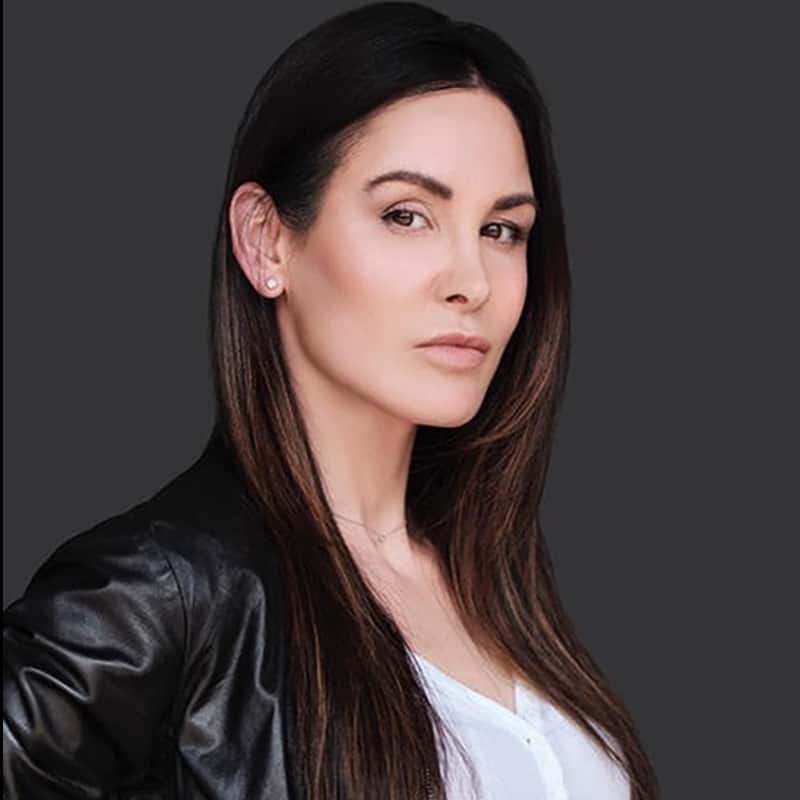
“My biggest piece of advice is don’t wait for someone to hand you an opportunity. Auditioning alone as an actor, it’s not enough. You have to create your own work. And when you hit a roadblock, you figure out a way to either go through it or go around it. Pivot as many times as you can until you’re back on that other side and you’re on that straight line again. You just have to keep moving, brainstorm about the what’s not working and how to get there. What haven’t you tried that’s going to help you get there?” ~Ruby Garnet
Ruby Garnet grew up a “theatre nerd,” with childhood dreams of movie stardom. But as she says, “I needed something stable. It was far less scary to go to boot camp than it would have been to go to college to study theatre.”
So, Ruby joined the Marines. She spent eight years in uniform and was made Sergeant at twenty, responsible for two dozen Marines under her command. Married at 20, with the birth of her firstborn son at 24, Ruby soon realized that the Marines would not be her lifelong pursuit. After working for the Department of the Navy as a collections officer – someone who is tasked with managing satellites and other tactical intelligence assets to gather critical information – her focus returned to her creative imagination and acting. She took acting classes and spent time modeling and working in regional commercials. Eventually she began making her own short films – 10 of them since 2021, using the name Ruby Singleton when directing.
Living by her motto “Hustle hard, or don’t bother,” the ambition to produce a feature film was part of her long-term plan. Though Ruby didn’t initially think her first feature would be a western, she made “Dogwood,” which she co-wrote, co-produced, co-directed and in which she stars alongside Eric Roberts and Amy Zubieta. “Dogwood” is the intense story of a young Civil War-era widow with three young children trying to survive in an unforgiving and harsh world. I found the movie to be both heartbreaking and uplifting. Look for Dogwood on multiple streaming platforms.
Ruby also has the lead role in the new web series “The Ladybugz,” about an all-female rock band from Liverpool, as well as a supporting part in the feature film “The Legends of Moll Dyer.”
WEBSITE:
IF YOU LIKE THIS EPISODE, YOU MAY ALSO ENJOY:
- Tom Ruegger, Animator-Producer-Writer-Episode #369
- Drew Brody, Writer-Producer-Episode #345
- Hal Ackerman, Screenwriter-Novelist-UCLA Professor-Session 2-Episode #333
- R.J. Stewart, Producer, Xena: Warrior Princess-Episode #329
- Richard Walter, Author-Legendary Teacher-Session 2-Episode #323
- Okema T. Moore, Film Producer-Episode #314
- Paul Chitlik, Writer-Producer-Director-Teacher-Episode #312
- Max Kinnings, Novelist and Screenwriter-Episode #308
- David Stenn, Screenwriter-Producer-Director-Episode #303
- Joey Hartstone, Screenwriter-Novelist-Episode #302
- Rob Marshall, Director-Producer-Choreographer-Episode #299
- Amanda Raymond, Writer-Director-Producer-Episode #222
- Charlie Peters, Writer-Director-Episode #221
- Karen Leigh Hopkins, Writer-Director-Producer-Episode #207
- Kit Steinkellner, Writer-Producer-Episode #115
- Bob Goodman, TV Writer-Producer-Episode #105
- Todd Robinson, Writer-Director-Episode #89
- Howard Suber, Film Educator-Episode #47
Steve Cuden: On today’s StoryBeat
Ruby Garnet: My biggest piece of advice is don’t wait for someone to hand you an opportunity. Auditioning alone as an actor, it’s not enough. You have to create your own work. And when you hit a roadblock, you figure out a way to either go through it or go around it. Pivot as many times as you can until you’re back on that other side and you’re on that straight line again. You just have to keep moving, brainstorm about the what’s not working and how to get there. What haven’t you tried that’s going to help you get there?
Announcer: This is Story Beat with Steve Cuden a podcast for the creative mind. Story Beat explores how masters of creativity develop and produce brilliant works that people everywhere love and admire. So join us as we discover how talented creators find success in the worlds of imagination and entertainment. Here now is your host, Steve Cuden
Steve Cuden: Thanks for joining us on Story Beat. We’re coming to you from the Steel City, Pittsburgh, Pennsylvania. My guest today, Ruby Garnett grew up a theater nerd with childhood dreams of movie stardom. But as she says, quote I needed something stable. It was far less scary to go to boot camp than it would have been to go to college to study theater. Close quote so Ruby joined the Marines. She spent eight years in uniform and was made sergeant at 20, responsible for two dozen Marines under her command. Married at 20 with the birth of her firstborn son at 24, Ruby soon realized that the Marines would not be her lifelong pursuit. After working for the Department of the Navy as a collections officer, someone who is tasked with managing satellites and other tactical intelligence assets to gather critical information, her focus returned to her creative imagination in acting. She took acting classes and spent time modeling and working in regional commercials. Eventually she began making her own short films, 10 of them since 2021, using her name, Ruby Singleton when directing Living by her motto, hustle hard or don’t bother. The ambition to produce a feature film was part of her long term plan. Though Ruby didn’t initially think her first feature would be a western, she made Dogwood, which she co wrote, co produced, co directed and in which she star stars alongside Eric Roberts and Amy Zubietta. Dogwood is the intense story of a young Civil War era widow with three young children trying to survive in an unforgiving and harsh world. I found the movie to be both heartbreaking and uplifting. Look for Dogwood on multiple streaming platforms. Ruby also has the lead role in the new web series the Ladybugs, about an all female rock Band from Liverpool, as well as a supporting part in the feature film the Legends of Mal Dyer. So for all those reasons and many more, I’m deeply honored to welcome to Story Beat today the actress, writer, producer and director, Ruby Garnett. Ruby, thanks so much for joining me on Story Beat today.
Ruby Garnett: Steve, it’s a pleasure. Thank you so much for having me.
Steve Cuden: Well, it’s my great pleasure, Believe that. So, first of all, before we even begin, let me just say thank you for your service to the country. It’s greatly appreciated.
Ruby Garnett: Thank you, Steve. My pleasure.
Steve Cuden: So now let’s go back in time just a little bit. How did you come to the conclusion that being a Marine was less scary than being an actress?
Ruby Garnett: Well, um, when I was in high school and I was waitressing, I had dreams of going to school and I had to audition for those spots. And I was going through the Overture Awards Scholarship Program and working on that. But I grew up pretty poor in a big family, and I really didn’t know how to navigate college. So as I’m in, as I’m working in this restaurant, it’s a family restaurant, it’s still here in my hometown. I’m watching moms support their families on a server budget, on being a waitress, and even men that worked there trying to raise a family. And I had no idea how much school was going to cost. I didn’t know how to navigate that, but I knew that I didn’t want to struggle and I didn’t want to work as a waitress. I hated being a waitress, and I just didn’t want to do that anymore. And I knew that if I went to college, it would be a lot of struggling for a really long time. And. And, uh, the other thing is I was looking for adventure. I was looking for a lot of things, stability that I didn’t have and I wouldn’t have if I had gone to college. So when I’m 25, 30 years old, and I decided to join the military, then it would be a lot different than had I decided to join the military at 18. You know, joining the military at 18 proved to be invaluable to me. Like, I learned so many things, I was essentially set up for the rest of my life with serving the country, whether it be for only four. I did eight years. But, you know, all of the incentives that I got back for serving my country, it was. It was incredible. At 36 years old, I had three children and I bought a house by myself on my salary as an intelligence officer. And I was making good money. But I didn’t have to put the 20% down that, you know, non military folks would have to put down in order to get a home loan. So, you know, there, there are all these things that really. And I didn’t know some of those things then, but it was, it was an incredible and the best decision, so.
Steve Cuden: And great training.
Ruby Garnett: And great training. I mean, I learned so much. I loved to work out in high school and, and being a Marine, you get paid to work out.
Steve Cuden: You
Ruby Garnett: know, I mean, it’s not always the funnest workouts, but it was eight years of some of the best times of my life and some of the worst times.
Steve Cuden: You’re not going to be a Marine and not be in shape, that is for sure.
Ruby Garnett: Absolutely. So, you know, I had two different paths to take or to choose from. I know, you know, my brothers were marines and I knew what this path looked like and I knew essentially what was ahead of me if I, you know, going to college and trying to become an actress. And I mean, the statistics are not in your favor?
Steve Cuden: Well, as a, as a person in the entertainment industry, uh, you know, the chances of you automatically having a career and making money is very slim. So it is a much bigger risk in terms of finances than going into the military or, or even taking just a regular job of some kind. The risks are much higher. So at what point in your early years did you start looking at you, uh, say you grew up as a theater nerd. What was it that drew you to it? When did you start to look at theater and acting and so on as something that was of interest to you?
Ruby Garnett: So I started my first play that I remember I was a Sugar Plum Fairy in kindergarten and I loved performing, I loved singing. I would do photo shoots. Um, I found a camera and I was doing all these photo shoots with this camera that just randomly, I randomly found on the road when I was walking home from school one day. And we developed the photos and it actually being, it was one of my neighbor’s cameras, but I would get cameras, um, and do photo shoots all the time. I wanted to be a model. That was really the biggest thing that I really wanted to do.
Steve Cuden: Uh, at what age?
Ruby Garnett: I was in fifth grade when I wanted to do modeling. I did a pageant in fifth grade also. And it was, I don’t remember the name of it, but it was in Columbus, Ohio. It was for Ohio, the state of Ohio. That was my first pageant I did, I believe I did a couple more after that. And I, I just love speaking in front of people. I Love. I’m not a good singer. Um, and I actually had a girl make fun of me about not being a good singer at this pageant. It is what it is. I mean, I wasn’t a good singer. But what I do, what I enjoy doing, I like doing things that make me uncomfortable. And I like doing things that make me uncomfortable because it helps me learn. And I know that might be a weird thing, but it helps me learn one. Things that I need to improve upon. And it helps me figure out what my. My left and right lateral limits are for myself. You know, nobody got better at doing things they were good at.
Steve Cuden: Well, that’s true. You always have to dig deeper to get to the next place. Explain for the listeners what left lateral and right lateral mean.
Ruby Garnett: So when you’re in a fighting hole, you’re in a fighting position, and you are. You have a fighting hole over to your left and you have a fighting hole to your right. Or a gun position. It doesn’t necessarily have to be a fighting hole, but you have to put up a, like a guideline or a barrier so that you know that that’s your left limit so that you don’t go past that left limit and shoot the guy to your left.
Steve Cuden: That would be a bad thing to do.
Ruby Garnett: Your friendlies to your left. So the same thing is your right limit. So your left and right limits of, uh, where you can go and pretty much be safe.
Steve Cuden: And how do you think that that relates to then having at some point, then, uh, later on a career in the arts? I think that that’s a very interesting parallel. How do you look at that as something that’s parallel to it?
Ruby Garnett: The reason why it’s important when it comes to the entertainment industry and the entertainment, very similar to every other job that I had. Everything’s about networking, everything’s about relationships and people and why that that’s important. It helps you guide yourself and know that this is too far. This is too far. And I need to stay within these parameters to, to, you know, to keep myself safe or sane, but also so that I don’t overdo.
Steve Cuden: Everybody has their limitations. Everybody. Doesn’t matter how great they are, they have limitations. And it’s good for you to know. I can’t go too far over this way or that far the other way because I’m gonna exceed it and then I will be ineffective. And so I think that’s what you mean. Am I right?
Ruby Garnett: That is. Thank you. That was a brilliant way of putting it. But yes, essentially, yes. I don’t want to Put myself in a pick by overdoing my M Limits.
Steve Cuden: Exactly, exactly Right. Have you. Did you think of yourself back in the day as a storyteller? Were you someone who told stories as a kid?
Ruby Garnett: I wasn’t a good storyteller as a kid. Um, I loved writing stories, but I wasn’t a very good storyteller. I did put on different plays and things, sometimes they were incoherent. But, um, I think my storytelling has gotten better because of different briefing techniques that I learned as an intelligence officer. So when I was a intelligence officer and briefing the director of National Geospatial Intelligence Agency, I would have to put together a script essentially about everything going on, say in the Levant area or, or everything going on in, you know, right now, this is happening in Syria. And I would essentially have to tell her a story about this is happening. And then this is how we’re tackling the issue. This is what we’re using our assets and this is how we’re using our assets. So I would not only have to put together a story, a quick story for her, uh, the director was Letitia Long at the time, but I would also have to make it very concise and coherent. And then if she had any questions, of course I would have to do follow ups. But putting together that quick 30 to 60 second story for her and making sure that it hit all the wickets and she could understand it. And I think that’s something that really helped me hone in and get better at storytelling
Steve Cuden: and should help you immensely as a filmmaker because filmmaking is a very condensed and very rigorous task to make a story within a very certain window. It’s not like a 40,000 page novel. It’s. You have to make it within a certain parameter. And so learning how to tell a story like that, that’s concise and clear, I assume that was the biggest challenge you had when you were doing that is how do I this clear in this short period of time?
Ruby Garnett: Yes, absolutely. I mean there were times that I didn’t. It wasn’t as clear and someone would have follow up questions. But yes, absolutely.
Steve Cuden: So who did you early on, not in the military, now in your art world, in the acting world, in the storytelling world, who did you look up to? Who did you admire and think, you know what? That person has a really great attitude, they’ve got a great career. I would like to be like.
Ruby Garnett: My favorite actor is Morgan, um, Freeman. He started late in his acting career. He’s an Air Force veteran. So I feel like I have a lot of similarities with him, and he’s just, uh, every time he speaks, he commands the room, whether it be on an interview, whether. Whether it be on a film set or in a film. You know, when you look at The M. Film 7, you don’t even notice Brad Pitt because of Morgan Freeman. And if there were. If there was any actor that I could be as good as, that I could do things the right way, like, it would be Morgan Freeman.
Steve Cuden: Well, that’s an outstanding choice of actor to pick, because he’s about as good as they get. You know, um, he’s got a voice that’s very special. That’s a help. And he’s got a very good way of just sort of making things sound proper, correct, and on target all the time.
Ruby Garnett: Yes.
Steve Cuden: What is it that you think makes great actors great? What is it that you admire? What are you trying to aspire to?
Ruby Garnett: I definitely want to be, you know, unique. I don’t want as much comparison as you might see. I want people to look up to me and say, I can do that, too. You know, I. She’s. She started out late. She, you know, she really understands, not just in front of the camera, but behind the camera. Um, I have. I mean, I have a lot of work to do to be. To be as good as Morgan Freeman or to be a great actor. But I. I would like people to be able to see my track and say, you know, it is possible I can do this if I work really hard, if I, you know, if I study what. What I do when I am trying to. And trying is the wrong word. I want to be able to take a character and put, of course, some of me inside that character, but turn that character into a grounded, realistic, and just vision of what people can understand by telling the story through the character.
Steve Cuden: What kind of characters attract you? What is it that you like to play?
Ruby Garnett: I love comedy. I have really good timing with comedy. I have a really odd sense of humor. I do write a lot of comedy myself. My next feature film that I’m writing right now is a comedy. I have a stereotype that a lot of women are not funny. So I feel a lot of women. And there’s some times that I just don’t get it. It takes. For me, it takes a lot for a woman to be funny. And, uh, I want to show how women can be funny in film.
Steve Cuden: Why is it that you think that that stereotype is there? What has caused that? I mean, if you think about the last 15 or 20 years of Saturday Night Live, which churns out Huge numbers of successful comic actors. Um, the majority of the great ones that have come out in the last 15 or 20 years are all women.
Ruby Garnett: That is true. So I think that those are. Those are not the norm. I don’t. They’re. I just.
Steve Cuden: Do you think that society looks like women can’t be funny or something? Is that what you think?
Ruby Garnett: I don’t. I don’t. I don’t necessarily think that’s it. Um,
Steve Cuden: I think women are hilarious, by the way. I think.
Ruby Garnett: I think there are some very funny women. I just. There are some times that maybe I just don’t get their humor. Maybe that’s what it is.
Steve Cuden: But isn’t that true with all kinds of different comedians? I’m sure that there are lots of comedians you don’t get their humor, but others you do. I think that’s just, you know, that’s taste.
Ruby Garnett: Yeah. And, you know, my husband hates that. You know my feeling about that. But, um, I don’t know. I’m just. It just bugs me. There’s. I forget the. The woman’s name. Um, but I think she.
Steve Cuden: In.
Ruby Garnett: She’s in. Um. What, uh, is her. Is it Bridesmaids? She’s Kristen
Steve Cuden: Wiig.
Ruby Garnett: Yes, I. She’s one of my favorite. That’s Kristen Wiig. She is one of my
Steve Cuden: favorite. Good. Yes. So when you’re create. When you’re creating a character, are you thinking about whether it’s comedic or not? Obviously, in Dogwood, which we’re going to talk about in a moment, uh, it’s not a comedy. It’s. It’s a drama. But are you thinking about the audience and how they’re going to react to what you’re doing? Is that in your mind, or are you not worried about that at all? You’re simply working on the character itself.
Ruby Garnett: I’m simply working on the character. And when I write comedy, it’s usually things that have happened to me, and it’s usually very silly or funny, and I write it in a way that it. It is humorous. Um, but no, I were. I. I only focus on me and the character. I don’t. I don’t worry about the audience and how they’re going to interpret it.
Steve Cuden: I think that’s probably a quite wise way to think about things. Well, let’s talk about Dogwood. We just alluded to a moment ago. Um, I barely said what it’s about in the opening. Explain for the listeners what Dogwood is about. Tell us what the story is and how you played in it.
Ruby Garnett: Okay. The story of Dogwood. Is about a woman who loses her husband in the Civil War. And the Civil War ends. She and her three children cannot afford to live in Virginia, so they move out west to Ohio, where her husband, her late husband’s family owned a homestead. So they move out to be with his family. When, when they get there, his family isn’t there either. So they’re just kind of on their own trying to figure out building the homestead. And that’s when they run into some trouble. One of the landowners wants the land of her late husband’s, and, um, they have to fight to keep it.
Steve Cuden: And that landowner is played by Eric Roberts.
Ruby Garnett: And that landowner is played by Eric Roberts. And after a few things happen, Harriet, who is me in the film, she unites the town to stand up against Eric Roberts and his goons.
Steve Cuden: So where did this idea come from? It’s an original, correct? It’s not based on a story.
Ruby Garnett: It is not based on a story. It is an original. The inspiration was my little sister. She is. She loves movies. She is really big into westerns. And it was her idea for me to, to write and produce a Western. With some reluctance, I said, you know what? Fuck it, let’s do it. Let’s see what happened. So I started writing and I rewrote it a few times. And then, um, and then I rewrote it even more after we put production on hold in 2022 and 2023 came around, rewrote a little bit more. And then In March of 2024, we went into pre production
Steve Cuden: and. And you knew you were going to be in it at that time when you wrote it?
Ruby Garnett: Yes. So when I produce all the films that I write and produce, I’m. I’m usually in the. Well, I’m always in the film and sometimes I play multiple parts, but I’m always in the film.
Steve Cuden: So in other words, this is important for the listeners to understand. You’re not just fulfilling your desire and your goal, but you’re actually creating your own career at the same time.
Ruby Garnett: That is correct, yes.
Steve Cuden: And I think that’s something to admire. Uh, not everybody thinks that way. You bit off what I think of as a really difficult chunk by doing a Western. I mean, I watched the movie and I sat there and said, how? Where did they get all the horses? And, uh, you’ve got guns. You’ve got all kinds of things going on in there, and that’s like a very high bar to get over. What made you think to yourself, yeah, let’s do this as the first one out of the Gate.
Ruby Garnett: Well, you know, I was very reluctant when my sister came to me with the idea. I did a lot of research to find out where are we going to do this at? And everything is just incredibly expensive. I looked in um, North Dakota, South Dakota, Arizona, and my little sister, you know, this girl has the best luck. She’d probably not agree with me, but she has really good luck. So she found an old west town an hour from where we grew up.
Steve Cuden: Wow.
Ruby Garnett: So the Montgomery’s who own Dogwood Pass, phenomenal people. And they do reenactments in this old west town. And so they have everything, they do everything from early 1800s to, I think it’s late 1800s, different reenactments. They do Civil War reenactments. They do, they do a whole lot of everything. And they have a whole town that are always doing these reenactments. So a lot of those individuals had all the clothes and they have a wardrobe there that had all the clothes. They have an armory that had all the weapons. They’re just a wealth of knowledge. And they have all the horses, they have the uh, they have the covered wagon. They had, they have way more than what we even used in the film.
Steve Cuden: And essentially a small town already existing that looked like it belonged back then.
Ruby Garnett: Exactly. So, um, and we did, we did film in a few in West Union and Northern Virginia for a couple other scenes. West Union, Ohio’s um, I’m actually sitting in West Union, Ohio. So we filmed 10 minutes from here. There were 1800s cabins that um, Joseph Newman, he’s um, he’s from the UK. He and his wife, they built three 1800s cabins from the ground up. And they, so those, that site we used for their homestead. But um, but this Old west town, they even had bunk houses that half of the cast and crew stayed in when we were filming there. And I mean just Frog, Frog, who is Mike Montgomery, who is the owner? He, he. I, I don’t know how we would not have been able to do Dogwood without, without him and his crew and his town. There’s no way
Steve Cuden: were the uh, the many townspeople that would show up in the, in the movie and the reenactors, are they just the locals that, that worked at that facility?
Ruby Garnett: A lot of them were the locals that worked there at the facility.
Steve Cuden: So they already knew that era. They understood what it would be like to play those roles. I guess, um, uh, even if they had no lines, they were part of the scenery or part of the scenes. And uh, it certainly came off as feeling like real. You’re up there, you’re, um, uh, driving a wagon and all the rest of it. And so did you have to learn how to do some of that stuff?
Ruby Garnett: Frog gave me a quick rundown, and Frog was in the wagon with us the whole time. So that if the horses, um, the Blues Brothers, that’s the name of the horses, if they did something crazy and took off, he could be in there to stop them.
Steve Cuden: Are you a trained horse person?
Ruby Garnett: I took horse lessons for four years before leading up. So from 2021 all the way through, um, Dogwood, I was taking riding lessons.
Steve Cuden: So you didn’t, you weren’t unfamiliar with how to ride a horse. You were good at it.
Ruby Garnett: That’s correct. Um, and I had ridden horses when I was younger, but from that till 2021, I hadn’t been on a horse.
Steve Cuden: Because if you had not, and, um, um, it’s kind of an irrelevant statement, but nevertheless, if you had never done that before, you probably would have looked really uncomfortable on a horse, especially in front of cameras.
Ruby Garnett: Yes, and I wanted to avoid that. I was trying as hard as I could to look, um,
Steve Cuden: on a
Ruby Garnett: horse. Exactly. Yeah.
Steve Cuden: Well, you did. You looked like you belonged in it. Uh, I couldn’t tell that. You know, it didn’t appear to me that you didn’t know what you were doing. It looked like you knew exactly what you were. Um, when did you actually start working on the movie? Did you say. Was this before COVID
Ruby Garnett: It was 2021. It was after Covid. So when Covid kicked off, all of 2018 and 2019, uh, everything was great. I was working in Manhattan. I was, I was in New York all the time in 2020. I, I, I was a lead in a film. It didn’t finish getting made. So, uh, you know, like, like everybody else, 2020, everything got put on hold. And I was just trying to figure out what I was going to do next, how, how I would just keep going. And my husband was like, well, just write your own. Start writing your own scripts. Start writing your own stories. Start doing this, start doing that. So we did. That’s what I started doing.
Steve Cuden: And this was among the first ones that you started to work on.
Ruby Garnett: This was, I think it was like, number five that I started working on. And I was going to make it a short, but I couldn’t get everything in there that I wanted to get into the story. So, um, it was about an hour long, and then we added to it to produce it in 2024.
Steve Cuden: And who is Harriet based on?
Ruby Garnett: Harriet is based on me.
Steve Cuden: That’s the character that Ruby plays, Harriet.
Ruby Garnett: Yes, Harriet is the character that I play in Dogwood, but it’s based off of what I could have been like in the 1860s.
Steve Cuden: And how did you conjure that? What was your imagination telling you?
Ruby Garnett: My imagination was telling me, um, how, you know, how a strong woman would be in the 1860s, how I would have grown up and, and what would have led me to have three children and be married in the 18, or probably 1850s, 1855, um, what it would have been like to be married at that time. And I did do a lot of research on, on how women, how women were in that period of time. And of course I grew up with weapons and I, you know, I grew up very, in a very humble household. So those things kind of ran parallel with how, um, how people grew up or how a woman would have, would have grown up in that era.
Steve Cuden: Well, certainly we know that in, in that era it would be unusual for a woman to, to be out front acting in a, what we would think of in that day and age as, as a manly profession being.
Ruby Garnett: Yes, yeah,
Steve Cuden: so, so, so it would have been an unusual and special thing that she was doing, which it, which is the way you presented.
Ruby Garnett: Yes. And, and so, you know, initially Harriet had, you know, was, was kind of, um, you know, taking a backseat. But then when her husband passed away and they had to move, you know, her son is only about 14, so she’s kind of taking on the role of her husband and her son’s stepping up and she was just kind of thrust into it how everything happened. So when, when I was riding Dogwood, I didn’t want Harriet to, I wanted her to be the traditional woman and because that’s how it is or that’s how it was. So she, she wasn’t, she wasn’t used to fighting, she wasn’t used to using a weapon. She wasn’t used to any of those things. And she just kind of had to just figure it out and do it on the fly. And, and that’s kind of the parallel between, you know, me, I, I just take things on and I learn things on the fly if I don’t know it.
Steve Cuden: Well, we know that you were, uh, a full blown Marine sergeant, so you are definitely someone who takes charge of things. That’s not a foreign thing to Ruby, that’s for sure.
Ruby Garnett: No, it’s not. So that was hard for me not to put that into Harriet and showcase that as the character. Um, and that’s why in the fight scenes, she doesn’t know how to fight.
Steve Cuden: I was gonna say you do a bunch of stunts in this movie. Uh, not big, super dangerous stunts, but nevertheless fights and stunt work. Did you train for that?
Ruby Garnett: I didn’t train for it. So I’m not a stunt person. I’ve taken a lot of, um, combat training, like stage combat training. And in the Marine Corps, you do mixed martial arts, so you learn how to roll. You learn how to do flips and things without hurting yourself. So a lot of those things helped me out with. With the fight scene. Um, and that morning, the morning that we were filming the fight scene, Jesse Wakeman, who was. He took the lead with, um, choreographing the fight. He, Danny Brock and James Storm, who is the. Who is the, um, other actor that I fought, who is Obadiah. And James Storm is a. He’s a wrestler, so he’s very much well versed in fight choreography. So Jesse created the choreography and how it would all play out, how we would just, like, dance it all out. And we went step by step several times, and we did this scene through.
Steve Cuden: It’s like a dance. You have to choreograph it like a dance.
Ruby Garnett: Yes. So while we’re fighting and, of course, I’m, you know, not doing things correctly, or he’s, uh, like, no, you’re hitting me. Like you would really hit somebody. You have to hit me like you would on film. So James Storm walked me through continuously. I’m sure it was very frustrating for him, but he walked me through continuously on what I needed to do, so.
Steve Cuden: Well, they didn’t want to actually hurt you. That would not make sense.
Ruby Garnett: And I did hurt James, uh, a couple times. So
Steve Cuden: you actually hit him?
Ruby Garnett: I did, yeah. Yeah. He’s just like, uh, okay. I think he was very. He’s a pro. He’s a total pro. And he never showed it, but I’m sure he was very frustrated by the time we were done, so. Yeah,
Steve Cuden: well, so you didn’t hire a stunt coordinator. You figured it out on your own?
Ruby Garnett: I would consider Jesse and Danny Brock, the stunt coordinators,
Steve Cuden: as stunt coordinators. Okay. Did you also then, um, on top of that, have I assumed you had somebody wrangling the horses and that kind of stuff? Yeah,
Ruby Garnett: they. So Dog would pass the guys at, um, that own the. The Old west town, they were the horse wranglers. So they were. They had, uh. They were three different ranches that brought their horses, including Dogwood Pass, and those guys had their own wranglers, and they were there on set the whole time.
Steve Cuden: So you had, you had pros on set. It wasn’t like you had, um, a bunch of amateurs just trying to figure it out on the fly. You actually had people that knew what they were doing.
Ruby Garnett: Yes, absolutely. Yeah.
Steve Cuden: And I think that that’s really important as we’re having this conversation,
Steve Cuden: that
Steve Cuden: people don’t think that you’re going into a, ah, first time production and you don’t have the right people around. That’s when people get hurt. That’s when they really get hurt.
Ruby Garnett: Yeah, absolutely. And, you know, safety was paramount on because of not only having horses, not only having weapons, and they were all black powder weapons, but you just never know if someone’s going to put black powder and the ammunition in there and leave it in there. You know, you just never know. So the armors were constantly checking, making sure the weapons were safe and m. Making sure that the horses were safe. There was one time where one of the horses was just very irritated and the frog had to let the horse go back to the stable and then bring another horse in because we, we just don’t want a horse to get upset and somebody to get hurt or whatnot. But, uh, I mean, they were always right there on set making sure that everything was working properly and that the horses were taken care of, people were doing things safely. It was m. Yeah, I mean, I, I was pretty confident everything was going to be done very safely, but you just never know.
Steve Cuden: And. And on top of it, you had three young children on set too.
Ruby Garnett: We had more than just three young children. There were, there were quite a few young kids, but Annie, Ellie and Sam were on set every single day. So sometimes we didn’t have all of the other, the other, um, townspeople, but those three were on set all the time. And those kids, they’re just complete professionals. It was incredible how good they were.
Steve Cuden: Well, sometimes that’s what makes it work. I made one movie, um, many years ago, and we had a trained movie dog on that set. And that dog was the easiest to direct of all the actors because it took its orders and direction perfectly. Um, how many days did you shoot this? How long did it take to shoot it?
Ruby Garnett: Principal photography we filmed from August 4th through August 15th of 2024. We did two days of filming for, um, the Civil War reenactments in June of 2024. And what that was, there was reenactments happening and we just got the film for it and used, you know, so that was a pretty easy. Those were two easy days.
Steve Cuden: That’s almost like being a documentary filmmaker. At that point, right?
Ruby Garnett: Yeah, pretty much, yeah. Um, we filmed three days in September 2024. We did one day in December, one day in January, and then three days in March of 2025.
Steve Cuden: So all told, what is that under 20 days total?
Ruby Garnett: Um, I think it was right at 20 days. Let me check.
Steve Cuden: So that’s a quick production. That’s not a long drawn out production. That’s fast. Especially when you have all those elements like horses and wagons, costumes and all that. That’s very quick. Um, how important do you think it was that you had a known star in it being Eric Roberts?
Ruby Garnett: I’m not sure it would get the same attention it’s getting if we didn’t have a known actor. Um, there are a lot of people that are fans of Eric Roberts, and Eric Roberts, I think is a phenomenal actor. He added a lot of, to the scenes, especially on set. I wasn’t sure what to expect when he came on set. Um, you know, you just never know what you’re getting at times. But he, he integrated really well and he added a lot of value. But you know, as I’m pitching for distribution and whether that be international or North American distribution, it really does matter. I, um, know when you’re looking at the higher film festivals, we needed a more hot A list actor to get into some of those film festivals, which is too bad. I feel if you watch the film, it’s pretty impressive knowing that it was a quick independent film and the budget was pretty low compared to what some of these studio films are putting out. And you know, it’s. Sometimes you won’t even get a look unless you have a higher A list actor.
Steve Cuden: I think you said something that’s super important, uh, for listeners to understand that when you’re making a movie and you’re, it’s a feature and you’re hoping to get your investment back through distribution, especially in foreign markets and so on. It’s almost super, uh, critical that you have someone in it that has a name, some kind of name recognition. In this case, it’s a well known actor, Eric Roberts, but it could also be someone less well known, but yet known. I think that’s a critical factor. Don’t you agree?
Ruby Garnett: I absolutely agree. And so also we have James Storm in the film. And James Storm, has he, uh, he has grown a lot in the last two years with his following not only in the, in the wrestling realm, but now in the, in the acting arena. And you know, I, it, it was just an organic thing. But I, I do think having James Storm in the film, he’s not as big as Eric Roberts is yet. But, uh, you know, in Germany, westerns are huge, and Eric Roberts is huge in Germany, same thing.
Steve Cuden: And he’s been around for decades. He’s not, uh, new to it at all.
Ruby Garnett: Yeah, in Asia, they love westerns and they love Eric Roberts. Pakistan is also another huge, you know, area that they love Westerns and they love Eric Roberts. It’s. You just never really know.
Steve Cuden: Are you finding it relatively easy to secure distribution around the world?
Ruby Garnett: I. I’ve turned down some distribution deals. I. I just want to make sure that I’m able to make back my investment as best and not just jump into a distribution deal for international.
Steve Cuden: Well, yeah, I mean, that’s. That’s a tightrope that a lot of independent filmmakers, uh, walk on because you have to try to figure out how to make your money back, but at the same time not get ripped off. And all kinds of different problems with distribution. Um, and so how long were you in post production? How long you shot for? 20 days approximately, or on the nose, one of those two. But how long did it take to then cut the movie and go through post and music and everything else? I thought, by the way, the music was very excellent and really enhanced the production, which is a quality for film festivals particularly.
Ruby Garnett: Thank you. Um, so I do want to touch on the music, but in post production, my. The dp, the main cinematographer, the director of photography, John, he was also the editor. And he, as soon as every night we were done filming, he was looking at film and already making, um, edits and changes and putting things where they go. And in mid September, that’s when we made our first decision to go back and reshoot a few things and add things to it in September. And then once that was done, we’re looking at film again and putting things where they go. And in principal photography, in August, we got maybe 60% of the script filmed. So there was a huge part of the script that we did not get filmed in August. And, um, so in September we did a few reshoots and then another, I think, two scenes that weren’t with the original script. And then in December, two or three more scenes that were not with the original script. And then same thing in January. And then in March we had, I think it was four, seven scenes that were not with the original script. And then we reshot some, uh, we added two other scenes that were already shot. Fixing or tweaking or redoing something that didn’t work. Um, there was a lot of film that we couldn’t use for various reasons. And, um, and then we did ADR with a lot of the. Not a lot, but some of the cast members. We did some ADR fixing a few audio issues.
Steve Cuden: Well, especially when you’re outside and working with, again, horses and noises and things like that, sometimes you really have to go back in post and fix all the audio issues.
Ruby Garnett: Yes. So from the time we finished filming in August until I think it was September 17th of 2025, we were doing post production.
Steve Cuden: So how long m. How many months?
Ruby Garnett: Um, about 13 months.
Steve Cuden: So I want the listeners to understand what Ruby just said, which is really critical. The production itself, the pre. Production probably took you several months, I’m assuming.
Ruby Garnett: Yes.
Steve Cuden: Uh, and then production is 20 days. And then post production to put the whole thing together is 13 months. Production is the smallest part of it. I mean, you have to have it and without it you don’t have a movie at all. But the most important lengths of time are before the movie is in production and after the movie’s out of production. And that’s what you’re telling us.
Ruby Garnett: Yes, absolutely. And you know that. And, uh, that’s why I think it’s very important for actors to not only do their work and craft and what they need to do to be an actor in front of the camera, but being behind the camera is invaluable. It just, it helps you understand and manage the expectations that you have, not only for production, but then for yourself. And, and you won’t, you know, you won’t be so upset if something’s not done in a, uh, in a few months or a year. Starting to make my own productions has helped me be a better actor.
Steve Cuden: What do you think are the most important lessons you’ve learned doing that?
Ruby Garnett: I’ve learned what different angles are necessary for camera. I’ve learned, um, how not only the importance of when you get a script and learn. So what I do when I get a script is I learn the lines verbatim. And then I go back and I understand what I’m saying and I learn how I will say it and what the lines mean and, and what the story is. And then I perfect it over time, but I always make sure the lines are verbatim. And the reason is, is because when you’re doing audio and they have to sync that audio track with what you’re saying, you have to say it the exact same way every single time. Because if you don’t and uh, that audio gets, you can’t use it for whatever Reason.
Steve Cuden: Well, if it doesn’t, if you can’t cut from a piece of a line to another piece of a line, it makes it impossible for them to make the cut.
Ruby Garnett: Exactly. And then they have. Sometimes that’s why scenes get cut completely or, you know, they have to do ADR and they have to pay for this and they have to pay for that. So it’s very, you know, understanding how budgets work on a film has. That’s been invaluable for me to understand. Um,
Steve Cuden: so you think, you think being a filmmaker has made you a better actress?
Ruby Garnett: Yes, absolutely. And I’m just understanding the house, the writing aspect of the script and it’s just everything. It has made me be more patient, it’s made me want to help out more, just be more flexible. Um, and not as neurotic.
Steve Cuden: Well, actors have a reputation and writers have a reputation as sometimes being neurotic. That’s a long standing complaint. Uh, I guess it is. Or observation about actors and writers in particular. Um, but you’re saying that it gives you confidence as an actress. I think that’s what you’re saying. Give that being a filmmaker has made you more confident as an actress.
Ruby Garnett: Yeah, I would, I would agree with that. Yes.
Steve Cuden: Uh, I mean, that’s what it sounds like. It’s. That’s given you an understanding in a way that makes you will go onto a set and have less neurosis and less concern. Um,
Ruby Garnett: yeah.
Steve Cuden: Do you, do you learn lines easily or is it difficult for you? How do you learn lines?
Ruby Garnett: It’s pretty easy now. Um, for example, I had a callback audition last week and I didn’t get the script. I didn’t know that they sent a new script. So I got a call back and they. It was three lines. I had three lines in this callback and you know, the director. Oh, you didn’t get the thing or you didn’t get the script? No, I didn’t get the script. Well, these are the lines. I wrote down the lines and I knew them in 30 seconds just writing them down.
Steve Cuden: Wow.
Ruby Garnett: And we went through it three times and I booked the audition.
Steve Cuden: Have you always been a good, uh, sort of looking at paper and getting it right away, absorbing it?
Ruby Garnett: I, I’ve gotten a lot better. I, I’ve always been really good at memorizing. And also this goes back to when I would do briefings, you know, memorizing the voice track that I had written down. But it’s gotten, I’ve gotten a hundred times better just within the last probably year. I’ve gotten a lot better.
Steve Cuden: Like so many things in life, let alone this industry, um, the more you do it, the better you tend to get at things. It’s just like, uh, an athlete. Uh, the more practice you have and the more experience you have, the better you tend to get at it. Uh, and that’s true for all aspects of the arts, including making movies. Um, uh, what would you say were the biggest challenges in production for you? What were the things that you now have been through on Dogwood that you know you won’t repeat because it was a challenge, or you’ll repeat them in a much better way on the next one.
Ruby Garnett: I will not repeat again on a production is giving agency to other individuals. On my creative work, I wrote Dogwood and then, um, got it to about 55 pages. Amy Zubieta came in and helped me get it to 69. After that, we went into pre production and we hired individuals and individuals came in, they wanted to add to the story. And I said, okay, if it adds value to the story, okay. But we’re only, we are. The script, the shooting script has to be no more than 70 pages. We’re not going to shoot more than 70 pages in that, um, what was it, 11 days? We’re not, we’re not doing that there. It’s, it’s not going to happen. Well, I did not stick to my guns. We, the, the script went up to 96 pages and I said, we need to cut 24 pages or 26 pages. Well, none of that was listened to. We went into filming with 96 pages and like I said, we only shot 60% of it. We didn’t make the day at all. And that person not only wanted writing credit, they wanted a film about, created by them.
Steve Cuden: Okay.
Ruby Garnett: And, um, so there was a lot of, a lot of issues. My husband and I were threatened to be sued. So those types of things, I, you know, that creative agency, I, I didn’t want to be petty and I’m like, okay, if it adds value, absolutely, let’s do it. Well, the problem was it didn’t add value. It added problems because we couldn’t make the day. And, um, a lot of it was just a bunch of fluff that we didn’t need in the first place. But it was done from my view. It’s because they wanted writing credit. So, um, they got writing credit even though we didn’t film any of the stuff that they’d put in. You know, I learned that lesson.
Steve Cuden: So you learned control, that you let go, that you had to come back and establish. Or you’re going to, in the future, establish control and maintain it.
Ruby Garnett: Absolutely, yeah. And putting up boundaries and sticking to those boundaries. Yeah,
Steve Cuden: it is, um, in collaboration, like making a movie is all collaboration. It’s not one person, it’s many people. And sometimes that collaboration, um, scheme can be, uh, thrown out of control quite easily. And so therefore, what we know from past history is, is that some of the most successful, uh, creators of films are a little bit of what we call control freaks. And you’re saying, uh, some of that makes sense if someone is a control freak, which of course then upsets other people who don’t want to be controlled and they have their own control issues. But it’s a collaboration. And so what would you say is the secret to collaboration and remaining in control?
Ruby Garnett: Um, I think the secret to that is setting expectations and boundaries and holding people to them in a way that you both understand and acknowledge what those expectations and boundaries are. And that’s what I failed to do. That is, that is one thing that I failed to do, that moving forward. That is something that I will make sure happens.
Steve Cuden: You’ll do it differently. You’ll have learned your lesson. And it, uh, sort of feels full circle to me a little bit in that you certainly must have learned that to a large extent in the Marines.
Ruby Garnett: Yeah. Ah.
Steve Cuden: That once you’re the sergeant, the people who are under you are not your commander. You’re their commander. Right,
Ruby Garnett: yeah.
Steve Cuden: And then the people who are above you, they’re your commander. And so that protocol has to be there.
Ruby Garnett: Yes, absolutely.
Steve Cuden: I love the fact that we came back to that and there is. You learned that lesson in the military, and now you’re going to bring it forward. Having been through an experience that said, wait a minute. I let the control go. I think it’s a great lesson. And it’s a great lesson for those that are thinking about making movies, or maybe they’ve made some and aren’t sure why they screwed up. Here’s maybe why. I think, you know, it is a matter of control. Well, I’ve been having just a, um, most fascinating chat for a good period here with Ruby Garnett about acting and making movies and all these good things. And we’re going to wind the show down just a little bit here. And I’m wondering, in all of these experiences you’ve had, whether in the military or making movies or being an actress, whatever it is, can you share with us an experience you’ve had that’s either weird, quirky, offbeat, strange, or maybe just Plain, funny.
Ruby Garnett: So in 2019, I wanted to see what it was like to be a background actor. And I submitted for Blue Bloods, and I was super excited. My dad loves or loved it when it was still on. So I’m working on the set of Blue Bloods, and they pulled me as a featured extra next to Donnie Wahlberg, and I was super excited. And one of the things about Donnie Wahlberg is he often will select people like other actors do and move them up to an even bigger role or have them come back and things like that. So I was really, really excited and was hoping that it would work out like that. And the other good thing about Donnie Wahlberg is he worked the room. He commanded everything. If things were not running on schedule, he made sure that they caught up, and he. He held people accountable. And not only that, he talked to all the background. He. He treated everybody like they were somebody, and he would hand out Werther’s originals. He was just really, really fun. So I’m super excited. I’m st. You know, sitting next to him in the Spotted Pig in Manhattan, and I was playing the girlfriend of another background actor, but I’m sitting right next to Donnie Wahlberg. We’re talking on camera and off camera, and he’s having a conversation again with us. And the guy. The actor that was playing my boyfriend, made a New Kids on the Block reference to Donnie, and he was pretty pissed off about it. So, you know, it. You could just immediately feel that everything changed. And we finished filming. Everything seemed to be okay. Like, everything was recovered. But then when the episode aired, they cut the entire. The. Not the scene. They cut the angle where I was, like, working with Donnie Wahlberg, and,
Steve Cuden: oh, my goodness,
Ruby Garnett: in the scene. And I was just so. It was so devastating because my dad’s watching, getting ready, and I’m, um, Like, this is the one. And.
Steve Cuden: And nothing.
Ruby Garnett: Nothing.
Steve Cuden: You know, that’s not. That’s not an uncommon story, by the way, to have something cut out for one reason or another. In this case, you’re pretty sure that got cut out because this guy made a dumb remark. Uh, but things happen, you know. You know, from making Dogwood that things didn’t make it into the movie that got shot one way or another. But that’s. I think that’s very funny. Did you ever get to go back on set, or was that it?
Ruby Garnett: No, I didn’t. Um, I never went back to Blue Bloods. I did do a. I tried one more shot with Katie Keene, and I was. I was a featured socialite on Katy Keene. And that was, you know, it’s so funny how productions are. That was the worst production. I. It was really, really awful. Um, I mean, lead actors didn’t know any of their lines. It was really, really awful. That was like the worst set. We got there at 10am and we wrapped at 4am the next morning.
Steve Cuden: Oh, my goodness,
Ruby Garnett: it was awful. And there were girls breaking their heels. Um, I brought tennis shoes with me because I knew better. But there were girls walking around in 4 inch heels, heels broken off. Just. People were just quitting and not doing what they were supposed to do in the, in the scenes. And there was a lot of really toxic stuff happening and it was just. It was the worst. I can understand why that show got cut off air.
Steve Cuden: Well, that’s just frustrating as a professional.
Ruby Garnett: Yeah,
Steve Cuden: incredible. All right, so last question for you today, Ruby. Um, you’ve shared with us a huge amount of very valuable advice throughout this entire episode. And I’m just wondering, is there a single solid piece of advice that you like to give to those who are coming up in the industry? They’re just starting out and they say to you, how have you managed to get to here or there? What’s your advice?
Ruby Garnett: I have tons of advice, but my biggest piece of advice is don’t wait for someone to hand you an opportunity. Auditioning alone as an actor, it’s not enough. You have to create your own work. And when you hit a roadblock, you figure out a way to either go through it or go around it. Pivot as many times as you can until you’re back on that other side and you’re on that straight line again. You just have to keep moving, brainstorm about what’s not working and how to get there. What haven’t you tried that’s gonna help you get there
Steve Cuden: and you’re proof of it. And I think that that’s really outstanding advice for anyone who’s thinking, why can’t I catch my break? Well, maybe you can make your break, which is what you’re all about. Where can people find Dogwood if they really want to see it?
Ruby Garnett: October 2026, Dogwood hit streaming. Everything except for Netflix and Hulu. It’ll be on every streaming platform. And, um, it’ll be there hopefully for many years to come.
Steve Cuden: Well, and from your mouth to God’s ears, as they say. Ruby Garnett, this has been an absolutely wonderful episode of Story Beat. And I can’t thank you enough for your time, your energy, for and for all your wisdom. And I wish you, uh, a lot of good luck as you continue to proceed forward to make movies that hopefully we can all enjoy. Thank you so much.
Ruby Garnett: Thank you, Steve. I really appreciate it. Thank you so much.
Steve Cuden: And so we’ve come to the end of today’s Story Beat. If you like this episode, won’t you please take a moment to give us a comment, rating, or review on whatever app or platform you’re listening to? Your support helps us bring more great Story Beat episodes to you. Story Beat is available on all major podcast apps and platforms, including Apple Podcasts, YouTube, Spotify, iHeartRadio, TuneIn, and many others. Until next time, I’m Steve Cuden and may all your stories be unforgettable.










0 Comments