
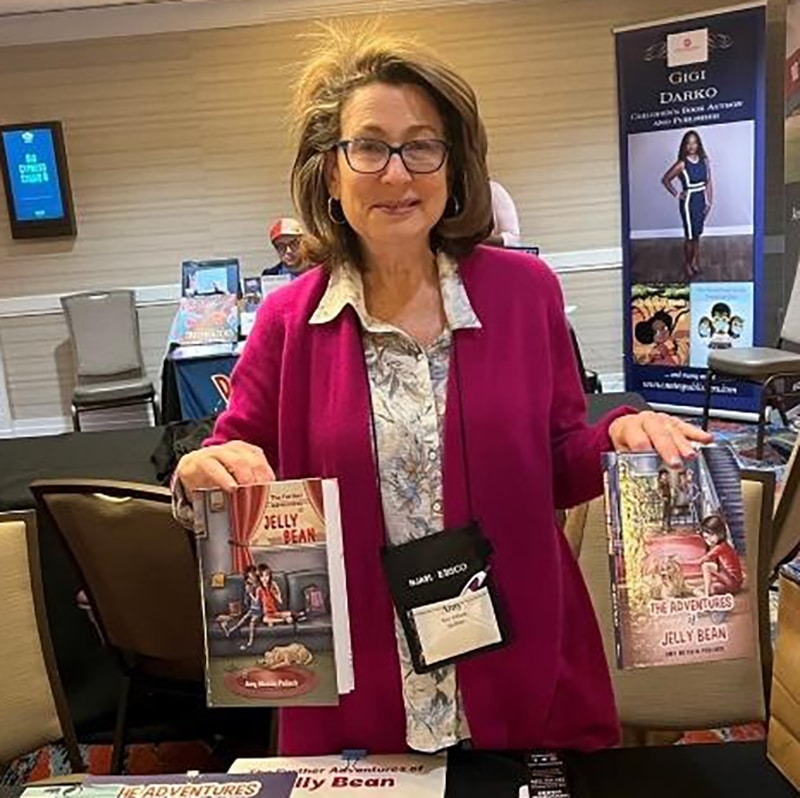
“I did bring him some of my writing and he wrote me back and said, you dialogue crackles, which I always remembered. But, and this is so funny to think back on, you need more experience. You need to have more experiences. Uh, I think about that now. And he was right. Because what did I know at that time?”~Amy Pollack
Amy Meislin Pollack was a teacher for over four decades. From her own childhood, to the classroom, to being a parent of three and grandparent to seven, she’s perfectly positioned to write her coming-of-age book series based on a mischievous young girl, Jillian Kramer, who everyone calls Jelly Bean. After 60 years of occasionally working on her Jelly Bean books, Amy took advantage of the Covid pandemic to finish them.
The series began with The Adventures of Jelly Bean, which first came to Amy when her fourth-grade teacher asked her to get up in front of the class and tell stories about Jelly Bean, which she would make up as she went along. Several years later she began writing down the Jelly Bean stories, and would work on them periodically in any free time she had during her teaching career and while raising her three children.
The second in the series, The Further Adventures of Jelly Bean, was followed up by The Still Further Adventures of Jelly Bean, which I’ve read. It’s a charming take on the emotional challenges confronting Jelly Bean as she tries to navigate through the relentless turmoil of growing up. She tries to work out relationships with her friends, her parents, her older brothers, and her uncle among others. Jelly Bean’s parents don’t want her best friend, who is of mixed race, to visit. Another friend is anorexic. One brother drops out of school. A grandparent dies. In other words, it’s about the struggles many young girls face as they grow up.
Amy earned advanced degrees from the University of Pennsylvania Graduate School of Education and NYU. For six years Amy was a professor of writing, and a teacher in the tutoring center at Montclair State University.
WEBSITES:
Instagram:@jellybeanthebookseries
IF YOU LIKE THIS EPISODE, YOU MAY ALSO ENJOY:
- Maria Baltazzi, TV Producer-Teacher-Author-Episode #297
- Danielle Sunberg, Author-TEDx Speaker-Episode #292
- Rosanna Staffa, Playwright-Author-Episode #290
- Michelle Danner, Actor-Director-Episode #285
- Peter Brosius, Artistic Director-Minneapolis Childrens Theatre Company-Episode #266
- Monte Schulz, Novelist-Songwriter-Singer-Episode #257
- Melanie Zanetti, Actress-Episode #253
- Candi Milo, Voiceover Actress-Author-Episode #219
- John Vorhaus, Comedy Writer and Novelist-Episode #210
- Jeff Keane, The Family Circus Cartoonist-Episode #161
- Ron Diamond, Animation Producer-Episode #125
- Chris Pearson, Animation and Comedy Writer-Episode #81
- David Richardson, Comedy Writer-Producer-Episode #87
- Kelly Ward, Actor-Writer-Director-Choreographer-Episode #66
Steve Cuden: On today’s Story Beat.
Amy Pollack: I did bring him some of my writing and he wrote me back and said, you dialogue crackles, which I always remembered. But, and this is so funny to think back on, you need more experience. You need to have more experiences. Uh, I think about that now. And he was right. Because what did I know at that time?
Announcer: This is Story Beat with Steve Cuden a podcast for the creative mind. Story Beat explores how masters of creation creativity develop and produce brilliant works that people everywhere love and admire. So join us as we discover how talented creators find success in the worlds of imagination and entertainment. Here now is your host, Steve Cuden.
Steve Cuden: Thanks for joining us on Story Beat. We’re coming to you from the Steel City, Pittsburgh, Pennsylvania. My guest today, Amy Maislen Pollock, was a teacher for over four decades. From her own childhood to the classroom to being a parent of three and grandparent to seven, she’s perfectly positioned to write her coming of age book series based on a mischievous young girl, Gillian Kramer, who everyone calls jellybean. After 60 years of occasionally working on her Jellybean books, Amy took advantage of the COVID pandemic to to work toward finishing them. The series began with the Adventures of Jellybean, which first came to Amy when her fourth grade teacher asked her to get up in front of the class and tell stories about Jellybean, which she would make up as she went along. Several years later, she began writing down the Jellybean stories and would work on them periodically in any free time she had during her teaching career and while raising her three children. The second in the series, the Further Adventures of Jellybean, was followed up by the Still Further Adventures of Jellybean, which, which I’ve read. It’s a charming take on the emotional challenges confronting Jellybean as she tries to navigate through the relentless turmoil of growing up. She tries to work out relationships with her friends, her parents, her older brothers, and her uncle, among others. Jellybean’s parents don’t want her best friend, who is of mixed race, to visit. Another friend is anorexic. One brother drops out of school, a grandparent diesel. In other words, it’s about the struggles many young girls face as they grow up. Amy earned advanced degrees from the University of Pennsylvania Graduate School of Education. For six years, she was a professor of writing and a teacher in the tutoring center at Montclair State University. So for all those reasons and many more, I’m truly delighted to have the longtime educator and excellent writer Amy Pollack join me on Story Beat today. Amy, welcome to the show.
Amy Pollack: Oh, uh, thank you, Steve. Glad to be here.
Steve Cuden: It’s a great pleasure to have you. So I know you were quite young, obviously, when you started making up jelly bean stories.
Amy Pollack: Yes.
Steve Cuden: But exactly how old were you when you first became interested in words and writing?
Amy Pollack: Oh, uh, as early as I can remember. I know. My dad used to take me to the library every weekend in the mornings and we’d pick out books, come back and read them. He just read me everything from the Bible and Greek mythology and onto all of Dickens. Well, I started reading them myself after a while, but between the ages of 9 and 16. So I always loved reading and I loved writing.
Steve Cuden: What were the books that you most enjoyed when you were that young?
Amy Pollack: Oh, gosh. Well, I do remember them pretty clearly. ABC books. I loved biographies. I would read shelf fulls. And, um, when I was young and would read to myself, I loved Nancy Drewes. I liked all the classics. Oh, gosh.
Steve Cuden: So you were reading everything then?
Amy Pollack: I was, I was pretty eclectic, yes. In my tastes.
Steve Cuden: Was your head full of made up characters at the same time?
Amy Pollack: Pretty much, yes. Yes, I did have a pretty vivid imagination and that did kind of continue. And certain. I can remember very selectively. So certain things would stick out in my mind, others not so. So much so later on when I was assigned to be teaching math and science. And I did it because that’s where the jobs took me. But it was more of a struggle for me than the English and languages. And then onto writing, which was teaching writing, which was my favorite.
Steve Cuden: You’ve always enjoyed, uh, teaching. Obviously you’ve taught for a very long time and you were always, even as a kid then, a storyteller. You were telling stories not only in school, I assume, but. But to your friends and family as well.
Amy Pollack: Yes, yes, they did, uh, really always enjoy. I mean, there’s plenty of things I can’t do very well, but that’s one thing that I could. And they were always entertained and entertaining and we’d also get into various types of mischief, which is kind of fun to remember.
Steve Cuden: Well, do you think that your writing has been an extension of your teaching? Do you think you’re teaching still?
Amy Pollack: Hmm. M. Probably. Yes. Yes. I never quite thought of it that way, but yes, that does actually sound pretty, pretty accurate. That’s interesting.
Steve Cuden: Yes, that’s, uh. As a writer myself, I. Long time ago, well, not so long ago, but, uh, a while ago, I thought to myself, the writing that I do is also a form of teaching because I too taught for 10 years here in Pittsburgh But I think that that’s an important thing for writers to consider sometimes is, are you teaching something? You don’t have to, but that’s a way to think about it. Um, what. What do you think that teaching has taught you about being a writer?
Amy Pollack: Oh, gosh. Well, first of all, you run into so many different kinds of boys and girls, like, just the gamut. I’ve taught in many different kinds of schools of different economic background, different racial and ethnic backgrounds. And it’s all, you know, like the poem goes, the child’s the father of the man. And, uh, from my own children and from their friends and from the students, you’re just always, always, always learning.
Steve Cuden: Well, I think that’s true for sure. How did you manage with as busy a schedule as you had teaching and raising kids, how did you ever find time to write at all?
Amy Pollack: Well, that was a little bit of a problem. And as I said, you brought it up that, um, Covid actually made m forced me during the pandemic to sit down and actually complete these books. I’d written other things, but these were always there kind of on the back burner, which, you know, every so often I think, gee, I really should get back to that. And I give presentations in a lot of the schools, mostly to third, fourth, fifth and sixth graders. That’s who I mainly write for middle grade boys and girls. And I’d always say, okay, who here knows what procrastination is? Well, every. Practically every hand goes, oh, my mother says I do that. And I’ll say I was very guilty of that. I have a million excuses as to why I never finished these. It took me 60 some odd years to finish these, which is crazy. You know, who goes around thinking they have that much time? I mean, speaking for myself, I guess I don’t really recommend procrastinating, but it was hard with all everything else I was doing.
Steve Cuden: So you’re saying that you had more m or less developed all three of these books as you were going along in life, and then along comes the pandemic and that sort of got you to sit down and finish all three, Is that what you’re saying?
Amy Pollack: Well, uh, somewhat. What happened was I finished the first book during the pandemic and sent it around because, as you said, do you have any stories vis a vis this? And I had a cousin who I happened to be sitting next to at a family event, and she helped me with telling me exactly who I should send my story around to that you need a. And I’m. I’ve paid this Forward many times to people that ask me, you need a one pager about yourself and your book. And I’d say, oh, I have one, but it’s about three pages. And she’d say, no, you can’t do that. Someone in a big pile of stuff, they’re reading. They’re not going to sit and read if you’re a new writer. So I learned a lot from her. From that.
Steve Cuden: Did you receive formal training as a writer? Not a writing teacher, which obviously you have, but did you go to school and learn how to write in school as well?
Amy Pollack: So that’s interesting because I did take courses not at nyu, but at the New School. And that helped me. Those courses were very good. I used to go in like one day a week and there were some very good teachers there. And I hadn’t thought about that in quite a while. It helped me be able to put my words in a better format, like be more organized about my writing, I guess.
Steve Cuden: And then the, the. I guess you didn’t really need, uh, to learn a whole lot about the art, uh, of storytelling because you’d been doing it forever.
Amy Pollack: Oh, and I’d been reading so much. And you learned just so much from your reading.
Steve Cuden: It’s not possible to become a successful writer without doing a lot of reading, I think.
Amy Pollack: No, right. I mean, when I would teach, and I love teaching English at the high school where I taught, that was great, you know, aside from having a discipline. And uh, any teacher will tell you that about. That’s why college is. Most of the kids kind of want to be there for the most part. Except for the ones that were sleeping. But that’s, uh. I digress.
Steve Cuden: I had a few of those too. So I understand.
Amy Pollack: It happens. Um, but in the high school they had. It was a very good curriculum. Even I had kids that were not college bound and let’s say slower learners, um, want to try to use the right terminology to the ones that were various. A whole variety of levels. And I just learned so much, not only from them, but from what I was teaching. Like the short story unit was so good. Like, I don’t know if these things stick in my mind. And it’s one of my son’s favorite, um, favorite stories. The Most Dangerous Game.
Steve Cuden: Yes.
Amy Pollack: So that for one example is just so well crafted. And it’s just one of those stories where you can peel back the onion and find out the real kernel of truth in the middle and what it’s about and what it signifies. That’s just one example. And there’s the, uh, we did the Open Window in this short story unit. Have you ever read that one?
Steve Cuden: I’ve never read that one. I’m trying to. The Dangerous Game. I know I’ve read it. I can’t remember who wrote it. Who wrote that?
Amy Pollack: Oh, gosh. Um, now you’re asking me difficult questions. I’ll probably think of it after I hang up.
Steve Cuden: I might think of it too. Yeah, for sure. Uh, but I do remember reading Dangerous Game when I was a young man.
Amy Pollack: That’s from like 1920. A man who, you know, goes after as prey, other humans.
Steve Cuden: So when, at what point, uh, you’d gone all these years, you finally finished at least the first book. Uh, when did you think to yourself, you know what, this is actually good enough to be published. What was the epiphany that said, yeah, I’m gonna put this out in the world?
Amy Pollack: Oh, that’s an interesting question. I mean, I was hoping it was good. Guess I have the confidence in that aspect of my life. Uh, I guess after you reach a certain point and helping with your students and telling them, you can do this, I can’t tell you how, but you’ll get there. When they would say things like, you know, whoa, uh, what if, what if, what if? I don’t. And my own children to have to encourage. And now with my grandchildren and I guess it. And my parents, I have to say, were always very encouraging to me. I was very, very lucky in that you just kind of take it for granted. Things about your parents speaking for myself growing up. And then you see what other people go through. Like one time in my, um, teaching freshman writing class I taught at Montclair State, I went around the room and we were each the assignment they had to write about a conflict. By the end of that, they each had to say what their conflict was they were going to write about. I was in tears. They had the saddest stories for real family stuff. And so I’m like, God, I was lucky with that.
Steve Cuden: Well, uh, obviously, if you’ve got. There’s nothing more satisfying to me as a teacher than having students that are giving you back something that’s wonderful.
Amy Pollack: Oh my goodness. Yeah. Mm mhm.
Steve Cuden: I mean, that’s a really critical thing in a classroom, I think. But so at some point you.
Amy Pollack: What’d you do?
Steve Cuden: Did you send it around to publishers?
Amy Pollack: Oh, well, again, this cousin of mine, Ariel, helped me with, I’ve given her credit in my forwards, um, who, uh, who I should try to send my stories to. And she said it has to be people that are taking you know a brand new writer. You can look in writer’s market and it’ll give you all this information and someone you should funny because we were talking about your past shows. Um, you know you should look at some of the things they have published and try to find someone who would seem to be simpatico with you what you’re writing about and try those like don’t go for someone who likes science fiction because I don’t write that. Yeah. That kind of thing. Try to find publishers who um. Seem like they would like your hopefully like what you’re writing.
Steve Cuden: So what category do you think your book falls into? Is it ya?
Amy Pollack: Oh no, because that’s. That’s teenagers. I write for preteens. And everyone asks what’s gonna happen when she gets older. Because I am gonna continue my series. Cause many people. Yes. And she is going to get older for now for these three books. And I’m in the middle of my book four where she’s only in fifth grade so far my main character. So I have no cursing and I have no uh. M. Nothing sexual because it’s for um. Ages pretty much 7. If it’s a advanced type of reader ages 7 or let’s say 8 to 12 past that they probably would find it too babyish. I think for the most part. Although it depends on the reader.
Steve Cuden: I’ve got to assume there’s a fairly healthy market for that kind of uh. Story.
Amy Pollack: Yeah, does appear to be. I know my. My books seem to be pretty popular and I think they’re also what goes on in my books. As you were describing Steve is very, very relatable to many kids. Like conflicts with her parents. Her parents don’t like a best friend. That happens pretty much 98% of the time. The more because a lot of the kids would confide in me and I know from my own children and their friends, you know that kind of thing happens. They don’t like a friend for X and such reason.
Steve Cuden: So I, you know when I read the books or uh. The book I read the one book. Uh, I felt that it was covering huge amounts of ground and in terms of the way that kids experience the world. I’m assuming that was your intention.
Amy Pollack: Yes, very much so. My book is. It’s pretty upfront, it’s pretty honest about how she feels and I like all the generations. Well especially I guess being a grandmother that often like the mother is so mad at which happens. I’ve been a mom, you know for something she’s doing something jelly bean is doing that the mother. Mother doesn’t really approve of. The dad usually goes along with her, which, you know, happened in my family a fair amount. As far as a whole gamut of things that go on in my books. Yeah, it’s like a grandparent dying many times. It’s things I experience myself.
Steve Cuden: Well, that’s. Well, let’s get into that a little bit. Let’s talk about the book itself. Let’s go way back in time. Where was the inspiration for. Back when you were in the fourth grade for Jelly Bean? Where did that come from?
Amy Pollack: So, uh, you know, I try to think about that because people ask me and I think it just kind of sprung out of my head and as you were asking me what books I liked. And I think, what can I say? Mine was based on just a lot of my. A lot of my reading. Gosh. I mean, I loved Robert Louis Stevenson with all these wonderful characters. Dickens had a, uh, gazillion various types of characters, and I guess they kind of stuck in my mind and resonated with me. And also people I knew and things that. I guess I was just pretty creative. And I could think of these things. As I said, by contrast, when I was assigned to teaching math and sciences, that did not come to me naturally, whereas this did. So I guess it’s a right brain, left brain.
Steve Cuden: When you’re a young person and something comes naturally and makes your life easy in some way, you glom onto that, you head toward that.
Amy Pollack: Yes. And so did my teacher. And I remember her so vividly. My fourth grade teacher and some classmates of mine from then. And I’m talking about Steve, like 63 years ago, I met while we went to another classmate’s funeral and someone brought with them something I had written and I had turned my stories into a play and given everybody parts. I didn’t even remember that. And I was like, betsy. You know, these are popular names at the time, which I had to change along the way actually, to make them more okurant. So I said, you know, most people my age have moved at least once or twice on average. Still have this, uh. I couldn’t even believe it. I’m like, wowee.
Steve Cuden: So tell the listeners a little bit about what the whole book is about, what the Still Adventures of Jellybean is about.
Amy Pollack: She’s in fifth grade now and she has to deal with some challenges and some changes, as we all do. But for a 10, uh, year old, it can be a little rough. Her grandmother, who has been living in her room, moves away and she Moves to Florida, she gets remarried. And at first, Jelly Beans, like, you know, she says what she feels. Why aren’t you happy with us? You know, we. Everyone loves you here. And she’s in Jelly Bean’s room and she’s being a grandmother myself. You know, you have a little more time than you usually than your mom has. Um, when I was a mother, I was certainly busier, um, with more pressing matters. But the grandma who lives in her room, which Jelly Bean at first thought, hmm, Hm, I don’t know how that’s gonna go. But she loved having more attention. And, uh, her grandmother is a very good listener, as my mom was. And so she’s gonna lose that.
Amy Pollack: Well, you know, we’ll communicate and you’ll come down and she’s like, well, you
Amy Pollack: know, that’s not gonna be the same. Which, of course it’s not. And her best friend moves away. Also her best friend, who the mother hasn’t been that keen about. Um, and Jelly Bean has confronted her in my first Adventures of Jellybean book and said, you just don’t like her because she’s poor. Which would get said in a lot of households. But of course, the mother’s. No, no, no, that’s not it. But she’s someone, um. Brittany, who’s very spunky and Jellybean has just adored her and loved being with her. And this happens to a lot of kids. I know. It happened to me when my closest friend moved away in grade school.
Amy Pollack: It’s very hard.
Amy Pollack: The kid, the little girl who you prefer more than anyone to be with. Um, but she’s moving with her family. It’s a little tricky as a kid when you’re figuring out what makes her special, what makes people respond to her. Whereas if someone else said the same kind of thing, it wouldn’t work out.
Steve Cuden: But isn’t that the way it is with all humans? Is we have chemistry with certain people and certain people we don’t have chemistry with. And there’s something that we like about this person, but we. Even though everybody thinks they’re the most popular person, you may like them or not like them. Right?
Amy Pollack: Yeah, exactly. And Jelly Bean does continue to have her ups and downs with popularity, but which is another. I, uh, think people find that, and this is why I get all these really great reviews, is because it resonates with a lot of people. Well, my book is for 8 to 12 year olds, but as you were saying, Steve, in general, like, what makes someone really the one that people want to be with? Um, and others not so much. And how people idolized this one person, Shelby, in her grade. And how Jellybean figures out, through trial and error, as most of us do, what she’s willing to sacrifice with to be in this popular group and what she’s not. And she has her two loyal friends who she likes well enough. Is it worth it to her or is it just a bother to her to try to be with these other girls?
Steve Cuden: And, um, at that age, for most kids, it’s not easy to figure all that out because you want to be with the popular group, but sometimes you don’t like the popular group, so that’s a challenge.
Amy Pollack: Or you’re not willing to be a certain way to be liked by them and to try that out or not. That’s to be or not to be. That’s the question.
Steve Cuden: So what do you think Jelly Bean’s m main focus is then? What does she really want?
Amy Pollack: So she’s figuring that out as we go along. And when I was talking to my PR person because someone had asked me, well, what’s the theme? And since I taught for so many years, this, uh, did come up along the way. And it’s a question of learning to think for yourself, learning to try to figure out things without making too many mistakes along the way, which is tough because you don’t want your child yourself, let’s say, to make a, uh, really bad mistake with bad repercussions. And, you know, it’s tempting to be rebellious, let’s say, or not go along with the crowd. Everything does have repercussions. Like she, Jelly Bean also tries certain activities like that her mother would want her to, but she doesn’t really want to stick with them. And I, uh, don’t know, I sort of thought along the way, I kind of really. I want to say that I made my kids do certain things, but I wanted them to continue. I know you really makes you think. And a lot of parents and grandparents have said that this resonates with them. Like, if I had to do it over again, would I?
Steve Cuden: Well, we know just experientially in life that some parents are. Don’t parent well. And some parents parent extremely well. And so kids sometimes. See, there are kids that grow up in poor parenting households that thrive. And there are kids that grow up in excellent parenting houses that do not. So there’s no accounting for it really, is there?
Amy Pollack: No, it’s fascinating. It’s nature and nurture all the way with every one of us. I mean, I know when I taught writing in college and we Went around the room and they each had to talk about a conflict that they were
Amy Pollack: going to be writing about. I was in tears at the end.
Amy Pollack: There were 19 kids in each class and boy, oh boy, some of their family situations were just awful. And I had some, a few, couple of students in high school where they were called, um, there was a name for this. Oh gosh. Where both parents sign off on them and they just end up having to raise themselves. And I had never heard of such. It’s an emancipated minor.
Steve Cuden: Oh, emancipated minor, sure.
Amy Pollack: Okay, so what do you do if neither parent wants to. Parent wants. Decides. Uh, uh, in one student I had, which I felt so terrible because he ended up, I don’t know what became of him but dropping out of school. The dad had gone off and had another family and went to be with them. The mom went back to her original country. I think she may have been sick. And they had said to me, well, if anyone could handle him, you can. I’m like, oh great. And I did have a class of non, um, college bound kids and I just had them settled down to a good place, more or less. And he had entered my class, this boy who you can only imagine when he got home with no one to really care about him or to care for him. And he would throw things and yell and he really couldn’t read or write. And I’m talking about 11th grade. So this was a big problem and it disrupted everything. And I tried everything I could. Candy. I would show snippets of movies. I would, you know, have them write about things of interest to them related to the books that we were reading. We talked about job hunting, etc. Etc. But he just, you know, uh, another child with these, with certain issues like this who had had parents who cared, would have been sent to a special school. But it takes care, it takes money, it takes effort. So.
Steve Cuden: So you started writing these books when you were a kid, basically when you were a young girl. And so, uh, and suddenly you come out with books and they reflect a certain, to a certain degree, things that you then experienced as an adult. In other words, as a teacher. You discovered this and I think that you injected a certain amount of that throughout the book, wouldn’t you say? Or all three books?
Amy Pollack: Yes, because I do presentations all over. Many fourth, mainly third, fourth and fifth grades, some sixth. And I’d say, does anyone here know what procrastination is? Oh yes, my mom says I do that and all this. And I said, well, I have had every excuse in the world not to finish these. But, yes, I did start them in when I was in fourth grade, and my teacher would pull me up to the front of the room and when she had downtime and kids responded to them. And as I said, I could give you a laundry list of things I’m
Amy Pollack: not very good at, but I was
Amy Pollack: always a pretty good storyteller.
Steve Cuden: So why did you head toward a young girl? Was it because you were a young girl when you first started writing them? And why do you continue to be attracted to her? What does Jelly Bean say to you? Why is Jelly Bean your protagonist when
Amy Pollack: you’re that age, 9 or 10? Let’s say things to me, it would seem, and from having taught all ages and from my own experience raising children, raising my three kids, and now I have seven grandchildren, is that. That’s when things kind of come into
Amy Pollack: focus in your world?
Amy Pollack: I find that before that age, for the most part, give or take, kids kind of, you sort of accept what your plight in life is.
Amy Pollack: You know, you, uh.
Amy Pollack: Okay, you know, you have to do this, you have to do that. You see things happening.
Amy Pollack: Okay.
Amy Pollack: You know, that’s how life is. But then I find at that age, you kind of begin more looking into things and questioning things that are in your environment that happen to you and happen around you. And this is, I guess, what caught my interest for the most part and seemed to work for me.
Steve Cuden: Uh, that age. She’s, again, she’s 10, 11, starts off
Amy Pollack: at nine, and now she’s 10 in my book three.
Steve Cuden: And that’s a very heavy developmental age, isn’t it?
Amy Pollack: Very much so, yeah.
Amy Pollack: You’re learning about your world.
Amy Pollack: You’re making more decisions, making more judgments on your own with the help of, let’s say, your parents or your caretakers or your grandparents.
Steve Cuden: Well, you’re a preteen, but you’re no longer a baby. You’re no longer a little kid. You’re sort of understanding the world really, uh, in a deep way for the first time, and things are coming to you that way. So how much of your own family experiences do you think are reflected in this book and in your other books?
Amy Pollack: A lot, because that’s how I grew up.
Amy Pollack: And that’s. I, uh, was so lucky.
Amy Pollack: I mean, you don’t really.
Amy Pollack: To me, speaking for myself, you don’t necessarily. You sort of take it for granted at the time, because this is my life. These are my grandparents who I miss. These are my parents who I miss. And I was very blessed. I was very lucky. And you only realize that as you get a little bit older starting, let’s say, at those ages and you go to other people’s houses and you meet other people who don’t have that experience for one reason or the next. I remember being really taken by surprise for one example. I don’t know if I spoke of this one example. I could point to many things.
Amy Pollack: Uh.
Amy Pollack: I don’t know. My parents were always busy and rushing around doing things like the parents in the book. And I can’t say they. I mean, they always made time for me. But I can’t say they were lounging around doing nothing waiting for me to come by and. Oh, what would you like to do? Not at all. Like, we had responsibilities.
Steve Cuden: I don’t think any kid has that unless it’s a helicopter parent. I think if it’s a helicopter parent, they’re. They’re scheduling them. They’re taking them everywhere. Here and there. I know when I was, of course, the generation I grew up in, uh, nobody paid any attention to any of us.
Amy Pollack: Yeah. It’s all according.
Amy Pollack: And that’s not so terrible. I mean, right? No one wants.
Steve Cuden: No, it’s a way to grow up. You grow up fast that way. You learn things. You learn how to be in the street, so to speak. Common sense. You learn common sense.
Amy Pollack: Right.
Amy Pollack: True, true, true. We love playing out in the street. And we had a fair amount of freedom. We were allowed to walk, road, our bikes everywhere.
Amy Pollack: And, uh.
Amy Pollack: Well, we had rules. My parents were pretty strict about certain things. Like, for example, I went over this one friend of mine’s house and I remember I was in seventh grade at this point and I was shocked when her mother came in the room told her something or other she had to do and she said, just shut up. I know. And her mother did nothing. And if that had been me, uh, I would have been lucky to have lived to tell the tale. No, Kibby, we were not allowed to be rude to our parents. That is for sure. And that was a, uh. No. No.
Steve Cuden: Or any adult. You were not allowed to be rude to your friends, your family or your neighbors, your teachers or anyone.
Amy Pollack: Oh, my God.
Amy Pollack: I remember when my daughter told me she was in a certain class in her college and the prior class was leaving and the teacher was erasing the board for the next teacher to come in. And she was, like, shocked because some of the kids were saying, you’re a bad teacher. I didn’t get all that down, like, put. And she said, like. The teacher said nothing. And, uh, there’s A lot that goes on that’s kind of shocking.
Steve Cuden: So Jelly Bean is thrown for a major loop when uh, her grandmother basically departs, uh, and also when Brittany leaves. So there’s. We already talked about that a little bit. So she’s thrown for this loop and it alters her life in a dramatic way. How do you think young people should deal with drama like that? What’s the way that they should think?
Amy Pollack: That is a really tough one because, well, spoiler alert. There is a death in the book and her mother wants her to go over with her and she’s like, m. Who’s looking forward to that? Like being with the uh, child that she’s not that crazy about. And if you read on, you can see the reasons and so forth. And the mom is dying in the room across the hall. And on the way back, her mom said, you know, thanks for coming with me. And she says, well, you made me. And her mother said, well, if you had seriously objected to it, I wouldn’t have made you. And that’s like a whole question I know about. Like my kids were young when my father died and some people said you should take them to the funeral, some people said you shouldn’t. But it’s a way to say goodbye. And you know, so does depend on the family and it depends on the kids and what they’re like and, and
Steve Cuden: culture might be culturally right or wrong depending upon your. What?
Amy Pollack: Oh, definitely no that enters in for sure.
Steve Cuden: I, I personally think that if a child is notoriously a well behaved child, not a got ants in their pants or whatever, that they should go to those things. They should. It’s a learning experience.
Amy Pollack: I happen to agree. I do. Now of course, when my youngest was three, uh, it wouldn’t have been meaningful to her at that age. But my older ones, I did.
Steve Cuden: Now what do you think about you’ve got this marvelous new relationship with Aunt Carolee? Uh, and so what do you think of how a child should react to a new personal adult coming into his or her life?
Amy Pollack: Oh, that’s so interesting because she wants to find out. When you read my book, you’ll see she’s so curious why this wonderful, beautiful, sweet person got divorced. And that’s a really logical question that kids would wonder about. And so I have her have it explained to her and in I think appropriate language for what she could comprehend, which I think is important because like when I was growing up, well, I’m 73 now, so you can do the math. Things just were not talked about. Certain things just were not mentioned. Like, my aunt was dying of cancer, which my parents did much later on. Fair number of years later than that.
Amy Pollack: It was just not talked about at the time.
Amy Pollack: And I went with my mom to see her in the hospital. Oh, they think there’s something wrong with her bones. I remember her saying that. And I was like, oh, what? You know, which is sort of bad because it makes the kid think, oh, what if there’s something wrong with my bones?
Amy Pollack: So it is.
Amy Pollack: It’s kind of tough how you, um, became much more open with my own kids as a result. Not about every single thing, but many.
Steve Cuden: No, but, but, but it’s kind of honesty is the best policy. That old cliche, right?
Amy Pollack: I think so. I do. I really do. In terms that they’re able to understand with not too much difficulty.
Steve Cuden: When you first sat down to think about writing your books, did you go through a process of outlining so you knew where you were going and what you were doing?
Amy Pollack: Yes, so I always start with an outline, but I’m not very good about, you know, carrying, um, through with it because I’m always making changes. And what develops is not necessarily the
Amy Pollack: idea I started out with, because something
Amy Pollack: comes along that’s more interesting or more compelling to me, and that’s what I end up going with.
Steve Cuden: You made a good choice by sticking with your protagonist throughout. We really focus on Jellybean. It doesn’t sort, uh, of veer off into other people and categories unless Jellybean is around. It’s her story.
Amy Pollack: Right, right. True, true, true.
Amy Pollack: I think she is always, always gonna be the focus. It just works.
Steve Cuden: Could you tell as you were writing that the story was working? Can you feel it as you’re working, or do you need someone else to tell you that it’s working?
Amy Pollack: So interesting. And I’ve read about so many writers that have this, like, crisis of confidence as I’m writing. And then I read it. Well, you write also. And sometimes, uh, I’ll read it back afterwards and think, I don’t know, like, I thought this was good, but now it seems terrible. I’m just not sure. And then I’ll start, like, reading it to my husband, and I’ll look over and he’s asleep, you know, and that’s not.
Steve Cuden: That’s not a good sign.
Amy Pollack: Not a great sign. But. But otherwise I’ll. I’ll try it out on my kids or now my grandchildren, and they’ll give me some ideas that are, ah, kind
Amy Pollack: of helpful when I need.
Amy Pollack: Not sure of what direction to go in. But I usually Have a pretty, a decent idea if it’s working, something is working or not. And then of course, when I got my reviews that, you know, luckily that has been very good, um, reinforcement.
Steve Cuden: Can you offer advice to anyone about whether or not getting to a publisher is something that you should do and if so, how do you go about it?
Amy Pollack: Uh, oh, this is a really tough one. I’ve helped a lot of people with this, but it’s not easy. I mean, I’ve had. My dealings with my publishers haven’t been 100% wonderful. But I would say if you, because someone helped me with how to get to a publisher that’s going to be a good fit for you, for you. You have to, um, for one, you know, not just you personally, but you have to look in writer’s market and find, um, publishers that take. If you’re a brand new writer, that are open to new writers and you have to, you know, not get discouraged. I guess I had about 25 rejections or so. And then luckily this Austin McCauley took me, uh, for my first two books. And then I had some issues, some ups and downs, which as I’ve talked to more and more people, is pretty commonplace. So then I sent my book three around and I got to Pegasus and I’ll see what happens with my book 4.
Steve Cuden: Did you have an agent do this or did you do it yourself?
Amy Pollack: Did it myself. Because I think I would like to try an agent. But I’ve heard such mixed stories about that. I’ve heard that, you know, that some, uh, will just take your money and not do anything for you. Some are wonderful if they believe in your book and are the type that, you know you should get a recommendation for that.
Steve Cuden: Well, uh, in theory, an agent shouldn’t take any money from you unless you earn money. In other words, they take a percent of what you earn.
Amy Pollack: Yes, that would be the ideal way
Amy Pollack: to shoot for the more you read up on it and talk to various people. I think that.
Amy Pollack: And people that, whose judgment you trust
Steve Cuden: and, and you have stick to it. Iveness. You have patience and you keep going.
Amy Pollack: You have to be resilient. You really do.
Steve Cuden: All right, so tell me about teaching. What made teaching for you fulfilling?
Amy Pollack: So I really did love teaching for the most part. You learn a lot from your students and you learn a lot about yourself. And I especially love teaching English. Well, I love teaching science also, because you could kind of explore your work. I don’t love having to correct all the papers every night.
Steve Cuden: Did you feel like you learned as much from your students as they learned from you.
Amy Pollack: Totally. I just felt like it just opens up new worlds. Every kid’s experience and every kid’s life is good, better, and different. Like, uh, just such an eye opener, you know, things that you just never would expect that kids go through and have to confront. And you try to help them the best you can and have them say, you know, you were my favorite teacher and I’ll always remember you and that kind of thing. And I would also make them do
Amy Pollack: evaluations, which you have to be pretty brave about. And I really learned a lot from.
Amy Pollack: I loved all the compliments, but from the criticisms, I learned a hell of a lot.
Steve Cuden: So. All right, well, we’re going to wind the show down just a little bit now. Amy and M, in all of your experiences, whether as a teacher or as a writer, can you share with us a story that’s either weird, quirky, offbeat, strange, or maybe just plain funny?
Amy Pollack: I was working in advertisement for advertising for a while, which, I mean, this is why I tell people, don’t get discouraged. I couldn’t find a teaching job for a while. And, um, this was back in the 70s, okay, so I worked in advertising. Advertising, which was also fun and interesting and a lot of hard work. And I just did everything for my boss because I was office, uh, manager,
Amy Pollack: production manager, and so forth.
Amy Pollack: And he once said, okay, bring this in. Ad campaign. This was in New York City up to Neil Simon, because this campaign featured different celebs. And it was like, so and so likes New York magazine, because blah, blah, blah. So I was just about to say, oh, this isn’t my job, you know? Um, what? I know I was in my mid-20s. And so as I was walking up the street, I remember it was a beautiful day in May. I’m like, what am I, crazy? Of course I want to meet Neil Simon’s agent. You know, I had wanted to be a writer at the time, you know, So I go to this beautiful plush office, and I said, oh, can I talk to Mr. Simon? Because he had said, oh, let’s call him right now. I’m like, okay, cool. And I said on the phone, because I’m always telling my kids and my students, you have to be bold. I said, would you take a look at some of my writing? And I hang up. And, uh, he sort of unenthusiastically said, okay. Um, the agent said, why didn’t you ask me? And I said, well, you’re interested in looking at my writing. And he said, we’re always looking for new writers. I’m like, okay, you know, not really believing him.
Amy Pollack: But I brought him and we ended up talking for hours.
Amy Pollack: Actually, I did bring him some of my writing and he wrote me back and said, you dialogue crackles, which I always remembered, but. And this is so funny to think back on, you need more experience. You need to have more experiences. Uh, I think about that now. And he was right, because what did I know at that time? So that kind of resonated and we were in touch for.
Amy Pollack: He sort of mentored me for quite
Amy Pollack: a while, which was really nice. And so just, I don’t know, it’s a good thing to tell people when you’re just about to say, hey, that’s not really supposed to be part of my job. I mean, I didn’t like it at
Amy Pollack: the end of the day when my
Amy Pollack: boss would say to me, here, go, go get my car for me at 9 o’ clock at night in a parking garage in New York. And I tossed him back as keys and said, no, I’m not doing that.
Amy Pollack: But that’s a little of a different bag of worms. But this, you know, turned out well and helpful.
Steve Cuden: Amy, this has been a fantastic chat with you today on Story Beat, and I can’t thank you enough for your time, your energy and your wisdom. And I hope everyone that has any interest in reading your, uh, books, they’ll go out and check them out on Amazon and elsewhere. Especially Jelly Bean. Look at the Jellybean books by Amy Pollock. Amy, thank you so much for being on the show today.
Amy Pollack: Thank you so much, Steve. Take care. It was fun.
Steve Cuden: And so we’ve come to the end of today’s Story Beat. If you like this episode, won’t you please take a moment to give us a comment right rating or review on whatever app or platform you’re listening to. Your support helps us bring more great Story Beat episodes to you. Story Beat is available on all major podcast apps and platforms, including Apple Podcasts, YouTube, Spotify, iHeartRadio, TuneIn, and many others. Until next time, I’m Steve Cuden and may all your stories be unforgettable.









0 Comments