
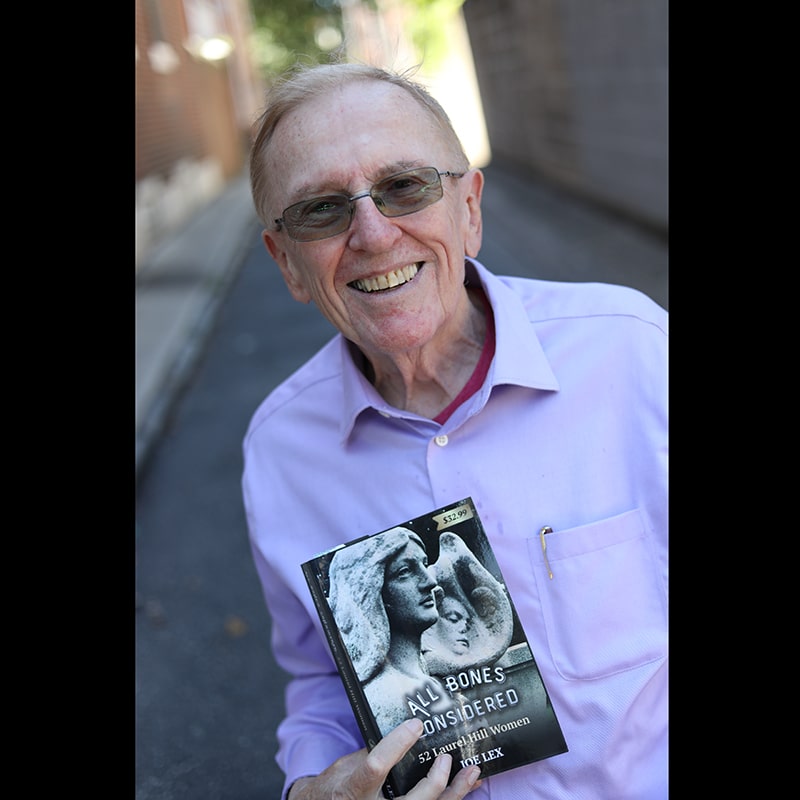
“My philosophy was always the same in that if I didn’t learn at least three new things when I was preparing a talk, I had nothing to teach anybody. I always started with the assumption that everybody knows as much as I do, and if I don’t teach myself some new things, I’ve got nothing new to teach people.”
~Joe Lex
Joe Lex retired in 2016 after 45+ years in emergency medicine. He started as a combat medic in Viet Nam and ended as a professor of Emergency Medicine at Temple University
When he took a tour of Philadelphia’s historic Laurel Hill Cemetery, which was founded in 1836, he realized that the role of a cemetery docent seemed to suit his personality. After a year or so of giving tours, he decided that both cemeteries, Laurel Hill East and West, needed a podcast to talk about their amazing inhabitants. The result was “All Bones Considered: Laurel Hill Stories”, followed a couple of years later by “Biographical Bytes from Bala: Laurel Hill West Stories.”
Soon, Joe had accumulated hundreds of scripts loaded with biographical and historical information, along with some pretty astounding stories of movers and shakers, artists, authors, entertainers, scholars, educators, healers and givers, among many more.
After Viet Nam, Joe earned an associate degree in nursing. He later graduated from medical school at the University of Texas Health Science Center, San Antonio. He subsequently spent 14 years as a community emergency physician before entering academia in 2003.
He’s been an invited speaker at dozens of national and international meetings of Emergency Physicians. After serving five years as chair of the education committee for the American Academy of Emergency Medicine, its Educator of the Year Award was renamed the “Joe Lex Award.”
And for seven years he was the producer, researcher, and announcer for a weekly radio show on WPPM-Philadelphia. One of his podcasts is now ranked the Number 1 Philadelphia History Podcast.
Recently, Joe published All Bones Considered: 52 Laurel Hill Women, which I’ve read and found to be a fascinating compendium of amazing women buried at Laurel Hill Cemetery, many of whom helped make the United States the remarkable place it has been for so long. I highly recommend it to you.
WEBSITES:
For more information, please see: https://allbonesconsidered.com/
IF YOU LIKE THIS EPISODE, YOU MAY ALSO ENJOY:
- P.K. Edgewater, Doctor and Author-Episode #415
- Ron Roman, Author-Episode #399
- Qin Sun Stubis, Columnist-Poet-Author-Episode #359
- Lady Dhyana Ziegler, Author-Professor-Songwriter-Episode #354
- Sharon Virts, Author-Artist-Entrepreneur-Episode #346
- Tom Stein, Author-Episode #339
- Adam Rosenbaum, Author-Episode #336
- L.A. Starks, Author-Episode #334
- Martin Dugard, Author-Episode #328
- Jon Kremer, Writer-Episode #319
- Stephen Games, Author-Publisher-Episode #275
- Peter Smith and Laura Smith, Authors and Teachers-Episode #244
Steve Cuden: On today’s Story Beat.
Joe Lex: My philosophy was always the same in that if I didn’t learn at least three new things when I was preparing a talk, I had nothing to teach anybody. I always started with the assumption that everybody knows as much as I do, and if I don’t teach myself some new things, I’ve got nothing new to teach people.
Announcer: This is Story Beat with Steve Cuden, a podcast for the creative mind. He Story Beat explores how masters of creativity develop and produce brilliant works that people everywhere love and admire. So join us as we discover how talented creators find success in the worlds of imagination and entertainment. Here now is your host, Steve Cuden.
Steve Cuden: Thanks for joining us on Story Beat. We’re coming to you from the steel City, Pittsburgh, Pennsylvania. My guest today, Joe Lex, retired in 2016 after 45 plus years in emergency medicine. He started as a combat medic in Vietnam and ended as a professor of emergency medicine at Temple University. When he took a tour of Philadelphia’s historic Laurel Hill Cemetery, which was founded in 1836, he realized that, uh, the role of a cemetery docent seemed to suit his personality. After a year or so of giving tours, he decided that both cemeteries, Laurel Hill east and west, needed a podcast to talk about their amazing inhabitants. The result was All Bones Considered Laurel Hill Stories, followed a couple of years later by biographical bites from Laurel Hill West Stories. Soon, Joe had accumulated hundreds of scripts loaded with biographical and historical information, along with some pretty astounding stories of movers and shakers, artists, authors, entertainers, scholars, educators, healers and givers, among many more. After Vietnam, Joe earned an associate degree in nursing. He later graduated from medical school at the University of Texas Health Science Center, San Antonio. He subsequently spent 14 years as a community emergency physician before entering academia, and in 2003, he’s been an invited speaker at dozens of national and international meetings of emergency physicians. After serving five years as chair of the Education committee for the American Academy of Emergency Medicine, its Educator of the Year award was renamed the Joe Lex Award. And for seven years he was the producer, researcher and announcer for a weekly radio show on WPPM M Philadelphia. One of his podcasts is now ranked the number one Philadelphia history podcast. Recently, Joe published All Bones Considered 52 Laurel Hill Women, which I’ve read and found to be a fascinating compendium of amazing women buried at Laurel Hill Cemetery, many of whom helped to make the United States the remarkable place it has been for so long. I highly recommend it to you. So for all those reasons and many more, I’m truly privileged to have the longtime emergency medicine doctor, educator, podcaster and writer Joe Lex join me on Story Beat today. Joe, welcome to the show.
Joe Lex: Thanks, Steve. Thanks for having me.
Steve Cuden: Well, it’s, um, a great pleasure, believe me. So let’s go back in time a bit. How old were you when you first fell in love with medicine?
Joe Lex: Medicine? Geez, probably 19. I was drafted when I was 19, and, um, I didn’t want to go into combat, so I figured maybe if I join, I can get into something that’s not combat related. And I got into medicine. So I went and enlisted. And indeed, they let me be a medic. But I did well enough in basic medic training at Fort Sam that they sent me to Valley Forge General Hospital here in Pennsylvania for a 40 week course as a clinical specialist. So when I finished that, I still ended up in Vietnam, and I still ended up in an infantry unit as a combat medic. But I was the assistant battalion surgeon. So I was the supervisor of the rest of the line, one of the supervisors of the rest of the line medics. I was the medical supervisor. There was an administrative supervisor also. So I was still out there in the field and I was still taking care of acutely wounded people. But I was not a line medic. I was a combat medic in a front position at the battalion aid station.
Steve Cuden: Well, first of all, thank you for your service. That’s first. And second of all, uh, was it as dangerous as it sounds? I assume it was.
Joe Lex: Uh, yeah. We were in a combat zone and there were snipers and there were booby traps, and it was a real honest to God war. You know, nowadays the drones have taken over, which I suppose in its own way is good, although it takes away a little bit of hesitation that people might have about pushing a button if you’re not looking at somebody’s face. And that. That’s part of the problem with drone warfare. It’s so impersonal. Um, which I suppose it has to be if you’re killing people. Um, you know, it wasn’t like in Vietnam. It was literally people shooting each other and throwing mortars at each other and throwing grenades at each other and dropping bombs on each other and setting up booby traps for each other. That was. That was the way war was fought back then.
Steve Cuden: It was up close and personal in a large way.
Joe Lex: Oh, yeah. Oh, yeah.
Steve Cuden: So, uh, were you fascinated or drawn to history and books and so on at the same time, or is that later?
Joe Lex: I’ve always been fascinated by history. I have a complete set of American Heritage magazines at Home. It started publishing in 1955, I think. My parents got me a subscription when I was 10 or 11, and eventually I filled in the back issues. But I’ve got a complete set of American Heritage going back to the mid-1950s. It’s a popular history magazine and it, it did a good job of teaching me a lot about American history.
Steve Cuden: Well, and we’re going to talk obviously much more about your book in a moment. But the book is a history book essentially. Um, and, uh, I clearly you have a fascination with it.
Joe Lex: It’s a history book. It’s a biography book. Also. It’s only within the last few weeks that something has dawned on me how I can tie in being a cemetery docent and a cemetery historian with being an emergency physician and a combat medic.
Steve Cuden: Explain how that works.
Joe Lex: Okay. I’m trying to raise the dead.
Steve Cuden: Yes, indeed.
Joe Lex: It’s a God complex. It took me 75 years to figure this out, but I think it’s all a God complex that I’m trying to raise people from the dead. I did it in the emergency department and now I’m trying to do it with stories about people.
Steve Cuden: Sure. One of the questions I have is being, um, uh, an emergency room medic. My assumption is you’ve seen people die in your time, not just in Vietnam, but in the emergency room as well. And is that what drew you to the cemetery in the first place?
Joe Lex: I don’t know what drew me to this cemetery. I’ve always been attracted to cemeteries. Part of it is I was born in Springfield, Illinois. Okay. Abraham Lincoln’s home. The first house I grew up in was on Monument Avenue, which is about two blocks from Lincoln’s burial place. So I have movies from the late 1940s of me sledding down a hill beside Lincoln’s tomb. That’s probably where my interest in cemetery started because I developed a fascination with presidential assassinations. Believe it or not, when I was in medical school, I had access to medical library. And I got dig into the archives of, um, medical libraries to old journals. And I wrote a big paper on, uh, gunshot wounds in four assassinated presidents. In fact, I developed a talk about it that was very popular and I still give part of it. Um, I’ve got part of it on YouTube. In fact, on YouTube, what I’ve got is it’s called the Gunshot that Killed Lincoln. It’s a medical look at the shot that Lincoln took. Could he have survived today, what would have been done differently, etc. Etc. Um, so it’s there on YouTube. I’ve got a bunch of stuff on YouTube, like that medical history stuff.
Steve Cuden: And so you’re.
Joe Lex: You’ve.
Steve Cuden: Then you’ve always been drawn to that kind of storytelling. Uh, were you also a writer and a storyteller as a young man?
Joe Lex: Nothing formal. Nothing formal. I’ve always enjoyed writing. Well, I shouldn’t say I enjoy writing. Who enjoys writing? I’ve always been good at writing if I force myself to do it. It’s like, you know what Red Barber said. Remember Red Barber, the old sports writer? He said, writing is easy. You just sit at the typewriter and open a vein. And that’s kind of the way it is, is sometimes you sit at the. You sit at the keyboard and you open a vein and you hope something rolls out.
Steve Cuden: Well, well, yeah, I mean, it. It’s a hard thing to do to be a writer. It’s not easy.
Joe Lex: I mentioned before the show started, I’ve always been more of an aural person than a visual person. I’ve always preferred radio over television. My writing, most of the writing I did was to be heard rather than to be read. I’ve always been better at writing short, little explanatory essays, uh, scripts. I’m very good at writing scripts. I don’t know if you’ve listened to any of my podcasts, but. But the podcasts are well written, I can guarantee you that. I’ve got. Always had a philosophy as a teacher, okay? I was on the teaching circuit for many years. I was on the international teaching circuit for about 10 years. I was out of the country 10 or 12 times teaching. My philosophy was always the same in that if I didn’t learn at least three new things when I was preparing a talk, I had nothing to teach anybody. I always started with the assumption that everybody knows as much as I do, and if I don’t teach myself some new things, I’ve got nothing new to teach people. So that’s the way I have always approached my teaching style, and that’s the way the podcasts come across. Also the podcast. I finished a podcast the other day on Flir Bubble gum. Okay? We don’t talk about the guy who invented it until 20 minutes into the podcast. I talk about what people have chewed throughout history. I talk about animals who are gummivores. I talk about, um, the beginnings of chewing gum and how people have used toothpicks and chew sticks. And then I get into pink. Why is bubblegum pink? What does pink taste like? You know, just get into the details like that. And eventually I get to talk about the Guy who actually invented the bubble gum. But, but that’s the way I like to teach, is to get a lot of information out there and to keep it entertaining and to let you think, wow, I never knew that before. If you don’t say I never knew that before, at least three times with listening to what my podcast and I’ve failed.
Steve Cuden: When you say that, uh, the people that you are speaking to, um, you think that they know as much as you do, is that true? Do they really know as much as you do?
Joe Lex: If they don’t, they can catch up pretty quick. That has to be my assumption. That doesn’t mean I’m not going to go back and explain something.
Steve Cuden: Right?
Joe Lex: But at the same time I’m not going to, I’m not going to stand in front of an international audience and explain the coagulation cascade. I’m not going to explain a second year medical school theory to an international audience. I’m going to approach the international audience as a group of people have been practicing emergency medicine for a long time and they want to learn a few new things and they want me to tell them a few new things. So I’ve got to learn a few new things myself.
Steve Cuden: Well, I think that’s a really fascinating way to uh, approach being a lecturer or a teacher because, because I’ve always found. Cause I taught full, uh, time for 10 years and I always found that I learned as much from my students as they did for me, that they were always teaching me things. And so what I think I’m hearing in you, and you correct me if you think I’m wrong, is that you teach by telling stories. You’re actually a storyteller.
Joe Lex: I think so, yeah.
Steve Cuden: You’re not just going to spout one fact after another. You’re going to tie it together with some kind of a story.
Joe Lex: Absolutely right.
Steve Cuden: So who were your early influences or maybe your current influences in terms of writing history or stories or anything that you then think to yourself? Um, I learned something from that author. Who were your influences?
Joe Lex: My first major influence I can remember in high school was Ambrose Bierce. I just fell in love with his style, his writing, his snarkiness, his m. And then the whole mysterious story. The mysterious story just disappeared into Mexico, ran off to fight with Pancho Villa and disappeared. Nobody knows what happened to Ambrose Beerus yet. He was next to Mark Twain. He was probably the most popular author in the 19th century America. Uh, but I read Devil’s Dictionary and I read, uh, twice, not twice. Told tales, tales to. I forget the name of the collection of short stories. But it impressed me deeply, uh, the way that he wrote. Um, C.S. lewis was another author who impressed me when I was young.
Steve Cuden: And neither of them are thought of as historians, although they would write in a period, but they were not thought of as history writers. Um, and so, uh, your writing ability comes from that influence of people who wrote fiction, right?
Joe Lex: Well, they wrote stories. Yes, they wrote stories. Just like I try to tell stories.
Steve Cuden: Right, but you try to tell stories and again, correct me if I’m wrong, you tell stories that are based on real people and real incidents as opposed to making up fiction.
Joe Lex: Fiction, yeah. I don’t know how well I would do it. Fiction, I’ve never tried fiction. I’ve never tried. I like reality too much. You know the old saying, the difference between reality and fiction? Fiction has to make sense. Fiction has to make sense.
Steve Cuden: It’s true. It’s absolutely true.
Joe Lex: And that’s not the world we live in.
Steve Cuden: It has to be what we. It’s what we call believable. It has to be believable. Even when what you’re writing about is unbelievable.
Joe Lex: Exactly. Fiction has to be believable. Reality just. It’s reality. It is what it is. It’s what happens.
Steve Cuden: What for you, when you’re, when you’re reading, whether it’s a historical story or a fictional story, what for you makes a good story good? What attracts you about it?
Joe Lex: I mean, obviously holding my interest over a long period of time, leading me through a story, giving me a start, giving me a logical story through to a conclusion. That’s what storytelling is supposed to be. 90% of the reading I do anymore is research. For the podcast and the tours, other than news, you know, I spend a couple of hours. One of the joys of being retired is I can spend two hours every morning reading newspapers. So I go online and I read the New York Times and the Washington Post and the Times of London. Other than that, most of the reading I do is research for the next podcast I’m working on or whatever tour that I might be putting together.
Steve Cuden: So on the podcast, you write it out, you script it, and then you read it as well, correct? Yes, it’s a scripted piece. But when you’re, ah, giving tours at the cemetery, do you have a script in your hand or is it out of the top of your head?
Joe Lex: When I give tours of the cemetery, I’ve got a sheet of paper on it because of the dates. I don’t retain the dates really well, and they’re sometimes the numbers you know, the thing. And then there were 43 generals, you know, well, I’ve got to look. Maybe it was only 41. So I’ll keep some data on sheets of paper, but 90% of what I tell on a tour is off the top of my head. Now, when I’m doing the podcast, obviously, I’ve got a script. I try to make it sound conversational. I think I managed to make it sound conversational, but I’m reading a script.
Steve Cuden: So that’s a different kind of presentation, isn’t it, when you’re reading something off of paper versus coming off the top of your memory of what you’ve, uh, researched and figured out.
Joe Lex: Absolutely.
Steve Cuden: So let’s talk a little bit about the book and Laurel Hill Cemetery and so on. Um, uh, we’re speaking today in the year 2026. This podcast should be around for a long time. Uh, but this year, America turned 250 years old. And Philadelphia, where you are, you are in Philadelphia, right?
Joe Lex: I’m at block outside of Philadelphia, but, yeah, close enough.
Steve Cuden: Um, and Philadelphia feels, and I think it is truthfully, the birthplace of what we think of as the core of American philosophy and ideals. Philadelphia is that birthplace. Um, do you think that your book reveals not just the history of this cemetery, but the history of the city and the nation at the same time, in the way that you present these women?
Joe Lex: To be honest, no, it doesn’t, because the cemetery wasn’t founded until 1836, and most of the Founding Fathers died before then. We do have one signer of the Declaration of independence, Thomas McKean. We do have Charles Thompson. He was the secretary of the Continental Congress for its entire duration. I mean, you talk about somebody who knew where all the bodies were buried. He knew everything that was going on in the Continental Congress. But since he didn’t represent one of the colonies, he didn’t sign the Declaration of Independence. Um, he designed the national seal with the eagle and the talons and the flag on it. Um, so we’ve got a few Founding Fathers. We’ve got David Rittenhouse, the first director of the U.S. mint. Um, we’ve got Thomas Godfrey, the guy who invented the quadrant, which later became the sextant. Uh, Jonathan Miller, the first director of, um, the U.S. military Academy. Um, William Short, Thomas Jefferson’s adopted son. So we’ve got a lot of Founding Fathers. But if you want Founding America, you go to Christchurch burial yard over at 4th and Arch Street. Either go to Christchurch at 2nd and Arch, or 2nd in America, or American and Arch, and then 4th in Arch is their burial yard. That’s where Benjamin Franklin and Benjamin Rush and Philip Singh, physic and all the signers of the Declaration of Independence are buried is over at Christchurch. What we’ve got at Laurel Hill is Laurel Hill east is the Civil War crowd. We’ve got more than 1,000 Civil War soldiers, 40 Civil War generals, I believe we have only, only the US Military Academy and Arlington have more Civil War generals than we do at Laurel Hill. I think, I think I might be wrong on that, but we’re in the top five. We’ve got General George Meade. We even got, um, Pemberton. We’ve got one of the Confederate generals. He’s buried in the south section, of course, appropriately. Um, so the history that we cover at the cemetery is really, I describe Laurel Hill east as a Civil War cemetery that’s very Victorian. Laurel Hill west, on the other hand, was founded in 1869. It is a great war cemetery that’s Edwardian, it’s twice as big. It’s got twice as many people. The benefits of working on people buried in the newer cemetery is it’s easier to get information on them because m most, many of them have, um, obituaries in newspapers that are fairly, fairly well written. They’re not always truthful. I mean, you know, you know as well as I do obituaries, the person looked terrific. They do. They’re not necessarily the place to find the truth about somebody, but they’re a good place to get some good information about them. When you’re looking at 19th century people, you’ve got to look in, in different place. You got to go to some primary sources, you know, dig around in the cemetery archives, see what they’ve got. Philadelphia, you, um, pointed out how historical we are, but we’ve got the historical society, we’ve got the library company, the Athenaeum, um, public library. We have so many historical places we can go for primary information here that it’s an embarrassment of riches.
Steve Cuden: Well, obviously, am I correct that Laurel Hill east Has something like 75,000 people buried there?
Joe Lex: Laurel Hill east has about 75,000 people, about 30,000 monuments. Laurel Hill west is actually bigger. Laurel Hill west has about 100,000 people. It also has 270 mausoleums, 270 family mausoleums, most of which have stained glass. And we’ve identified eight Tiffany stained glasses, one Tiffany mausoleum and five Tiffany tombstones. Believe it or not, Tiffany studios made tombstones, uh, and we have several of them, but we even have a mausoleum that’s from the studio of Louis Comfort Tiffany.
Steve Cuden: That’s amazing. Well, I’ve been in the Tiffany Museum down, uh, in Orlando, Florida. There’s a museum down there.
Joe Lex: I’ve heard about that. I’ve not seen it.
Steve Cuden: Yeah, there’s a lot of beautiful stained glass windows in there. Obviously, that’s what it’s about. Um, so who keeps track of everything? Is there a place where you can go and figure out where everyone is buried?
Joe Lex: There’s an archive that is very well managed. It has paperwork that dates back to the beginning. There are a couple of plots, a couple of sentimental favorite plots that are still active, that were purchased in 1839. How about that for 50 cents a square foot? They paid 50 cents a square foot for the, the, uh, the rights of burial. And, uh, they are still active plots. The Boland plot and the Weatherill plot are still active plots. The Bolands live out in Villanova, and the Weatherills live in Chestnut Hill. And whenever a family member dies, they go into this plot with the 70 other people who were already there.
Steve Cuden: That’s him. So there’s still open space for them to go.
Joe Lex: There’s open space also, but not in the historic part of the cemetery. You can still get buried in the historic part if you can show that you are a family member and there’s no objection. But if you want fresh space, you can get buried at Laurel Hill east or Laurel Hill West. I will tell you, however, that currently death practices in the United States, more than half of people go for cremation or green burial rather than the standard burial, their standard crypt, the standard underground. Um, we have a beautiful columbarium at Laurel Hill west that is, um, almost full. It looks like it’s going to have to be expanded soon. But green burial, we have so many green burial places available right now. We could, we could probably take a couple hundred people who wanted green burials. We haven’t got Aquamation yet. It’s not legal in Pennsylvania.
Steve Cuden: What is Aquamation? I’ve never heard of it.
Joe Lex: Aquamation is liquid. It’s an alkali liquefaction process that leaves basically a zero carbon footprint. And, um, you’re left with bones to be crushed just like after a cremation. And everything else just goes into the sewer system. Everything else just gets recycled. Ironically, we can do Aquamation for pets. We can’t do it for humans. There’s a pet cemetery at Laurel Hill west, and if you bring your, your, your lemur or your raccoon, and we can acclimate your raccoon, but. But, uh, not your mother. So that’s, that’s just the way it is. Yeah. Ah.
Steve Cuden: All right, so let’s talk about the book in specific. What. What was your purpose in writing all bones considered, 52 Laurel women? What were you hoping to accomplish by picking out these 52 women and writing about them?
Joe Lex: Bringing them back to life. Bringing them back to life. You, you got a copy of the book, I assume. You, when you looked at the index, when you looked at the index, how many names did you recognize?
Steve Cuden: Oh, uh, a few.
Joe Lex: Okay.
Steve Cuden: Because they’re, they’re historical.
Joe Lex: Cecilia Bow, the artist, and maybe a couple of others. But most of the names were not familiar to you, I assume. And yet when you read the stories, as I did so often, I’d say, why have I never heard of this woman before? Like Elizabeth Dwayne Gillespie, the woman who literally saved the sanitary fair to raise money during the Civil War. And then when the centennial came along, she raised the money for that. And when the men kept her out of the main hall, she went out and raised another $30,000 and built a building just for the women. And then on their opening day, no men were allowed. It was an all woman only opening at the women’s building.
Steve Cuden: Well, you mentioned earlier about newspapers, and that’s how you do research on the, on the, on the newer cemetery, which is more difficult in the older cemetery. Um, but today we have the Internet and we have electronic and digital archives. And my assumption is people may or may not be remembered longer because of it. But it all depends on whether those research, uh, not research, but those storage materials last for a really long time. Newspaper, we know other than it getting into the weather tends to last a fairly long time.
Joe Lex: Steve, you bring up something that is always in the back of my mind. Uh, we haven’t talked about this, but sitting over in the corner here is a series of three ring binders. It holds 170 letters that I sent home from Vietnam more than 50 years ago, which my mother saved. And I didn’t know she’d save them and I didn’t find them until a few years ago. And if you don’t think that’s a revelation to go back and read stuff that you wrote when you were 20 years old from a combat zone.
Steve Cuden: Sure.
Joe Lex: People don’t write letters like that anymore. How do we know what happened on a day to day basis in the Civil War? From the letters that the soldiers wrote home. How do we know what it was like in Europe during World War II? From the letters that people wrote home. I’m going to get my letters published. That’s one of my goals this year is get these letters published. Notes from now 170 letters that I sent home. Now they send emails, now they send text messages. Who’s going to write the history of these wars and what the people did during these wars when they don’t have a paper record to go on?
Steve Cuden: Yeah, it’s going to be more challenging, that’s for sure.
Joe Lex: It’s going to be tough. It’s going to be tough.
Steve Cuden: It’s going to take a number of people who are experienced in those things, the war itself, to sit down at some point and write their history. And that’s where some of this will come from. But the letter writing, um, um, that’s become sort of bygone. I guess not too many people do it anymore.
Joe Lex: I encourage people to write, just put it in a journal, put something down every, if not every day, every couple of days. And odds are it’s going to end up in a landfill someplace. But there is that one in ten, one in a hundred chance that a hundred years from now somebody’s going to pick up that book and look at it and it’s going to change their life. I mean, it sounds strange to say, but it’s happened so many times to people. We know what happened in colonial Philadelphia on a day to day basis primarily because of the diary of one woman. Her name was Elizabeth Drinker and her relatives are all over the city still. Um, in fact there’s. I’ve done, I’ve done podcasts about seven drinkers. I’ve done seven podcasts about the Drinker family. That’s how big they are, that’s how popular they are, but. And Elizabeth is not even buried at one of my cemeteries. Everything we know about the day to day life of citizens in Philadelphia is because she wrote it down in her diary for her grandchildren. That’s how we know what happened in the past.
Steve Cuden: I was going to say, you write in the book, I quote you. The act of remembering is powerful and you need that writing to have that act of remembering. Right?
Joe Lex: Yeah. I mean there’s a lot of different sayings about when somebody really dies, they really die. The last time, when somebody mentions their name the last time, I mean, that’s all well and good. There’s so many people that led such interesting lives. I wouldn’t necessarily want to follow them, but I certainly enjoy reading about them. I mean, when you were reading the book, which women did you like?
Steve Cuden: I kind of like the ones that were arts related. That’s What I think of those that were related in some way.
Joe Lex: Did you know about Anne Francine? Was Anne Francine new to you?
Steve Cuden: I didn’t know about in any detail any of the women. I recognized some names. They were like, I’ve heard those names before somewhere, but I didn’t know any of these women. So you definitely dug out and uh, expounded on a whole bunch of people that probably aren’t terribly well known today.
Joe Lex: And it’s frustrating because I’ve got somebody like Glenna Collette Vere, the woman who won the US Women’s Amateur Golf.
Steve Cuden: She fascinated me too. Yeah? Mhm.
Joe Lex: She won it five times, got married, had two kids and said she wanted to see her new name on the cup. So she went back and won it a six time. And nowadays the Ver cup is given every year to the LPGA woman with the lowest score, the Ver Trophy. She’s buried in an unmarked grave at Laurel Hill West. This woman who could drive a golf ball 300 yards with a wood shaft club in 1910 or 1920. 1920, uh, even in her 80s, they put her in a foursome. In her 80s, when she was playing something like her 55th Rhode island tournament and off the first tee she out drove the other three women who were about a third her age. I mean, that’s the kind of joyous stories I like to discover.
Steve Cuden: Well, that’s what I was going to ask you. You’re attracted to the more, um, unusual, unknown and fascinating, uh, twists on life in those stories. That’s what I saw. So you had to go through a lot of women or a lot of dead people, I guess, in order to figure out which ones you were going to write about. What criterion did you use to say, I’m going to write about this one but not that one.
Joe Lex: What it came down to is when I had probably 300 scripts I’m looking through and I say, okay, uh, 52. I won a week. I choose 52 men. And I’ve still got the list here for the 52 men. And then I looked at the list of 52 women. It was obvious to me which was more interesting. The women were vastly more interesting than the men because the men were going to be. Because the men were going to be your standard businessmen, your standard military admiral, um, your standard baseball player. With the women, you’ve got three women who start a school for children. You’ve got a woman who’s, who’s um, so beautiful, she’s painted eight times by the most famous portrait painter in the United States, who happens to be her aunt. Um, you know, that would be Amy Ernesta Drinker, Bullet Bow Bartlow. There’s another drinker, Amy Ernesta Drinker, Bullet Beau Barlow. They had to do something out of the ordinary or they wouldn’t have made it into the book. I mean, every woman in this book did something that was extraordinary for either for her day or her gender or something that made her stand out.
Steve Cuden: And so what I would ask you in reverse from what you asked me, who were the ones that absolutely stood out as the most interesting to you? Uh, who were the really top stories?
Joe Lex: The most interesting, I think was Amy. Amy or Ernesta. She went by Ernesta Amy Ernesta Drinker, Bullet, Beau Barlow, simply because she was stunningly gorgeous. Uh, she had more than 50 marriage proposals before she was 18 years old. Um, her first husband was Bill Bullitt, who was a newspaper man at the time. He later became our first ambassador to the Soviet Union. Um, when she broke up with him, she had an affair with the artist Rockwell Kent. And then she took up with the opera composer Samuel Barlow. So she live this amazing life in high society, a life that I can’t even imagine. Uh, Wednesday night music salons in their apartment in New York where Paula Robeson or the, the Amadeus String Quartet might stop by to, to sing or to play something. Um, so that, that’s a world. Part of that is because it’s a world. I can’t even imagine that upper class New York world, world. The woman that impressed me the most, I think though was, was Helen Thompson Bradford Woolley, the PhD, the psychology PhD who studied under Dewey. And Dewey said that her PhD thesis was actually better than his. But unfortunately she had mental health issues and um, ended up in an institution late in life. But she, she did incredible work in behavioral psychology and gender studies in the nineteen teens and twenties, years before these were popular topics. And most of the work that she did back 100 years ago is still very legitimate. And yet she’s not recognized. People don’t recognize her as one of the pioneers in gender studies. I was going to say another one that I did not make the book because I discovered her too late, was another drinker, but she married into the family. And that was Sophie Hutchinson Drinker, who was an amateur musician who with her husband had these Sunday night sessions in their house where amateur singers would get together and just sing for hours. And um, she went looking for music that was written by and for women, by women composers for women choirs, and there wasn’t any. She ended up writing the first. First feminist perspective on musicology back in the late 1940s. Now, of course, all of that stuff is very well covered, and we’ve discovered there are a lot of composers, women composers from back then, but she couldn’t find any. And, um, anyway, Sophie’s work was so important that there is a college of music named for her in Bremen, Germany. Not even in the United States. So she’s recognized over in Germany and not so much here. Nobody’s ever heard of her here, but there’s lots of women like this who’ve done incredible things.
Steve Cuden: Well, obviously, I mean, you were able to pluck 52 out of thousands. Uh, and clearly there are more than just 52 who would be of interest. You’ve got enough to do at least
Joe Lex: another book, I assume almost enough for the second book, but I’ve definitely got enough men if I decide to go that way. I just. I don’t think there’s that much interest in the men.
Steve Cuden: Interesting. So you. You write in the book, and you. Which I. We’ve. We’ve. You and I talk. Spoke about a little bit prior to the show that you write. Most of this is a quote. Most of these women prove the maxim that everything worth having is on the other side of fear. Close quote. Explain that further. What do you mean by that?
Joe Lex: It is. It was my philosophy of mentorship for many years. Let me explain the way emergency medicine is taught. Yes, there are classroom teachings, but emergency medicine is taught in the emergency department at the bedside, because that’s where the patients are, and that’s where you learn is with the patients. So mentoring people in the emergency department is a matter of guiding them through fear. Because as I’ve said before, everything worth having is on the other side of fear. And you may not be able to get there on your own, but that’s what having a mentor is all about. A mentor is a good mentor is not trying to make a mini me. If you have a mentor who’s trying to make you into a mini me, get a new mentor. A mentor is there to pull you through a fear or pull. Push you through fear and get you to the next level. And so you can go look back and say, well, that wasn’t so bad. It’s really that simple. These women just did. Were fearless when it came to the things that they thought needed to be done. I detected very, very little reluctance in most of the women that I wrote about. They just plowed ahead and did what had to be done.
Steve Cuden: What do you think, uh, is, uh, the quality in People that allows them to get to that point and overcome fear. Is there a quality that you can point to?
Joe Lex: I wish I could, because it would be nice to be able to point it out to people, wouldn’t it? It really is a matter of getting through the fear, uh, of, uh, just getting over that hesitancy that you have. Do people have more regrets about things they’ve done or things they didn’t do?
Steve Cuden: Oh, that’s a good question. And I think the answer is that they have regrets more about what they didn’t do than what they did. Because they didn’t go somewhere, they didn’t achieve something, they didn’t meet someone.
Joe Lex: Those things, you know, the counterfactual. What if I’d done this back in 19, for instance, 1972, I was offered a job as road manager for Weather Report, and I turned them down. Okay, what would my life have been if I’d been road manager for Weather report starting in 1972?
Steve Cuden: Very different.
Joe Lex: Very different. Very different indeed.
Steve Cuden: When you’re talking about Weather Report, you’re talking about the jazz fusion group, correct?
Joe Lex: The jazz group. Yes, Jazz super group. They just put their first album out. They were doing an early tour. Miroslav Vitos, the bass player, was serving as their road manager. We had them at the University of Illinois for a weekend, and they. I was with another guy. We. We had a management company, and, um, they like the way that we manage stuff enough that after they left town, Miroslav called me a couple of days later and said, we really like the way you do stuff. Would you be our road manager? And I said, no. So that’s one of those moments in life you look back on. You say, yeah, that would have been different. That would have been something. Something different.
Steve Cuden: Uh, we all, including all the women in your book, we all reach some crossroads in our life where we take one path rather than the other. And, uh, and you. Sometimes those paths, those directions that you take are very advantageous and turn out very well. And sometimes not so much. And. And that’s life.
Joe Lex: That’s life. That’s it. That’s why you keep going, well, that one didn’t work. Let’s try this one. You were talking about creativity. The difference between creativity and artistry. Creativity, I think, is nothing more than having a lot of ideas. I mean, to have good ideas, you have to have a lot of ideas, because most of the ideas you have are not that good.
Steve Cuden: Uh, well, that’s right. So may I add to that by saying it is a lot of ideas, but it is often the combination of two things creating a third thing that’s never been there before. So it’s not just the ideas, but it is the human ability to take things that are not. You wouldn’t expect them to be together and put them together in some way. Is that fair?
Joe Lex: That’s fair. That’s fair.
Steve Cuden: So. So I want to ask about, uh, the book itself. Was there anyone that you interviewed for the book or was this just all entirely research of people who have died a long time ago?
Joe Lex: I don’t remember interviewing anybody. I exchanged some emails with a couple of family members, of women. I talked, uh, to make sure they were okay with me, including, and from, like, I don’t know if you remember the story about Winnie Haris, the, um, community organizer who planted more than a thousand trees in our neighborhood and everybody’s property values went up. And then some sobs broke into her house. They thought she had drugs there and killed her in a home invasion. I talked to that daughter because the daughter didn’t want me to emphasize the home invasion so much. They wanted to emphasize the fact that Winnie was the first person in that family to go to college. So I made sure I emphasize that. The same thing with the story about Ralph or Julia Cole, the swimmer, the black swimmer. I got in touch with the daughter, um, just to make sure that I had the story straight about when they were looking for the home in, um, Yaden. There, um, was a black section and a white section. And the stuff that I was reading in the paper was confusing. The daughter happens to be, um, a lawyer down at Louisville, University of Louisville. And I emailed her for permission and we actually had a nice conversation back and forth. So those are the conversations that I had. It’s just, just getting permission to talk about certain aspects of somebody’s life.
Steve Cuden: You can’t have interviewed any of the people who are the subjects of the book because they’re all gone. But, uh, so. But I was curious if you then in your research went to other historians or you spoke to family members and that’s the answer. So that’s, that’s a very good, uh, thing to know.
Joe Lex: I did it, but infrequently.
Steve Cuden: Mostly just your, your brute force research, just your reading and looking at things. Did you need to, did you need to clear copyrights for anything or was it all in the public domain?
Joe Lex: That’s a, That’s a tough question to answer because I’m lousy at research. I don’t have a, I don’t have a college degree. I never, never got a bachelor’s degree in anything. I’ve got an associate degree in nursing and an MD So I never learned how to do research in college. I’m paying the price for it. If you look in the book, the end of each chapter, I have all of my sources but when I submitted this to a publisher they said that’s not good enough. We want you to go back and back reference, we want you to tell us which sentence came from that. And I said no, I’m not going to do that. I mean the references are there. I just, I just, I’m not going to put exact footnotes in. I’m just going to put. Because I wasn’t writing it as a scholarly article, I was writing it as a, a um, script, a script for a podcast. So I’m not going to be keeping track of footnotes. But fortunately I kept most of the articles. So the articles were in a folder and um, I was able to give a decent bibliography at the end of each chapter. But copyright, that’s why I had to publish it on my own is because publishers said uh, they were worried about copyright issues because of the way that I referenced it.
Steve Cuden: Yeah, personally I wouldn’t, you know I would want to talk to someone more expert than me but uh, it seems to me that you covered it just by putting all of the references in there.
Joe Lex: I thought so too.
Steve Cuden: Well, who’s the most recent person uh, to have be deceased? That’s in the book. Who’s the most recent?
Joe Lex: That would be Winnie Haris, uh, the community Advertiser. I think 2016 was Winnie’s um, Grace. Let’s see. Grace Nottage was 2015.
Steve Cuden: All those people would be copyright wise in the public domain. Unless you were quoting from a more recent article, you would be clear.
Joe Lex: I think so also. But I’m not going to get into it. It’s not that vital right now. The reason I did the book is so that the cemetery has this in their book shop now or in their gift shop now. I gave the book to the cemetery. This is their fundraiser. Instead of leaving him money in my will, I just gave him the book and um, see what they do with it. If um, I’m debating whether I want to go through doing one on men right now because this one’s not selling like I wanted it to. But it’s not like I’m losing money on it. It’s just this. The uh, if I’m, if I’m going to spend this much money promoting things, I might as well just give the money to the cemetery as a donation. Well, of course I want to get word out. I think people enjoy it. I think it’s enjoyable. I think it’s good stories. I truly do.
Steve Cuden: I think it is too. Do you think that your years of working in medicine, in terms of being a disciplined person in, um, the field of medicine, that that helped you to do the work that you did on this book, the research. Do you think that you have a disciplined mindset about doing that kind of work?
Joe Lex: The discipline in doing the work is the discipline I used to apply when developing a talk. I told you I was on the international speaking circuit for several years. It would take me between 30 and 40 hours to put together a 45 minute talk. It’d be a. But when you heard the talk, you know where the work was. It was all there. And that’s kind of the way it is with this is, is, um, I’m trying to tell the story. I mean each chapter. I’m hoping you learn three or four new things in each chapter. Just like with the podcast, learn about stuff that you’ve never, never heard about before.
Steve Cuden: And that, and that in and of itself, I’m guessing was fairly gratifying for you. Just like it was when you put your talks together when you would find new information that was completely unknown to you for the book that was fascinating to you.
Joe Lex: You cannot believe that. Let’s see this guy. Let’s see, his name is Rupin Exurgin. Okay, good Armenian name. I wonder what he did. Oh, he developed the atomic cannon and he designed the Silver Streak locomotive. Where did this guy come from? I just discovered him a couple of weeks ago. Yeah, he, um, he, he. I’d never heard of an atomic cannon, to be honest with you. We actually had in this country a cannon which fired 240 millimeter atomic shells 20 miles.
Steve Cuden: Wow. I did not know that.
Joe Lex: And it was only used as sample. There are films of it. If you go to atomic canon on YouTube, you can see films of it. You can see the mushroom cloud coming from 20 miles away. There are still a half a dozen of these things scattered around the country. These atomic cannons.
Steve Cuden: And how do you find these people? Is it by walking around the cemetery or is it through your research?
Joe Lex: It’s a combination. It really is. Walking around the cemetery is fun, but it’s maybe 10 to 20% productive. In other words, as far as finding interesting, finding interesting people.
Steve Cuden: So what’s, what’s the rest of the ways?
Joe Lex: I can only talk about so many men who made their living making socks. Okay. That’s where a Lot of these fortunes came from with the men. They were, they were the knitters. You know, they had the sock mills. Or, um, one guy controlled the hay markets, which is kind of like owning all the gas stations in Philadelphia. And leather merchants, oh Lord, there were so many leather merchants. That’s because everybody had horses. So everybody needed the gear for the horses. And all the books were covered in leather, so that makes sense. But it gets boring to talk about leather makers after a while.
Steve Cuden: Well, you know, of course none of them, uh, died and were buried there in the hopes that you would write a book about them. So, you know, so you get what you get. It’s, that’s what’s there.
Joe Lex: That’s it. And I like to think I’m bringing them back to life just a little bit.
Steve Cuden: Well, I think that you are. I’ve been having just an absolutely wonderfully fascinating conversation with Joe Lex. And we’re going to wind the show down just a little bit. And Joe, in all of your experiences, whether in medicine or in being a docent or in, uh, working on this book, uh, can you share with us any kind of story, uh, that’s either weird, cool, quirky, offbeat strange, or just plain funny.
Joe Lex: A couple of years ago, one of the people I discovered at Laurel Hill east is named Cyril Sigourney Webster Fay. He was an Episcopalian minister who converted to Catholic priest. And, um, he became good friends with Cardinal Gibbons. He became a secret agent between Cardinal Gibbons and Pope Benedict xv. He mentored F. Scott Fitzgerald. If you look at, um, this side of paradise, it’s dedicated to Sigourney Fay. And eventually he became the namesake for Sigourney Weaver. Because Sigourney Weaver took her name from reading the Great Gatsby. And Fitzgerald used the name Sigourney in The Great Gatsby. Mrs. Sigourney Howard. That was where, uh, Jordan was staying. Jordan, the golfer, was staying with her aunt, Mrs. Sigourney Howard. So anyway, we have now this is a Catholic priest buried at a secular cemetery. He was also a 300 pound albino who loved to wear perfume and cross dress.
Steve Cuden: That’s wild.
Joe Lex: Okay, I’ve written a play about it. I’ll send it to you if you want it. I’ve actually written a play about this guy. I’m going to put it on a fringe next year.
Steve Cuden: That’s an unexpected character.
Joe Lex: Um, so anyway, I was on another guide’s tour and we have a habit when there’s another guide on the tour. We say if there’s somebody you Want to talk about, let me know and we’ll stop there. So I told Rich, the guide, I said, yeah, let me talk about Father Fay. So we’re walking toward Father Fay’s tomb. I am not a mystical person at all. I do not believe in spiritualism. I do not believe in mediums. I am not a religious person at all. As we’re walking to Father Fay’s grave, he’s got a table stone, a fish flat table stone. There is a dove, a pure white dove, sitting on the head of his tombstone on what would be his left shoulder. And we got there and the dove looked up at me and I told about Father Fay. And the dove just watched me all the time I was talking about Father Fay. And afterwards we moved on and I turned around and the dove was still sitting back there. Nobody had ever seen a dove in the cemetery before. We have no idea where this one came from, whether there was a wedding nearby. And, you know, a dove escaped and got confused. How the dove ended up on the tombstone of the only Catholic priest buried in the cemetery was just a little bit. Just a little bit weird. And I have a photo of it too. I actually have a picture of the dove sitting on the tombstone. So that’s my quirky story.
Steve Cuden: That’s pretty quirky. Especially in a graveyard. That’s pretty quirky. All right, so last question for you today, Joe. Um, you’ve given us a huge amount of advice along the way as we’ve been talking, but are you able to lend advice to anyone who is starting out, whether it’s in medicine or in writing or in being a docent? Do you have a piece of advice that you would lend to them?
Joe Lex: Yeah, it’s pretty much a combination of some of the things we’ve been talking about. Um, getting through fear. If you don’t have a mentor, maybe you’re not ready for a mentor. Maybe you don’t know how to find a mentor. Taking first steps is among the hardest things that we do on a day to day basis. Taking first steps toward things we’ve never tried before. Was it Mark Twain says, if you have seven things to do today and one of those things to eat a frog, eat the frog first. Always do the most unpleasant task first. I don’t, I don’t know if that’s exact quote. I don’t even know it was Mark Twain, but it sounds like something he’d say. Um, and I agree with the philosophy behind it. If you have a series of. Let me ask, let me ask you this. Are you a Person who drives around for weeks with the low tire light on in your car, or as soon as that goes on, do you say, oh, I got to get that filled up?
Steve Cuden: Well, it might not be the. The immediate thing, but it’s within a very short period.
Joe Lex: See, I’m a person who can go months and just let that thing sit there. And it’s. When I do fill the tire, it takes, what, two minutes, three minutes? And I never learn anything from it. The next time the tire goes low, the same thing happens. That’s the type of thing you have to get through is. Is that reluctance, uh, to get started on something. You just have to start, and if you feel that’s okay, there’s plenty of other things to choose from.
Steve Cuden: I also imagine that as a person who dealt with people in a lot of pain and who come into an emergency room with all kinds of issues, and probably many of them on the worst days of their lives, that you have to get through that fear pretty quick of dealing with those kinds of people.
Joe Lex: I don’t even think about that in the emergency department. When I was in the emergency, I, uh, couldn’t tell you the last time I was stuck, scared, working in the emergency department because everything in the ER just. It was. That was the life. That was the milieu. That was what you did. It was hard and it was. It was awful at times, but it wasn’t really scared.
Steve Cuden: But all those people in the emergency room who were coming in as patients, probably a significant number of them, were scared witless.
Joe Lex: Well, they’re scared witless. Yeah.
Steve Cuden: They’re out of.
Joe Lex: They’re scared out of their minds. You know, they think they’ve got cancer, they think they’ve had a stroke, they think they’re going to die. And if you don’t acknowledge that, people are going to think you’re an idiot. It’s something that was hard to get across to Residents is you have to say something. If somebody comes in with belly pain, they’re worried they have cancer. If you don’t say something about, uh, cancer, they’re going to think you’re an idiot. If somebody has numbness in their arm, they think they’ve had a stroke. If you don’t say something about stroke, they’re going to think you’re an idiot. Even though you and I both know it’s not a stroke, it’s a peripheral nerve problem.
Steve Cuden: I think that that’s really very wise advice, not just in the er, but, uh, or the ed, however you want to call it. But the. It’s it’s, uh, I think that’s wise advice in general in life is that when you don’t know what’s going on with your friend, your family, someone that you are dealing with. And to ask the question. Joe, Lex, this has been an absolutely fascinating, uh, time today on Story Beat. And I, I can’t thank you enough for your time, your energy and your wisdom.
Joe Lex: I hope I was able to get two or three points across to people that they hadn’t heard before.
Steve Cuden: I think you have. And I thank you kindly for being on today with me.
Joe Lex: Thanks for the invitation.
Steve Cuden: And so we’ve come to the end of today’s Story Beat. If you like this episode, won’t you please take a moment to give us a comment, rating or review on whatever app or platform you’re listening to? Your support helps us bring more great Story Beat episodes to you. Storybeat is available on all major podcast apps and platforms, including Apple Podcasts, YouTube, Spotify, iHeartRadio, TuneIn, and many others. Until next time, I’m Steve Cuden, and may all your stories be unforgettable.







0 Comments