
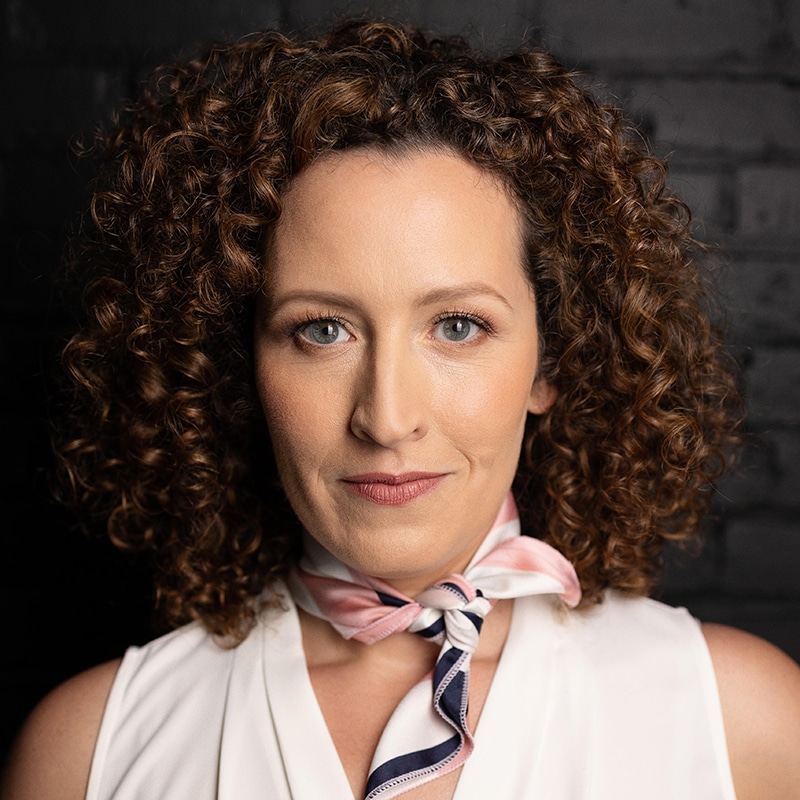
If you think you’re good at something and you’re willing to do what it takes to get there, there’s nothing that’s going to stop you. So you may as well jump in. I would just say go see as much as you can and read, read, read. You know, people, I just encourage people to read all the time. Um, I’ve definitely gone through periods where I don’t read and I just get back into it. I’m like, oh my God, why did I leave it for the last three months? Because it will constantly give you inspiration and ideas for stories and for just living a life of like, wanting to tell stories is really about observing the world around you and taking in as much information as you can.
~Crystal Manich
Crystal Manich has directed over 90 productions of opera, plays, musical theatre, and circus across the USA, Argentina, Australia, and Europe. Her work has been acclaimed by the New York Times, The Wall Street Journal, and other major publications for her “lively” and “imaginative staging.”
She wrote and directed her first opera libretto, Time to Act, written with composer Laura Kaminsky, which premiered at the Pittsburgh Opera in 2026. I saw Time to Act and found it to be well-written, hard-hitting, and compelling. She is also the writer-director for Triângulo: A Mixed Martial Arts Opera, which premieres in 2027.
Crystal served as Artistic Director for Cirque du Soleil’s Crystal and previously on Quidam. She directed the opera The Copper Queen as a western-thriller feature film for Arizona Opera, garnering an award at the 2021 Toronto International Women’s Film Festival.
She was nominated for a 2021 Chicago EMMY for a multi-camera livestream of Daniel Catán’s Spanish-language opera La Hija de Rappaccini for Chicago Opera Theater at the Field Museum.
Crystal holds a BFA in Drama-Directing and a Master’s in Arts Management from Carnegie Mellon University, a certificate in Business and Management of Entertainment from UCLA Extension, and a Professional Certificate in Screenwriting from UCLA.
WEBSITES:
www.crystalmanich.com/
Instagram: @crystaldirects
IF YOU LIKED THIS EPISODE, YOU MAY ALSO ENJOY:
- Richard Skipper, Entertainer-Singer-Episode #295
- Jimmy Roberts, Composer-Lyricist-Poet-Episode #287
- Catherine Filloux, Playwright-Librettist-Activist-Episode #269
- Dr. David Sharp, Writer-Performer-Spiritual Teacher-Episode #268
- Peter Brosius, Artistic Director-Minneapolis Childrens Theatre Company-Episode #266
- Amy Powers, Author-Songwriter-Producer-Coach-Episode #262
- Holly Reed and Kelvin Reed, Musical Theatre Writers Episode #223
- Marcus Stevens, Writer-Actor-Director-Episode #198
- Frank Ferrante, Actor-Director-Producer-Episode #196
- Douglas Levine, Composer-Pianist-Music Director-Educator-Episode #194
- Robert Cuccioli, Actor, Singer, Director-Episode #188
- Karen Mason, Broadway Singer and Actress-Episode #173
- John Davidson, Singer-Actor-Host Extraordinaire-Episode #164
- Bill Nolte, Broadway Actor-Singer-Artist-Episode #158
- Richard Maltby, Jr., Tony Award Winning Writer-Lyricist-Director-Episode #155
- Karen Ziemba, Tony Winning Broadway and TV Actress-Episode #154
- Julie Budd, Legendary Singer-Episode #153
- Jamie deRoy, Tony Award-Winning Broadway Producer-Episode #143
- Jonathan Deans-Renowned Theatre Sound Designer-Episode #141
- Yuval Shrem, Screenwriter-Director, Composer-Episode #98
- Stephen Cole, Musical Theatre Writer-Episode #78
- Bruce E.G. Smith-Nancy Zionts-Leon Zionts, Theatre Producers-Episode #75
- Kelly Ward, Actor-Writer-Director-Choreographer-Episode #66
- Michele Brourman, Singer-Songwriter-Episode #50
- Kevin Hammonds & Kristin Bair, Musical Theatre Writers-Episode #39
Steve Cuden: On today’s Story Beat.
Crystal Manich: If you think you’re good at something and you’re willing to do what it takes to get there, there’s nothing that’s going to stop you. So you may as well jump in. I would just say go see as much as you can and read, read, read. You know, people, I just encourage people to read all the time. Um, I’ve definitely gone through periods where I don’t read and I just get back into it. I’m like, oh my God, why did I leave it for the last three months? Because it will constantly give you inspiration and ideas for stories and for just living a life of like, wanting to tell stories is really about observing the world around you and taking in as much information as you can.
Announcer: This is Story Beat with Steve Cuden, a podcast for the creative mind. Story Beat explores how masters of creativity develop and produce brilliant works that people everywhere love and admire. So join us as we discover how talented creators find success in the worlds of imagination and entertainment. Here now is your host, Steve Cuden.
Steve Cuden: Thanks for joining us on Story Beat. We’re coming to you from the steel City, Pittsburgh, Pennsylvania. My guest today, Crystal Manich has directed over 90 productions of opera, plays, musical theatre and circus across the usa, Argentina, Australia and Europe. Her work has been acclaimed by the New York Times and the Wall Street Journal and other major publications for her lively and imaginative staging. She wrote and directed her first opera libretto, Time to Act, written with composer Laura Kaminsky, which premiered at the Pittsburgh Opera in 2026. I saw Time to Act and found it to be very well written, hard hitting and compelling. She’s also the writer director of Triangelo, a mixed martial arts opera that premieres in 2027. Crystal served as artistic director for the Cirque du Soleil’s Crystal and previously on Ki Dame. She directed the opera the Copper Queen as a western thriller feature film for Arizona Opera, garnering an award at the 2021 Toronto International Women Film Festival. She was nominated for the 2021 Chicago Emmy for a multi camera live stream of Daniel Catan’s Spanish language opera La Hija de Rapaccini for Chicago Opera Theater at the Field Museum. Crystal holds a BFA in Drama Directing and a um, Master’s in Arts Management from Carnegie Mellon University, a certificate in Business and Management of Entertainment from UCLA Extension, and a professional certificate in Screenwriting from ucla. So for all those reasons and many more, I’m honored and delighted to have the multi talented writer director Krystal Manich join me today. Crystal, welcome to Story Beat.
Crystal Manich: Thank you, Steve.
Steve Cuden: It’s a great pleasure to have you here. So let’s go back in time a little bit. How old were you when the showbiz bug first bit you? When did you first start looking at all this stuff?
Crystal Manich: Uh, when I was 12, actually. I, uh, had seen some theater shows before. Actually, a lot of shows that I have actually directed now, like Fiddler on the Roof was one of the first musicals I ever saw. Uh, but the bug really hit me when I was 12. A, um, couple of things coincided that year. I went on a school trip to Toronto to the Pantages Theatre to see Phantom of the Opera. And I had never seen spectacle live like that, uh, in my life. And I remember during that first scene change, after the explosion of the, uh, chandelier and the prologue, all of the sheets, you know, in that beautiful production, all the sheets that were covering the proscenium all seemed to disappear magically. And all of a sudden we were transported back in time. And I remember looking at that going, I’m gonna do this for the rest of my life. And I didn’t know it was the scene change, but I thought I was gonna be an actress, you know, um, because I wanted to be Christine. I wanted to do so. Um, but I fell in love with theater. And, uh, uh, I was living, um, outside of Pittsburgh in Peters Township at the time, and we did, you know, middle school musicals. And I was regretting I didn’t do the one in sixth grade. So in seventh grade, my first performance was as a sister and a cousin and aunt in a reduced middle, ah, school version of HMS Pinafore. Um, and I’ve never done a Gilbert and Sullivan since. Uh, so it’s really funny that, um, that’s how it started.
Steve Cuden: Was it the of what was happening before you that really drew you in?
Crystal Manich: Yeah, I, you know, I loved film, you know, growing up, and my mom raised me on old movies from the 40s through the 60s. So I was really well versed in, um, those older films. And I loved black and white and all of that. But then, you know, the special effects happening live in front of me, I think is what got me. And then the stories, obviously, I started getting really into, um, storytelling and, uh, trying to get into character myself by singing musical show tunes in my room, you know, when I was little. And so it was, it was a really incredible thing. And I really thought I was gonna be a performer. Um, I was a good dancer and a good actress, but I was a horrible singer. Um, and, uh, I had to Admit it to myself in high school, it’s like singing is not what I’m meant to do.
Steve Cuden: So. So as a horrible singer, you wind up doing nothing but working on things where people sing.
Crystal Manich: Exactly. I think it was like a wish fulfillment. You know, I always say that I respect singers so much for what they can do because I couldn’t do it. Um, but I. But I do think has always inspired me. I see images when I hear music. I’m inspired by, um, the sounds of certain instruments and want to understand what it means dramatically. And I think that that has really, ah, led me down a path of opera, musical theater.
Steve Cuden: So you went to school at CMU and got a degree as a directing major. Um, so obviously you’ve done a lot of directing, and now you’re also doing some writing. Do you think of yourself as a director primarily, or do you now think of yourself as a writer director?
Crystal Manich: Yeah, uh, I think I’m still primarily a director, but I have written so much now, especially since COVID Um, that’s really where I got so many of these projects going and other projects that had been on the back burner. Uh, so, you know, I’ve written a few screenplays. I’ve written these two stage shows. Um, I’m writing, uh, another libretto. I, uh, started another one recently. So, yeah, I’m really trying to balance out the two because I really want to continue to do the writing. So I guess I’m a writer director now, which is a really crazy thing, uh, because I never thought I would get to that point. You know, I always wanted to be a writer, but couldn’t make the time. And then Covid gave, uh, me the time and I took it, you know, and now it’s a part of my life, so.
Steve Cuden: Well, as a director, you’re obviously, um, creating something, interpreting something out of the writing. You’re trying to draw something out of it that is not actually there on paper. You have to see it stood up in order to understand what the full impact of it is. Do you think that your ability as a director for all these years, uh, is what has helped you to become a good writer?
Crystal Manich: Absolutely. I think working on, you know, some of the greatest works in the operatic repertoire that have strong libretti, uh, like La Bohme, like the Mozart operas. You know, I think all of that experience certainly counts for something when you. When you really have to look at a text and say, what makes this work and why, um, is this important and what are the flaws in what’s written as well, because we all Know that, um, even the best operas have dramaturgical, uh, uh, challenges sometimes. So, yeah, for sure. I think just reading all that material and working on it has definitely, um, led me down this path.
Steve Cuden: Well, I don’t think there’s any such thing as perfect. Everything has something in it that could be improved in some way. I think there are certain productions that I’ve seen. I know you’ve probably seen them as well, where you think, wow, this was perfect. But even still, if you stop and analyze it, there’s something that you could have done, maybe different, better, whatever that might be.
Crystal Manich: Of course, always, it’s never done. You know, I think the only way that something is done is, you know, opening night just determines that it’s done. But I think we would all keep going if we had our druthers.
Steve Cuden: Well, you know, Lorne Michaels, the longtime producer of Saturday Night Live, has famously said, uh, we don’t go up at 11:30 because we’re ready. We go up at 11:30 because it’s 11:30.
Crystal Manich: Exactly.
Steve Cuden: It’s just, it’s time to go. That’s it. So what do you think that your training as a director at CMU and whatever your other, um, education is from ucla, what do you think you’ve taken away from that education that has held you in good stead for all these years?
Crystal Manich: Well, Carnegie Mellon was intense. It’s a conservatory style program within a larger university. So you’re taking core classes in the larger university in addition to all of your, uh, all the demands of the program that we had. Uh, and I think that that really set me up for a busy life in the theater because I think that, uh, you know, I juggle multiple projects at once professionally. And I don’t think I could have done that if I hadn’t learned that early on in school. And you don’t just do one thing at a time in this kind of life usually. Um, so, yeah, that was really amazing. And I think with ucla, what I learned from both of the different programs that I did, one through extension and one through the, the film, television and theater department, was um, you know, about how to translate ideas that I’ve had in my head to film and television. Um, I really just wanted to expand my vocabulary. I directed a lot of film projects during COVID and um, it brought me back to my love of film, uh, especially old style, uh, filmmaking. And uh, I really, uh, value the writing skills that I picked up. You know, being. Being able to enter a class even though it was remote you for almost an entire year and being forced to submit pages every week really, um, taught me how to manage my time. And also that a couple of hours a day, whether it’s one hour or three hours, you really do chip away. And you’ll get to the end, no doubt.
Steve Cuden: Uh, you know, if you’re going to direct something, obviously you have to move ahead with some dispatch. You can’t do just a half a scene a day for, you know, you’d be there forever. But as a writer, you can kind of chip away at 2, 3, 4, 5 pages a day and get something really accomplished over a relatively short period of time. That doesn’t mean it’s going to be any good, right?
Crystal Manich: No. And I’ve talked to young students like I talked to a. I spoke to a high school recently in Florida, Performing Arts High School. And the thing that they said they struggle with is just either getting started or being afraid of not finishing. Um, and I think because we think about, oh, I have to sit down and write it all at once, but that’s just not true. It’s a process. And, um, I was really being encouraging, saying, look, you can just work on it a little bit every day, and after six months, see where you’re at. M. You’ll have more than you realize.
Steve Cuden: Well, that’s. In fact, that is the best technique is to just, you know, it’s the old, uh, cliche, how do you eat an elephant? Well, one bite at a time, and that’s the way you get through it. And that’s one of the things that stops people from writing big pieces. People can write a small, short, uh, page account piece, but the big piece will sometimes stymie people because it seems so daunting, but it really is just a lot of little pieces all put together.
Crystal Manich: Yeah, that was the biggest takeaway for me. So now when I just have an hour for writing, I take it, you know, because I just think, well, I’ll be able to achieve something in that
Steve Cuden: hour, even if it’s only a page. You know, that’s something. Um, so you obviously had this training at CMU as a director. Were you directing operas at CMU at the same time?
Crystal Manich: No. I fell in love with opera at age 16. By 16, I realized I wanted to be a director. My drama teacher at Mount Lebanon High School, uh, outside of Pittsburgh, pointed, uh, it out to me that she thought that I was a great actress, but that I was a leader and that I had vision for a bigger picture. And so, uh, I directed my first scene, which was from Fiddler on the Roof. That piece comes back again, uh, and it comes back again later on in my care. Uh, and directing that scene really changed my life. And I realized that that’s what I loved to do. So I went to see my first opera.
Steve Cuden: What was it that happened during that, uh, moment that really, uh, uh, spoke to you?
Crystal Manich: I prepared it for days, you know, had, you know, drew a little ground plan. Drew little figures moving in space at certain times. Oh, he’ll lift the fork here and she’ll put down the knife there. And, you know, it’s Seitel and Mahdl setting the Sabbath table. And when I got there, I was so well prepped that I just threw the script away and I was working with who was there, and we were create. I just remember my friends Tom and Sarah, I’ll never forget. We just created the scene together. It was just incredible. And, um, the four, the three of us were. Were really, um, in sync in that moment. And I thought, oh, this is cool. This is like we’re creating something.
Steve Cuden: And are you still doing that to this day?
Crystal Manich: Oh, yeah. Oh, yeah, the same thing. You know, I over prep everything so that I can get in the rehearsal hall and then forget about it or do some version of it or with the people I’m working with if they have a better idea. Uh, why not?
Steve Cuden: Does it have an equivalent for you as like, um, a coach of a sports team where you prep your game, you prep your game, you prep your game, and then you sort of go into it and then all hell breaks loose and you have to then adapt from there? Is it similar?
Crystal Manich: Oh, absolutely. You know, everything from, you know, you don’t have, uh, the people that you thought you were gonna have. Maybe someone had to get replaced. And then, you know, you have to work with someone new. And then how do you adjust to that so that the show can still be good and that they can still be good? Um, and, you know, I like to think that I can really see into actors and singers, that I can see what their strengths are and try to bring those out as much as possible in the character.
Steve Cuden: When you say you can see into them, is that what you mean? Is that you can see what their strengths and weaknesses are? Or is there something beyond that?
Crystal Manich: You know, I think I just get a very strong vibe from people within five minutes of me working with them. And I can somehow intuit their insecurities and their. The places where they feel. Where they feel good, right? And so I try to. I don’t tell them this, right? I just work with them. And I try to bring the best out of them. And sometimes, you know, with opera singers, too, it depends on what kind of training they’ve had. So many of them have had acting training, and so many of them have not. And everyone comes from a different background in opera. So, um, I meet everyone where they are, and I try to just encourage and be. Just being specific about. Okay, let’s talk about character. Let’s really go to the text. Let’s forget about the music for a second. Okay, now let’s. Let’s listen to the music and what’s the music telling us? And, um, I get them in their bodies, uh, if they need that. And it’s really been, uh, successful, you know, for me, um, trying to get everyone on the same page in the show.
Steve Cuden: So you could be terribly dangerous, I assume if you can actually sense people’s insecurities, you could just cut them off at the knees at almost any time if you chose to.
Crystal Manich: Uh, I like to think that I, uh, use my powers for good and
Steve Cuden: not ill. You have a moral sensibility, not. You don’t use it for evil.
Crystal Manich: Yeah, exactly. No, I want people to be the. You know, and I also think that we should be having fun in the rehearsal room. You know, I think there’s so much emphasis, especially nowadays, and especially in classical music, on perfection. Uh, I’m always saying that I think perfection, like you said, you know, there’s no piece that you can say is perfect or performance. Um, I say that in the room from the beginning. I always. If there’s a conductor I’ve never worked with, and the singers, I say, look, let’s make mistakes. I want to hear if your voice cracks. Great. We’ll just figure out how to make it so that, you know, you’re not straining in that way. Or let’s. Let’s just go for it. You’re gonna sing out of tune. Sometimes it’s okay until we figure out what physically we’re doing. If it’s a really physical opera, too, you know, you have to really manage the musicality with this, with the physical. So it’s, uh. I think that that’s all a part of, you know, failure in rehearsal is what we should be doing.
Steve Cuden: So perfection sometimes is what gets in the way of good.
Crystal Manich: Yeah, absolutely. Because perfection, wanting perfection, is all about having fear. Fear of, uh, not achieving. It really holds you back from m. Being creative. And I’ve seen that in people, and I have. I have to say, I’ve released a lot of people from that, um, just. Just from creating A room that is open to this kind of creative process and. And trying to make it positive for everyone.
Steve Cuden: So a person that is a performer that comes into the room fearful of, whether their own performance or the whole production or whatever their afraid of, you have a way of taking that fear and tamping it down or removing it.
Crystal Manich: Yeah, yeah. I think it’s about vulnerability. You know, I think a lot of people are afraid to be vulnerable, even though they’re performers sometimes. You know, you don’t. We don’t know what people have been through. And I think there is a lot of, um. You know, for whatever reason, a lot of people have traumatic experiences, um, training for. For these different artistic, um, disciplines. And, you know, a teacher said this to you. Oh, you can’t act. Or. Oh, I mean, there. There was someone at CMU who told a professor of mine that I couldn’t direct. Right. So these are all things that haunt us and that, uh, really, um, you know, and we can either choose to let them continue to haunt us, or we can just keep moving forward and keep developing.
Steve Cuden: Have you dealt with people that have fear of success?
Crystal Manich: Oh, yeah, I’m sure. Yes. I do know a couple. Um. Yeah, there are people who are afraid of that. Um, I think, you know, for sure in some of the film stuff that I’ve done, um, that definitely, um, happens as well. Um, but, yeah, I think in general, people are afraid of getting out of their comfort zone. I would say that that’s what really it is.
Steve Cuden: And being criticized and not knowing whether they’re any good or not, or then having, um, the feeling that, you know, they have their own suspicions that they’re no good. And so they worry that others will see it. So they’re afraid to even expose it. It’s a very strange business we’re in. I mean, we’re dealing with people and their personalities all day long. Um, especially a director, that’s for sure. So now you direct operas, plays, um, circus, and also musicals. Is your approach to all of them the same?
Crystal Manich: Yes, I come to it. All the same, but they are different disciplines. I think, um, directing an acrobat, uh, is very different from directing an actor or a singer. Um, you know, there’s just a different, uh. I think there’s just a different threshold of what you’re saying. And when timing, I think, is everything. Um, you know, and there are technical things that you have to be aware of too. Like if you’ve said to a performer who’s an acrobat, let’s say. Let’s say, I’VE worked with a contortionist on a circus show I directed in 2024. You know, she’s got to warm up in order to do the rehearsal that I want her to do. And if I get delayed or I’m behind and she’s cooling down, that’s a problem. And that’s a consideration that I need to be aware of so that, you know, she can do the rehearsal. Otherwise, it’s. Her body’s just going to be, uh, m. It’s going to be much harder for her, and that’s. And that puts a psychological burden on a performer that you don’t want to have, you know, when. When you’re going to do something important like that. So it’s. It’s a lot of. It’s about consideration as well.
Steve Cuden: So as opposed to just a straight play where the actors are going to come in, they may warm up, some of them may not. Uh, and they go through the motions. They’re not taxing their body, and usually in a major way. But an athlete or, uh, some kind of a circus performer or an opera singer, they’re dealing with their physical body in a way that requires a certain attention be paid to it. Correct?
Crystal Manich: Absolutely. And with opera singers, you know, there’s always the question of are they going to sing out in this rehearsal or not? And sometimes, most of the time, I don’t worry about it, because when you’re. When you’re getting stuff on its feet, you know, you. You. You can kind of have them what we call marking, and they don’t have to sing full out. But then I have to consider, like, okay, this next time we run it, I’d like to hear it sung full out. Because when they’re singing full out, they will physically be a little different. I mean, that’s just inherent in how the instrument works. So I will sometimes ask them, hey, tomorrow when we run this, would you be comfortable warming up so that you can sing full voice? And that’s a discussion that I have with the conductor and all of that. So, yeah, I get it. Is being considerate about making sure that communication is very clear.
Steve Cuden: And what do you do if a performer says, you know, I’m not going to do that. I don’t want to strain my voice. What. What do you do? What do you do as a director?
Crystal Manich: It’s happened. Um, and, you know, uh, the thing to do in those situations is to stay calm, obviously. I mean, your e. My ego is going to want to go, yeah, you’re going to do what I tell you. Um, but that’s. That’s the ins. What we call the inside voice. The outside voice says, okay, uh, when can we agree that we’re going to do this? And let’s talk to Maestro. Let’s talk to the conductor and see, and then, you know, come up with a plan. Because some people just need a plan. And again, it’s about adjusting to personalities and how, uh, you know, every performer has a different process. And part of being a director is just being able to be sensitive to those processes. And, um, you know, directing is really just mostly managing people all the time. Um, the story, sure, that. That gets told too. But most of the job, I would say, is. Is the management of people. And you’re constantly. There was a. There’s a fantastic directing book called Notes on Directing, um, that has, like, bullet points, um, of what it is to be a good director. And I’ll never forget one of the major things that the book emphasizes is that. Remember that as a director, you perform all day. You are performing all day long. Your actors are only performing for as long as they’re in the room. So, you know, how do you want to be perceived? And m. What’s your comportment?
Steve Cuden: All of the artistic roads lead through you. You’re a Rome, aren’t you?
Crystal Manich: Yeah, exactly.
Steve Cuden: So everybody’s coming up and asking you what you want done. The technical people are asking you, the actors are asking you, the conductors asking you. Sometimes the musicians might ask you, the stage managers asking you. Everybody’s asking you what to do.
Crystal Manich: Designers. Yeah, designers, everybody. It’s a lot. Some days it’s like, okay, just fielding all of these, you know, making decisions all day long. I mean, that’s what it is.
Steve Cuden: Is it exhausting?
Crystal Manich: Um, I find it invigorating, you know, I mean, certainly after you’re. You’re in a. If you’re an intense process, um, for several days at a time and, you know, all of that, it can be daunting. Uh, and, uh, that’s why days off are so good to have. But, um, there are so few of them in production, period. You know, so you have. I’ve learned how to. I’ve learned how to manage my time and my energy. Um, and a lot of it just has to do with, you know, how I eat and when I eat and, uh, just keeping that going and, you know, it’s just super important.
Steve Cuden: And are you able to make that happen as you need it to, or do things sometimes happen in production where you can’t follow your routine?
Crystal Manich: Oh, yeah. Oh, absolutely. Things um, get in the way all the time. Certain shows need you to be in the theater for 12 hours a day. Some don’t. Just depends on the production. But I try to, Yeah, I try to plan things out as much as I can, uh, to. To keep. Uh. To try to keep healthy, you know, during all of that process. And water is important.
Steve Cuden: Well. Well, there’s no doubt. You’ve got to keep healthy, because if you’re not healthy, then everybody’s in trouble. Of the four disciplines that you’re most into, again, plays, musicals, opera and circus. Is there one of those four that is your favorite? The one that you would. If you only were able to do one for the rest of your career, that would be it.
Crystal Manich: Well, it’s funny because, you know, when I started directing, uh, in school, uh, we were focused on. On straight plays and. And, you know, we. And of course, it’s. It was a classically based program, so a lot of, um, Shakespeare and Ibsen and Chekhov and then moving into other more contemporary things. But, uh. So I really loved that. But all the while that I was. Was there, I was scheming in my head, how do I apply this to opera? You know, how can I figure out how to apply this directing knowledge, um, and dramaturgical rigor, uh, to operatic works? And I didn’t know how to do that, um, because I just didn’t know how opera worked. And then when I got to walk across the quad to the School of Music because my directing professor, um, got me a gig directing opera scenes during my senior year, you know, I started learning, like, oh, this is so weird. Like, working, um, with singers was very different than actors. Um, and I was learning on the job, you know, with these other students. And, um, it was pretty incredible to make that leap, but I made it work for myself. And when I finished those scenes, I knew that that’s what I wanted to focus on. But, you know, I never saw myself as just staying in opera. I didn’t think I would become an opera director exclusively. I thought, well, maybe I’ll be able to do some opera and I’ll. I’ll just try to do some plays in New York. I mean, I didn’t know. You know, I was just like, I’ll just go to New York and see what happens, you know, And. But then I ended up just assistant directing opera. Um, so I think now and then, you know, Cirque du Soleil came along, and I joined them for one tour in Brazil as an assistant artistic director. And then many years later, um, as Artistic director of a tour. And, you know, I think. I think I love all of these things. I really do. I. But opera, obviously, is the one I’ve done the most, um, at this point. And so by default, I’ll get into an opera rehearsal hall, and it’s like riding a bike. It’s like, okay, I know how to do this really well. Um, and it’s definitely more of a facile activity.
Steve Cuden: And you love it, but you have passion for it.
Crystal Manich: Absolutely. I love it. Yeah, it’s wonderful. But I can’t choose one over the other and say, if I could just do. If I could write the rest of my life, I think I could be pretty happy. Um, at this point, I’m pretty thrilled with that part of my life.
Steve Cuden: That could turn into, um, more of a desire. Then at some point, if all you did was write for a while, you’d probably have a desire. At some point, I want to get back into the game again and direct. But right now, you’re doing so much directing that you want to write. I mean, that’s how that sometimes works.
Crystal Manich: That’s always how that goes. Pendulum. Yeah.
Steve Cuden: So of those four disciplines, again, the two that I think are the closest would be opera and musicals, because you’re dealing with singers and musicians and all the rest of it, and big fancy sets and technical elements and lighting and all the rest of it. Um, do you think that there. That musicals and opera are truly similar, or what are the differences between the two?
Crystal Manich: They’re similar in that especially like the really good musicals, you know, uh, are they. The music is really, um, really good at telling the story, and, uh, you can glean so much about character from the music. Um, the biggest thing is the dialogue, you know, and the performer that you need to do. Musical theater needs to know how to do dialogue really well and. And be facile at it. But then, you know, for the musical component, sometimes, um, when we go to musical theater, we don’t always see those two things being sort of equally. You know, it’s. They’re either a really good singer, maybe not as great of a actor with the dialogue, or vice versa. And certainly I’ve been directing a lot of musicals at opera companies where we’ve mixed together opera singers and musical theater people. And it’s pretty incredible because they learn from each other, you know, and then you’re seeing them run lines together, and the opera singer is sort of trying to adjust about, oh, how do I. How do I deliver this line? And, um, so that’s really where the Difference, I think, really lies. And of course, you know, dancing versus not dancing. All of that has to be taken into consideration as well.
Steve Cuden: Sure, sure. Well, that’s yet one more element that gets thrown in there. I think of musicals and art, and I actually think of musicals as being the highest of the bars, because there is not a whole lot of dance, typically in opera, but suddenly you have dance in a musical singing all the technical elements. I think of that as a, um. As an overall piece, a slightly higher bar because of the dancing. Do you agree?
Crystal Manich: Yeah, I think that it definitely requires, at least from a directing perspective, a lot more thought about, you know, how all those pieces move together. And what I can think most clearly about is the chorus. You know, is sometimes certain operas, um, you just need a chorus to just be a group of people. That is an overwhelming emotional thing for one single soloist. You know, like. Like, I don’t know, uh, in the opening of Otello by Verdi, you know, there’s just all these people in a storm, and it’s just the music is so heightened, and the visual of having all these people just, like, essentially yelling in this rainstorm is enough. Right. But in a musical, I feel like you really need to draw out each chorister as an individual character. Um, in the Fiddler that I’ve been directing around the country, um, that started, uh, in Cincinnati last year, um, I’ve been really focused on who these individual characters are. And we gave them, uh. We took the names that Jerome Robbins, uh, create, you know, gave to his chorus at the premiere, the world premiere of Fiddler, Um, we took those list of names and assigned them to our different choristers and their Yiddish names, you know, and so. And. And they. And each name has a meaning. And so my assistant was able to put together a sheet so that people could see what their name meant. And I said, okay, I want you all to build your character based on your character’s name and what the name represents. And it’s amazing when you give people that permission and that, um, responsibility that they take it, you know, and all of a sudden you’re seeing individuals up there. You’re not just seeing, you know, a herd of cats in Anatevka. You’re actually seeing people who are interacting with each other in specific ways, and it’s really great.
Steve Cuden: So how did this herd of cats get into Fiddler on the Roof? I’m kidding. That would be Angel Lloyd Webber. That’s a whole other show.
Crystal Manich: Or Cat on a Hutchin Roof. Right.
Steve Cuden: There you go. You know, I hope Someday, if you haven’t already, that you get to direct some of the great, for lack of a better word, um, rock opera musicals that would be, you know, the who’s Tommy or Sweeney Todd is generally thought of as an opera operetta, uh, or, um, Les Mis. Those are sort of more like operas than they are your typical book musical.
Crystal Manich: Well, and I listened to those so much, you know, when I was 12, 13, 14 years old, um, and I would love to do a JC Superstar sometime. I think that would be a great challenge. Um, yeah, there’s definitely some titles, and I’m doing my first Rodgers and Hammerstein Cinderella this summer, uh, at Charlottesville Opera in Virginia. And, uh, I’m really excited to. Because I grew up, you know, watching the Leslie Ann Warren 1960, um, version because it was on the Disney Channel all the time when I was a kid for some reason in the 80s and 90s. But, uh, so I really. It’s sort of like another bucket list thing I get to do.
Steve Cuden: Well, I hope you get to do your whole bucket list, whatever that would be. Um, all right, so let’s talk about your directing process a little bit. Um, you, as a director, have to come in, correct me if I’m wrong, in a sense, and exude some form of confidence.
Crystal Manich: Correct, yes, definitely.
Steve Cuden: Have you gone into situations like that where you actually weren’t confident, but you had to exude it anyway?
Crystal Manich: Oh, yeah.
Steve Cuden: Is there a trick for you? Is there a psychological trick that you do that gets you through that?
Crystal Manich: Yeah, for sure. I mean, I think, you know, there are different factors that make me feel that way. Um, sometimes it’s who the cast is, if they’re people that I deem names, and I’m like, oh, God, I. You know, I don’t know anything about this. Um, or if it’s a piece that I’m still struggling with, uh, you know, wrestling with the piece. Uh, but, you know, I have learned to just rely on the fact that, you know, a friend of mine gave me this advice when I was really nervous, um, you know, earlier on in my career, um, I used to get really much more nervous than I do now. And he said, crystal, you’re just going to walk in that room and then the piano will start playing and you’ll know what to do, because you have been doing, ah, at that point. I’ve been doing it for about ten years. Uh, and, uh, he was right. You just walk in, and once the downbeat happens, it’s like, okay, one piece. It’s like that one day at a Time thing with writing, it was the same thing. It’s like we do one or two scenes a day. That’s it. That’s all that we need to focus on. And eventually, um, that really helps get me through just focusing on, okay, what. What is the important thing here, and that’s that we’re telling a story. Um, and everything else about the fear of being judged or whatever, that’s all ego stuff. And I try to. I’ve trained myself to kind of try to, you know, quiet that down.
Steve Cuden: Uh, well, for sure. How long do you think you were at the directing game before you thought, Was it in college? Was it when you were 16? When did you think to yourself, you know what? I not only like this and want to do it, but I think I am pretty good at it, and I’m good enough to be a professional where people are going to pay me for it. Was there an epiphany for you at some point?
Crystal Manich: I think I always had that ambition and that hope that I had what it took to make it. I just didn’t know necessarily how to start. And, uh, when I learned that there is a sort of rite of passage in opera where you start as an assistant director, I thought, well, I can do that, you know. And, um, I started seeking out, you know, being an assistant director because I knew that I was going to be able to learn from people. And, um. And that’s exactly what happened. You know, I was in rehearsal so much for many years, um, assisting, and then started, you know, directing. Um, and I think that, you know, it’s sort of. There wasn’t necessarily an aha moment, but it was definitely like, ah, okay. I know that this is a building block to what I want to do.
Steve Cuden: What are the most important lessons you think you learned from the great directors you work with? You can name names or not, it doesn’t matter. But what lessons do you think you learned?
Crystal Manich: Well, I have to tell you that I, uh, Leonard Folia, who is a name, you know, Broadway director, uh, I saw his production of, you know, he did the original production of Masterclass about Maria Callas, the opera singer on Broadway, and then. And that toured with Faye Dunaway, uh, back when I was in high school and I went to see it, and I didn’t really know who Maria Callas was. I didn’t really know opera yet. I was 15. And that play. Seeing that play really inspired me in so many ways. First of all, the Maria Callas, I was like, this is a fascinating character. Who is this? And that’s what made me pull out my first opera recording from the library and listen to opera for the first time was her recording of Tos, uh, by Puccini. And then, um, the second thing I took away from that production was the directing. I thought that it was so beautifully directed, it was so simple, it was powerful. I felt something. And it was just, you know, it’s just, just one set and a piano. That’s all it was. It was, it was a set made to look like a concert hall. Uh, and so I, I never forgot the name Leonard Foliage. And then I was able to assist him at Washington National Opera on his production of Moby Dick, uh, that had its world premiere in Dallas, uh, many years ago, that my best friend that I met subsequently, uh, worked on as a choreographer and assistant director for him. But because now I was at the Kennedy center assistant directing shows and I knew Moby Dick was coming, I said to the production director, I said, please, I, my best friend is the choreographer of this. Leonard Folia is a legendary director that I have built my career on. Can I please assist Moby Dick? And they put me on it. So that was great. Um, and being in the room with Lenny every day really taught me a lot. He created such a, he was calm. He created a really good environment, like what I’ve always, always valued. Uh, and you know, he really let people create. He, he, you know, didn’t hold people on a tight leash. He said, okay, well here’s the circumstances. And, and it was a remount at that point, but he was letting it be new with people. And that was something that I had been working on at that time, um, to try to be that kind of flexible director. And it was nice to see it in action because all of a sudden, you know, this guy’s becoming Starbuck and this guy’s becoming Ahab and, um, on their own terms, you know, and, and it felt like in a live room rather than, okay, we’re just going to go through the motions and you stand here and you stand here and this is our remount. It was actually he was revisiting the material all the time, which was great. And he also listened to everyone in the room. He listened to me if I caught something or had a small suggestion. Definitely listened to my friends friend Katura, who was, um, you know, his associate and the choreographer. Um, you know, there was just an endless collaboration happening between him and everyone in the room and on the stage. Um, and so I didn’t tell him about my love for him since I was 15 until I wrote him an opening night note, and I wrote him the whole thing. And I. Because I didn’t have the courage to say anything to him, so I gave it to him. And, um. Because, you know, he’s intimidating. He’s a wonderful man, and we still, you know, we keep in touch, and I see him every now and then, but, you know, he’s. He’s intimidating. He’s larger than life, um, in the best way possible. You know, he’s very quiet, uh, and very introspective, but, man, he’s so brilliant. And, um, uh, he wrote me an email the next day, and he said, thank you for your note. And that’s all he said. And, uh, it was such a nice, you know, connection to make there with him.
Steve Cuden: Well, you learned from him. I gather that one of the important aspects of directing is to let other people do their thing.
Crystal Manich: Yes, yes. What are they good at? Yeah, absolutely.
Steve Cuden: And that’s another of your skill sets, isn’t it, that you can tell what people are really good at and what they m. Might be, their weaknesses, and so you can either help them with weakness or not feature the weakness.
Crystal Manich: Exactly. Yeah, that’s exactly right.
Steve Cuden: So. All right, so let’s talk for a moment about Time to Act, which is your first libretto, which I saw, uh, here in Pittsburgh. Uh, and it was fascinating to see because it was. Where did the idea come from? Was it your idea, or did somebody bring it to you?
Crystal Manich: Uh, so I. Yeah, actually, it was brought to me, uh, by a friend of mine who’s a conductor, and he the general and artistic director at Opera Santa Barbara in California. Um, he’s Greek. He called me shortly after the shooting in Parkland, Florida, and said that he was really inspired by the fact that so many of the, um, students who were speaking up about the tragedy were theater kids and that they were the ones really hastening this big movement, um, to expose that there’s a problem, uh, in American high schools with violence and among young people. And, uh, he said, you know, I had a vision. What if the Sophocles play Antigone is being worked on and performed by a group of high school students in a drama class, and they don’t really understand it, and then something happens in the school. Maybe it’s a school shooting, that. That then propels them to believe that theater is something that can help them get through the process of grieving or of the tragedy? Um, and so I started with that. It morphed. Since then it became about the aftermath of a school shooting in another school. But that a new student came, um, to interrupt, uh, the flow of this school, and we find out that her brother was the perpetrator. Because I wanted to really, um, parallel Antigone in a lot of ways, and that there was an epiphany, um, in the play in that way. But that development, uh, took six years to sort of figure out, uh, that story, come to that story.
Steve Cuden: So it took you six years from somebody saying, uh, here’s an idea to it being viable to be produced. Is that right?
Crystal Manich: Yeah. And it was. Part of that was because I was working with one composer on it for a little while, but then that relationship just didn’t work out. And I thought that the piece was dead after that. Um, that was. That happened in. In, uh. I think it was at. In 20. End of 2019 or something like that. And then when, um, that same friend, that conductor Costis, brought Laura Kaminsky, the composer, into the mix, he said, you know, Laura is interested in this. And. And she was very well known and had a lot of. Of, uh, operas under her belt. She’s actually one of the most produced contemporary composers in America. Uh, and of course I got really nervous. I said, well, I don’t believe you. I don’t think she’s interested, but whatever, I’ll have a meeting. And by golly, she was interested. And she. She really is, you know, someone who helped me reshape the story a little bit because we started having collaborative conversations about it. And then we ended up pitching, you know, I wrote a new outline and we ended up pitching it to a lot of people. And, um, the first company I pitched it to was Pittsburgh Opera because I had this good relationship.
Steve Cuden: Did she. Did you have a full libretto written prior to her seeing it, or were you approaching her with just an idea?
Crystal Manich: No, I had. I had like, eight versions of. Of what I would call a bad libretto.
Steve Cuden: Just eight that.
Crystal Manich: Just eight that I had worked on, uh, that I. I sent her. The one that I felt, you know, decent enough. I said, look, uh, this is not set in stone, but here’s version six or whatever it was, because I didn’t like the other two. Um, and, you know, from there we were able to really reshape what the story was. And after that happened, um, and I sat down to. To write what is. You know, I started from scratch again. Um, it was really great, but I remembered and I would look back at some of the lines that I had done already, and I used some of those. But in general, it was a whole new libretto, um, by the time, summer of 2024.
Steve Cuden: It’s not a true adaptation of Antigone. It’s sort of loosely inspired by Antigone, right?
Crystal Manich: Yes.
Steve Cuden: And so you created all the characters from scratch. You created the scenario, the plot, etc. All from scratch.
Crystal Manich: Yeah. And a lot of it came out of research that I had done, um, you know, on these tragedies and tried to find these parallels. And also, uh, spoke to my friend Lindsey Fordy, who is, um, a set designer that I met when she was a student at BU At Boston University. She, uh, designed a set for me her senior year, and I found out she was from Sandy Hook. Uh, and. But I met her before the Parkland, like, a month. Month before the Parkland incident happened. So when. When all of this started, I. I called her and I said, I want to write an opera about this. What do you think? And. And she gave me her thoughts, and so. And she ended up being the scenic and costume designer for the Pittsburgh Opera production. Because I. I said to the company, you know, it’s really important to me that we have someone on the team who really has lived through this, and this is the person. And so it. I felt like it was all kismet. You know, it really worked out in a beautiful way.
Steve Cuden: So when you sat down to write this, you wrote the libretto before any music was set to it, correct?
Crystal Manich: Yes. Yes.
Steve Cuden: And so once, uh, Laura Kaminsky comes in and starts setting music to your words, did you have to change anything in order to fit the music, or how did that work?
Crystal Manich: Yeah, sometimes, you know, when I wrote the libretto, I didn’t write it in a vacuum. I. I was sharing her big chunks as I was finishing them. We also had a dramaturg, and so the three of us would be. The. That whole summer of 24, we were in constant conversation. Um, so that was great, because I was able to do edits and adjustments in it while I was still moving forward. And then by the time Laura got to it, uh, after we did a libretto workshop at Boston Conservatory, um, she started doing the same thing, sending me pieces of the composition with a MIDI recording. Um, you know, MIDI recordings are what they are. They’re not. They’re not the best, but they. They give you a really clear sense of. Of what it is. And, you know, I would make comments, I would say, oh, you know, I. I thought that when I was writing this, I was imagining a little bit more space for this reason. Or, oh, I. I pictured this because I pictured the music in my head in a weird way, and I Said, you know, I pictured this at a different tempo. And she was really collaborative on that. On the flip side, she said to me, look, I think that this has too many. There’s too much text here. Is there a way that we can strip it away? What is the essence? And so I would rewrite it and we’d, uh, get to it. So it was a really great, um, lesson, uh, in another form of collaboration that I had never done before.
Steve Cuden: Well, yeah, because you have the words. And in a musical, if you’re going to write a musical, the typical way to do it, it isn’t always done this way. But the typical thing is to write a play and then figure out where the songs go. And then usually you take out chunks of the play and make songs out of them, or those emotional moments, whatever those are. Uh, in this case, everything is sung through. It’s all recitative or some kind of a song. Uh, and that makes it a little more challenging if you have a lot of text, because that’s just a big chunk to write music to.
Crystal Manich: And I definitely. I know that I overwrite. And you know what? It’s better than underwriting.
Steve Cuden: I think overwriting is a good thing because you can always cut. It’s much harder to pad.
Crystal Manich: Totally. And, you know, we had to decide early on in the outline. We decided, okay, where are the arias? Where are the ensembles? I, um, think this is a quintet. Whatever the thing is, um, and that was helpful for, you know, how to write it as well, because I already knew in advance what. What. What those places were.
Steve Cuden: Do you think that the. Of the three legs of a, um, opera and a musical, that being the book, the story, the. The lyrics. In this case, it’s everything. The whole text is lyrics. In case of an opera or the music of those three legs, do you think one is more important than the other?
Crystal Manich: I think if you don’t have a strong overall sense of, like, what is the major question that has to be answered in this. You know, it’s that dramatic question thing. I don’t think an opera can work, you know, and I think. I mean, maybe nothing can work, but I think in opera specifically, opera really has to hang on one major idea with lots of different threads coming out of it. I, um, think at one point, my libretto was just about a lot of different things, and I had to hone in on, okay, no, this is about Ilona. This is about this girl and how she affects the entire atmosphere with her story. And her story has to culminate in something positive that the group Unites because of her. And that Tyson, her antagonist, finds his light because of, you know, something that she’s doing. And so that was, uh. That became very clear as I was writing. And, you know, what is that Spine?
Steve Cuden: Well, I’m glad to hear you say that, because, uh, my whole thing is that it isn’t a musical or an opera unless there’s a story. You need that story to make it what it is. Otherwise, it’s a. You can have the music all day long. And that’s called a concert. You can have that.
Crystal Manich: Absolutely. And also, you, uh, know, I think there are lots of examples of operas that feel like meditations, more than. More than stories. And that’s great, but they weren’t intended to be meditations. So I would say that that’s probably not a success, um, in terms of, you know, when you’re trying to define
Steve Cuden: opera, well, the story in Time to Act, which is really very much focused on gun violence and what’s going on in our society right now, uh, it’s a challenging, um, show to watch. I found myself being challenged by it because it’s not an easy subject, and I, uh, think that that’s a good thing. Uh, did you. Were you worried about that as you wrote it? Were you concerned about this is going to be too much for the audience?
Crystal Manich: Terrified. Terrified most of the time. I mean, I was. I was dedicated and really had the conviction for it because I thought, you know, this is what people need right now, and people need to be uplifted by the end. Those were the two goals. Um, but that we needed to. That opera. You know, historically, opera has served as a way of holding a mirror to people, just like what Shakespeare did, you know, and, um, opera. Opera was often, you know, Mozart, when he wrote the Marriage of Figaro, that was controversial because the first scene opens with two servants, and you never would have had an opera about servants, you know, that as main characters. That’s just crazy. And seeing the upper class being made fun of. Um, so, you know, I feel like that the. With Time to Act, I definitely had, um, reservations. But I knew that what we were creating was going to be, uh, very impactful and special, and I just had to believe it. Otherwise it would have been a very milquetoast performance, and I think it just wouldn’t have worked.
Steve Cuden: So, obviously you also directed this, and did you enjoy, uh, directing something a. That you wrote that no one else wrote? You wrote it. Uh, and did you enjoy the. The idea of building from the ground up?
Crystal Manich: Oh, yeah, I loved building from the ground up and directing it. You know, I was nervous about it because I thought, how am I going to, like, wrestle with myself? And, you know, I.
Steve Cuden: Well, that’s a. That was a question I had. How are you going to wrestle with yourself?
Crystal Manich: Yeah. And like. And I would, uh. And I would say comments like, who wrote this? I don’t know. I don’t know. This is hard. It was really hard, guys. You know, And. And it put the singers at ease, though, too, right? Because this. These young singers in the Pittsburgh Opera program, uh, and also a couple people from the outside of the program. It was such a wonderful, uniting experience because the music was really hard because Laura’s music is difficult. But there’s a great gain, uh, emotionally from. From all that rigorous work and, you know, and the subject matter. And. And I had to take great care to convince this group of people that this subject matter was really important for us as opera storytellers to tell. And, um, we really got there, and it was. It was incredible because when we had the first workshop, um, almost, you know, In May of 2025, um, you know, people. People were having a hard time, um, dealing with it, and. And we worked with them. We worked with some people that helped us as well from the outside. Um, and then in December, before. December of 25th, before we started rehearsals in February, uh, we. I insisted on a zoom with everybody. Um, and we just talked about the piece. You know, we didn’t have to read the libretto again. We had just done that in the fall, um, of 25 at. And, you know, and gone through the orchestra workshop. And I said, I really want to talk about what. Let’s talk about character. Let’s talk about your concerns. Let’s talk about anything. This is an open space. And it really helped to set up the rehearsal process to be very positive. And the questions that came up were very valid, and it was great when I was directing it, you know, singers saying, oh, so what do you think is the backstory on this? Blah, blah, blah. And I’m like, oh, that’s the one part of that I didn’t think about. Well, let’s. Okay, well, I’ve got the writer right here. Let’s talk about it. And that was really. That was really fun. And, um, I’ll never forget it. I mean, if that’s the only time that that’s ever going to happen to me, I’m so grateful for it. You know, I felt so fulfilled on opening night. I just. I didn’t even cry. You know how, like, sometimes emotion can overwhelm you. I was so in this beautiful zone where I just was taking it all in and really enjoying it, uh, because these are once in a lifetime potential opportunities, you know, and to create.
Steve Cuden: I love the idea that you. You could not kick the writer out of the room.
Crystal Manich: Not this time. I’m sure someday someone might kick me out. Who knows?
Steve Cuden: No matter how big a pain in the ass they’re gonna be, you couldn’t kick them out of the room.
Crystal Manich: No. And I had to take them home with me every night, you know, Every night.
Steve Cuden: What would you say was the biggest challenge throughout the whole process?
Crystal Manich: I m think it was trusting every day that it was the right thing to do. You know, there were definite days where I thought, oh, God, this scene. This is so hard. How am I going to do this? Is this the. Was this the right thing? And then saying, nope, this is happening for a reason. And then going in and then feeling great about it, you know, afterwards. And the other thing, um, was just managing the fact that, you know, emotionally, I mean, I’m at my hometown company. Um, I grew up here. I, I, you know, I am, uh, well known in Pittsburgh, uh, for my work at the opera. And now all of a sudden, I’m telling people that I am also something else, which is this writer of operas. And that was terrifying. Um, and that, again, is like an ego insecurity thing that I had to work through. But it was, um. But it was. Yeah, it was worth it.
Steve Cuden: All right, so how did you overcome your challenge again? What was your psychological trick to yourself to get you through that?
Crystal Manich: I think it was knowing that so many. That I had such a huge support system, uh, in the city and, and with my family and closest friends. Uh, and it was funny because an opening night, uh, Laura was sitting behind me, the composer. And I turned around and I told my friend next to me, I said, oh, that’s my friend, blah, blah, blah, over there. And Laura said, crystal, I think this entire theater is just full of your friends. I think everyone. And she was right. I knew probably 90% of the people who are in that room. And it was, uh, yeah, it was so great. But I think, yeah, I was just knowing that. That I was. How lucky to premiere in a community that I loved and that I knew so well and that knew me and that so many people in that room had known me. I had high school teachers there who had known me since I was 14. Um, I had college professors there from Carnegie Mellon. Um, I had, you know, some of my parents there. So, you know, it Was. It was crazy. It was really, um, it was quite incredible.
Steve Cuden: So a little less stressful while being incredibly stressful, right?
Crystal Manich: Yes, exactly, exactly.
Steve Cuden: That’s very, very high bar. Well, I have been having just the most amazing conversation with Crystal, uh, Manich about her career as a director and a writer and lots of opera and music and so on. And um, we’re going to wind the show down just a little bit. And I’m just wondering, in all these experiences you’ve had, and you’ve had many, uh, can you share with us a story that’s either weird, quirky, offbeat, strange, or maybe just plain funny?
Crystal Manich: Yeah. Um, you know, I think I was thinking about how in opera as an assistant director you get really good at put ins when someone gets sick at the last minute. Sometimes you have a day’s notice and sometimes you have a couple of hours and you, as an assistant, you just got to put in another person, uh, into the role really fast. And how do you find that shorthand? And I got really good at it because when I was an assistant director at Pittsburgh Opera, I think I did six or eight put ins or something like that in, in two and a half years, uh, of, of being an assistant director there. And um, it was, it was kind of karma in a weird way, uh, because after I assisted all those shows and I did all those put ins, I suddenly got the opportunity to direct my own show, which was la Boheme in 2009, um, on the Benidham stage, which was actually the first opera I had seen when I was 16, the same production of Boheme on that Benidam stage. And 10 years later, here I was directing it myself. And I feel like the Fates, uh, had it out for me because, um, they said, well, you’re so good at put ins, we’re going to make you do one right now. So we, oh, we, we did opening night and I actually ended up staying because there was a student matinee and, and there were some of the young artists in the program who I had to direct into the student matinee. So I was staying through Thursday through that performance, and one of our singers, uh, got sick in the role of Marcello, a baritone. And we had a Tuesday night performance. Um, and he, uh, um, they said, well, we’re gonna, we’re gonna call someone in and, and that was a, ah, guy named Michael Todd Simpson. And I had known him from before. So I said, oh, cool. It’ll be great to, you know, Todd is great. He’ll be able to, you know, do it. And he literally landed on Tuesday. Um, the show went up at 7 and, and we rehearsed with him on the stage the entirety of his role in Boheme, uh, on the set from 5:00pm Maybe we start at 5:00pm um, maybe we started at 4:30 upstairs in the Benham Center. I can’t remember. And all I remember was they said they were going to hold the house and that they weren’t going to let people in at half hour like normal at 6:30. But I had to finish by like 6:40. Even though the curtain was down, you know, the noise was going to start because it’s 2800 seat house. So the noise was going to start getting pretty intense. And I just remember we, we worked backwards through the show because he wanted, you know, it was just going to be easier so that we’d already be set for Act 1 by the time we finished. Um, so that the crew had time, you know, to do everything else they needed to do. And when we finally got to act one and I just, it was like the fastest act one I’ve ever directed of La Boheme. And it was the first time I had been, I directed the piece anyway, so I had to be really quick. And I just remember they opened the house and we could hear people on the other side of the curtain. And I looked, I looked at the conductor down and I said, okay, I think we have to be done. And I remember Michael Todd Simpson looking at me. He goes, okay, okay. And I said, dude, do you remember any of that? He goes, you know what, Crystal? We will see. And I just left the stage like, oh my God, this is a disaster. Um, and my assistant was going to stay with him backstage and everything like that. And I remember watching the show just clenching my seat and he, he didn’t miss a beat. It was incredible.
Steve Cuden: So the key there was again, correct me if I’m wrong, the key there was La Boheme is in his repertoire so that he could just get up and sing it. He didn’t have to worry about the words or the music. All he had to worry about was the staging.
Crystal Manich: Exactly. And that’s what’s stressful about opera, is that you really need to find people who have done the role. And if it’s some obscure, you know, thing, it’s, uh, it’s harder, you know. So we were lucky that Bohem’s done enough that there were people to choose from and he was available. Which was, which was also serendipitous.
Steve Cuden: Well, yeah, because obviously if he didn’t know the part. Part.
Crystal Manich: Extremely.
Steve Cuden: Uh, well, the rest of it’s a, uh, fail. There’s no way you could succeed.
Crystal Manich: Oh, yeah. There’s no way. Zero chance.
Steve Cuden: Normally, I don’t tell a sidebar on my own stuff, but I can remember doing a show when I was at usc, when I was in school there, and we had literally finished painting the stage 40 minutes before the deck was being painted, 40 minutes before the doors opened. So the people went out on stage and were going on stage because it was still wet.
Crystal Manich: It reminds me of that story that who knows if it’s true or not, but that on opening night of Don Giovanni, uh, Mozart forgot to write the overture. And they said, maestro, where’s the overture? And he said, oh, just give me a second. And he wrote the overture in, I don’t know, an hour or something. And then he had to send it to the copyist, who had to copy it out, you know, in ink and quill. Uh, and the rumor is that the parts went onto the music stands wet. So who knows if that’s true? But the overture, Don Giovanni is pretty fantastic.
Steve Cuden: That’s a great theater story. It’s a mystery, but it always happens. Somehow. It always gets pulled off, isn’t it? So. All right, last question for you today, Crystal. Um, you’ve shared with us through this show just a tremendous amount of information and advice throughout the whole show. I’m wondering if you have a single solid piece of advice or a tip that you like to give to those who ask you, how do I do this? How do I get in? Or maybe they’re in a little bit, trying to get to the next level.
Crystal Manich: Yeah, I think it’s certainly different now than it was when I was coming up. I think every decade we sort of see these changes, and right now, um, there’s lots of challenges, I think, in having a life in the arts with funding and things like that. Um, but what I do tell people is that, you know, if you. If you think you’re good at something and you’re willing to do what it takes to get there, there’s nothing that’s going to stop you, so you may as well jump in. Um, but I also say, like, but keep an open mind to how else you could apply what you’re good at. You know, I’ve definitely done things where I, you know, adapted my skills to do things. During COVID certainly, I had to. I had. I did some online, uh, work that. That required a certain thing, but I felt like I had the skills for that because you know, somehow I found it through my leadership skills or whatever, through my directing. So, you know, these things are, um, valuable things to know. And I would say, you know, know thyself. And, um, and certainly I don’t think anyone should starve, uh, for this, for this art. I don’t think that that’s actually good advice. Um, but I do think that, you know, you have to understand yourself and what, what is your threshold? You know, what are you willing to do, willing to live with five people, um, so that you can do this, and if the answer is no, then, you know, you make adjustments. But I do think that you have to, um, and know what your talents are and know to what extent, uh, you’re willing to, to take on, you know, the responsibility of a career like that. And also I would just say go see as much as you can and read, read, read. You know, people. I just encourage people to read all the time. Um, I’ve definitely gone through periods where I don’t read, and I just get back into it. I’m like, oh, my God, why did I leave it for the last three months? Because it will constantly give you inspiration and ideas for stories and, um, for just living a life of, of like, wanting to tell stories is really about observing the world around you and taking in as much information as you can.
Steve Cuden: That is such wise advice. Reading is food for the creative brain. There’s no question about it. Crystal Manich. This has been an absolutely fabulous story, uh, beat today, and I can’t thank you enough for your time, your energy, and your wisdom throughout this whole thing and keep on making opera out there.
Crystal Manich: Thank you, Steve. It was great to talk to you and thank you for inviting me.
Steve Cuden: And so we’ve come to the end of today’s Story Beat. If you like this episode, won’t you please take a moment to give us a comment, rating, or review on whatever app or platform you’re listening to. Your support helps us bring more great Story Beat episodes to you. Story Beat is available on all major podcast apps and platforms, including Apple Podcasts, YouTube, Spotify, iHeartRadio, TuneIn, and many others. Until next time, I’m Steve Cuden and may all your stories be unforgettable.









0 Comments